Hood design-Week 2
Introduction: -
The hood is an opening body panel that covers the engine in front engine vehicle. The. Hood is also considered as another type of door in a vehicle as it consists of an outer panel and inner panel. Inner panel provides strength while the outer panel functions as the metal cover.
It not just designs for cover only cars engine. It is also design for the save a pedestrian life and also to save driver and front passenger from direct force generated during any accident
In Japan and Europe, regulations have come into effect that place a limit on the severity of pedestrian head injury when struck by a motor vehicle. This is leading to more advanced hood designs, as evidenced by multicone hood inner panel designs as found on the Mazda RX-8 and other vehicles.
Release/ safety and security mechanisms:-
The hood release system is common on most vehicles and usually consists of an interior hood latch handle, hood release cable and hood latch assembly. The hood latch handle is usually located below the steering wheel, beside the driver's seat or set into the door frame. On race cars or cars with aftermarket hoods (that do not use the factory latch system) the hood may be held down by hood pins. Some aftermarket hoods that have a latch system are still equipped with hood pins to hold the hood buttoned down if the latch fails.
Purpose of Hood Design:-
-Provide necessary access for the maintenance of engine.
-Safety of passengers
-Safety of pedestrians in case of accident
-Reduce engine noise for the better NVH
Design of a Hood Consist design of various parts like..
Design of Hood Outer Panel
Design of Hood Inner Panel
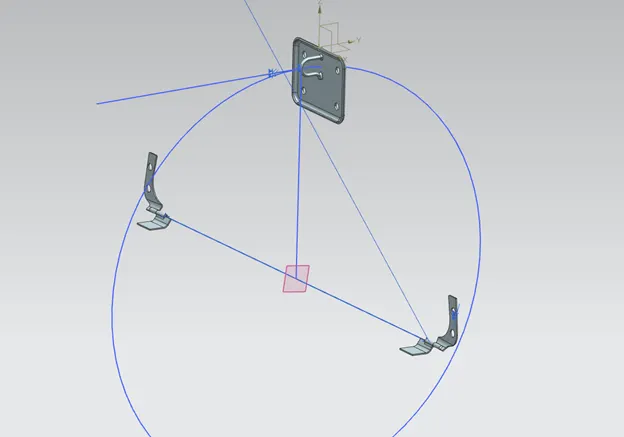
Design of Latch and Striker Reinforcement.
Design of Hinge Reinforcement
Design of Stiffener Pad
Important criteria for design a Hood:-
- Opening Angle.
- Height of tip of hood in open condition.
- Length of a hood.
- Hinge and its function.
- Functional requirement.
- Compliance of Important regulations.
- Noise, Vibration and Hardness (NVH)
Components of Hood:-
- Hood Outer Panel
- Hood Inner Panel.
- Latch and Striker Reinforcements
- Hinge Reinforcement
- Stiffener Reinforcement.
Manufacturing processes used for making a hood:-
- Deep Drawing.
- Blanking and Piercing.
- Hemming
- Gluing
Deep Drawing: -
Deep drawing is a sheet metal forming process in which a sheet metal blank is radially drawn into a forming die by the mechanical action of a punch. It is thus a shape transformation process with material retention. The process is considered "deep" drawing when the depth of the drawn part exceeds its diameter.
The flange region (sheet metal in the die shoulder area) experiences a radial drawing stress and a tangential compressive stress due to the material retention property. These compressive stresses (hoop stresses) result in flange wrinkles (wrinkles of the first order). Wrinkles can be prevented by using a blank holder, the function of which is to facilitate controlled material flow into the die radius.
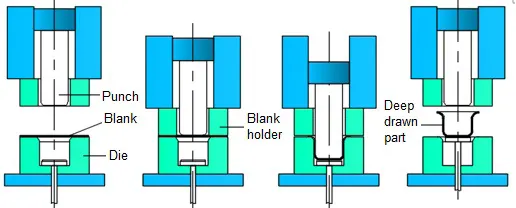
Image 1:- Deep Drawing Process
Blanking and Piercing: -
Blanking is a metal fabricating process, during which a metal workpiece is removed from the primary metal strip or sheet when it is punched. The control of the quality by the punch and die clearance, ... The ability to produce holes of varying shapes – quickly.
Piercing is a shearing process in which raw metal is pierced with a machining tool, resulting in the creation of a circular or other shaped hole. As the raw metal is pierced, the metal from the newly created hole is considered scrap.
Hemming: -
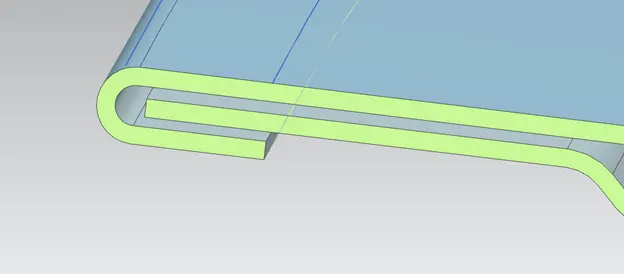
Hemming is the process in which the edge is rolled flush to itself, while a seam joins the edges of two materials. Hems are commonly used to reinforce an edge, hide burrs and rough edges, and improve appearance.
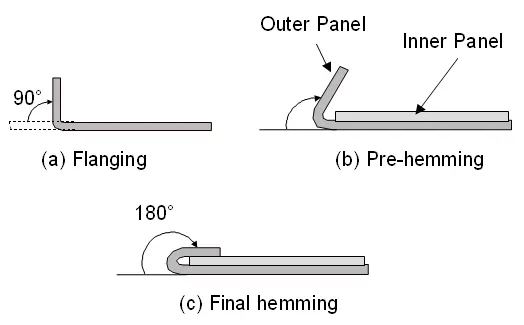
Image 1:- Hemming Process.
Gluing Process:-
Gluing is the process of joining two surfaces together, usually with the creation of a smooth bond. ... As a result, gluing is now the preferred method of joining for many applications, particularly when the bond is not exposed to prolonged heat or weathering.
Material: -
Hoods are typically made out of the same material as the rest of the body work. This may include steel, aluminum, fiberglass or carbon fiber. However, some aftermarket companies produce replacements for steel hoods in fiberglass or carbon fiber to make the vehicle lighter.
Features Used in NX Cad: -
Offset Surface: -
Offset surface command is used to make another surface using a reference surface.
Offset Curve on Surface: -
Offset curve on surface is command used for make a carve on a face or surface with reference edges of the surface.
Datum Plane: -
Creates a datum used to construct other features.
Through Curves: -
Through Curve creates a new body through a multiple selection where the shape changes passthrough each section.
Trim sheet: -
Trim sheet can cut desired area of a section in sheet.
Extract Geometry: -
Creates an associative copy of curves, faces, points and datums and associative mirrored copies of bodies, within the same part.
Law Extension: -
Creates a law-based extension from a base part or sheet, by input of a distance and angle.
Trim and Extend: -
Trim and extend edges of sheet or faces to the intersection with another set of sheets of faces.
Face Blend: -
Its blends a two or three face in shape of circular conic or law controlled.
Edge Blend: -
Rounds the sharp edges of between two faces.
Project Curve: -
Project points, curves and edges on a surface.
Emboss: -
Emboss is mainly used on surface, you can use intersecting solid as Michael shows, you can also use a curve or sketch profile.
Mirror Geometry: -
Copies geometry and mirror them across the plane or ref.
Sew: -
Combines sheet bodies by sewing common edges together or combines solids by sewing common faces.
Thicken: -
Converts surfaces into solid bodies by adding thickness.
Extract Body: -
Creates an associative body by extracting faces from another body.
Wave Geometry Linker: -
Copies geometries from other parts in the assembly into the work part.
Reference Drwaing and Standards Used:-
Master Section
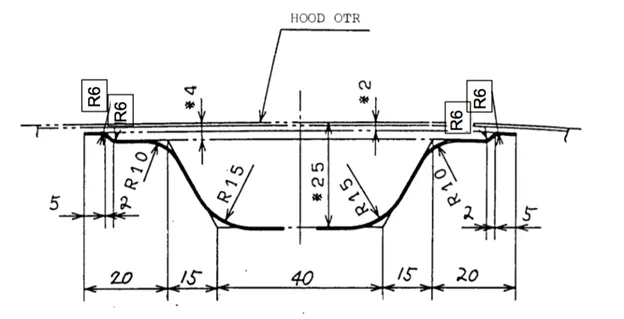
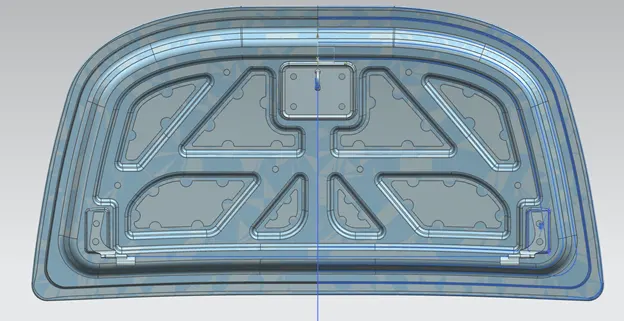
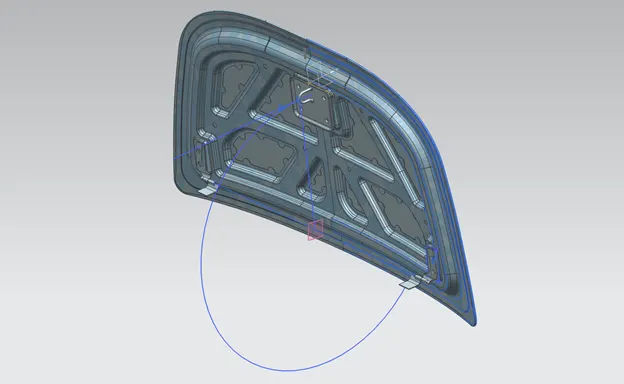
Hood Design Assembly:-
Top View
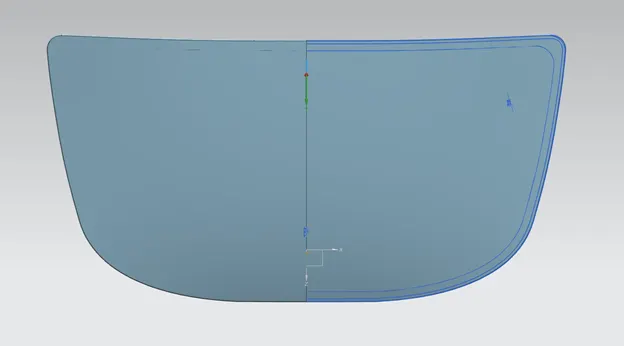
Bottom View
Latch Trajectory
Striker and Hinge Assembly
Hemming on edge
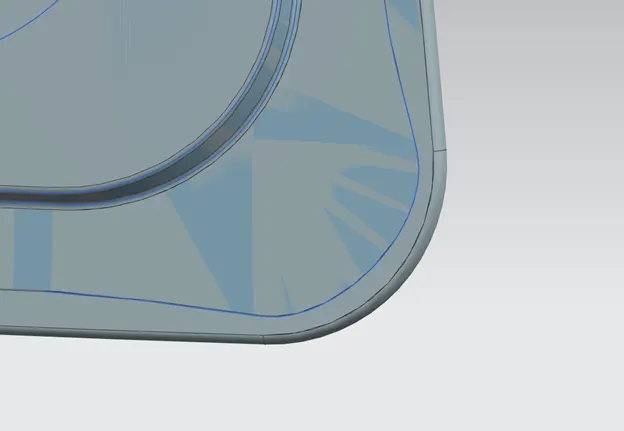
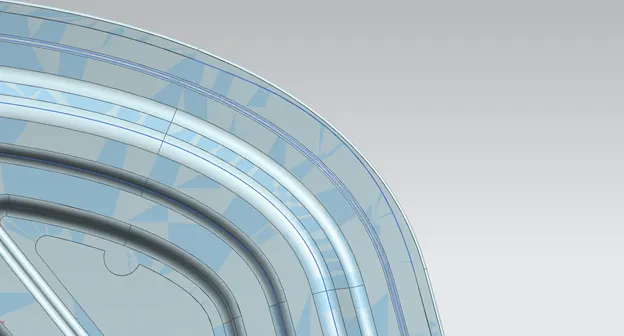
Corner Relief
Conclusion:-
For a car a hood is important door panel. So a Design using this criteria's is can save a life of pedestrian/Driver. Here is a design of a Hood by using a Siemens NX Software is completed succesfully.