Section Modulus calculation and optimization
A Report on a Section Modulus
Challenge: -
Use the Section from your Hood design and calculate the section modulus using the formula S = I/y
S = Section Modulus
I = Moment of Inertia
y = distance between the neutral axis and the extreme end of the object
Come up with a new section that has improved the section modulus of the previous section and mention what change you made that has increased the strength.
ANS:-
Section Modulus: -
- Section modulus is a geometric property for a given cross-section used in the design of beams or flexural members.
Types of Section Modulus :-
- Elastic Section Modulus
- Plastic Section Modulus
Elastic section modulus :-
The elastic section modulus is defined as S = I / y, where I is the second moment of area (or area moment of inertia, not to be confused with moment of inertia) and y is the distance from the neutral axis to any given fiber. It is often reported using y = c, where c is the distance from the neutral axis to the most extreme fiber, as seen in the table below. It is also often used to determine the yield moment (My) such that My = S ⋅ σy, where σy is the yield strength of the material
Plastic section modulus :-
The plastic section modulus is used for materials where elastic yielding is acceptable and plastic behavior is assumed to be an acceptable limit. Designs generally strive to ultimately remain below the plastic limit to avoid permanent deformations, often comparing the plastic capacity against amplified forces or stresses.
The plastic section modulus depends on the location of the plastic neutral axis (PNA).The PNA is defined as the axis that splits the cross section such that the compression force from the area in compression equals the tension force from the area in tension. So, for sections with constant yielding stress, the area above and below the PNA will be equal, but for composite sections, this is not necessarily the case.
The plastic section modulus is the sum of the areas of the cross section on each side of the PNA (which may or may not be equal) multiplied by the distance from the local centroids of the two areas to the PNA: 
Now we have to calculate the section modulus of Hood of a car. The More in the value the good number in section modulus.
we are going to calculate section of modulus of Engine hood, Hence we need two basic data.
1. Moment of inertia =
2. Distance between the neutral axis and the extreme end of the object
With the help is analysis command in NX Cad tool we have following value of our below Section.
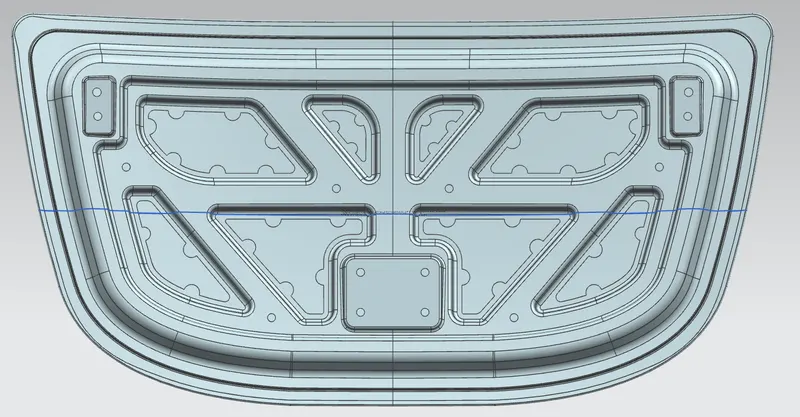
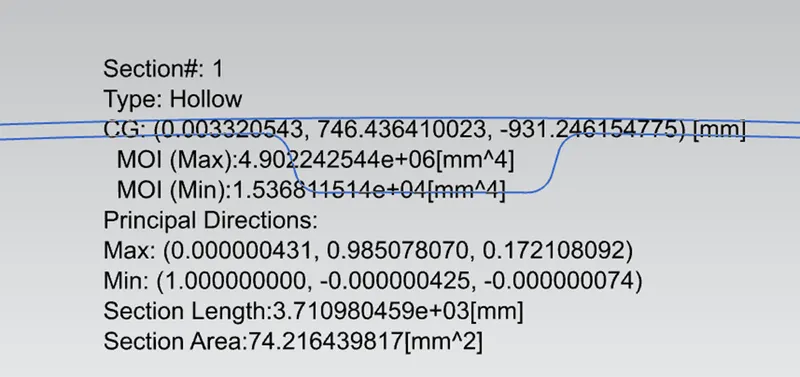
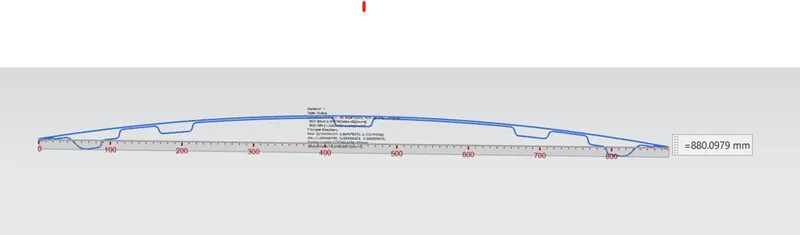
Calculation of Section modulus of Hood Assembly: -
Achieved Max. Moment of inertia: - 4902245.2544 mm4
Achieved Min. Moment of inertia: - 12368.11514 mm4
2Y = distance from one end to another end of a hood 880 mm
Y= 440 mm from Neutral axis.
Smax = Imax/ Y =4902245.2544/440 =11141.4664 mm3
Smin = Imin/ Y = 12368.11514/440 = 28.1093 mm3
Now we need some more we need safer design for our car and Engine hood, So we need better moment inertia of the section from above Design.
There are many ways to improve the Moment of inertia, like
-
MOI increases with the increase of section area.
-
MOI increases with the increase of section length
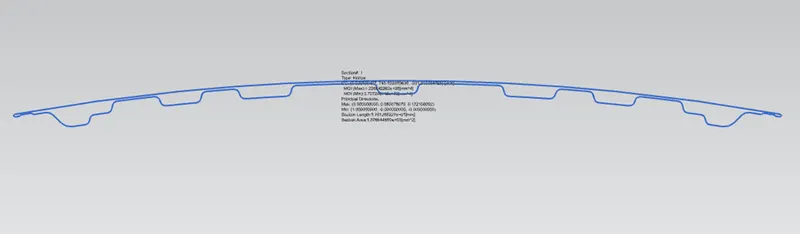
- but we will made change in Hood Internal for achieve better Moment of inertia.
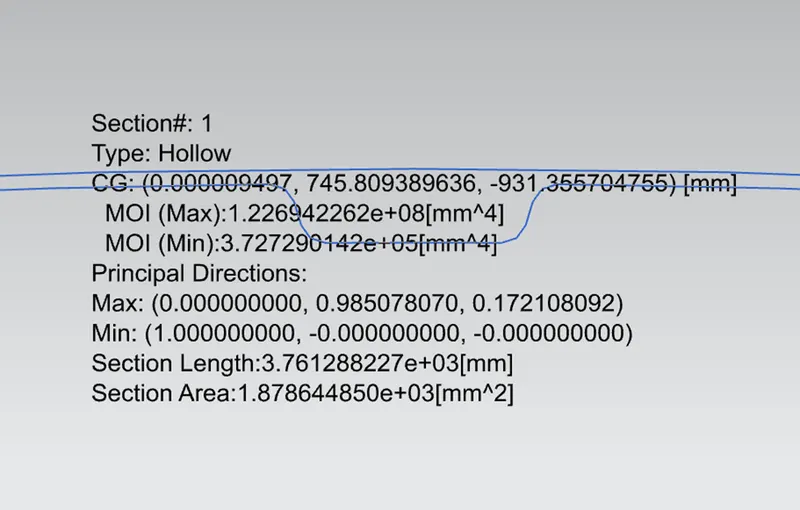
After change we have below section with better MOI.
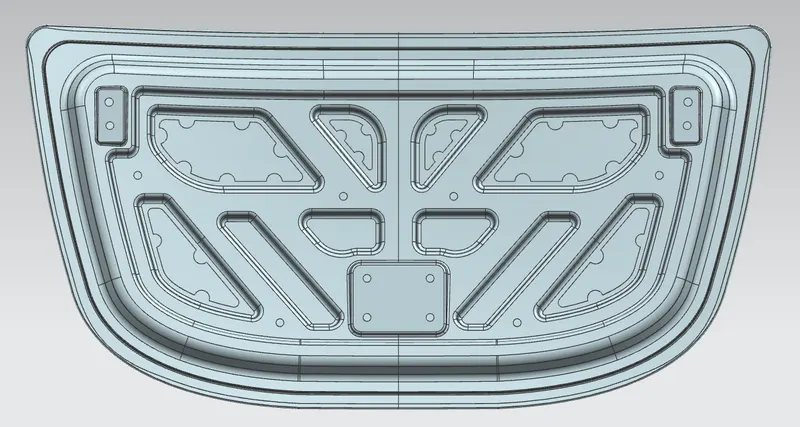
Revised Calculation of Section modulus of Hood Assembly: -
Achieved Max. Moment of inertia: - 122694226.2mm4
Achieved Min. Moment of inertia: - 372729.0142 mm4
2Y = distance from one end to another end of a hood 880 mm
Y= 440 mm from Neutral axis.
Smax = Imax/ Y =122694226.2/440 =278850.51mm3
Smin = Imin/ Y = 372729.0142 /440 = 847.11 mm3
Conclusion:-
Calculation-2 have better section Modulus then shown in calculation-1. After this calculation we can conclude that we have an optimized design for our Hood.