Hood design-Week 2
HOOD:-Car hood is also known as Bonnet and that encloses engine compartment of motor vehicle.It is located at front of vehicle,and it is designed to protect engine compartment and other components from dust,dirt and adverse weather condition, that can deteriorate the engine compartment and components.
Car hood are typically made of steel or aluminium. Car hood give direct access to engine compartment and we can do maintenance by opening car hood by activating the switch below steering wheel as shown below
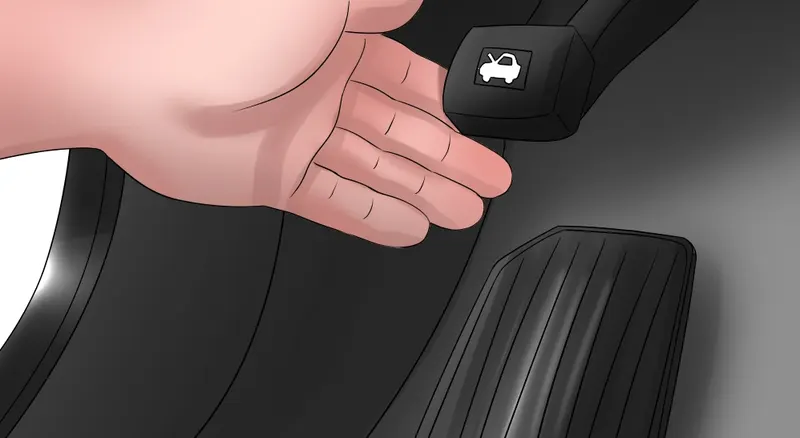
While designing the hood manufacturer give importance to air flow & cooling also give consideration to style,vehicle's visual appeal
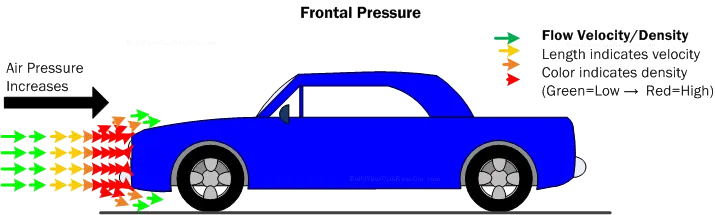
Designer always consider drag force due to frontal peressure i.e when air molecule approaches the car the compress each other and raise the air pressure in front of the car.Frontal pressure can be reduced by minimizing front surface area and making front end smooth continuous curve originating from the line of front bumper allowing the air molecule to pass.
Hood consist of following parts
i.e.
1.Hood outer panel
2.Hood inner panel
3.striker assembly
4. hinge assembly
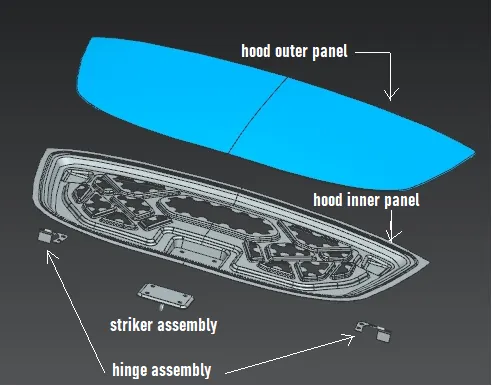
1.Hood outer panel:- it is the part which shows outside and design in such a way to give aesthetic look to vehicle.Generally it is a class A surface and the thickness of outer hood panel is around 0.65-0.75 mm and doesnt have much strength. So to provide strength Inner Hood panel is there. When pedesterian hit by car so to minimize impact on head of pedesterian there will be some space left and clearance between hood outer panel and hood inner panel and there will be some provisions for mastic also
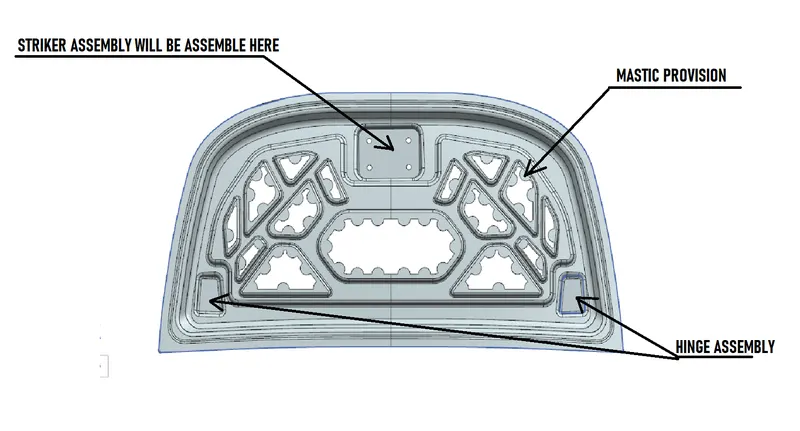
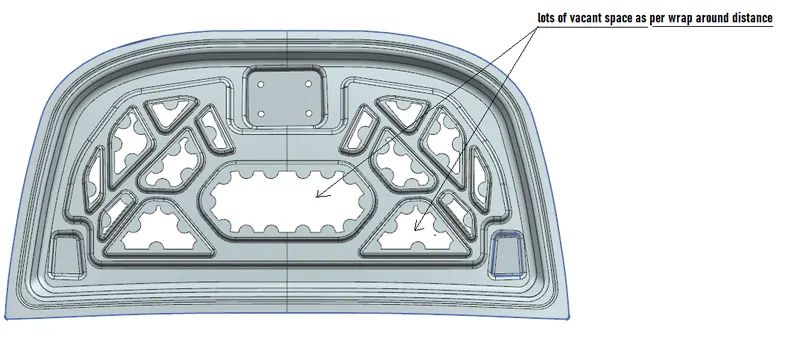
In inner hood assembly embossing will be there so that it will have some strength and some spaces left vacant so that when pedesterian hit by a car from front side when his head get impact on hood it will not injured severely. when pedesterian hit by a car from front side then pedesterian body wrap around the car hood. So it is very important that when a pedesterian hit by car his head or body will get minimum injury and for that wrap around distance is necessary to consider while designing hood
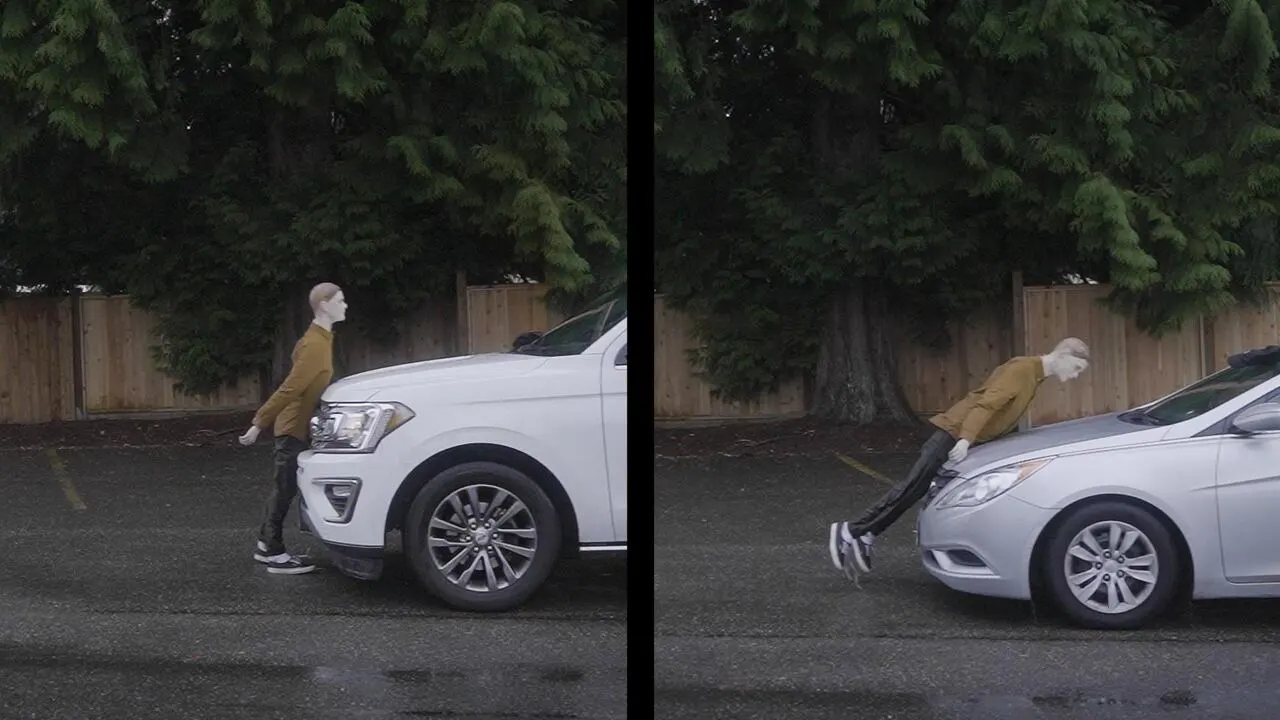
Wrap Around Distance:- When a pedesterian hit by a car in frontal crash his body wrap around the car i.e the distance at which the head impact the car from the ground is called the wrap around distance.
The more the height of pedesterian the more will be the wrap around distance.So from following figure we can understand WAD
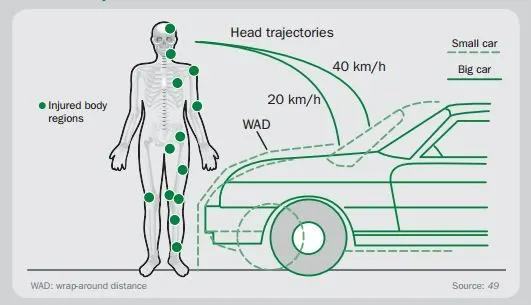
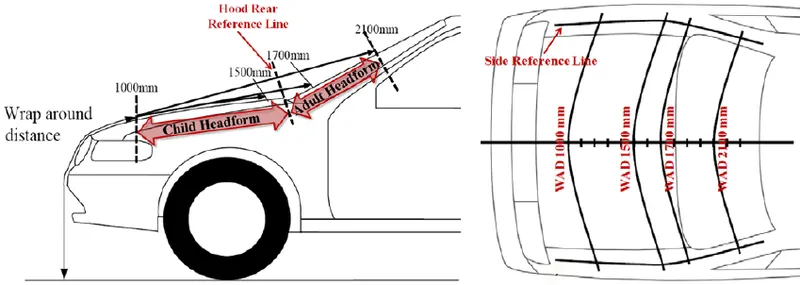
The wrap around distance will be more for adult and will be less for child head.let consider a case if only outer hood will be there and after this engine compartment then when frontal crash head of pedesterian will hit by engine compartment and that causes severe injury. So to ensure less injury a inner hood will be there and that will absorb all impact and transfer all the load toward hinges .
With the help of WAD We can predict that if a person of certain height will hitted by car during frontal crash then his/ head will be srike on hood so the designer will make lot of vacant spaces on inner hood. So the impact or injury on head of pedesterian will be less.
When a person hit by a car in frontal crash then the impact will be on hinges as shown below
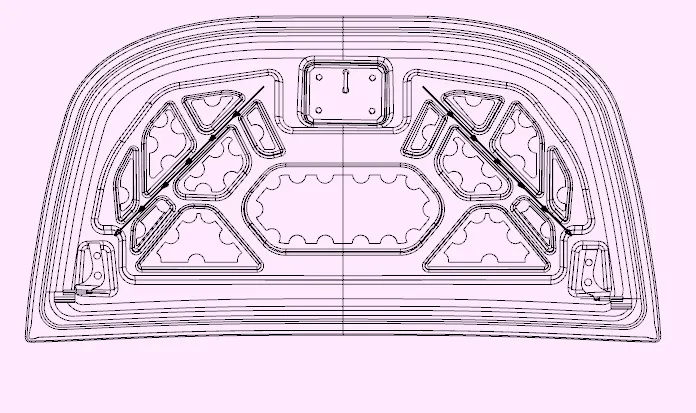
To make sure inner hood should be well stick with outer hood for that we can opt two options 1. welding 2. Hemming but instead of welding between hood outer panel and hood inner panel we always opt Hemming
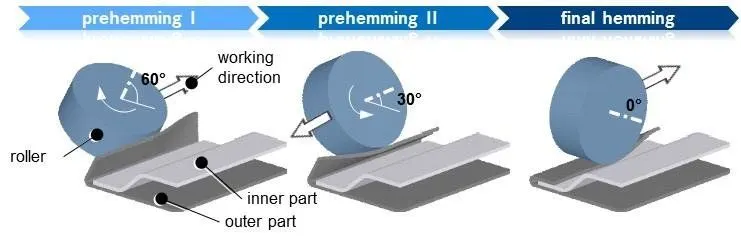
Hemming Hemming is a sheet metal forming process in which sheets are joined by bending it to 180°. Automotive body panels and automotive parts such as deck-lids, trunk-lids, doors, hoods and tailgates are formed by hemming process. In this process, usually a sheet is bent with the help of inner sheet in three different stages.
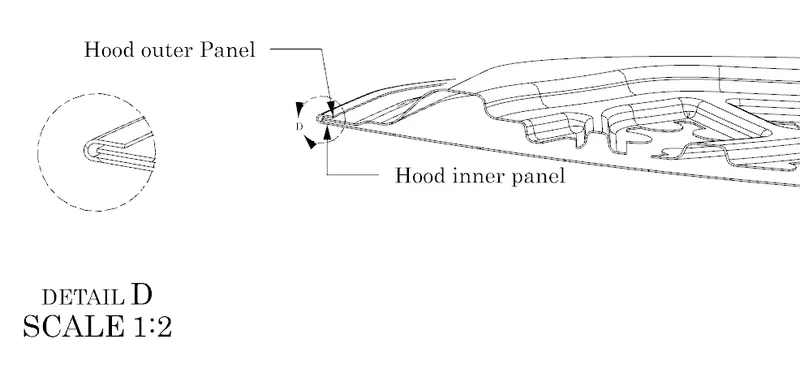
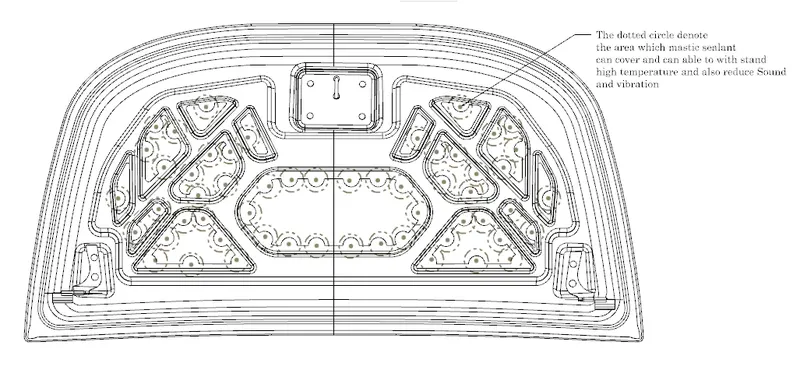
For joining hood inner panel with hood outer panel there should be a provision for Mastic is a type of seal which are used for the purpose of joining one surface to another Mastic has a benefit of heat resistant and also reduce NVH. Since our outer hood should look aesthatically good we dont do any welding to join two surface i.e. Hood outer panel and hood inner panel
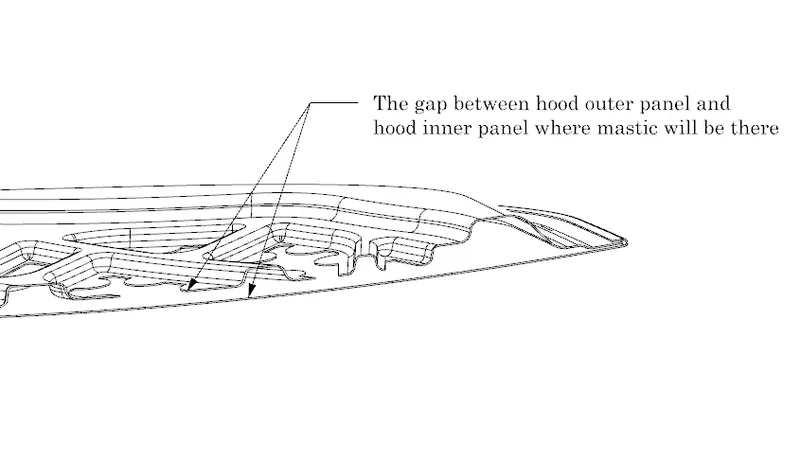
The mastic data can be shown below as schematic
To keep hood in open condition two components are there
1. support rod :-Design requirement of Support rod i.e No Support rod is always straight curvature should be more than 35 mm.
When we mount support rod it should be mount on opposite direction to Battery
2. Gas stay:-when a gas stay is use there will be one more component.i.e Additional bracket which is a kind of reinforcement is used
Whenever we add a material it lacks some are or strength.To compensate we use additional material (Reinforcement)
i.e. Hinge reinforcement,Latches reinforcement, striker Reinforcement its thickness will be decided or determine by the help of loss of material also to reduce NVH(Noise Vibration and Hardness) also we use stiffner pad to avoid Vibration
Hood Design Procedures:
Hood Inner Panel:
- Hood Inner panel surface is extracted from Hood Outer panel using copy or wave geometry linker commands.
- Hood inner panel is offsetted at distance as per master section and trimmed using offset in face command.
- Face blend or edge blend is applied on the surface.
- Emboss is applied on the surface with gap for striker and hinge assembly emboss.
- Another emboss is applied with mastic points cut outs.
- Sheet is trimmed for mastic points.Trims of the inner panel should be designed in such way that force applied during acciendatal impact,Hood crashes and disspiates force outwards so that passenger safety is ensured.
- Hinge assembly emboss should be flat surface.It can be analysed by local radius analysis.
- Inner panel is mirrored and hinge is assembled using assembly constraints.
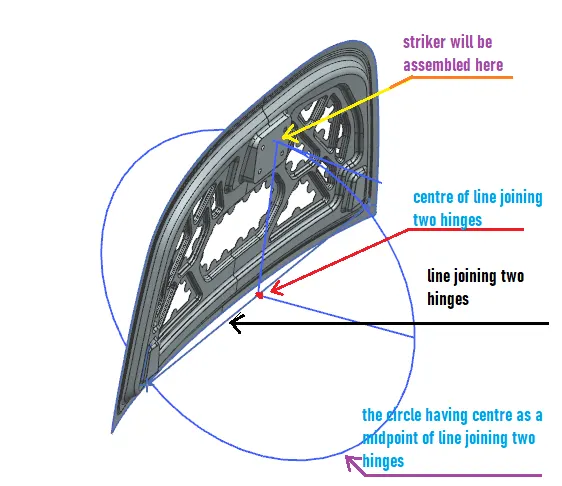
- From the hinge assembly axis,striker trajectory is formed and striker is aligned.
Emboss for Striker is formed and striker is assembled. Striker will be assembled at a tangent of Circle having centre as a midpoint of line joining of two hinges as shown below
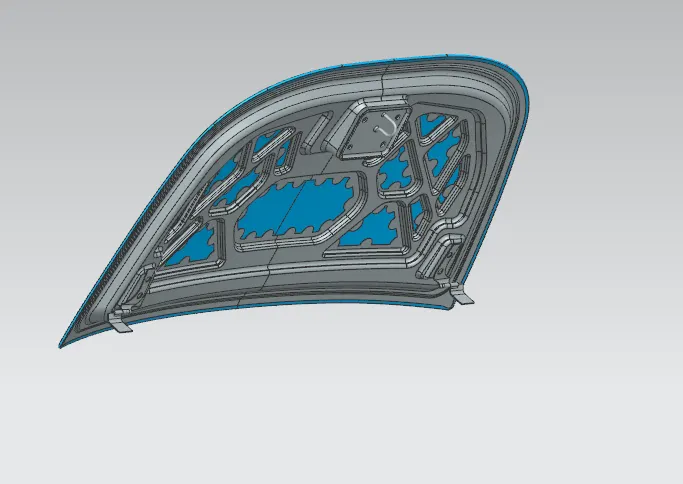
After assembly the whole assembly will look like below
Conclusion
Hood is designed as per master section where outer hood is offset and emboss with permissible draft angle , hemmed and mastic point is provided striker is assembled as per trajectory of tangent of circle passes through the centre of circle passes through the midpoint of line joining two hinges.