Hood design-Week 2
HOOD :
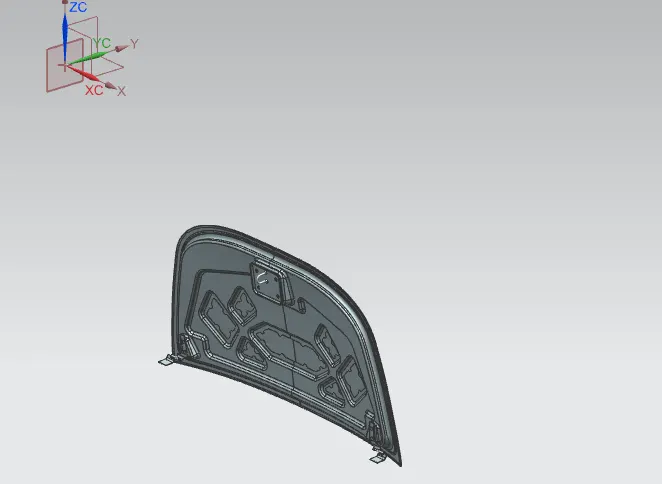
The hood or bonnet is the hinged cover over the engine of motor vehicles. Hoods can open to allow access to the engine compartment for maintenance and repair. The hood panel is one of the most important components of the BIW (body in white), it is considered as the closure sheet-metal component. A hood panel consists of two panels that are hemmed together to form the automotive hood assembly

COMPONENTS OF HOOD:
The hood assembly consists of four main parts are the outer panel, inner panel, latch system, and hinge system. The hood may also contain a hood ornament, hood scoop, and/or wiper jets. The hood is designed to protect all engine parts and radiators of the car. Car hoods are typically constructed from steel and sometimes from aluminum.
HOOD OUTER PANNEL:
The outside panels provide the shape of the car body whereas the inner panels reinforce the shell of the body. The various curved shapes are given to outer panels to provide the strength to panels.
HOOD INNER PANNEL:
The inner panels provide mounting locations for various trim panels and connecting assemblies. These two panels are welded together to pillars and rails so as to form the skeleton of the car body.
LATCH SYSTEM:
The hood latch mechanism in a car is a simple device. Although most cars are manufactured with similar hood release systems, they are individually designed for each make and model. This means that even though they all perform very similarly, they cannot be uninstalled from one make and model and then reinstalled in a different make and model. The overall concept of the mechanism is the same, but the schematics and design of the hood latch system is different on each vehicle.
The hood latch system begins inside the compartment of the car. Located on the driver's side (usually on the left-hand lower corner of the dashboard) is the hood release handle. The hood release handle attaches to a cable which then routes through the dashboard towards the front of the vehicle. The other end of the cable is attached to a secondary latch, which is manipulated by the pulling of the cable (activated by pulling the hood release lever). Only an inch or two is required to pull the secondary latch away from its position, and then the hood pops open. At the front of the vehicle, a safety latch retains the hood. Locating and releasing the safety latch releases its hold on the hood and then the hood is allowed to open.
Components of a Hood Latch System:
The hood release handle inside the vehicle is made of plastic and is attached directly to the hood latch cable. The cable has a protective outer lining to prevent corrosion of the cable where it is exposed to the elements. The cable is designed to move inside the lining back and forth to accommodate the pulling and releasing motion of the handle and the secondary latch. The opposite end of the cable is attached to the secondary latch, usually near the bottom. When tension is applied to the cable from the hood release handle, it pivots the secondary latch, which pulls away from a retaining seat located under the hood. By design, the secondary latch then releases the hood a few inches before a safety latch takes over. The safety latch is integrated in the hood latch system in case of accidental release of the handle inside the passenger compartment during operation of the vehicle. Without the safety latch, the hood would be susceptible to flying up and then back towards the windshield, blocking the driver's vision, and most likely causing extensive damage to the hood, the hood hinges, and the windshield.
The safety latch has a release lever which pivots slightly by moving it, which then releases the safety latch from its seated position of the hood. Most safety latches require release with no tension on the hood. This means, you most likely have to press the hood down slightly back in the closed position, thus taking the slight pressure off the safety latch to maneuver it and release it from the seat. Once that is done, the hood is free to open. Many hoods use a prop rod integrated with the vehicle. The prop rod is located on the upper frame of the front or side rails and attached at the bottom. A small clip holds the upper end of the rod in place. Release the rod from the clip, swing it upward and locate its seating position (usually marked) on the underside of the hood. Other models may have the prop rod attached to the underside of the hood and the seating position located on the upper frame rails. High-end vehicles are now using hydraulic hood shocks to automatically open car hoods and replace the hood prop rod altogether.
Maintenance to the Hood Latch Components:
After many uses and normal wear and tear, the hood latch mechanism has common areas of deterioration. The pull handle, often made of plastic can simply break. The cable can seize up inside the lining (usually on the end attached to the secondary latch where it's exposed to the elements). The secondary and safety latches can dry up being exposed to the elements and not release properly or may not return to the closing position require to close the hood properly. Although a hood release latch may allow you to open a car hood, if it is not functioning properly, it may prevent you from closing it. White lithium grease and regular maintenance are the two best friends a hood latch system has. A small amount of grease on each end of the cable (the interior side of the cable is protected against the elements of weather and deterioration so usually require little maintenance) to lubricate it and prevent it from seizing up inside the lining usually keeps the cable working well. If you wait until the cable is sticking or is seized altogether, you most likely will be too late for the maintenance of the cable and replacement may be required. White grease on the secondary and safety latches is also strongly recommended to keep the latches swinging on the riveted hinges.
Both the secondary and safety latches also integrate a tension spring. Keeping the springs lubricated helps them restore their tension. Keeping these components lubricated during every oil change will help provide longevity and reliability to the hood latch system.
HINGE SYSTEM:
A car hood hinge mechanism is a system of brackets and pivoted links that allow the hood to move between closed and partially open positions. There are different types of hood hinge mechanisms, including the four-bar linkage hinge, which has two pivoting bars linking an upper bar that mounts to the cover and a lower bar that mounts to the vehicle body. In operation, the four-bar linkage generates a compound motion of rotation and vertical translation
MANUFACTURING PROCESS:
POINTS CONSIDERED FOR FEASIBLE MANUFACTURING :
- Minimum Draft of 7 Degrees given for sheet metal - For easy removal of component from tool(Die)
- Sharp edges are avoided for easy manufacturing
- Complex shape is avoided.
Sheetmetal operations:
- Deep Drawing
- Embossing
- Hemming
DEEP DRAWING:
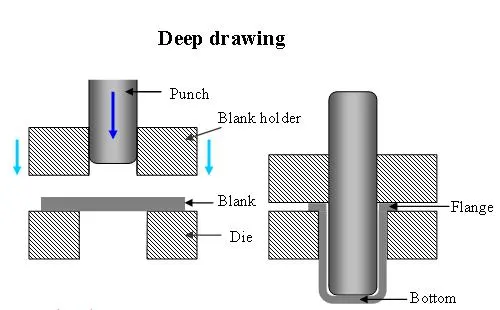
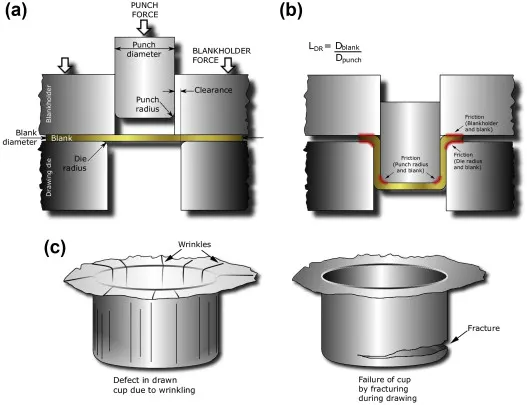
- Deep drawing is a sheet metal forming process in which a sheet metal blank is radially drawn into a forming die by the mechanical action of a punch. It is thus a shape transformation process with material retention. The process is considered "deep" drawing when the depth of the drawn part exceeds its diameter. This is achieved by redrawing the part through a series of dies. The flange region (sheet metal in the die shoulder area) experiences a radial drawing stress and a tangential compressive stress due to the material retention property. These compressive stresses (hoop stresses) result in flange wrinkles (wrinkles of the first order). Wrinkles can be prevented by using a blank holder, the function of which is to facilitate controlled material flow into the die radius.
EMBOSSING:
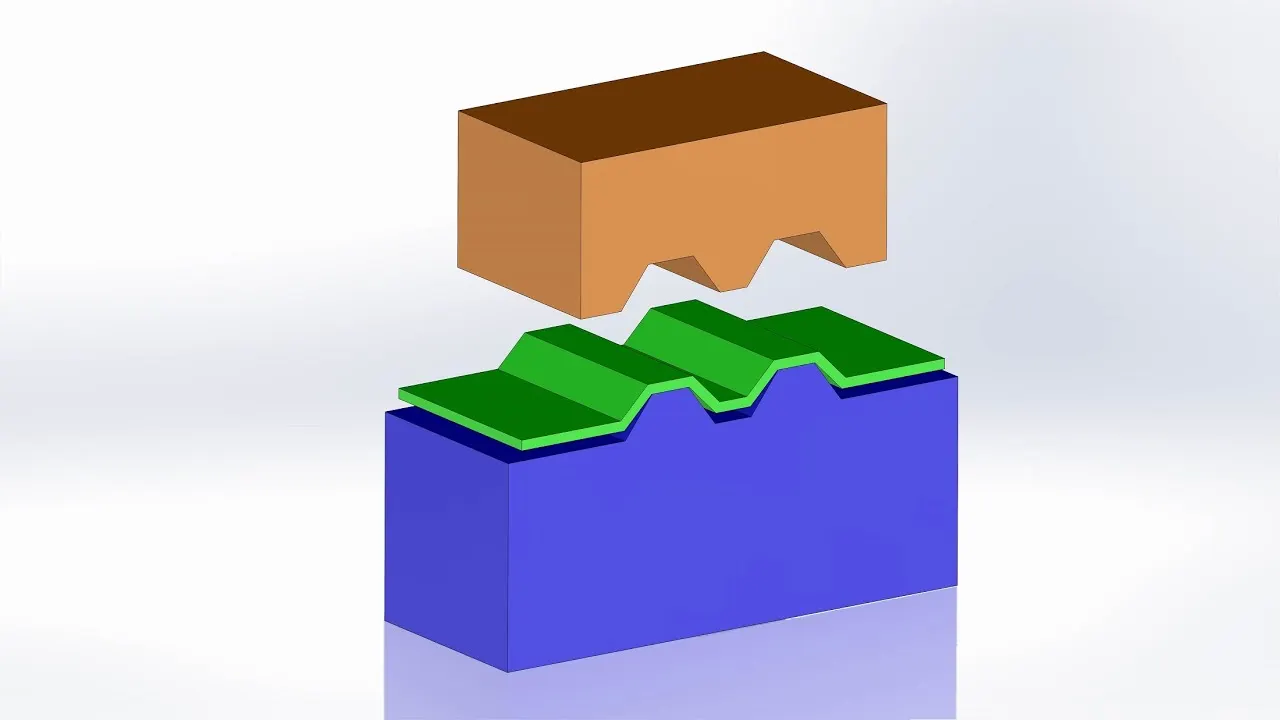
Embossing is a stamping process for producing raised or sunken designs or relief in sheet metal. This process can be made by means of matched male and female roller dies, or by passing sheet or a strip of metal between rolls of the desired pattern, theoretically with no change in metal thickness, or by passing sheet or a strip of metal between rolls of the desired pattern.
- Metal sheet is drawn through the male and female roller dies producing a pattern or design on the metal sheet. Depending on the roller dies used, different patterns can be produced on the metal sheet.
- Emboss should be in 7 degree to 25 degree inclinte in angle and it should not be in 90 degree angle,why because when we do stamping in manufacturing the stamping tool fits the sheet metal hence it will not come out of that sheet metal,So this is the main reason why the emboss face is in angle.
Characteristics of the metal embossing process include:
- Its ability to form ductile metals,
- Its use in medium to high production runs,
- The ability to maintain the same metal thickness before and after embossing,
- The ability to produce unlimited patterns, depending on the roll dies, and
- The ability to reproduce product with no variation.
Simple Image of Embossing:
HEMMING:
Hemming is a forming operation in which the edges of the sheet are folded or folded over another part in order to achieve a tight fit. Hemming is a technology used in the automotive industry to join inner and outer closure panels together (hoods, doors, tailgates, etc.). It is the process of bending/folding the flange of the outer panel over the inner one. The accuracy of the operation significantly affects the appearance of the car’s outer surfaces and is therefore a critical factor in the final quality of a finished vehicle.
- In hood design, hemming is used in assembly as a secondary operation after deep drawing, trimming and flanging operations to join two sheet metal parts (outer and inner) together.
Roll hemming:
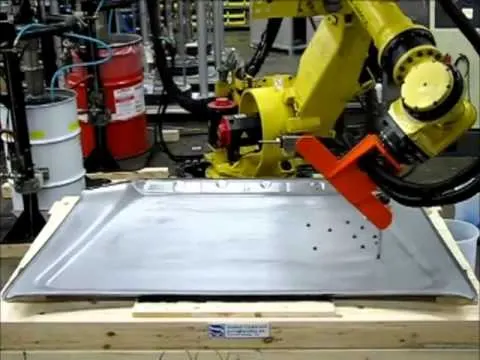
In roller hemming process, a robot guides a small roller across the flange to fold a sheet onto itself or onto another sheet. The process is oriented to low volume automotive applications, providing a distinct advantage in manufacturing closures and subassemblies with developed flanges.
MASTIC SEALANT:
A mastic sealant is a type of liquid sealant that cures in an elastic state, thus making it flexible while holding the bond of the surfaces that has attached together. It adheres to just about any material making an all-purpose type of sealant.
- The main purpose of the outer panel is for the aesthetic looks. Thus we cannot use bolts or welding. This has to be done with the help of the hemming and mastic sealants. Mastic sealants are elastic compound that behaves like the rubber. It is placed between the outer and inner panel. Initially is it in paste form, but after the hot furnace bath it gets hardened thus joining the outer and inner panel. Mastic sealant has the tendency to increase the strength of the panel and has influence of 80mm diameter.
PROS
- One positive characteristic of mastic sealant is that it has a very smooth exterior while keeping its rigid form underneath.
- Surfaces do not have to be primed when using this type of sealant, and although applied thick, it adheres smoothly to any surface. It is important that the area to be joined or sealed be clean and dry, just like any other sealant on the market
- Mastic sealant may be used outdoors as well because of its waterproof quality. It can be applied on rain duct leaks outdoors, for example.
- It is also favored for areas under high or low temperatures such as heater vents or drier vents and contains ultraviolet inhibitors to make sure that it is protected from damaging effects of the sun that will often weaken other types of sealants. That makes it a good choice for use on roofs, or any surface that is constantly exposed to sunlight. Most mastic sealants will also work well with metal because they do not corrode over time.
- It functions well in areas with mild vibration and heat, like hood, heating ducts.
CONS
- Mastic sealant is not recommended for areas that have too much joint movement, or anything that will be moved a long length.
- It works well with constant pressure on it, but not constant movement.
- It also works best when applied thickly and is not recommended if only a thin layer is needed such as touch ups. Another sealant is a better choice for those types of repairs
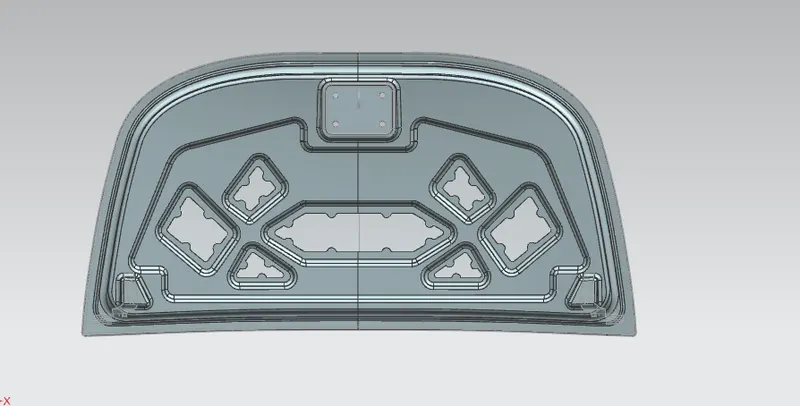
REMOVAL FOR INNER PANNEL OF MATERIAL:
For less impact on head in collisions(Pedestrain Safety), reduce tool cost, reduce material cost, ease of manufacturing and to make light weight.
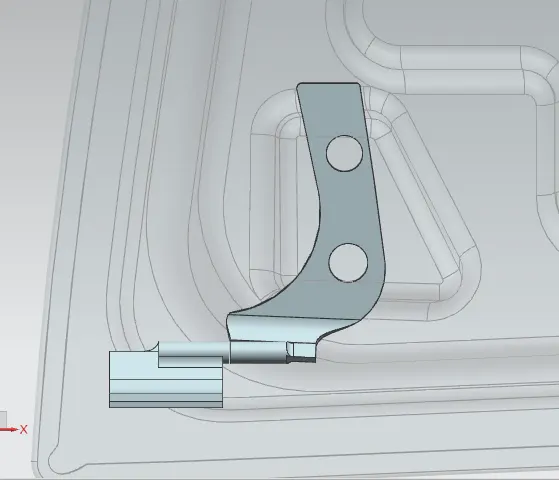
POSITION OF STRIKER AND HINGE :
For the proper opening and closing of the hood, the striker should be perpendicular to the trajectory of the hood. For this, hinge is assembled at its position. Once it is placed, hinge axis is drawn.
- To check the hinge axis as the center we draw a big circle to the position the latch in such a way that it is perpendicular to the hood trajectory.
- In between the two hinges, the striker is perpendicular to the midpoint of two hinges, because while closing and opening of latch and striker the opening position be similar actions.
LATCH TRAJECTORY:
The latch trajectory shows the path of the striker when the hood is opened and closed on a vehicle.
The radius of the circular trajectory is determined by the set standard based on the average height of a person. The radius is measured from the hinge axis up-to the latch.
HINGE ASSEMBLY:
Hinges is the assembly of components connected to the door and body of the vehicle, linked to each other and capable of rotating around the same axis. Conventional system consists of two hinges for each door, an upper hinge and a lower hinge.
STRIKER ASSEMBLY:
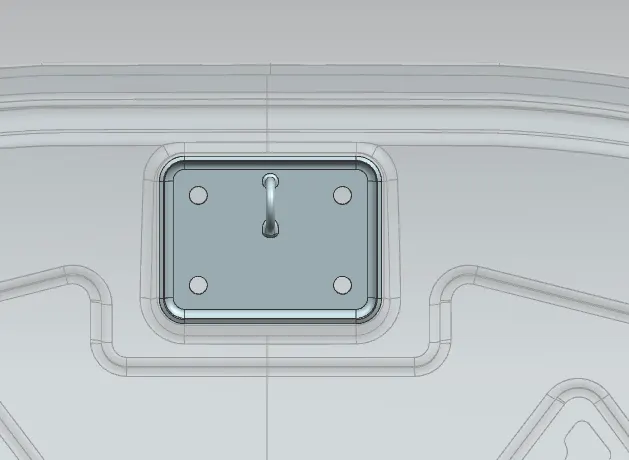
The door striker plates are installed in the door jambs, and precisely aligned with the door latches so that the latches catch onto the striker plate when the doors are closed. The door striker plate is made of hardened steel to resist wear as it is subjected to constant contact with the door latch.
The hood latch system begins inside the compartment of the car, hood release handle located onthe driver's side. The hood release handle attaches to a cable which then routes through the dashboard towards the front of the vehicle.
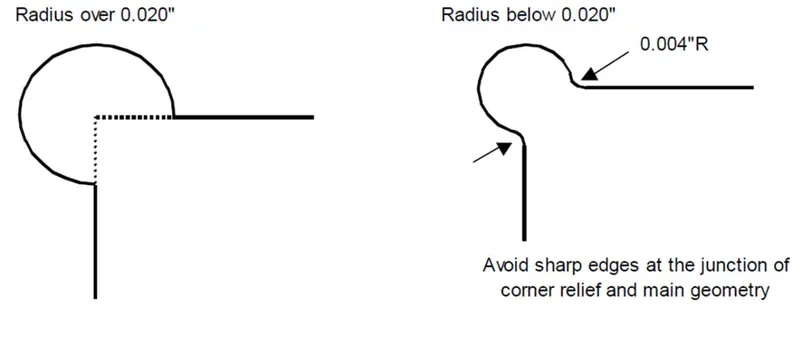
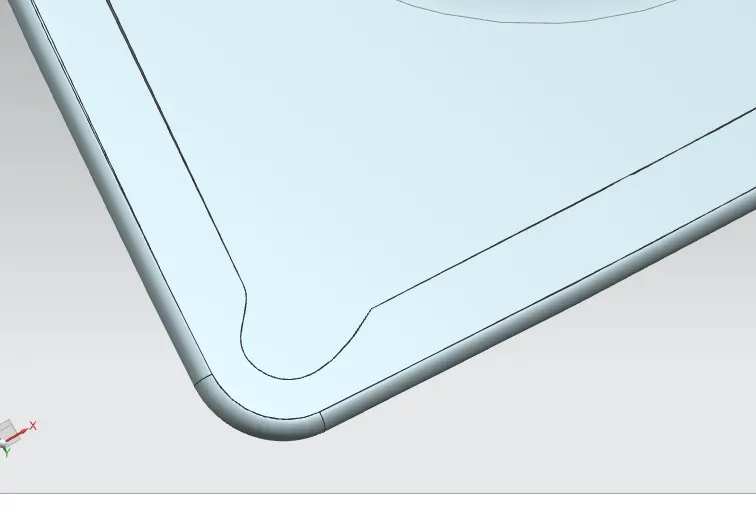
CORNER RELIEF:
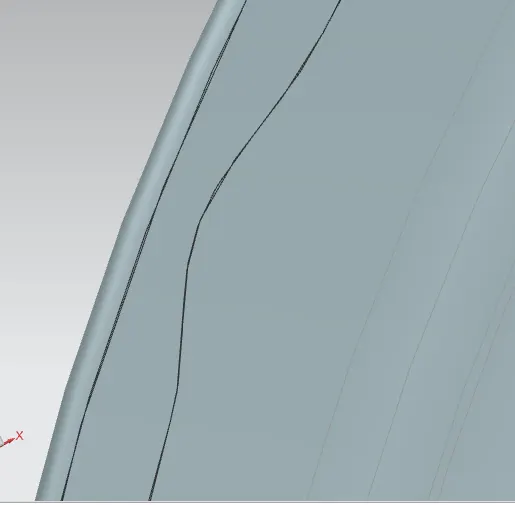
- Relief is provided onto the part or component in order to remove any stresses developed in a particular area i.e sharp corners that takes place during the hemming process is carried out. Thus corners are rounded or chamfered.
- Relief of 3 mm from sheet metal for Roll hemming process.
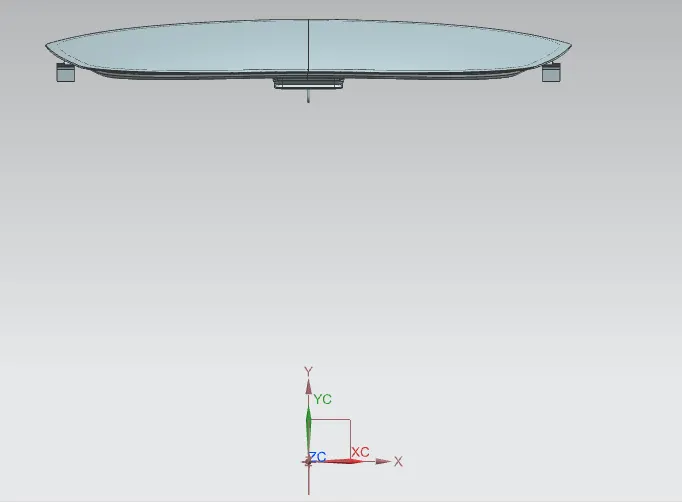
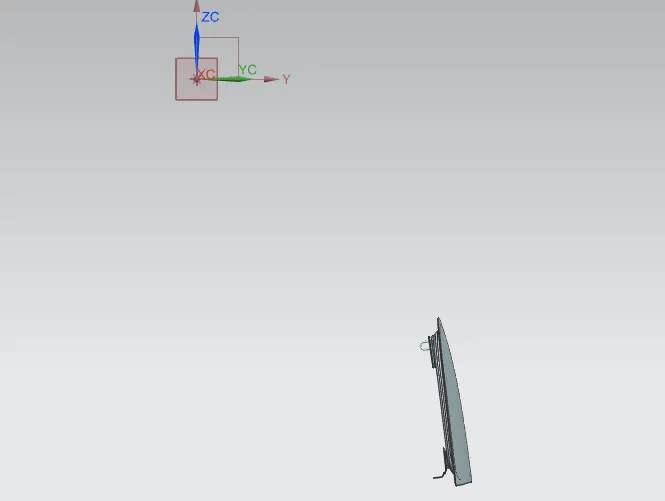
VIEWS OF HOOD PANNEL:
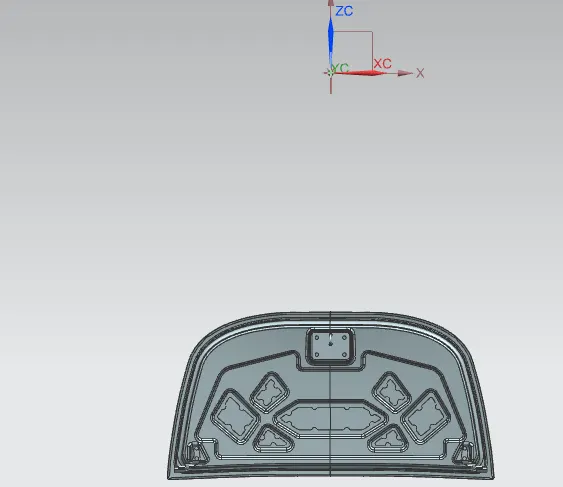
FRONT VIEW:
TOP VIEW:
SIDE VIEW:
ISOMETRIC VIEW: