Hood design-Week 2
HOOD ASSEMBLY DESIGN
AIM: In this challenge 03 the design of the hood aassembly by following all the desigtn considerations and the parameters in the siemens nx cad software
OBJECTIVE: The main objective is to make use of the components of the assembly like the hood inner and the outer panel, striker, hinge components and there by following the master sections while designing the hood assembly componemts by folowing all the desigmn values amnd the dimensions and design parametrs by taking into considerations like the crash analysis , pedestrain safety manufacturing realiability and the design done in siemens nx cad
HOOD ASSEMBLY:
A car hood also referred to as a bonnet in some other countries is the hinged cover that rests over the engine of a front-engine vehicle. Its purpose is to provide access to the engine for repair and maintenance. Car hoods are typically constructed from steel and sometimes from aluminum.
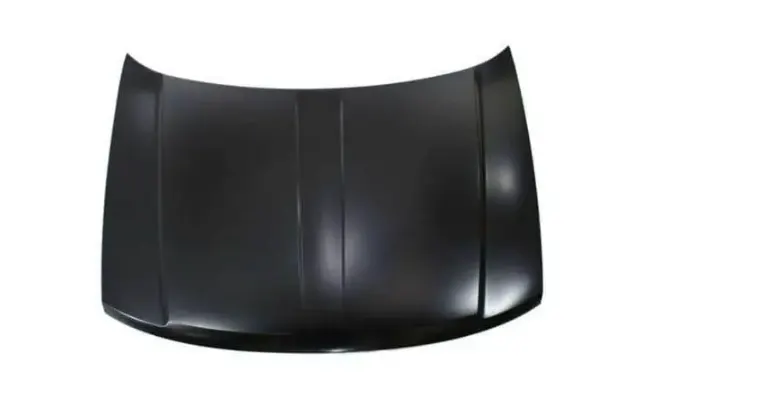
The hood allows direct access to the engine compartment for maintenance and repair purposes. In addition, it also protects these parts from direct sunlight and dust. A hidden latch is commonly used along with the hood to hold it securely when you’re taking a look inside your car.A hood may also contain an ornament on top, a hood scoop, wiper jets, power bulges, or even a power bulge with wipers
The common materials used for Hood manufacturing is the
- Steel
- Aluminium
Theother materials might include the carbon fiber, fiberglass, and dry carbon
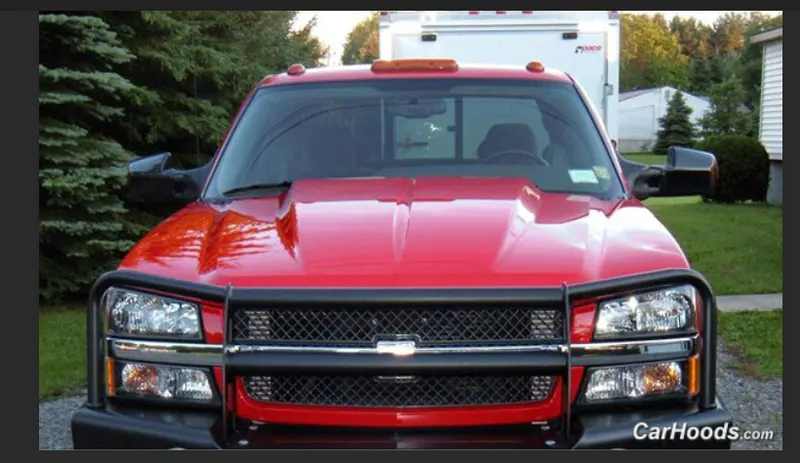
Steel hood cars:
It may be necessary for you to install a steel hood on your vehicle depending on its model. There are quite a few heavy-duty hoods available on the market that are quite big and bulky. There are a variety of colors and sizes available, so you will be able to find an option that fits your vehicle’s needs without breaking your budget.
As well as allowing proper ventilation throughout the hood of your vehicle, they also improve the efficiency of your engine by making sure enough air gets to the air inducers, which makes your engine run better and more efficiently.
Aluminium hood :
There is a misconception that aluminum is a lightweight metal that can be used as a foil, but thick aluminum in fact is much more of a durable metal that may resist rust and also weighs less than heavier metal.
A hood’s durability is not as important as it might seem in a crash when crumple zones and other safety features will have more importance than its strength in a crash.

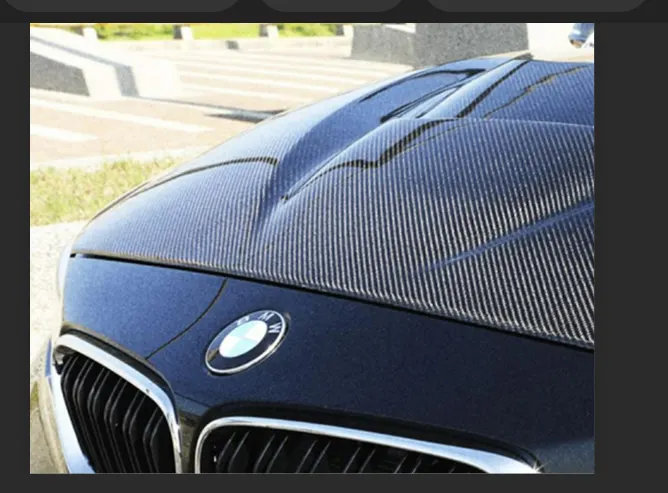
Carbon fibre hood :
In order to keep the new car looking and running at its absolute best, you need high-quality parts and materials to keep it running at its maximum efficiency. Carbon fiber, for instance, is one of those materials that are remarkably lightweight and strong, which means it can be molded into virtually any shape, which means it is suitable for producing components, materials, and a whole host of other products.
Fibre glass Hood :
A fiberglass hood allows the right amount of air to be ventilated while still maintaining a stylish appearance. Fiberglass hoods are easy to assemble and easy to maintain. Depending on the needs of your vehicle, you can choose from different colors and sizes when ordering your fiberglass hood to match the appearance of the vehicle.
In addition, the fact that they are made of fiberglass means that they will not easily get dented or deteriorate as a result of small accidents, and this will help you in saving money in the long run. When the fiberglass hood is installed, the engine will be able to cool more efficiently, and even the car can pass inspection without facing any hindrances.This fiberglass hood has been designed such that it cannot be opened from the inside of the vehicle and lifted to gain access to the engine bay; it must be completely removed in order to gain access to the engine bay because of the way it has been installed.
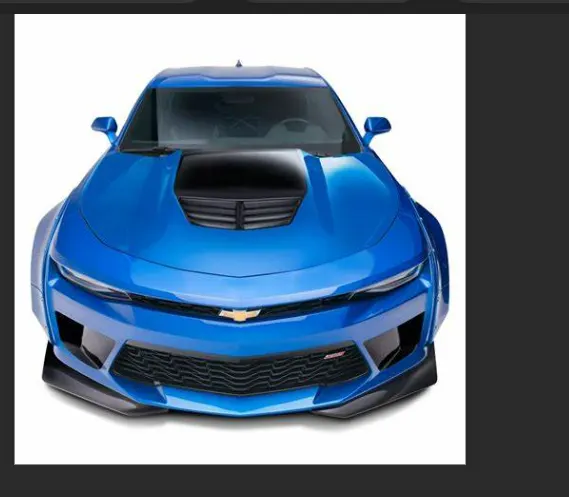
Dry carbon hood :
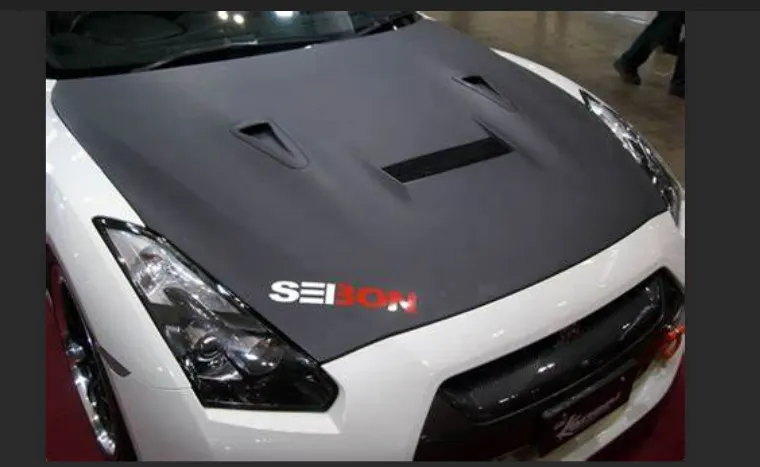
On most vehicles, there is a system for releasing the hood called a hood release, which is usually composed of an inner hood latch or lock handle, a cable used to open the hood, and a lock that secures the hood. In most cases, the hood lock handle is located on the same side of the steering wheel as the driver’s seat, or it can be located in the door frame on the opposite side
Importance of Hoods in a Car
The importance of the car hoods is as mentioned below:-.
- In simple words, the hood of the car is responsible for the safety of the car.
- All engine parts and radiators of the car are protected by the hood or bonnet.
- Car hoods are also used in sports cars as an aerodynamic mechanism by reducing the Air effect.
- Car hoods provide relatively easy access to the engines in case any maintenance is required.
- Having a hood on your car also reduces engine noise, which helps you drive more quietly.
- Keeping the paint under the hood longer can also help keep it in good condition.
- Getting out of the car before the hood catches fire can give motorists time to escape that is why a proper and strong hood is necessary.
Shapes of the Car Hood
Most of the hood’s general shape depends on the vehicle’s body shape, but there are two common shapes for its broad plane, which are listed below:-
- Flat hood shapes: A simple hood with little curvature or extra features are called an intuitive hood because these shapes are intuitively named. As a result of their flat surface, the designs of hoods can be positioned freely along it, and modifications can be applied if necessary.

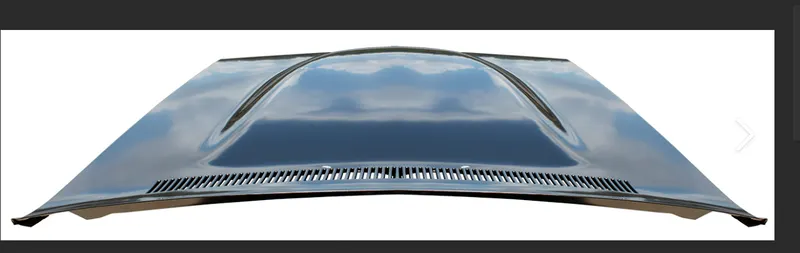
- Power bulge hood shapes: There is another design that is commonly found on hoods, and it is called the power bulge because the central portion of the hood is raised. According to theory, an engine block with a higher raised portion should be able to fit into the raised area.
Properties of ideal Car Hoods
Below mentioned a few properties of an ideal car hood:-
- The hood may have either a hinged front edge or a hinged rear edge, or, in earlier models, both the front and rear edges may be hinged together, along one centreline, or it may have two sections, one on either side, hinged along its centerline.
- Moreover, there is also a variant of this vehicle in which the bonnet and wheel arches are combined and where the entire front bodywork is able to tilt forward around a pivot located near the front of the vehicle, allowing it to look forward.
- A hood is an aerodynamically shaped piece of fabric used to prevent air from flowing over the car, and it also adds a luxurious look to the front section.
- There are many parts in the car that are covered by the hood, such as the engine , radiator and many other parts; for this reason, the hood must be designed in a way that can allow the engine to be serviced properly while the hood is on.
- A car’s hood system will be damaged most of the time when the vehicle is involved in any kind of accident in the front portion of the vehicle, and it will absorb some of the impact energy as a result of the accident.
- Typically, hoods are made from the same materials as the rest of the bodywork, and this may include steel, aluminum, or some combination of these materials. It should be noted, however, that some aftermarket manufacturers have produced steel hood replacements in carbon fiber or fiberglass in order to lighten the vehicle.
Safety consideration followed while designing the Hood :
SAFETY CONSIDERATION :
- Pedestraine safety : In japan and Europe regulation have come into effect that the place a limit on the severity of pedestrain head injury when struck by a motor vehicle. This is leading to more advanced hood design, as evidence by multicone hood inner panel designs, othere changes are being made to use the hood as an active structureand push its surface several centimeter away from the hard motor componenet during a pedestrain crash.
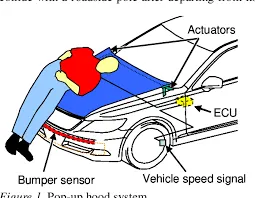
- Protecting Head : The hood in most vehicle is usually fabricated from sheet metal, which is complaint energy obsorbing structure which poses a comparatively small threat. Most serious injuries occures when there is insufficient clearance between the hood and the stiff underlying engine component. A gap of approximately 10 cm is usually enough to allow the pedestrain head to have a controlled decleratiobn and a significantly reduce risk of death.
- Wrap Around Distance (WAD) : When the car crashes on the pedestrain the whole body wraps around the front shape of the car, and the head impact on the bonnet or the windscreen. The distance at which the head impact on the car from the ground is mentioned as Wrap Around Distance (WAD).
NOISE VIBRATION HARSHNESS (NVH) :
Noise Vibration harshness (NVH)is the study and modification of the noise and vibration characteristic of the vehicle, perticuarly cars and trucks. to improves NVH, mastic sealent where provided on the inner panel. Here mastic panel plays a major role to avoid noise and vibration into cabin.
Mastic Data:
There should be ensuring that the hood must be hard enough to protect the main parts of a vehicle and must not be too hard too. Mastic Data enables the average hardness of the hood and ensures that there are no spaces between the inner panel nor the outer panel to reduce noise and vibrations from the vehicle
Manufacturing process :
Deep Drawing :
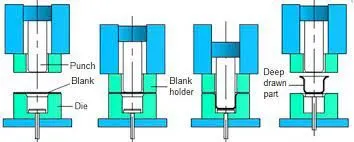
Deep drawing is a sheet metal formal process in which a sheet metal blank is radially drawn into a forming die by the mechanical action of a punch. It is tjus a shape transformation process with material retention. The process is consridered "Deep Drawing" when the depth of the drawn part exceeds its diameter.
Embossing :
Embossing is a stamping process for producing raised or sunken design or relief in sheet metal. This process can be made by means of matched male and emale roller dies, or by passing sheet or astrip of metal between rolls of the desired pattern, theoretically with no change in metal thickness, or by passing sheet or a strip of metal between rolls of the desired pattern.
Mastic Sealent :
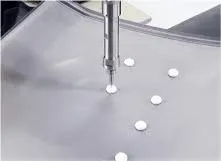
A mastic sealent is a type of liquid sealent that curea in an elastic state, thus making it flexible while holding the bond of the surface that has attached together. It adheres to just about any material making an all-purpose type of sealent.
The components of the hood assembly includes the .
- Hood inner panel
- Hood outer panel
- Mastic data
- Hinge
- Striker and the latch
In the followig assembly all the related data is provided for the hood assembly along side with the input master sections followed for the design considerations
The input data are the
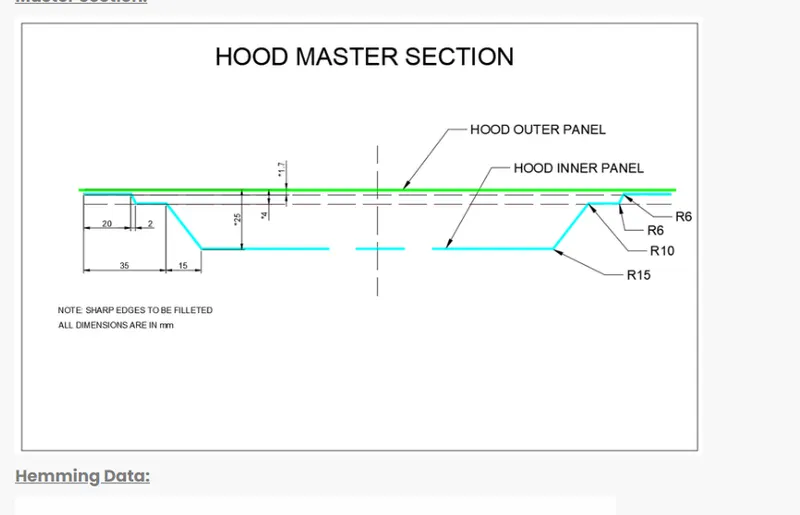
This is the master section data for the desifgn of the inner panel of the hood
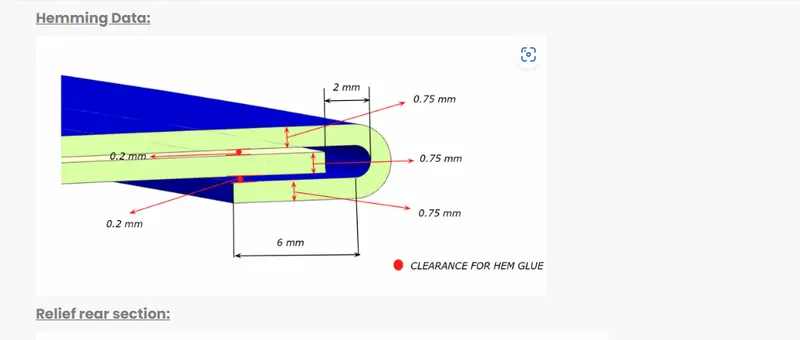
The above mentioned is for the hemming process which explained further in the report
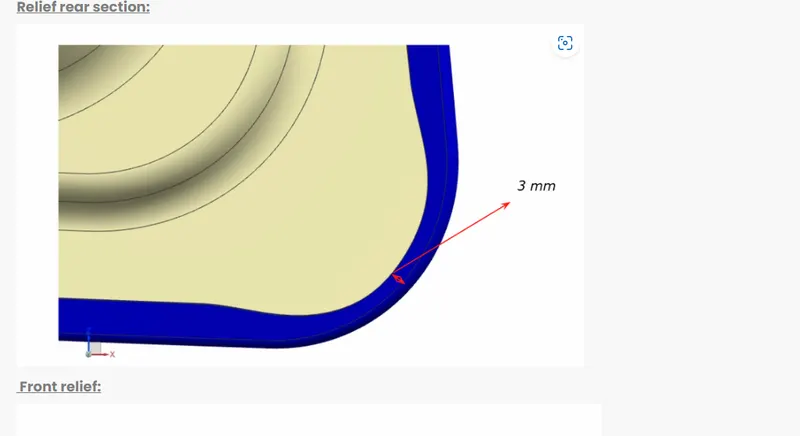
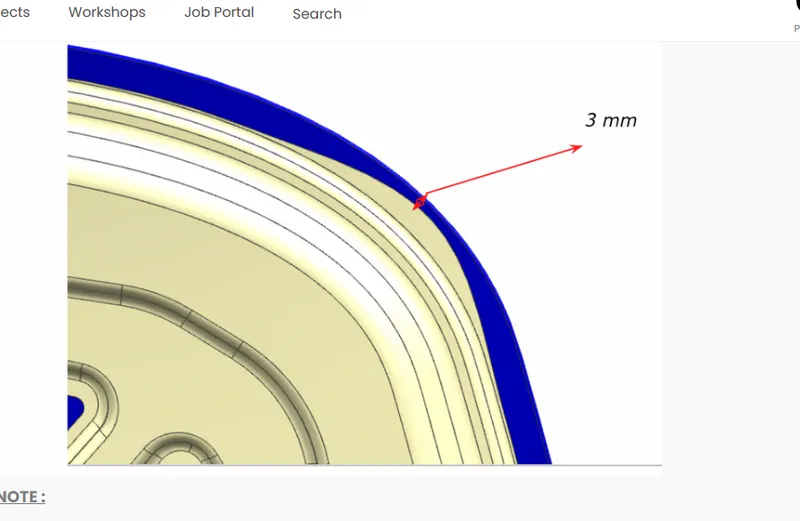
The hood design considerations provideds is the
- Hood innerb panel thickness = 0.75 mm
- Hood outer panel thickness = 0.75 mm
- Reinforcement thickness = 1.5 mm
- Draft angle = greater than 7 degrees
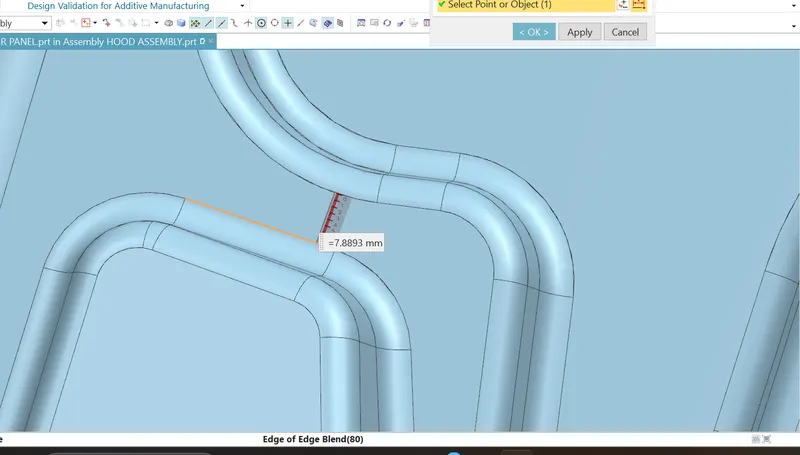
- A clearance of 5 - 10mm should be maintained between two consecutive componets like the embosses
The above mentioned are related to the hemm reliefs sections in order to avoid the stress concentration factor
STRESS CONCENTRATION :
The term stresss concentration is defined as the when there is a sharp corner on the material the dumping of the stress takes places ath the corner sharp point which leads to the failure of the material under the applied stress so , to avoid this the sharp corners are eliminated and the round corners are provided so that the applied stres is distributed uniformly along the corners which leads to provide ability to substain for the applied stress
The design of the hood assembly includes the following steps
|
CREATE A NEW HINGE ASSEMBLY IN NX CAD |
|
ADD ALL THE COMPONENTS TO THE ASSEMBLY INCLUDES THE HOOD INNER, OUTER PANEL, STRIKER AND THE HINGE ASSEMBLY |
|
CREATING THE TOOLING AXIS |
|
DESIGN THE HOOD INNER PANEL BASED ON THE MASTER SECTION |
|
MOUNT THE HINGE AND THE STRIKER TO THE HOOD INNER PANEL BY PROVIDING THE ASSEMBLY CONSTRAINTS |
|
DESIGN THE HOOD OUTER PANEL |
|
HEMMING PROCESS |
CREATING A NEW ASSEMBLY IN THE NX CAD :
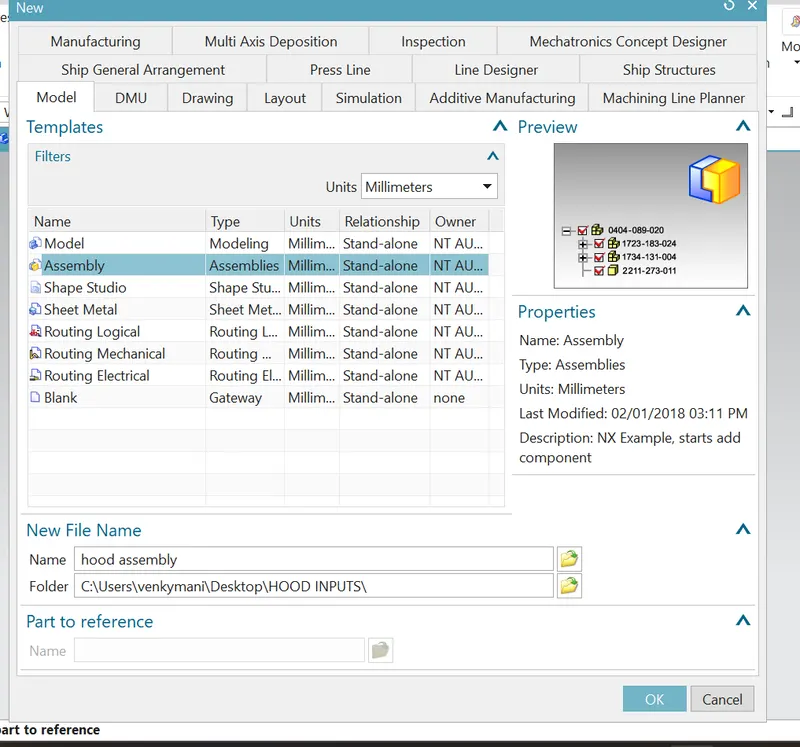
First of all we need to create a new a new assembly file for the design of the hood for this Go to new < Assembly < Provide the loaction for the file storage < click ok
ADDING THE COMPONENTS TO THE ASSEMBLY:
Go to the assemblies < Add new part < Then browse the part from the presaved directory Add the Hood outer panel
Hood outer panel :
Hood outer panel is the outer most panel of the hood which is moe aesthetic in nature which is visible to the customer The outer panel and the inner panel are joined together to a proces s called as the Hemming process
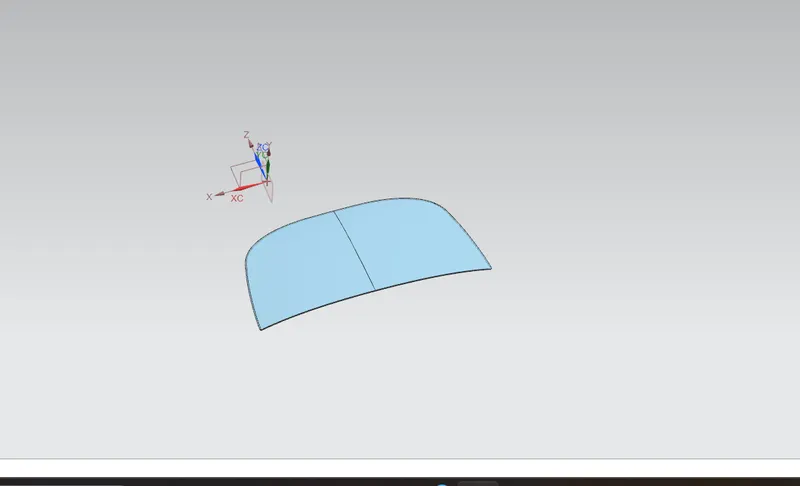
Once the hood outer panel is added then go to create new part < and save the same directory where the Assembly is saved < and add hood inner panel
HOOD INNER PANEL:
The main part of the hood which gives support to the outer panel of the car and with its embossing shapes dissipates the force in different directions when the vehicle takes crashes to not to injure the men in the car.
wave geometry linker :
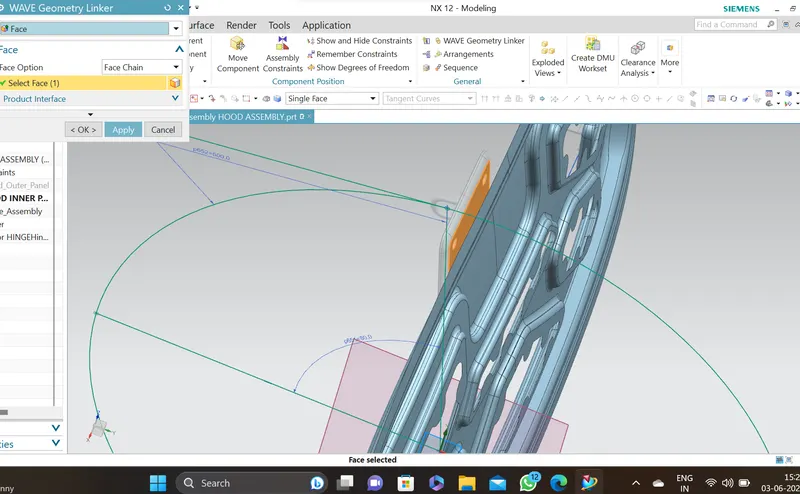
This is the feature in the nx cad which is like the Extrract in the catia v5 which help to extarct the outer panel face to be present in the hood inner panel
So extract the face of the hood outer panel in the hood inner panel
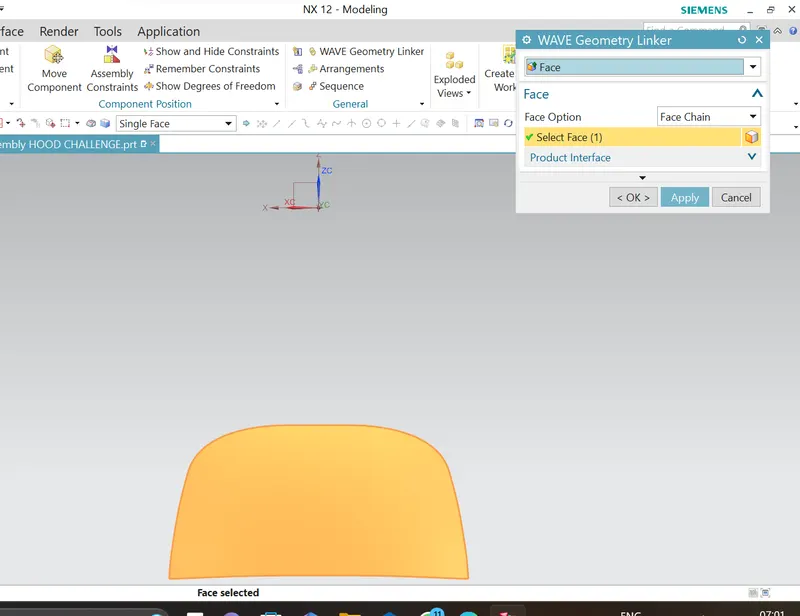
So fix the inner panel and teh outer panel with the constraints of the assembly With teh associatives whatever the changes in the hood outer panel will reflect in the hood inner panel
Tooling axis creation :
Tooling axis is the direction in which the tool moves for creation of the component
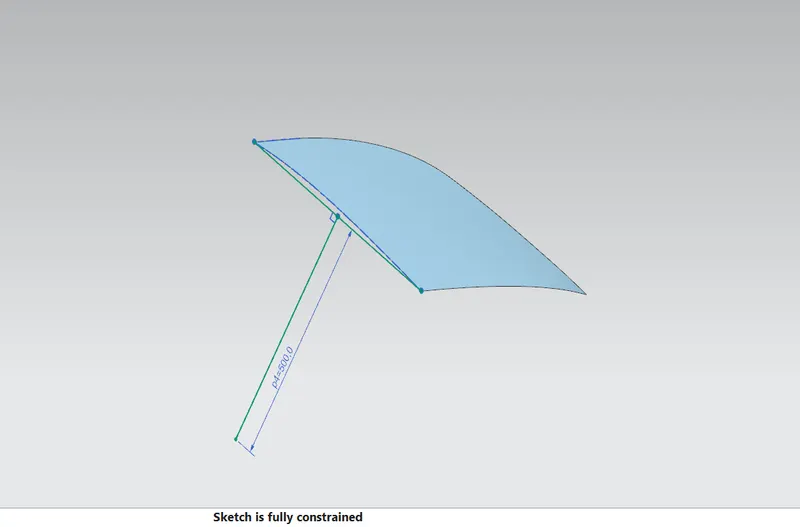
Beware that all the created sketches should be fully constrained
Flange creation :
using the master section create the flanges required
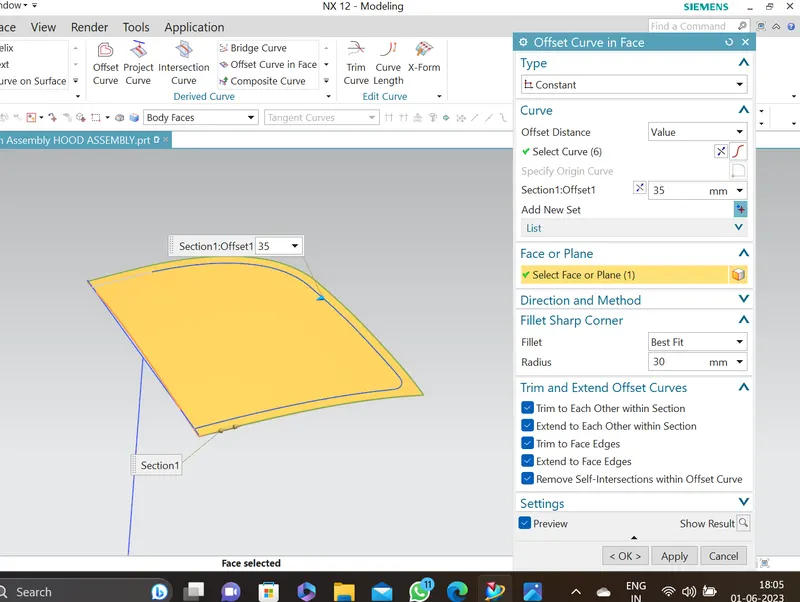
Use the offset surface and the offset curve on surfcae to create the flanges using the best fit fillet radius
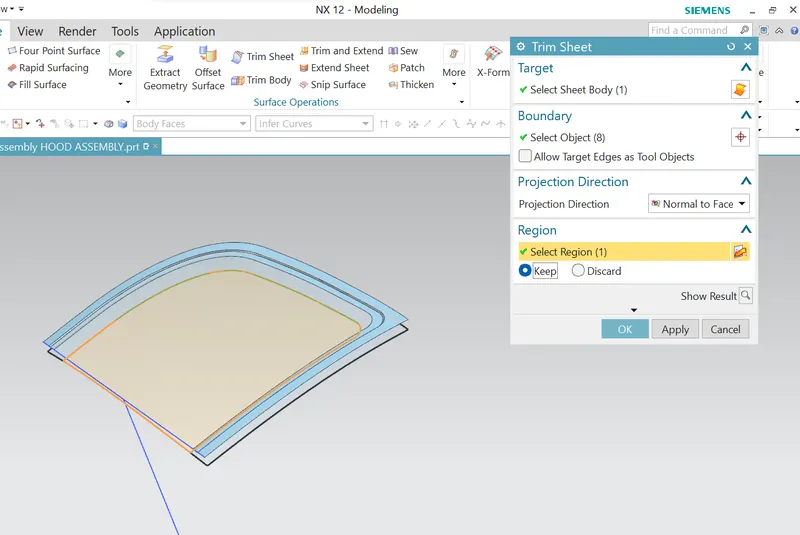
Use the trim sheet option to create the flanges
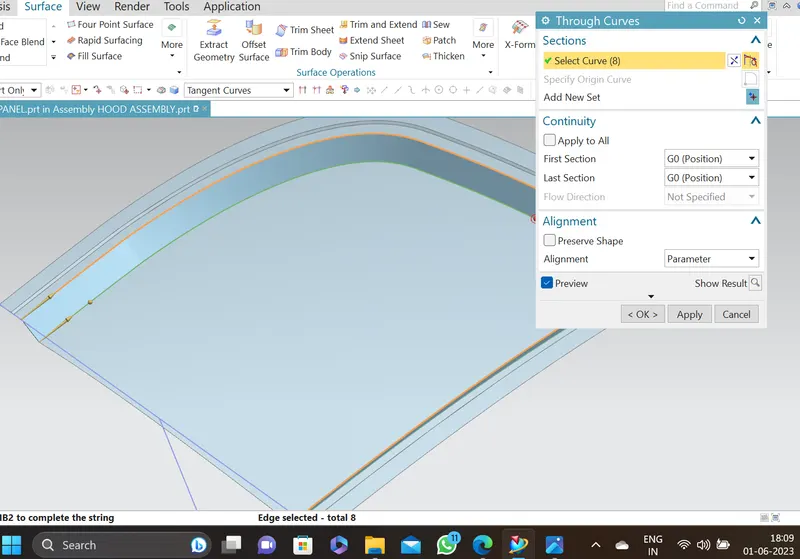
UIse the through curves to form the surfcae between the flanges
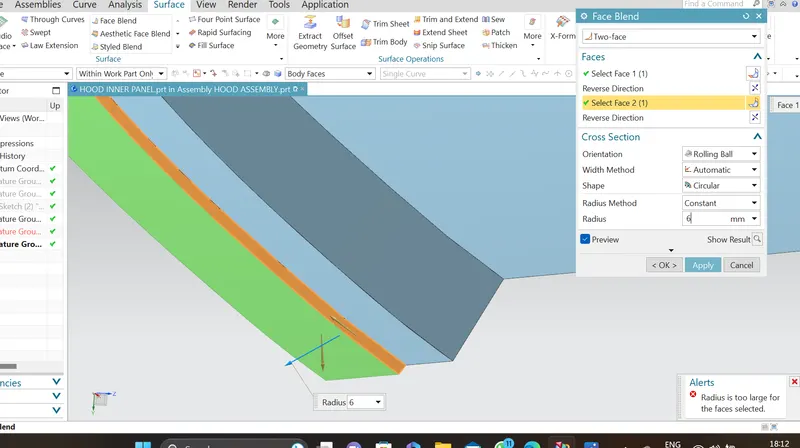
Now apply the face blend feature provided on the master section
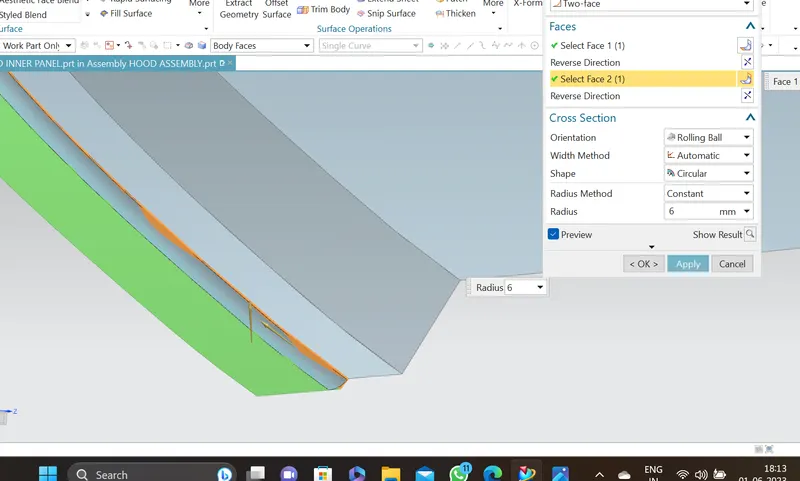
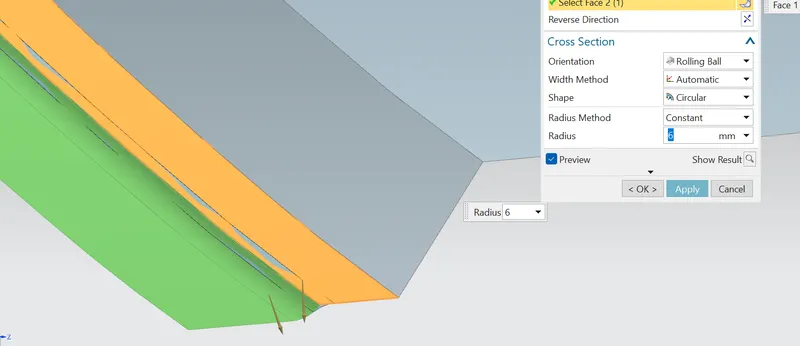
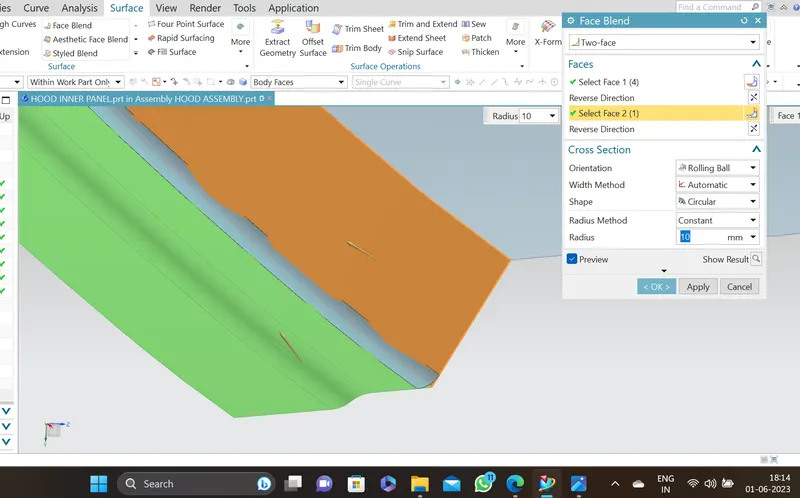
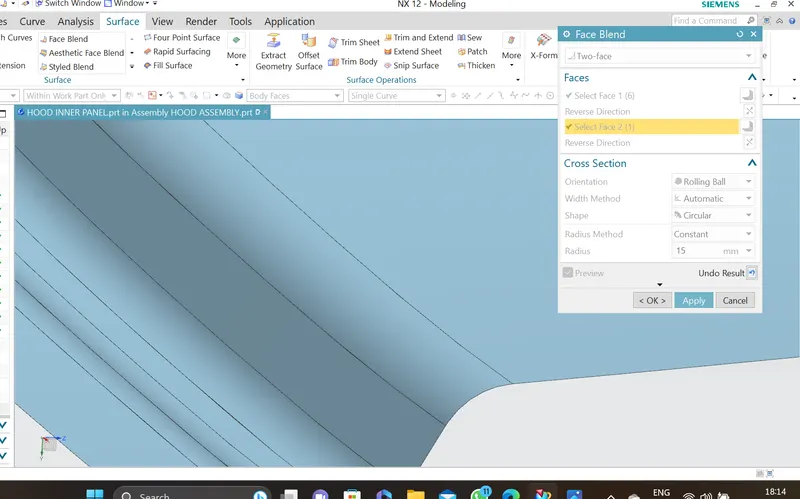
So the flanges formed finnaly are the
Emboss creation :
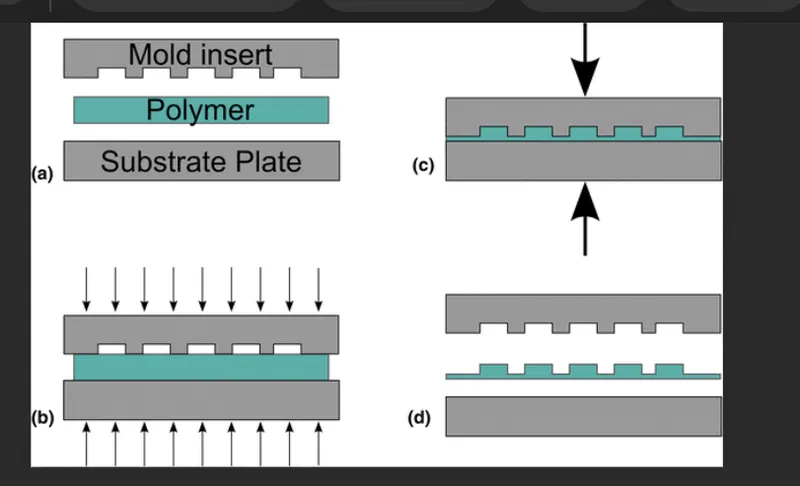
Emboss :
Sheet metal embossing is a stamping process for producing raised or sunken designs or relief in sheet metal. This process can be made by means of matched male and female roller dies, or by passing sheet or a strip of metal between rolls of the desired pattern. It is often combined with foil stamping to create a shiny, 3D effect.The pressure and a combination of heat actually "irons" while raising the level of the image higher than the substrate to make it smooth. The term "impressing" refers to an image lowered into the surface of a material, in distinction to an image raised out of the surface of a material.In most of the pressure embossing operation machines, the upper roll blocks are stationary, while the bottom roll blocks are movable. The pressure with which the bottom roll is raised is referred to as the tonnage capacity.
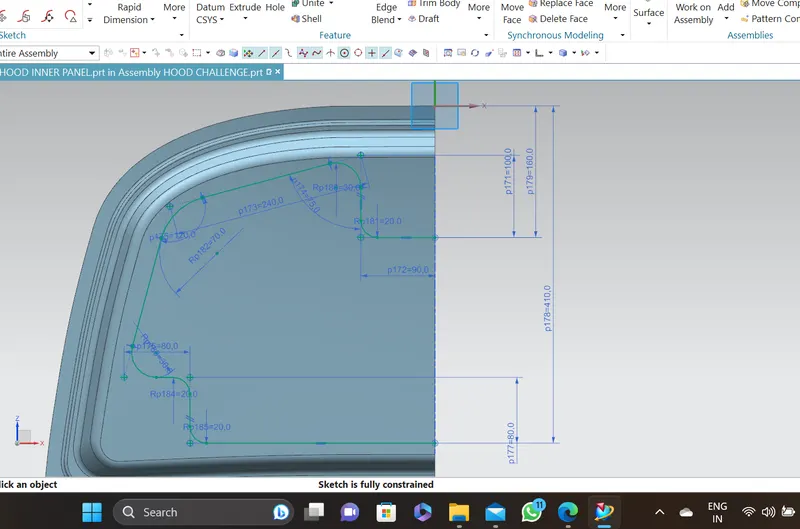
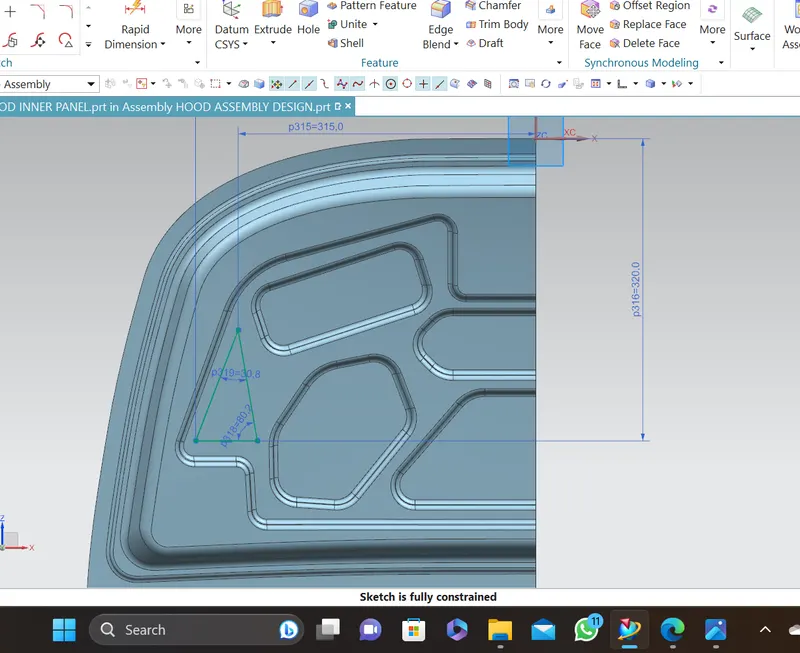
Now create the embosses for the hood
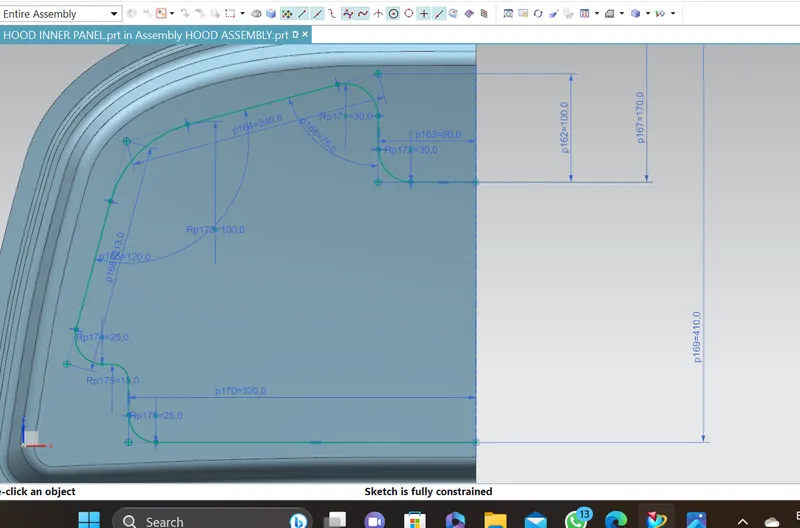
Now project the curve on to the hood inner panel
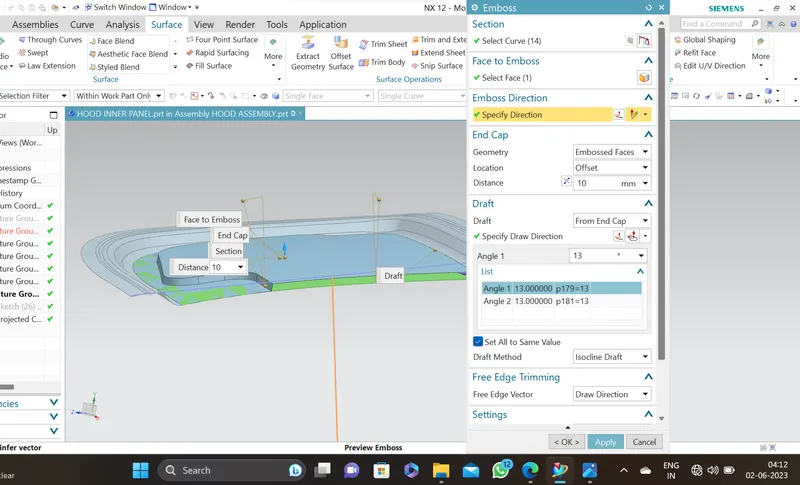
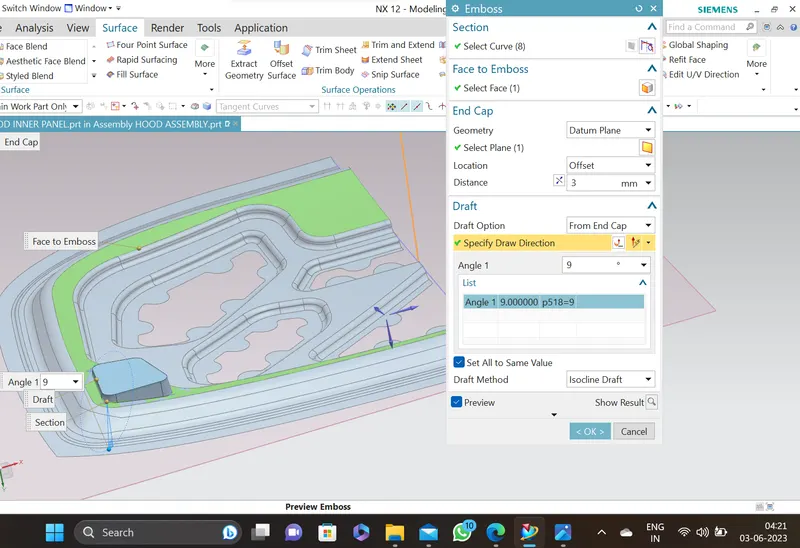
Now create the emboss with dimensions of
Emboss depth =10mm
Draft direction : tooling direction
Draft : more than 7 degrees
Now create all the Embosses provided
 .
.
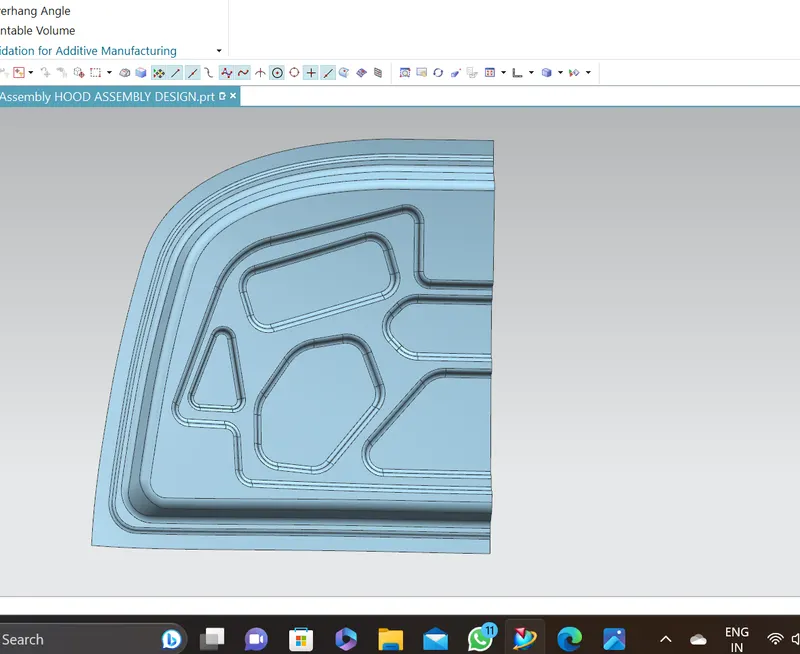
Now create all the cutouts for the embosses for providing the mastics for the support for providing the better crash analysis to distribute the forces among themselves to distribute the impact force
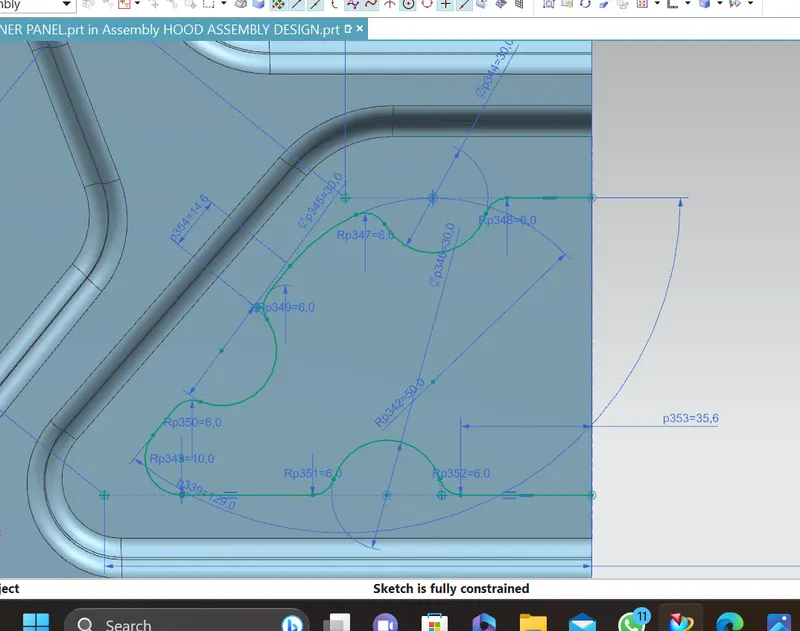
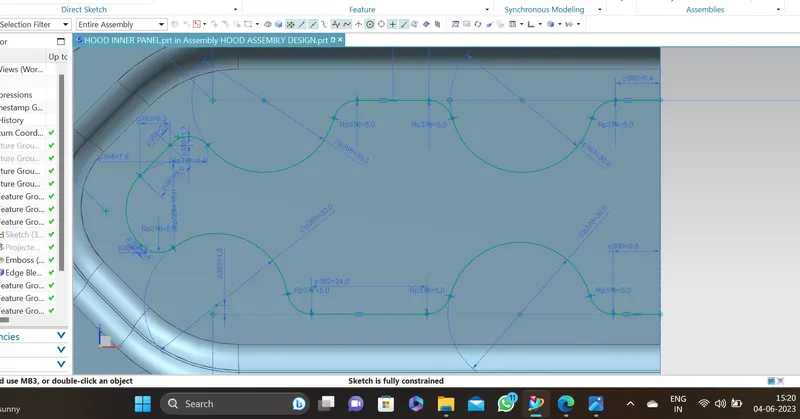
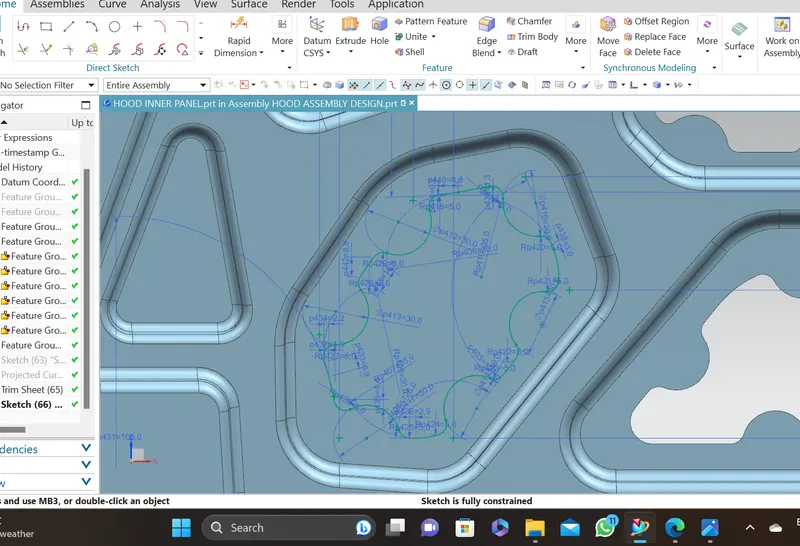
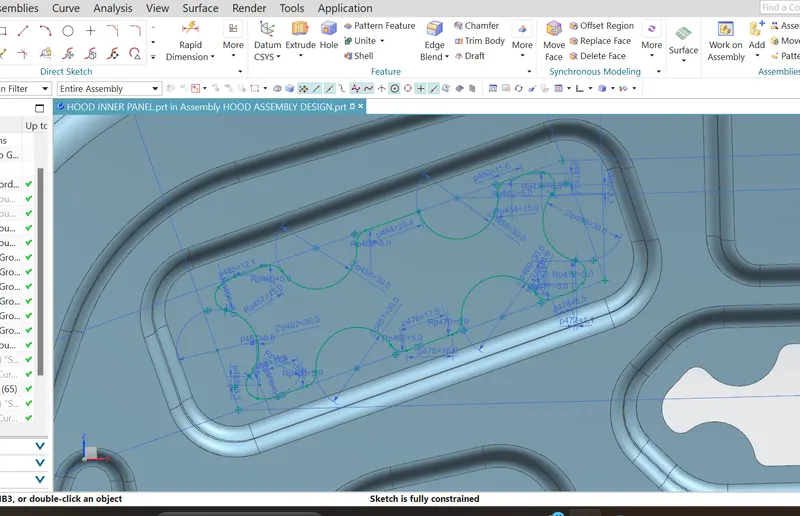
All the sketches need to be fully defined and constrained
Trim the sheet with the cutouts to eliminate the material for the mastics
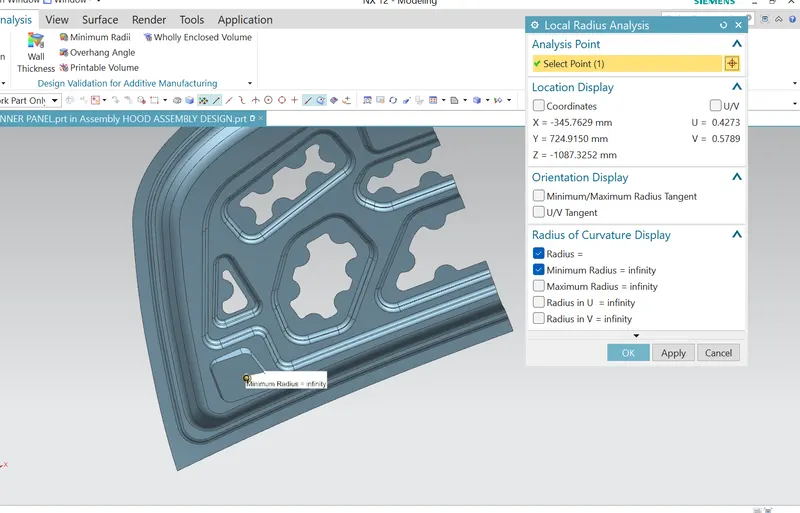
Hinge mounting :
Create the sketch for the hinge mounting to create the mounting for the hinges
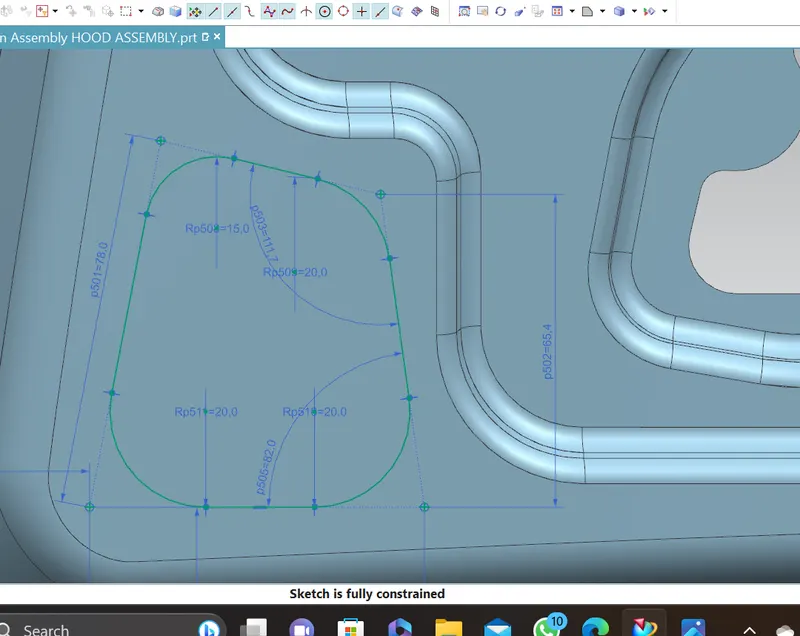
now apply all the assembly constraints to fix the hinge to teh hinge mount
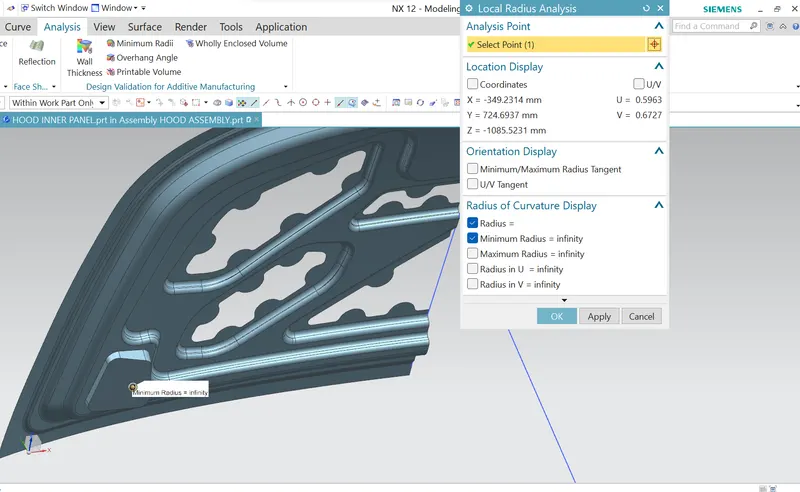
Now apply the edge blends with a value of 3Mm + thickness 0.75 mm
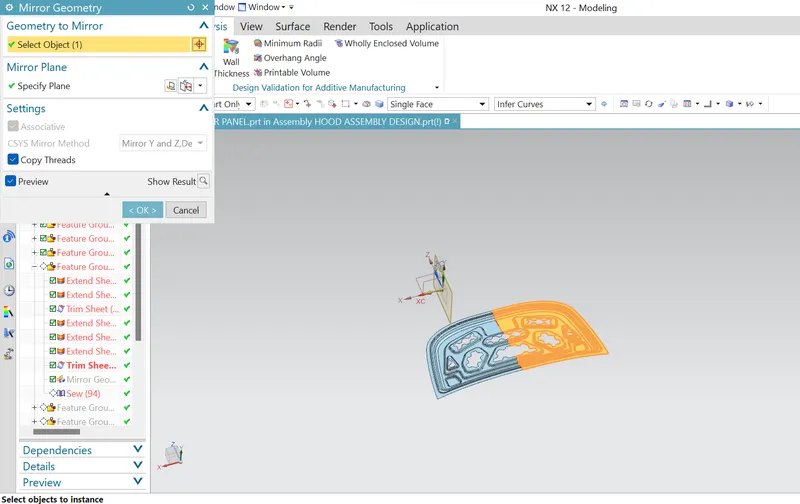
Mirror geometry :
Mirror the geometry with respect to the mid plane
Hood trajectory :.
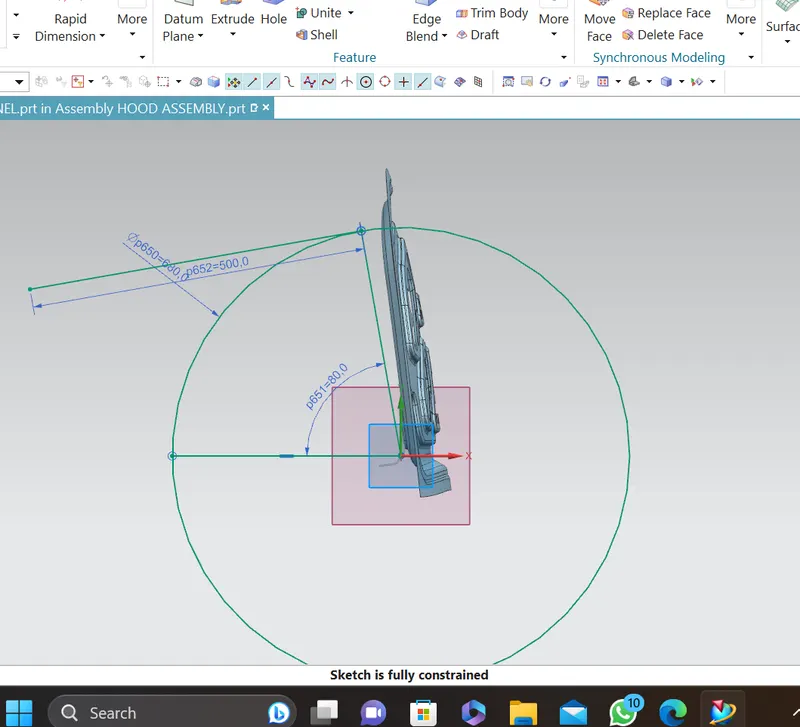
The trajectory of the hood is defined as the trajecory of the angle with the hood open or the close
Use the wave geometry feature to extract teh curves of the hinges to create the point for the creation of the line
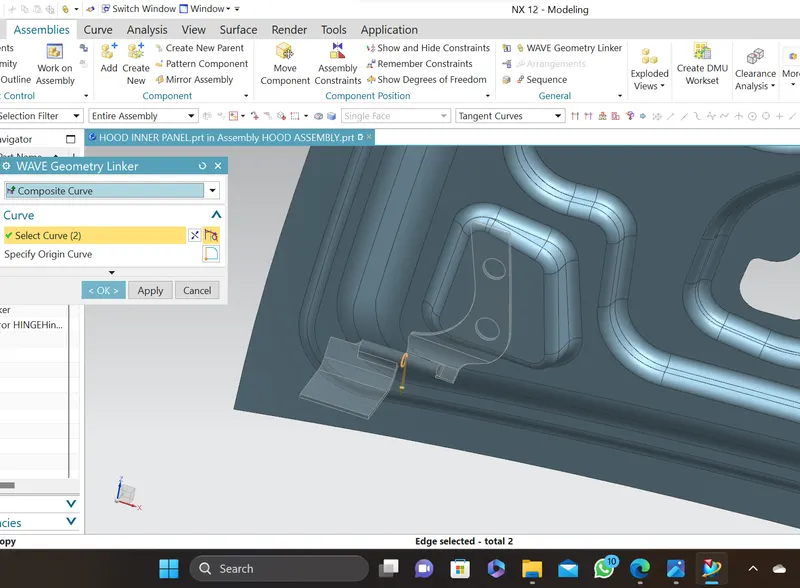
Create the line inbetween the points
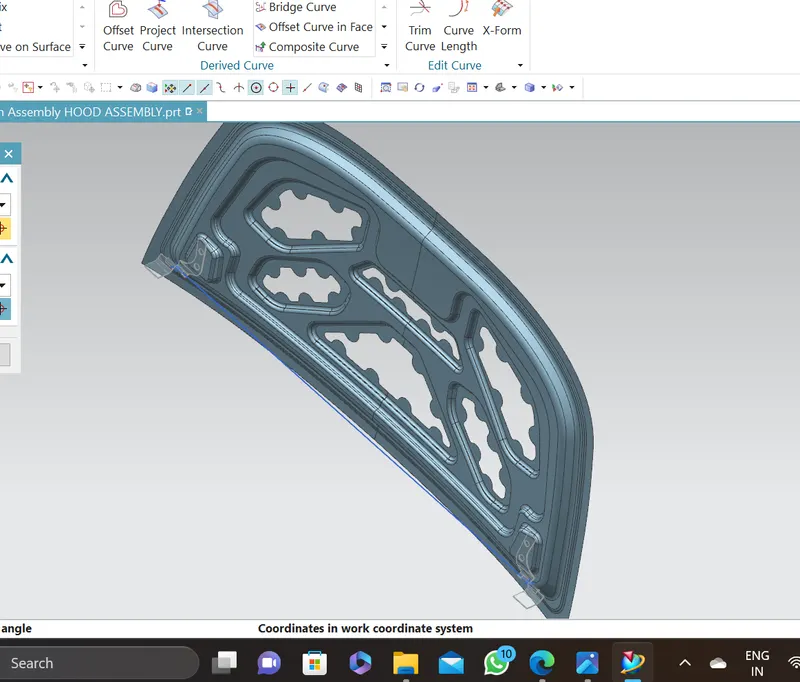
Now create the datum line at teh centre
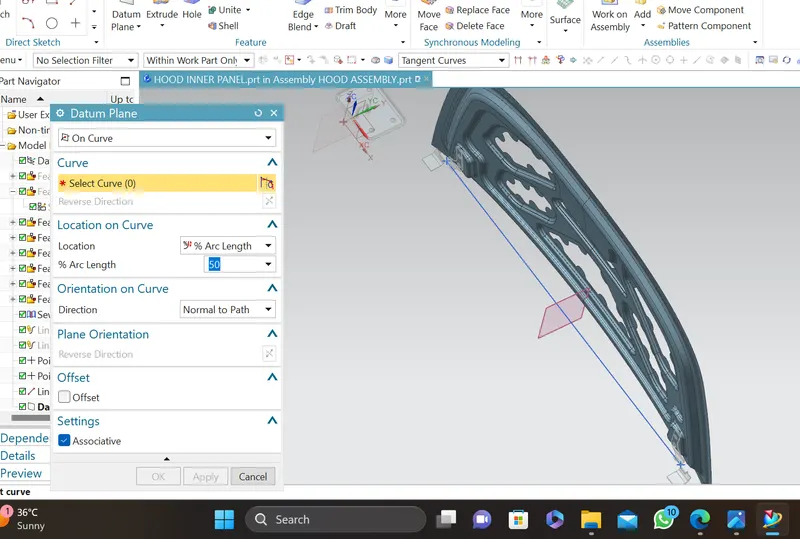
Create the trajectory with the sketch in appropriate motion for open and close with the strikera nd teh latch mechanism
Striker mounting :
Create the sketch for the striker mounting with the datum palne
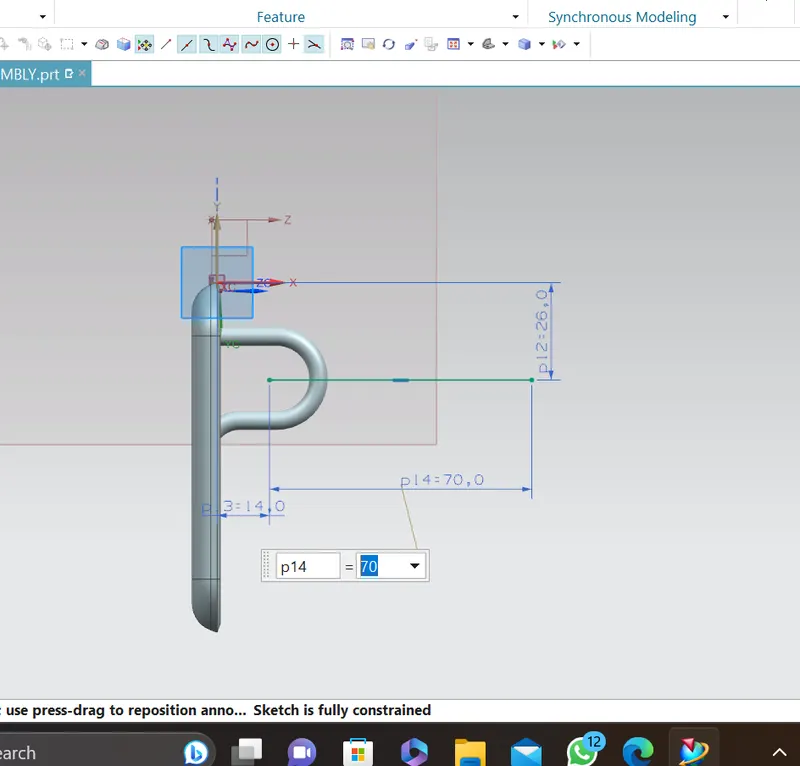
Apply the constraints to properly set the striker at the location
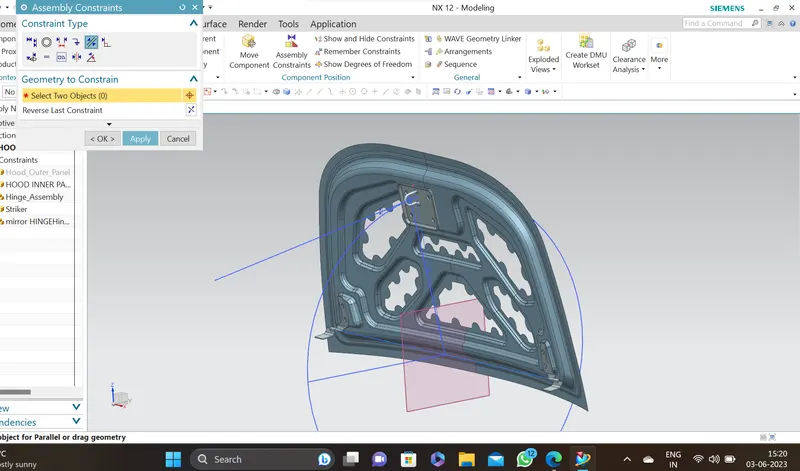
Useteh wave geometry linker to extract the face
Create the sketch for the proper mounting .
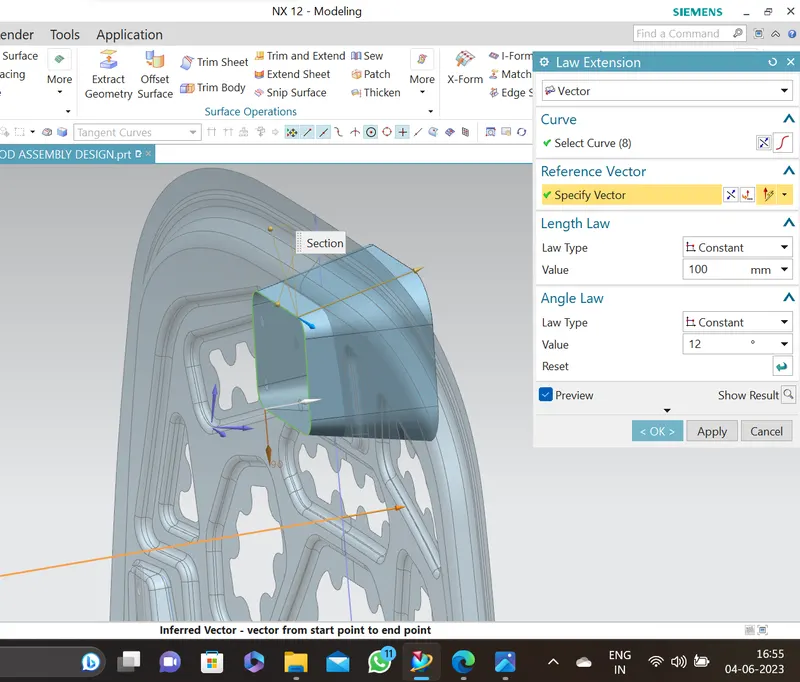
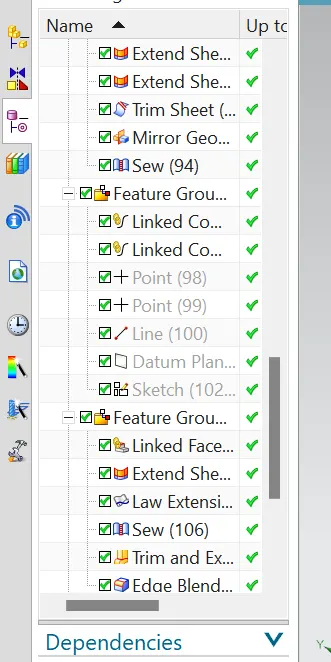
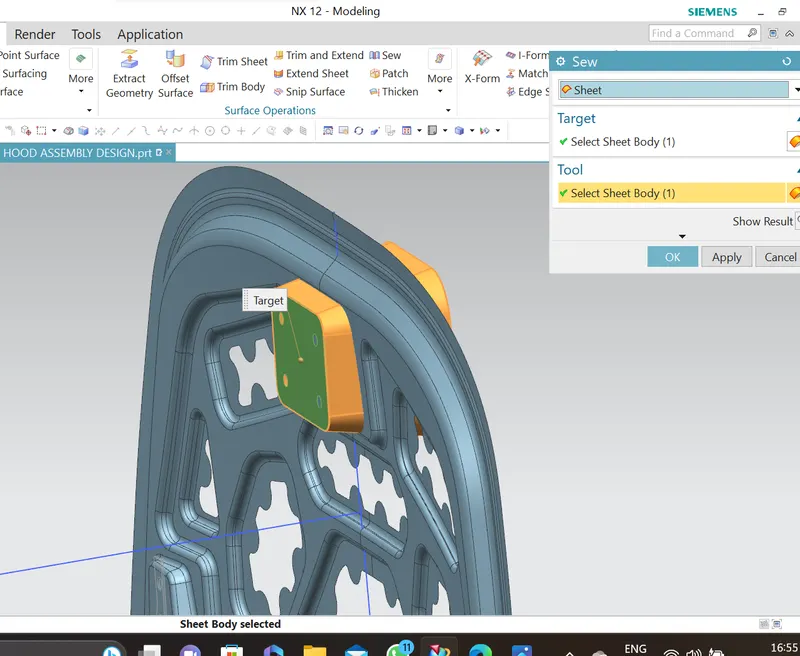
Trim the sheet with the hood inner panel and sew the striker mopunt with the hood inner panel
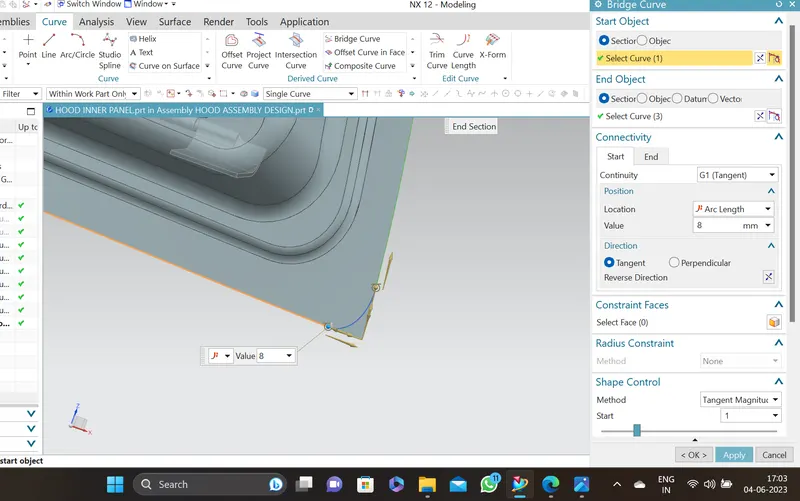
Eliminate the sharp edges :
Eliminate the sharp edges using the bridge curve option
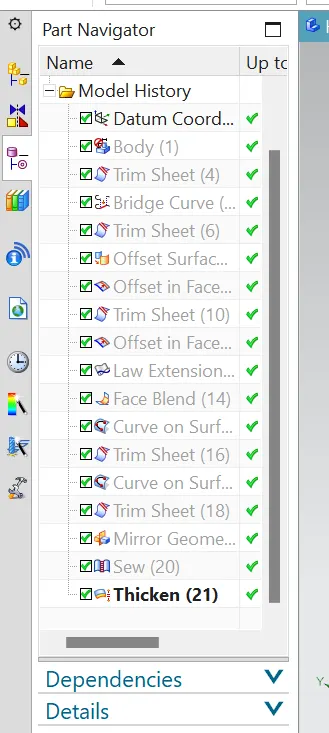
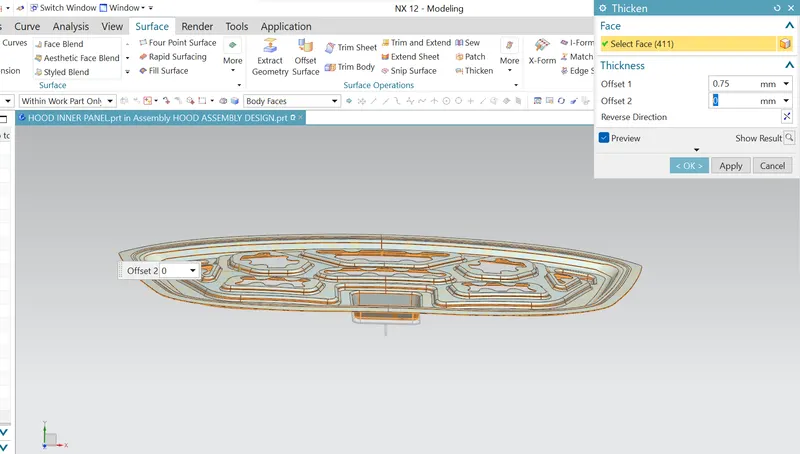
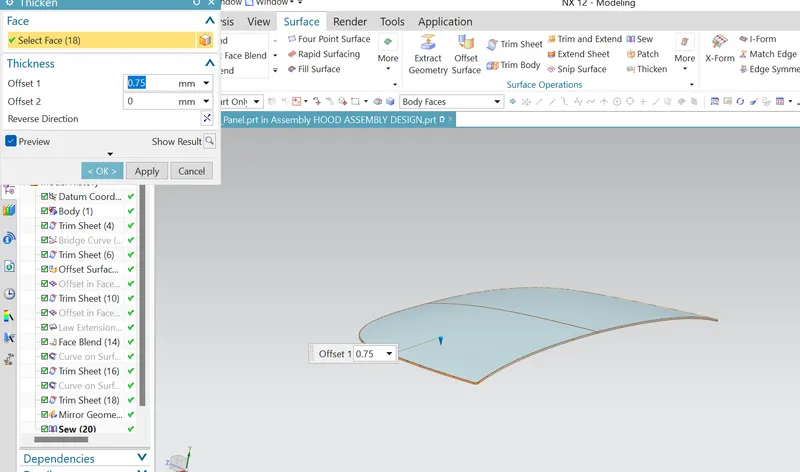
Now thicken the inner panel to a value of the 0.75mm inward
Outer panel design :
Now design for the outer panel
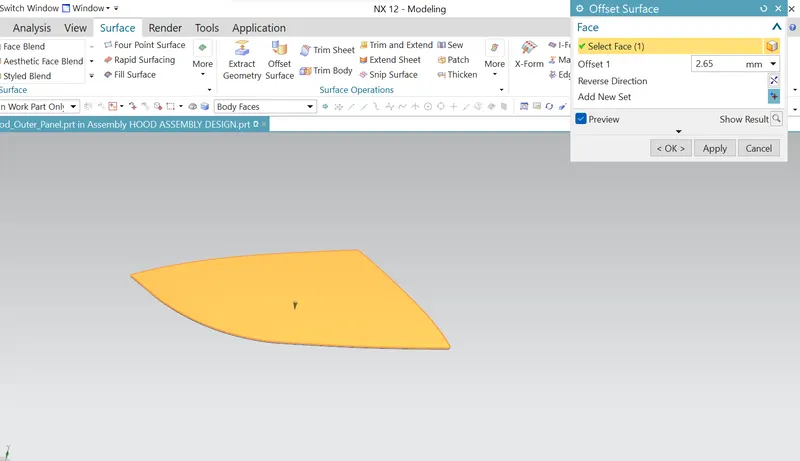
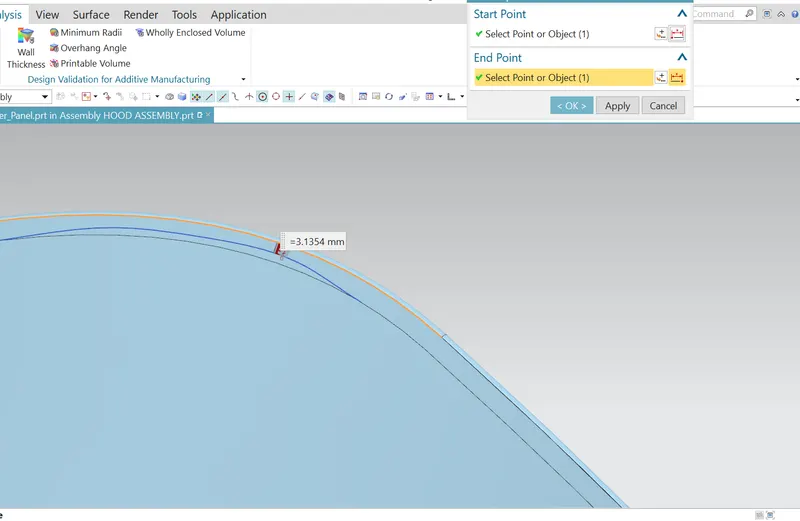
Now create the offset curve in face with best fit corner fillet
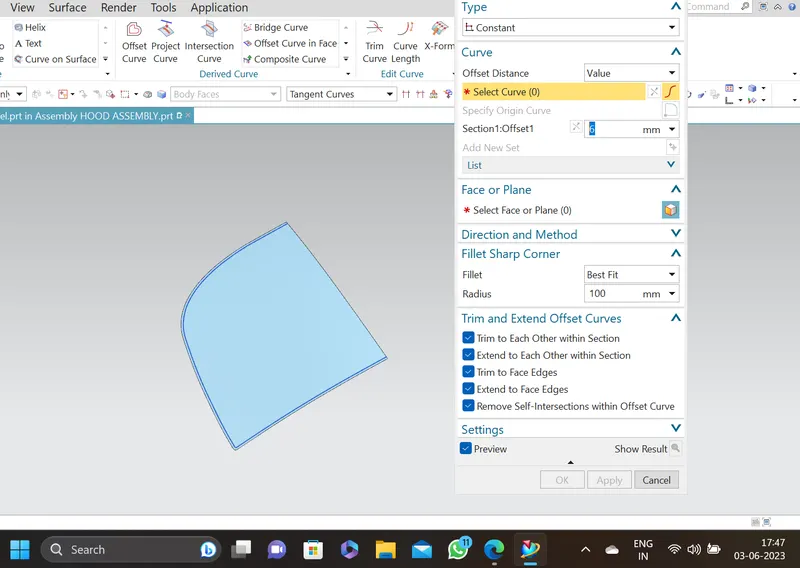
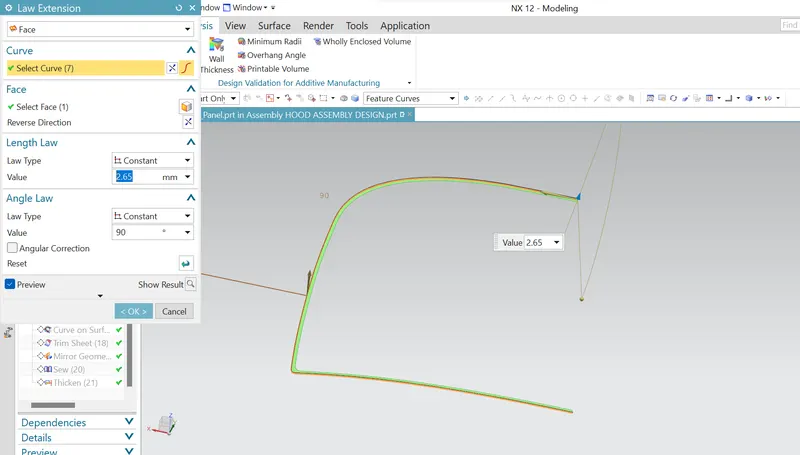
Now cteat a offset curve on face with a minimum value and create the law extension
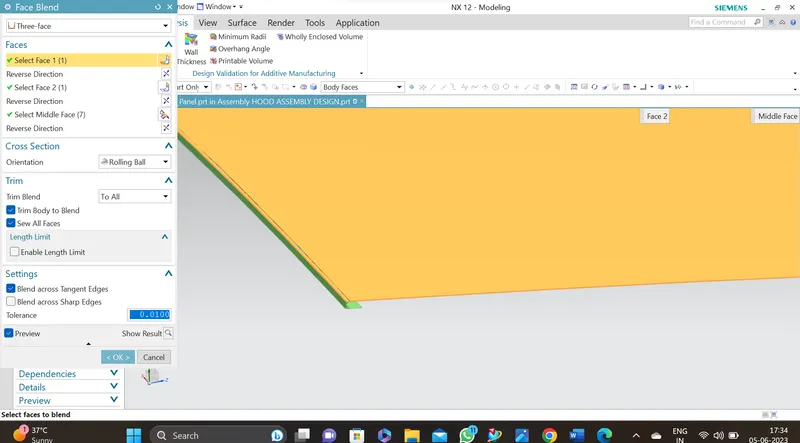
Now create the 3 face blend to form a curvature between the 3 faces for the closure
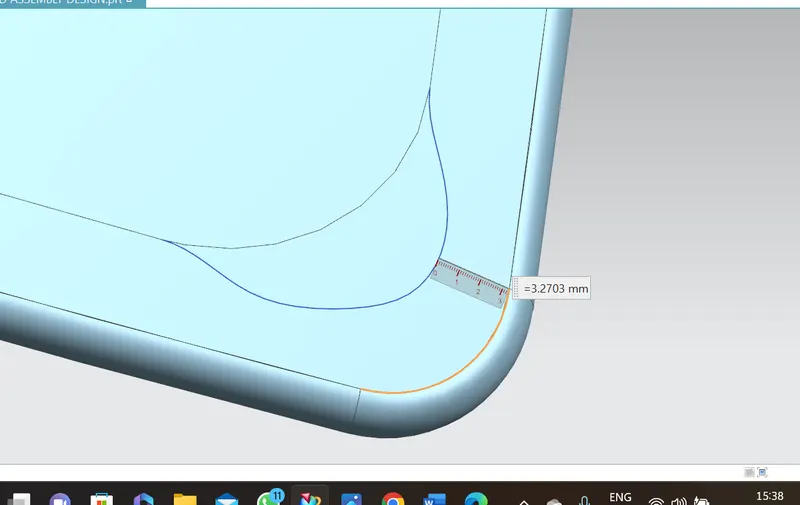
Now create the hemm reliefs for the distribution of the stress concentration to reduce the impact of the stress
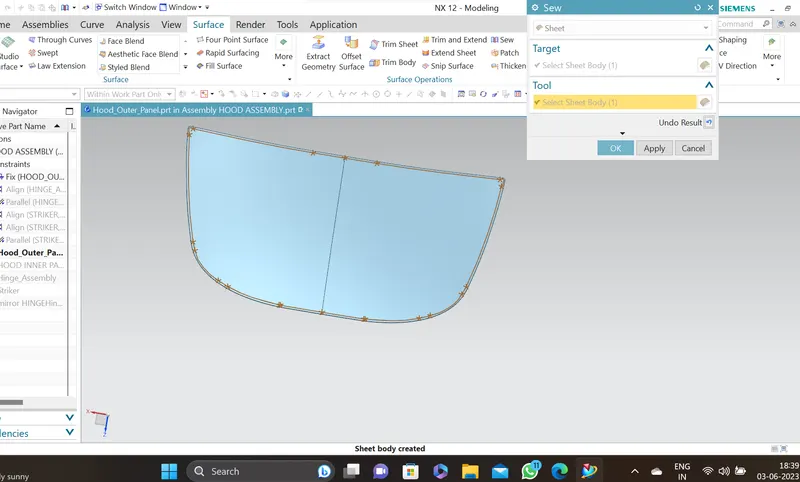
Now mirror the geometry and sew the faces
Now thicken the outer panel to a value of 0.75 mm
Hemming
- Hemming is a forming operation in which the edges of the sheet are folded or folded over another part in order to achieve a tight fit. Normally hemming operations are used to connect parts together, to improve the appearance of a part and to reinforce part edges.
- In car part production, hemming is used in assembly as a secondary operation after deep drawing, trimming and flanging operations to join two sheet metal parts (outer and inner) together. Typical parts for this type of assembly are hoods, doors, trunk lids and fenders.
- There are various types of hemming operations:
Conventional die hemming
Roll hemming
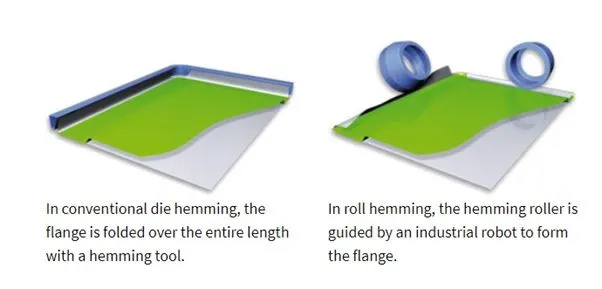
Conventional die hemming
Conventional die hemming is suitable for mass production. In die hemming, the flange is folded over the entire length with a hemming tool. Normally the actual hemming is a result of a forming operation in which the flange is formed with a hemming tool after the drawing and trimming operations have been completed. The formed flange is then hemmed in several process steps. These steps include, for example, the pre-hemming and final hemming depending on the respective opening angle of the flange. Production plants for conventional die hemming are very expensive, but the cycle times are very low.
Roll hemming
Roll hemming is carried out incrementally with a hemming roller. An industrial robot guides the hemming roller and forms the flange. Roll hemming operation can also be divided into several pre-hemming and final hemming process steps. Roll hemming is very flexible to use and tool costs are significantly lower as compared to those of conventional die hemming. However, the cycle times are much higher since the hemming is realized using a hemming roller which follows a defined path.
Use the clip section to view the master section claerly with proper dimensions and the properties
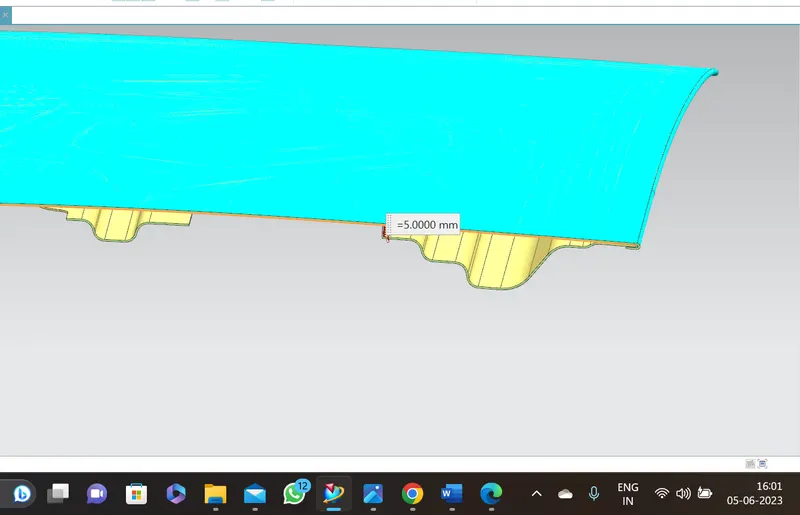
A 5 mm should be provided in betweemn th mastics
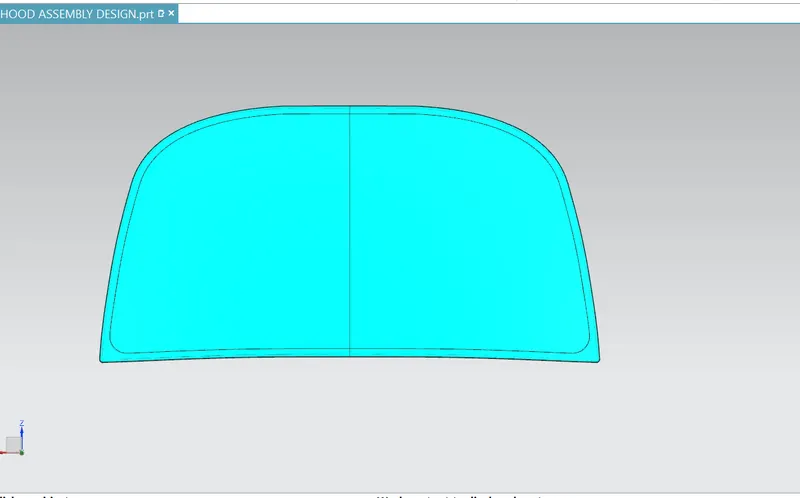
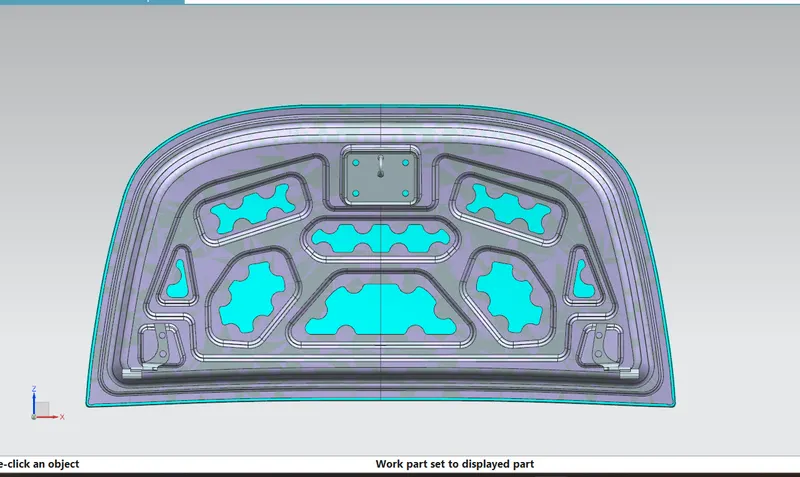
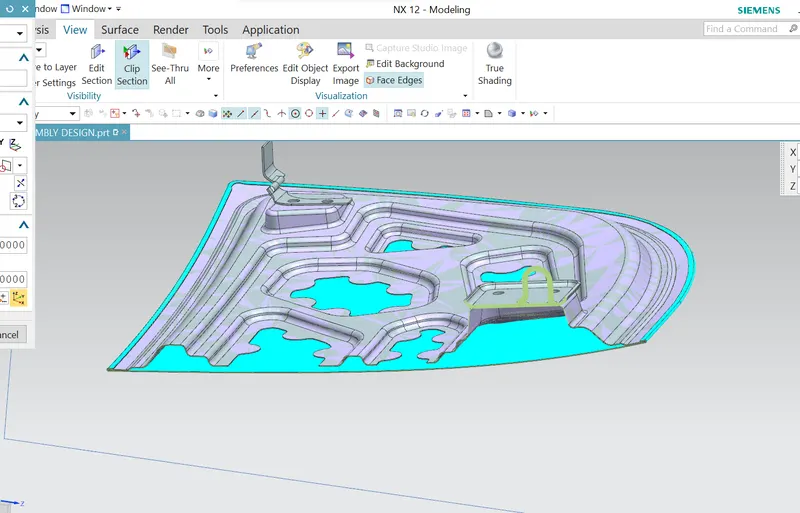
Hood assembly images
Conclusion :
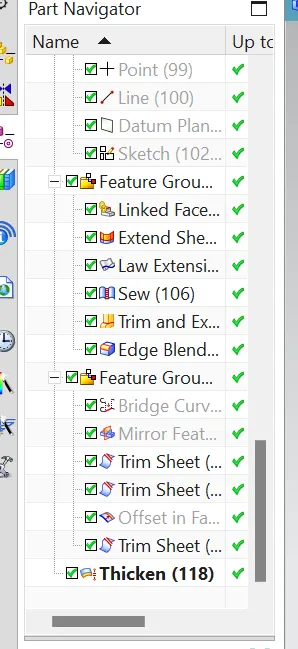
Hence the hood design assembly is completed with the help of the master section provided with proper safety dimensions and the design parametrs and the assembly images are submitted along side with the tree structure