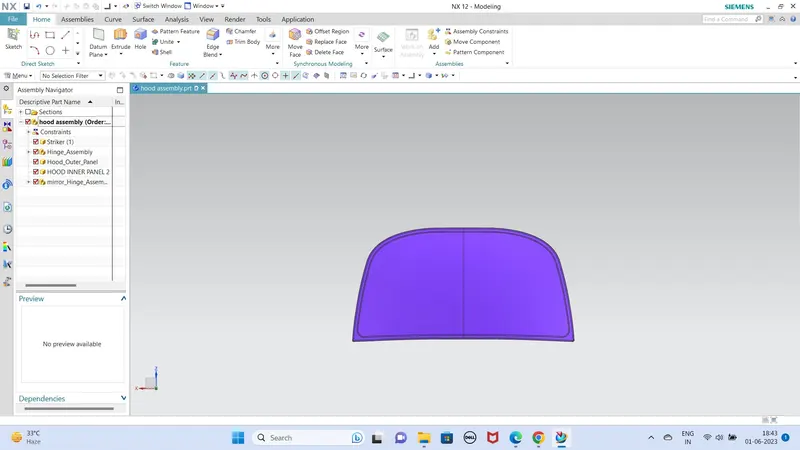
Hood design-Week 2
HOOD DESIGN USING NX CAD
Objective:
In this project we are going to design the hood inner panel by using NX CAD and which helps to get familiar with the NX CAD features and tools and also we will learn what are the design parameters and the engineering skills required to make the hood.
Introduction:
Here we are going to understand and design the concept of front-mounted engine’s hood according to the standards. The hood or bonnet is the hinged cover over the engine of motor vehicles that allows access to the engine compartment, or trunk for maintenance and repair.
On front-mounted engine cars, the hood may be hinged at either the front or the rear edge, or in earlier models, it may be split into two sections, one each side, each hinged along the centerline. A further variant combines the bonnet and wheel arches into one section and allows the entire front bodywork to tilt forwards around a pivot near the front of the vehicle.
Siemens NX 12 version software is used here.
Pedestrian -Vehicle Collision
-
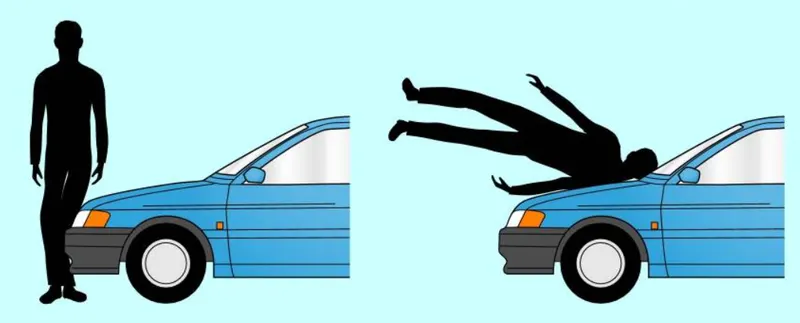
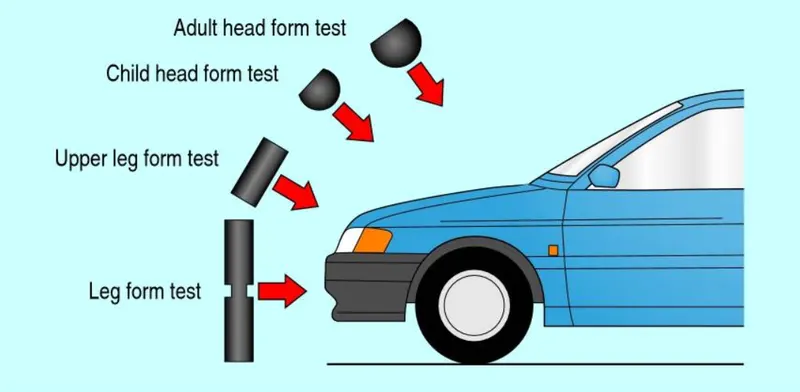
A vehicle–pedestrian collision has previously been defined as a physical contact of the pedestrian with a motionless or moving vehicle . However, considering that a motionless vehicle is not capable of causing serious injuries to a pedestrian, only interactions between pedestrians and a moving vehicle will be explored within this article.
Functional and Safety Requirements:
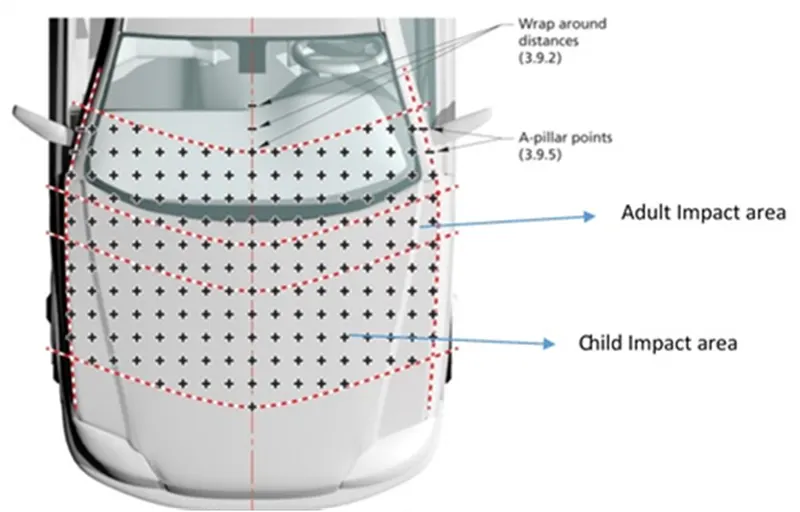
1. The most important safety requirement to be considered while designing the Bonnet is the frontal collision requirements.
The design intention of the hood according to the frontal collision requirement is that the hood crushes and dissipates forces in the upward direction and to the hard points on the hood thereby deflecting the force onto the body and not the passengers.
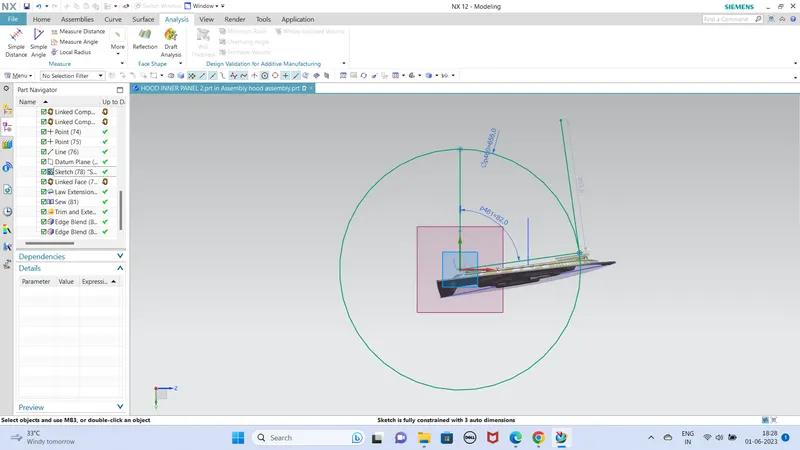
2.The second major function of the hood is the opening and closing the hood. This is done with the help of the latch and striker. To position the latch and striker effectively, we first position the hinge and draw the hinge axis. Now, using the hinge axis from the center we draw a big circle to the position where we need to place the latch.
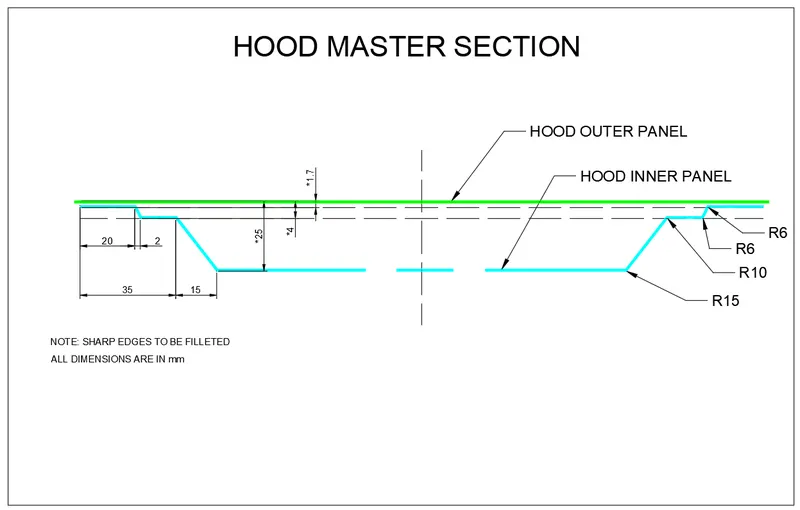
Master section
-
Latch Trajectory
Latch trajectory is given by the circle drawn from the hinge axis point. The hinge axis point is the center point of the hinge axis. First, we can fix either the latch or the hinge. If we have fixed the hinge position then we should plot the Trajectory circle for the latch. For proper mating conditions, the striker axis through the tip of the striker should be tangential to the latch trajectory.
-
Mastic Data
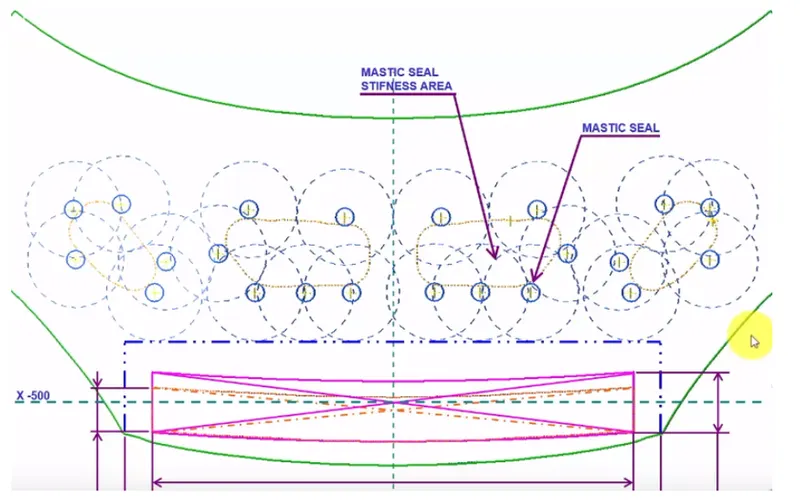
Mastic points are those points of the hood inner panel which are in contact with the hood outer panel with the help of sealants so as to minimize the effect of the vibrations produced by the engine.
Following are the design considerations for the mastic points
- The diameter of the mastic points was taken as 5mm.
- The distance between the mastic point and the hood outer panel is 5mm.
The distance between two mastic points was kept in such a way so as to minimize the vibrational effects
Embosses
-
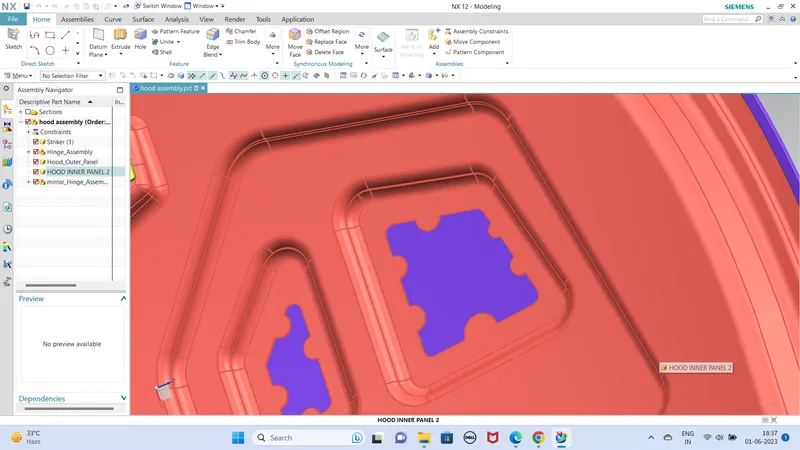
Sheet metal embossing is a stamping process for producing raised or sunken designs or relief in sheet metal. This process can be made by means of matched male and female roller dies, or by passing sheet or a strip of metal between rolls of the desired pattern. It is often combined with stamping to create a shiny, 3D effect.
The metal sheet embossing operation is commonly accomplished with a combination of heat and pressure on the sheet metal, depending on what type of embossing is required. Theoretically, with any of these procedures, the metal thickness is changed in its composition.
-
Deep Drawing
Deep drawing is one of the most widely used processes in sheet metal forming. Apart from its use in many other sectors, it is applied in the automotive industry for the manufacturing of car body parts. The deep drawing process is a forming process that occurs under a combination of tensile and compressive conditions.
Sheet metal blank is radially drawn into a forming die by the mechanical action of a punch. It is thus a shape transformation process with material retention. The process is considered "deep" drawing when the depth of the drawn part exceeds its diameter. This is achieved by redrawing the part through a series of dies. The flange region (sheet metal in the die shoulder area) experiences a radial drawing stress and tangential compressive stress due to the material retention property. These compressive stresses (hoop stresses) result in flange wrinkles. Wrinkles can be prevented by using a blank holder, the function of which is to facilitate controlled material flow into the die radius.
Hemming
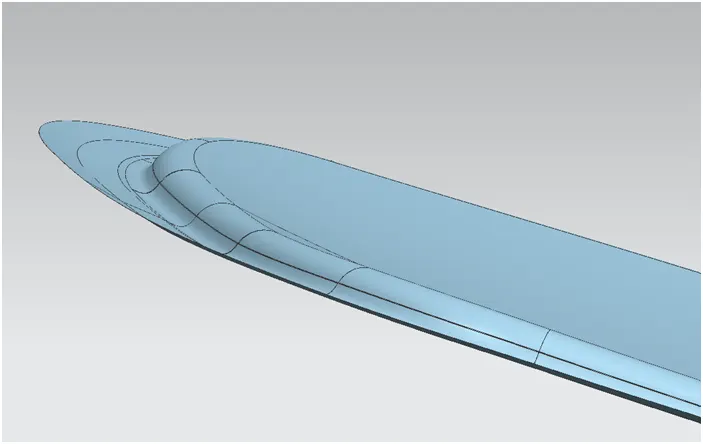
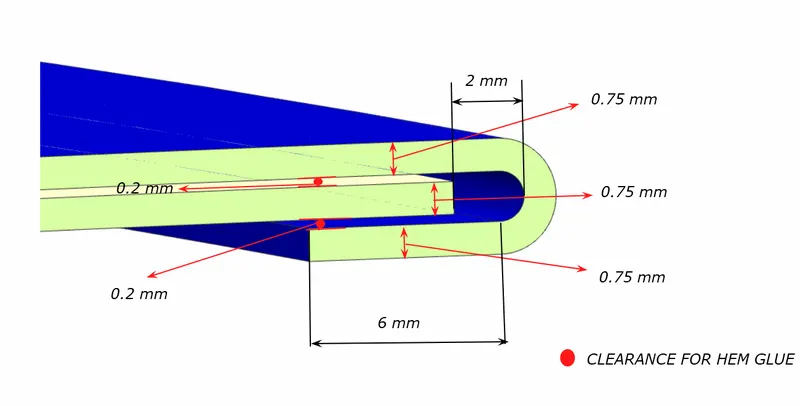
Hemming is the process of joining the hood inner panel and the hood outer panel. Due to the styling finish of the vehicle both the panels cannot be joined using the welded joints so in order to avoid these joints hemming is used. Hemming for the hood was done with the help of the hemming data as shown.
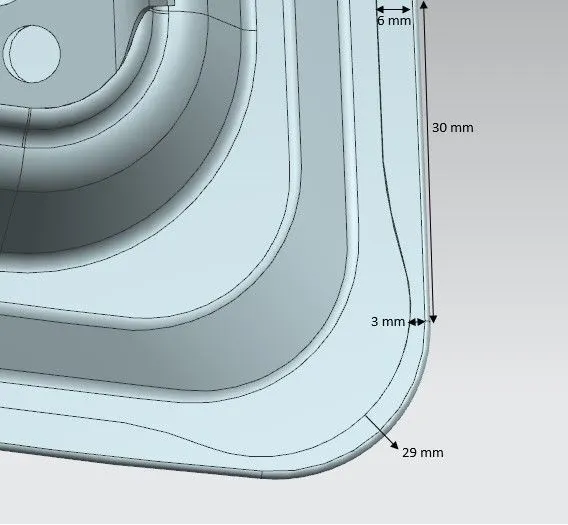
In the corners a relief is to be provided during hemming and for this relief following data was used.
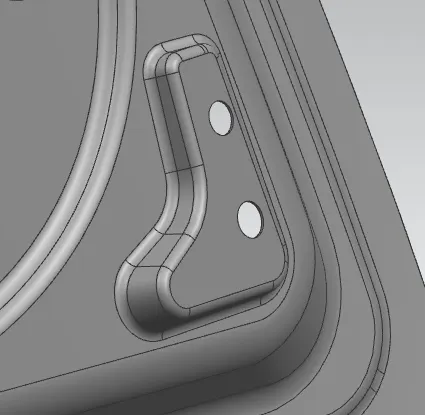
Reinforcement: When we give emboss we add some reinforcement which will compensate the lose strength. We added the stiff pad to it so that it gets the strength and also it has the mastic points.
DRAFT ANALYSIS
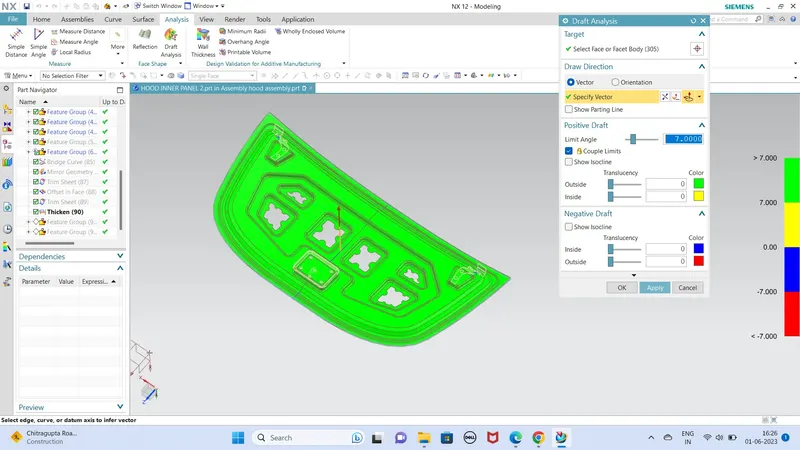
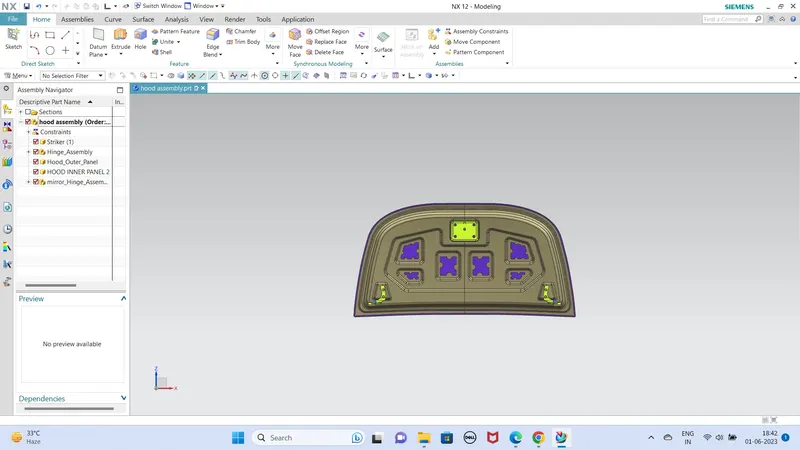
FRONT VIEW
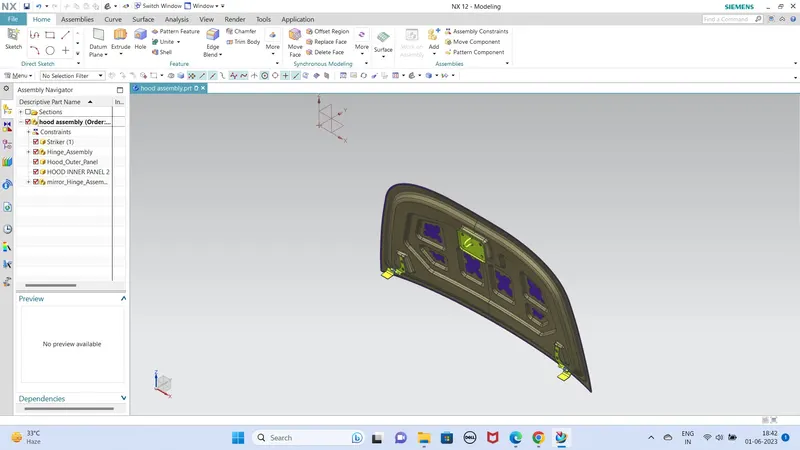
ISOMETRIC VIEW
LEFT SIDE VIEW
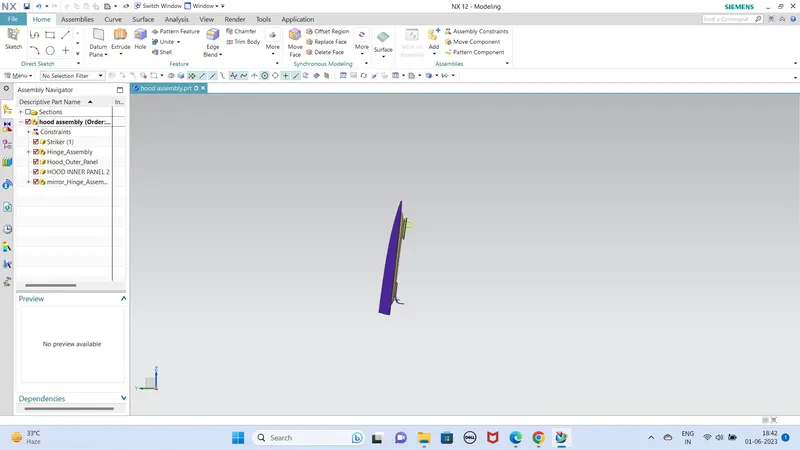
RIGHT SIDE VIEW
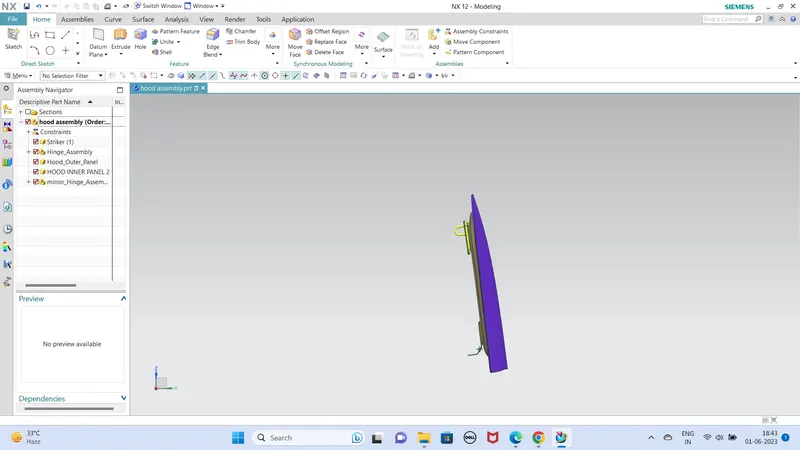
TOP VIEW
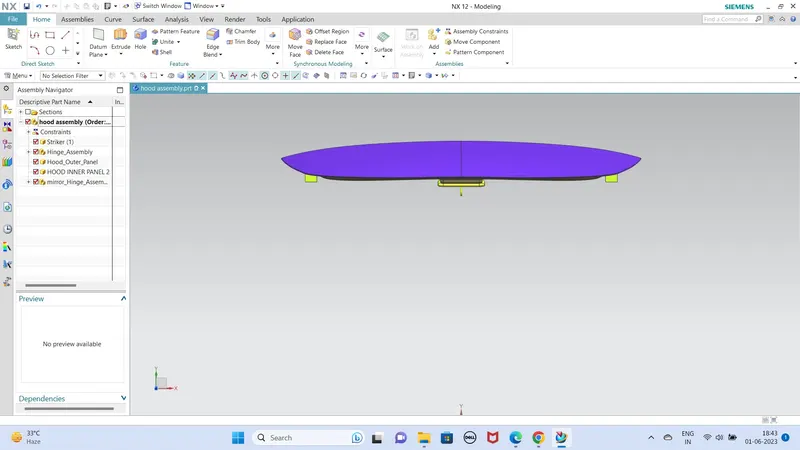
BOTTOM VIEW
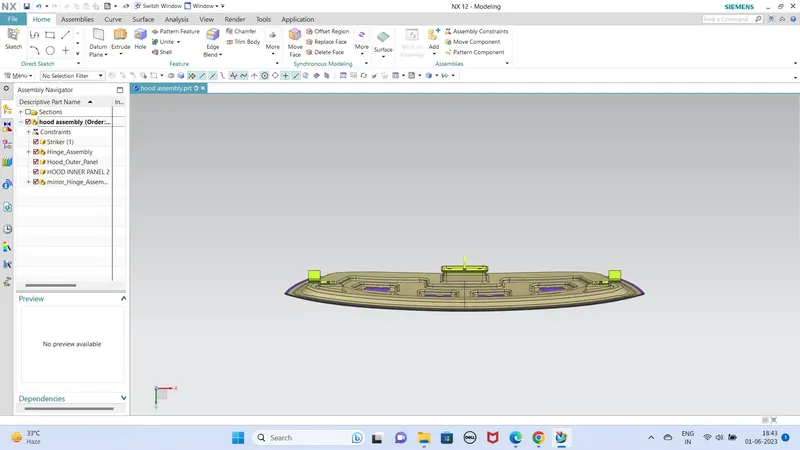
BACK VIEW