Hood design-Week 2
AIM : Design Hood Outer Panel, Inner Panel and the necessary reinforcements by following the Master Section mentioned with the Design parameters.
what is a car hood ?
A car hood, also referred to as a “bonnet” in some countries, is the hinged cover that rests over the engine bay of a front-engine vehicle. The car hood protects the engine and connected parts from the elements while providing easy access for repairs and maintenance.Car hoods are typically constructed from steel and sometimes from aluminum. Aftermarket car hoods may be constructed from various other materials, including carbon fiber, fiberglass, or dry carbon.
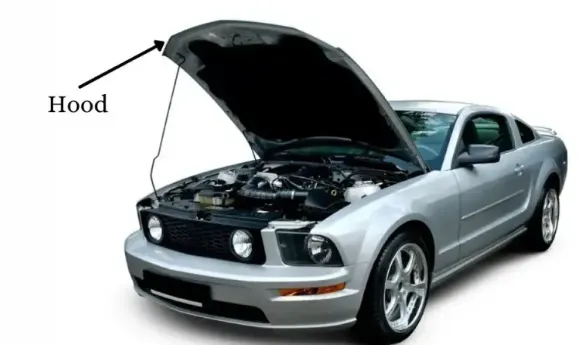
A concealed latch is typically used to lock the hood in place while driving. A release for the mechanism can be accessed from the dash below the steering wheel. On race cars and vehicles with an aftermarket hood, exposed pins may be used to secure the car hood.Hoods sometimes contain a hood scoop or a power bulge to allow for greater engine capacity and airflow to increase the car’s performance output.
Design considerations :
hood head zone for lock and striker :
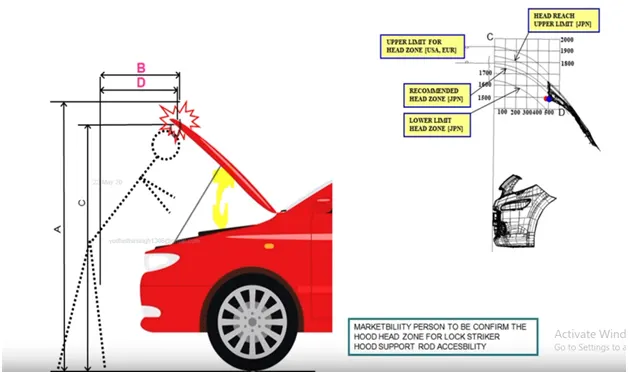
Head clearance zone is the clearance such that when the hood is in fully open condition it does not hurt the head of the person that is standing next to the hood . this is controlled by the opening angle of the hood . the opening angle of the hood is decided for the region the car is manufactured . some region may have people with average height of 5.5 ft and another region may have people with average height of 6 ft . so deciding the right opening angle for the hood is an important criteria.
hood stay :
A hood stay is an apparatus for an engine room of a car, which can safely keep an engine hood in an open state even if an external force is abruptly generated due to vibration, wind and can facilitate an opening/closing operation of the engine hood.
and its Purpose is , An automotive engine hood is arranged to be opened for the purposes of inspecting the engine room, replenishing cooling water and / or engine oil, changing parts, making repairs etc.
types of hood stay :
Support rod :
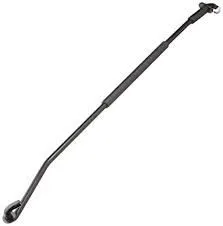
Support rod is usually inside the engine compartment , when we open the hood and keep it in open condition , one end of the support rod attaches to the hood and supports it . this support rod has to be fixed manually onto the hood . design of support rod is not linear but it should have some bends to increase the rigidity and strength of the rod . the support rod shoud be mounted such that it does not collided with other parts , also the support rod should be mounted on opposite side of battery to avoid interference with each other .
Gas stay :
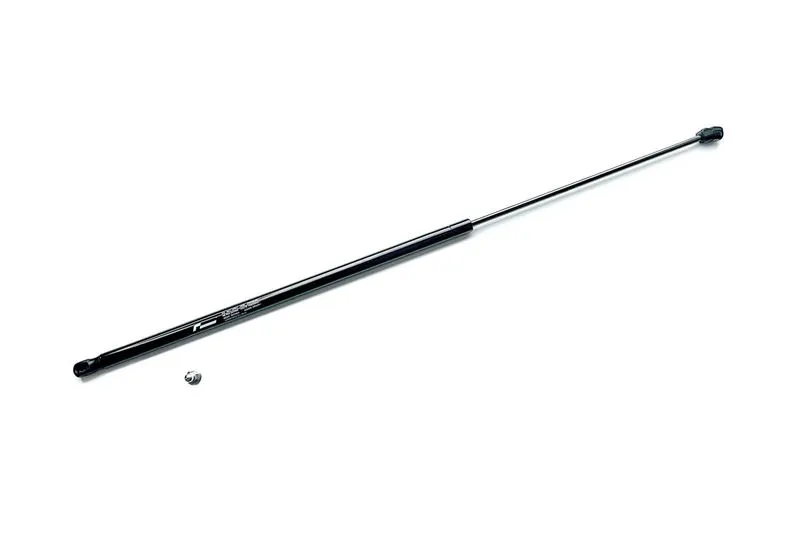
A gas stay is used to open the hood , keep it in a opened state and then closing the hood . this is a automatic process , that is the gas stay uses an actuator to open and close the hood . one side of gas stay is mounted on body side and other side is mounted on the hood . gas stay for the front hood are mainly used in high end performance cars .
Noise Vibration Harshness (NVH) :
Put simply, the noise is what you can hear, the vibration is what you can feel and the harshness is how much of an effect thumps, bumps, noise and vibration have on the cabin and its occupants.
Removing and isolating passengers from NVH is a field that's seen monumental advances over the past few decades. Originally the preserve of the most luxurious marques - and an acronym that was only even discussed by premium brands - NVH reduction is a global push, spurred on by consumers who want increasing insulation from the environment they're driving through. Perhaps to avoid the sound of other humans ROFLing.
Today, we even expect sporty convertibles to be NVH minimal.
This presents a quandary for engineers. Traditional sound and vibration-deadening material adds weight, which can spoil acceleration, handling and fuel economy, so they've had to come up with lighter and more effective methods than the traditional bit of tar paper.
In some cases, though, technology that offers a better drive can also offer a quieter ride. Unfortunately, it doesn't come cheaply.
Pedestrian safety :
Design should be such way that it should reduce the injuries to the pedestrians in the event of a pedestrian vehicle collision. The objective of these measures is to reduce the number of road accident fatalities and the severity of injuries sustained by pedestrians involved in a collision with a vehicle in urban traffic.
The height, weight and age of the pedestrian all play a role in the kinematics of the event and in his ability to survive. Most fatalities for the younger population are related to brain damage caused by head impact on the bonnet. For older people additional risks include rupture of arteries in the lower limbs and pelvis from bumper and bonnet leading edges.Impact frequency and seriousness of injury has been studied for many years, resulting in rating systems and improved design.
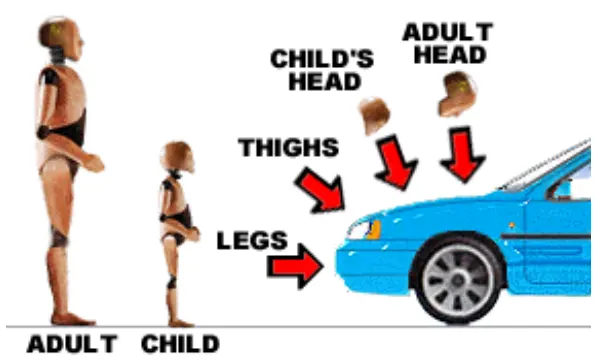
Evaluation of pedestrian safety for a bonnet must be carried out in the context of its surrounding elements like Vehicle styling, size (wrap around distance “WAD”) and under bonnet clearance to other elements (considered as hard points). Local bonnet stiffness is influenced by mounting point stiffness such as hinges, bump stops and latches. This is better understood by superimposing the kinematics of a dummy onto the test conditions.
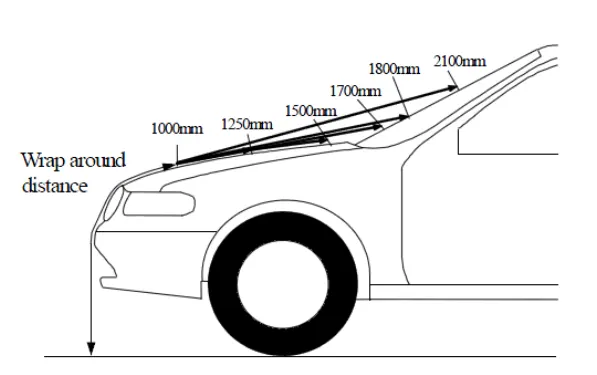
Wrap Around Distance (WAD) :- It is the geometrically traced distance from the contact point with the Ground Reference Plane, vertically below the front face of the bumper, to any point on the vehicle front structure.
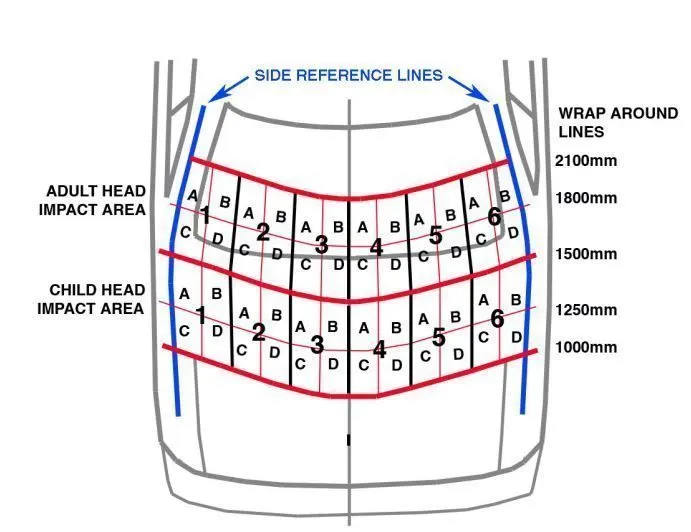
Side Reference line :- The geometric trace of the highest points of contact between a straight edge, held parallel to the lateral vertical plane of the vehicle and inclined 45 deg. is traversed down the side of the front structure, and the side of the front structure.
Child Head Impact Zone :- 1000 WAD to 1500 WAD
Adult Head Impact Zone :- 1500 WAD to 2100 WAD
hood creation :
given data :
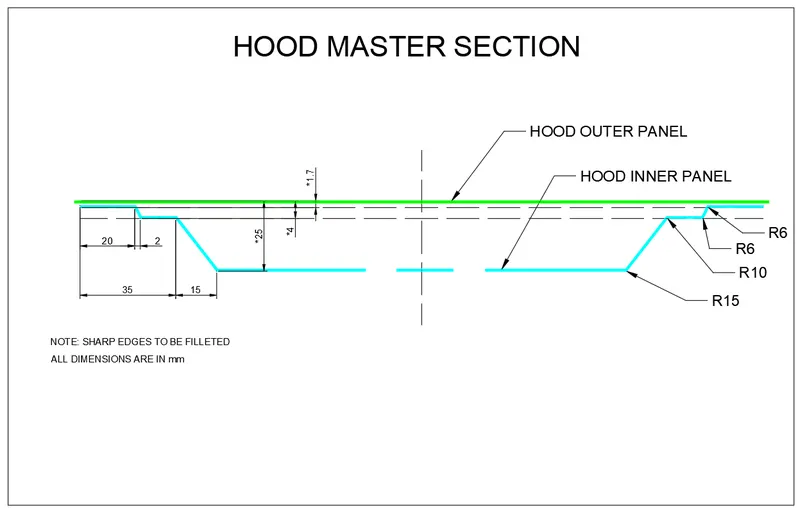
master section for hood creation :
Hemming Data :
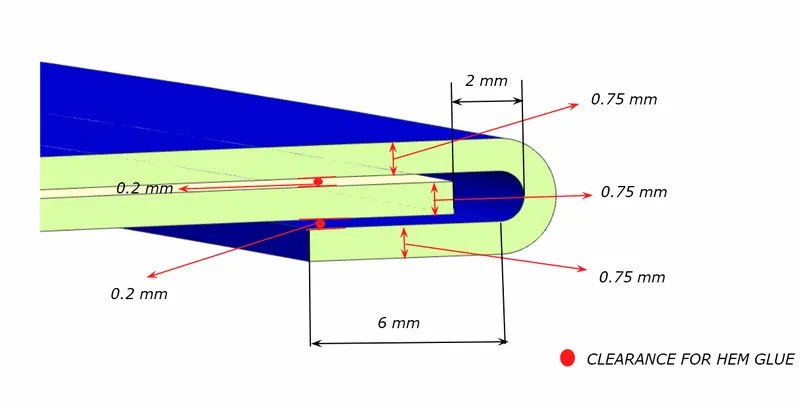
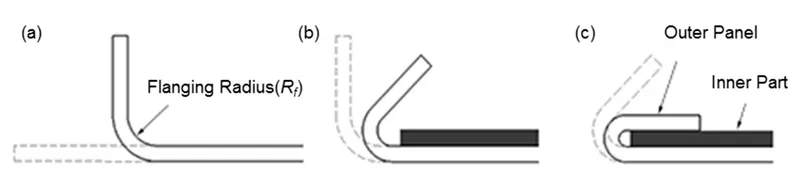
Hemming is a sheet metal forming process in which sheets are joined by bending it usually to 180°. Automotive body panels and automotive parts..
This assembly method is widely used in the final stages of production of automobile hoods, doors, or other closures for aesthetic purposes.
It is a metalworking process that involves rolling the edge of sheet metal over and onto itself, essentially creating an area of two layers. During this process, the edge of sheet metal is folded over. The two newly formed layers then lie flush with each other.
The typical three-step bending process of the hemming operation comprising of the flanging, pre-hemming, and final hemming process.
Deep Drawing
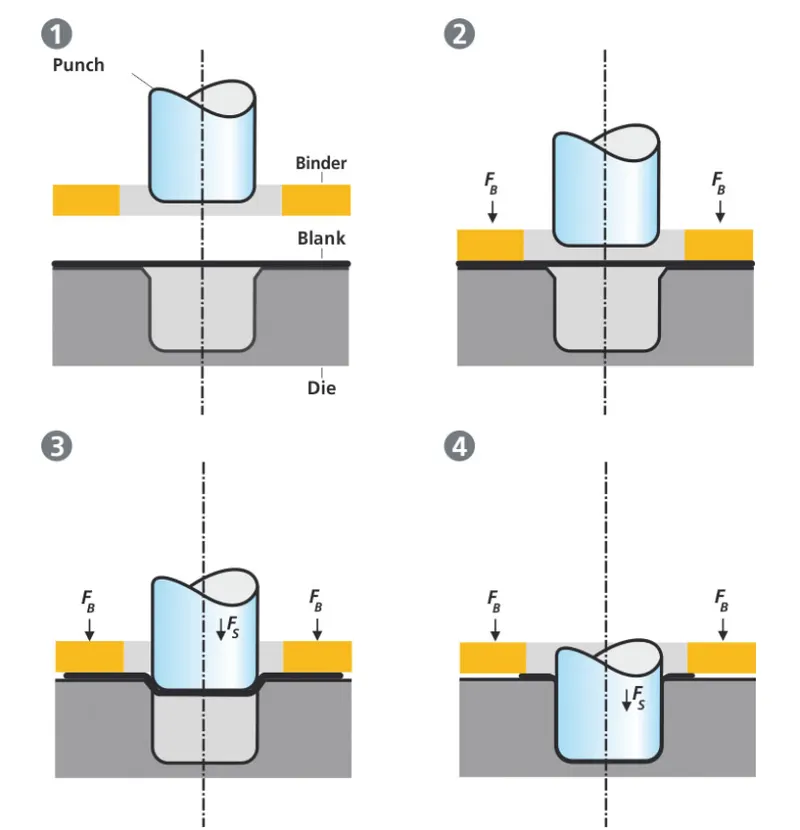
Deep drawing is a sheet metal forming process in which a sheet metal blank is radially drawn into a forming die by the mechanical action of a punch. It is thus a shape transformation process with material retention. The process is considered "deep" drawing when the depth of the drawn part exceeds its diameter. This is achieved by redrawing the part through a series of dies.
The flange region (sheet metal in the die shoulder area) experiences a radial drawing stress and a tangential compressive stress due to the material retention property. These compressive stresses (hoop stresses) result in flange wrinkles (wrinkles of the first order). Wrinkles can be prevented by using a blank holder, the function of which is to facilitate controlled material flow into the die radius. Deep drawing presses, especially in the Aerospace and Medical industries, require unparalleled accuracy and precision. Sheet hydroforming presses do complex draw work. Bed size, tonnage, stroke, speed, and more can be tailored to your specific draw forming application
Relief rear section :
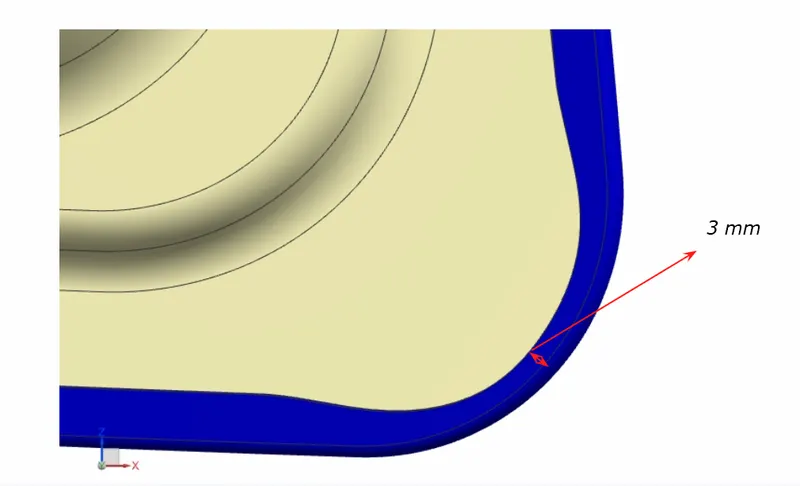
Front relief :
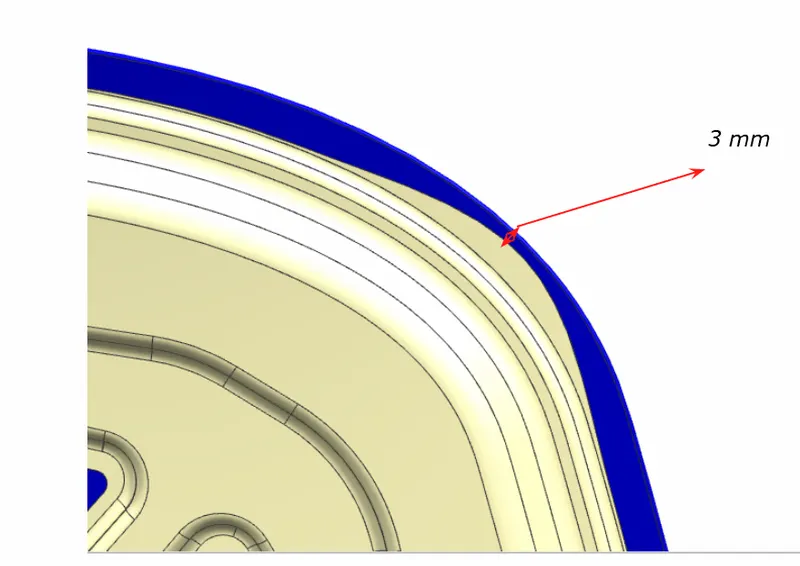
Hem Relief :
While performing hemming operation rollers rolls over the outer panel surface to create a hem.At the corner, the portion roller tends to roll the sheet in a nonuniform manner due to the presence of curvature.Hence it is necessary to provide some relief at corners.
provided surface :
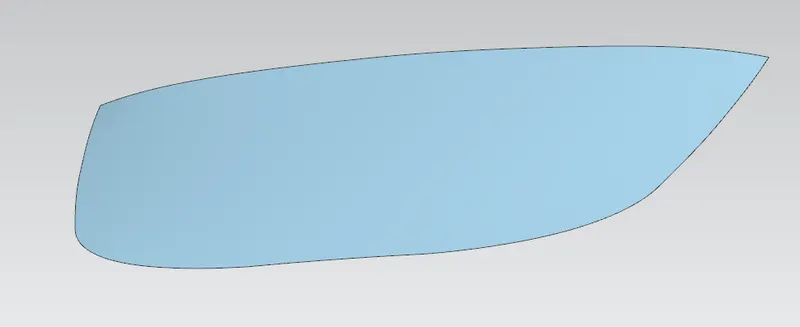
outer panel creation :
- insted of creating the wholoe outer panel at once we can create the half of it and using mirror geometry command we can create the outer panel.
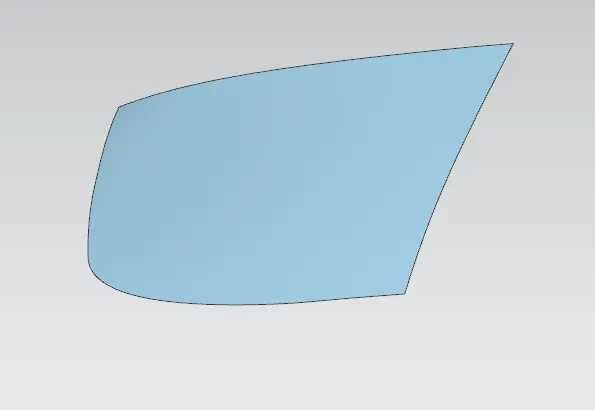
- splited the surface with the mid plane.
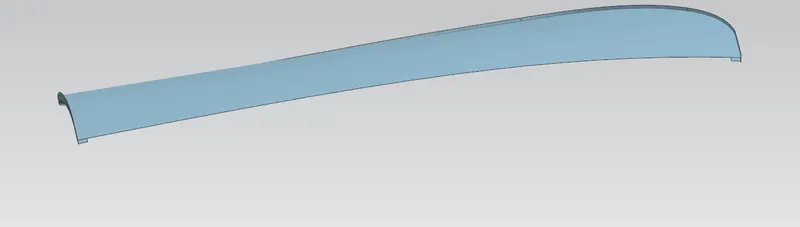
- using offset followed by trim followed by offset curve and law extention created these three surface.
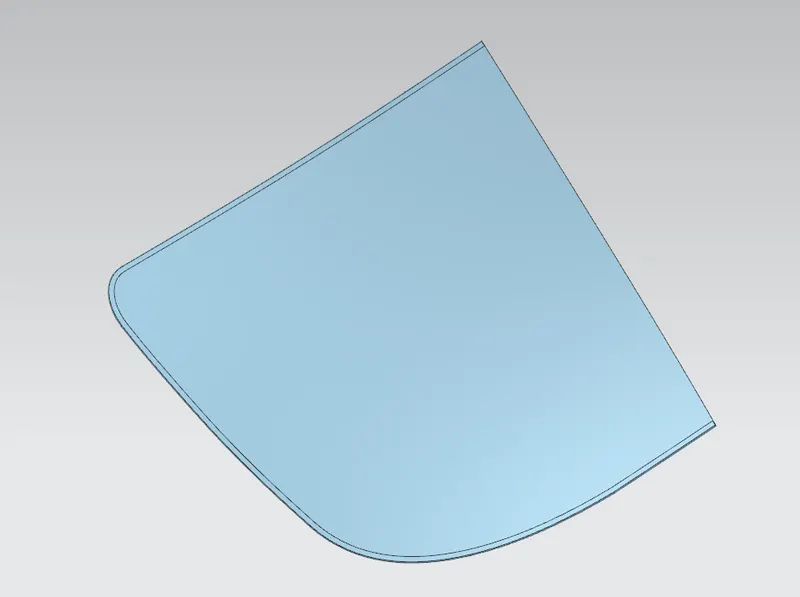
- used three face blend to achieve this surface.
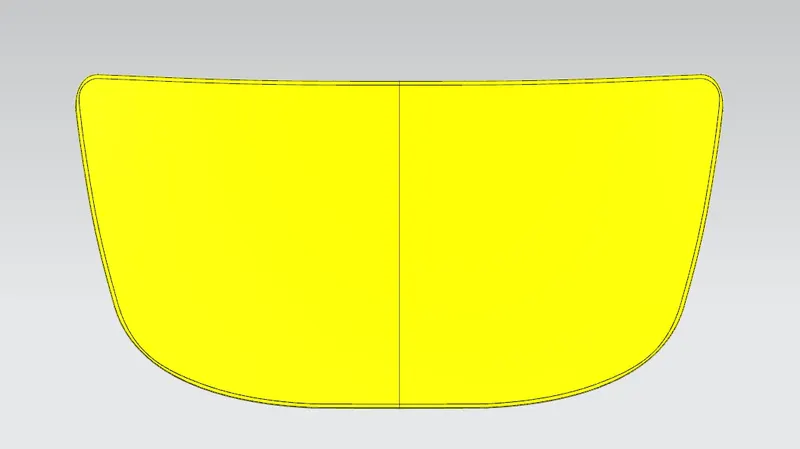
- created the reliefe using curve on surface then trimmed the portion , and finally mirrored the geometry and then thickened it for .75mm.
inner panel creation :
similar as outer panel , insted of creating the wholoe outer panel at once we can create the half of it and using mirror geometry command we can create the inner panel.
- splited the surface with the mid plane.
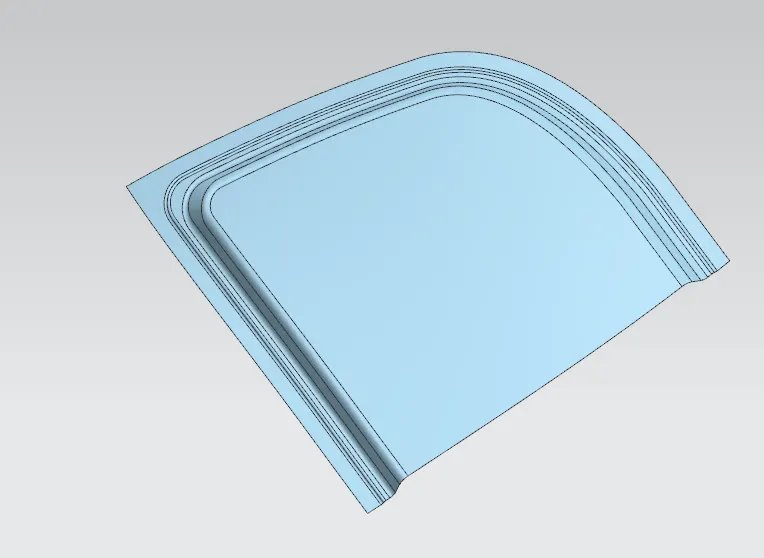
- as per thye master section , offseted the surfaces followed by trim operation , followed by sew and edge blend.
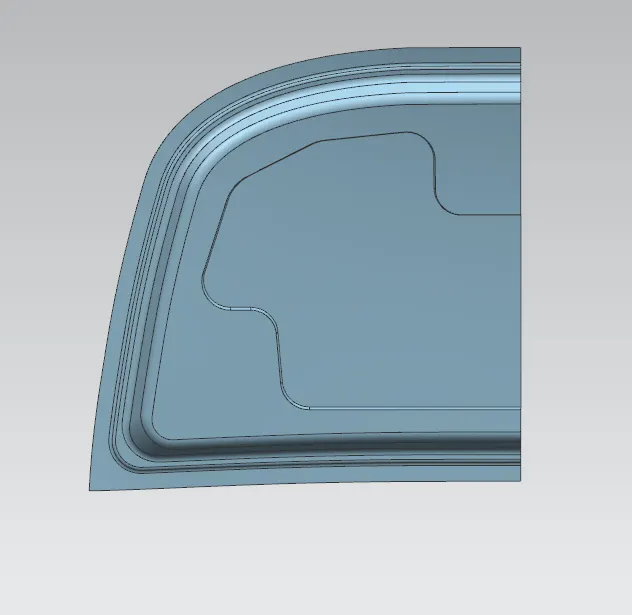
- considering the placement of hinge and srtiker , created a sketch for the big emboss and created the emboss using the emboss command.
emboss :
Sheet metal embossing is a stamping process for producing raised or sunken designs or relief in sheet metal. This process can be made by means of matched male and female roller dies or by passing sheet or a strip of metal between rolls of the desired pattern. It is often combined with foil stamping to create a shiny, 3D effect.
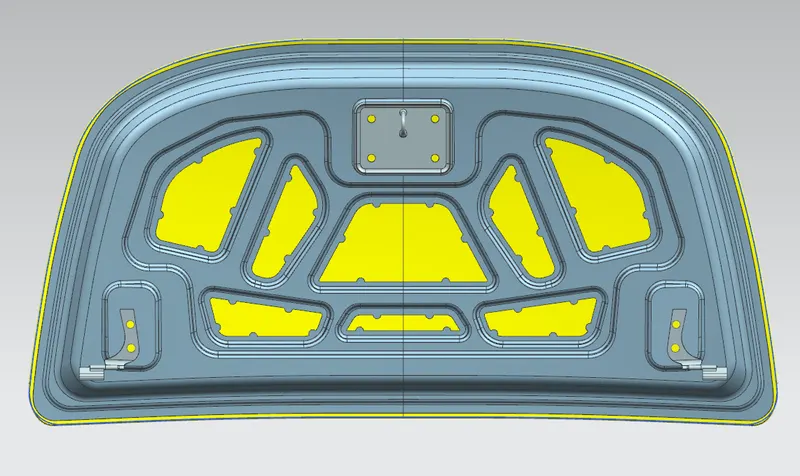
8 embosses were created onto the inner panel which is a type of circular slot. One triangular emboss was created in the middle of the inner panel.
The purpose of providing these embosses is to reduce the intensity of the front impact by diverging the forces into different directions rather than in the straight direction.
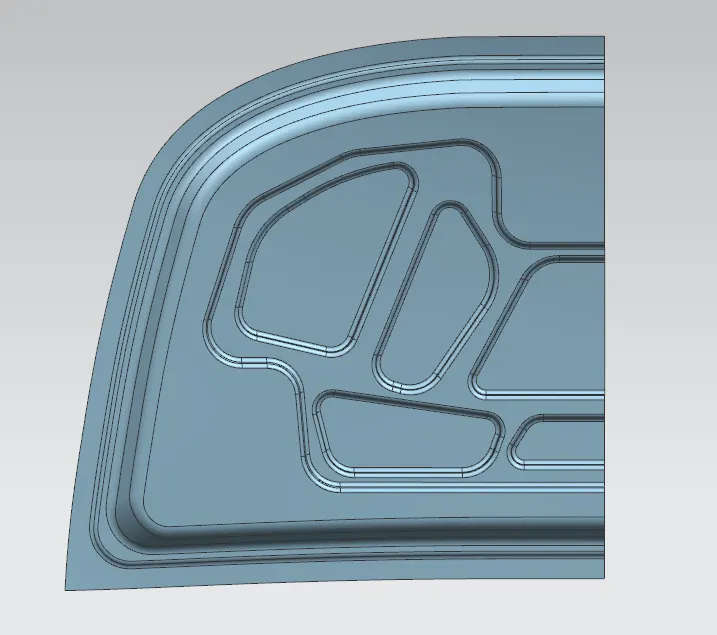
- similarly created the small embosses.
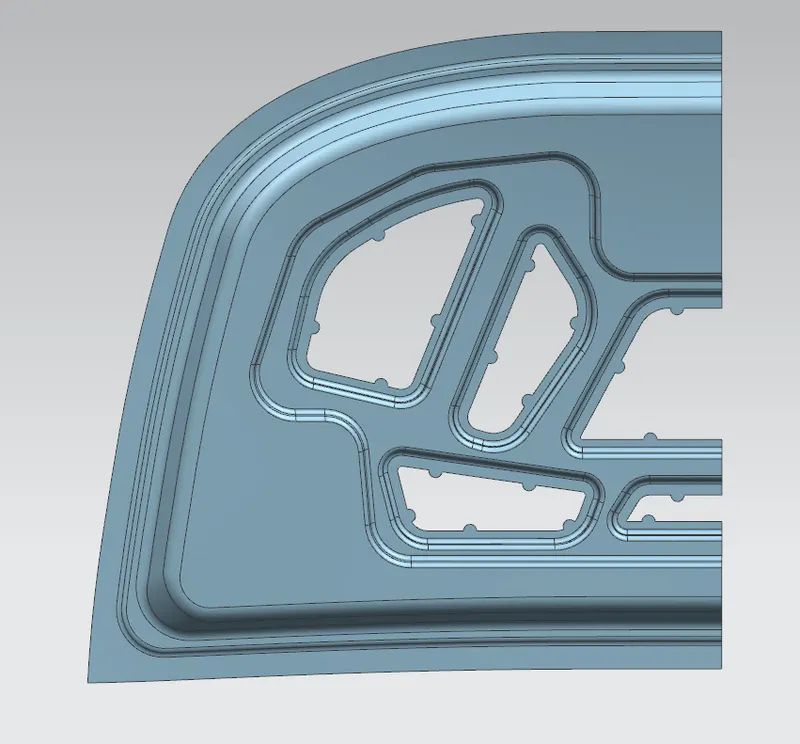
- created a sketch for the masticks and the cutouts and trimmed the sheet.
Mastic data :
Mastic sealants used between the outer and inner panel. mastic sealants are the rubber like elasic compound which connects the outer and inner panels of car hood at specified points. Mastic sealants are used in the region between the inner and outer panel because other joining process like welding or riveting are not good for car asthetic design. It also helps in improving NVH (Noise, vibration, and harshness) characteristics.
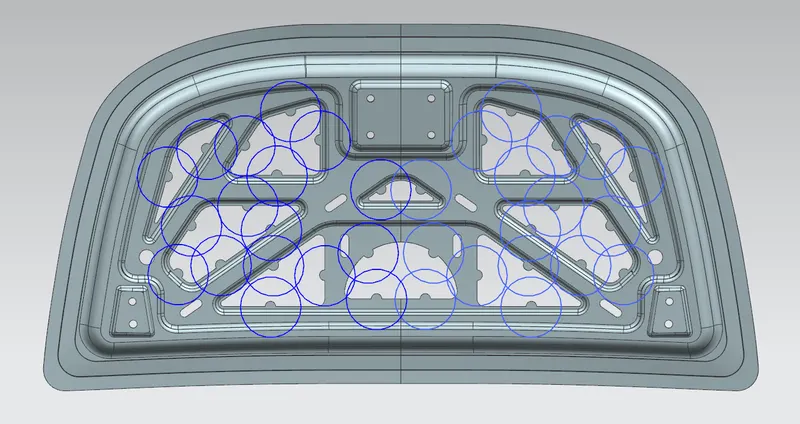
Mastic salant points are effective around a circular region of 80mm diameter.
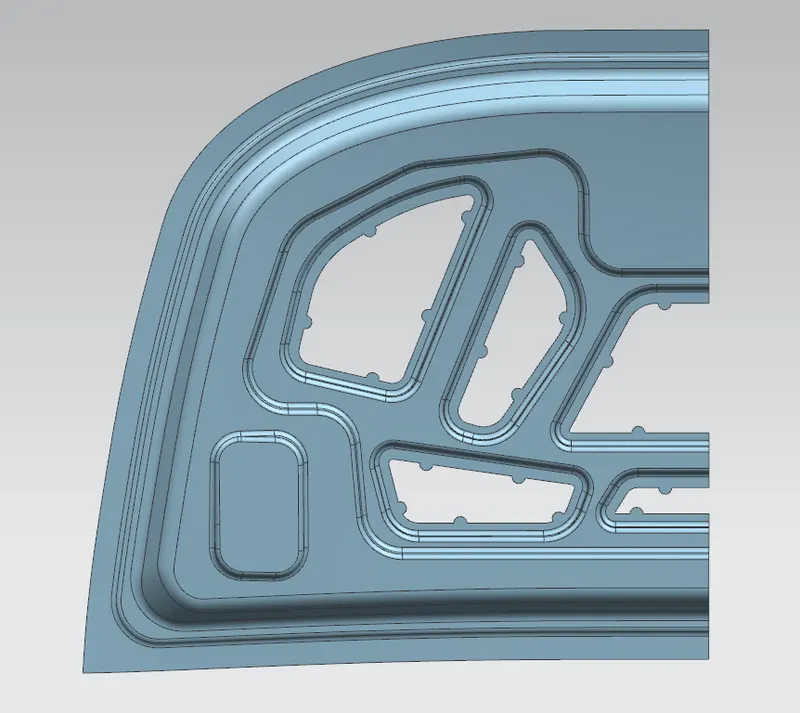
- for the hinge assembly , created another datum plane , because the hinge wont be able to attach with a curvy surface , for maximum contact area , created an emboss with flat surface.
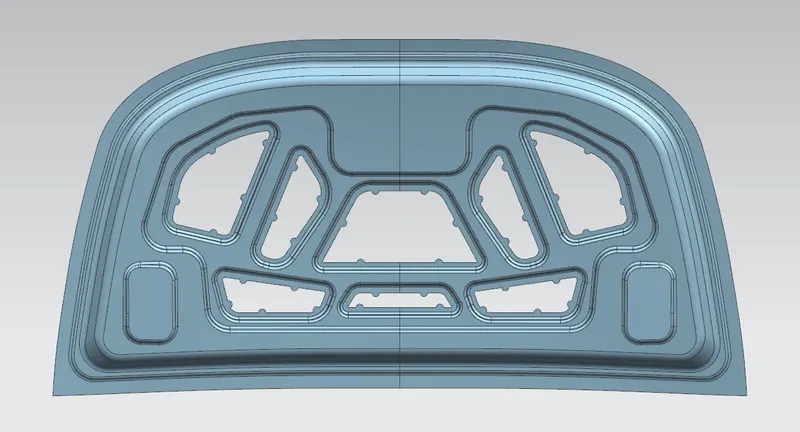
- mirrored the geometry and sewed the two surfaces.
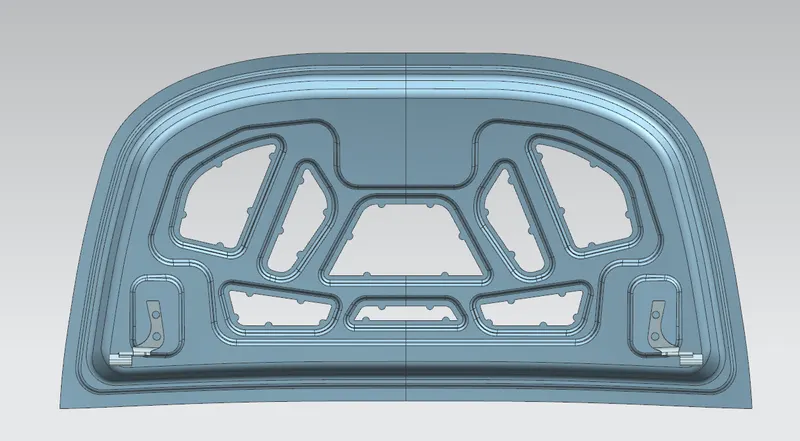
- attached the hinge assembly with contact and axis constrains.
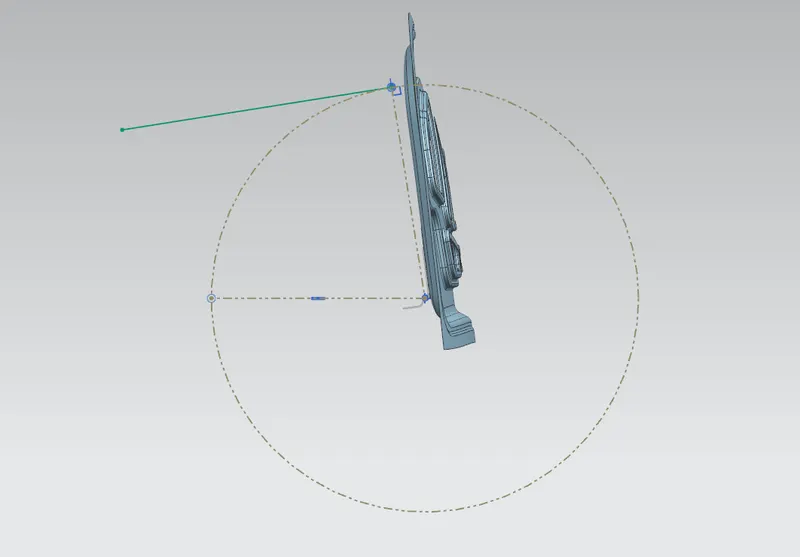
Latch Trajectory :
Circle is drawn from the hinge axis center so we can finalize the position of latch striker. For proper mating, the tip of the striker should be tangential to the latch trajectory. the position of latch striker follows the path of this circle.
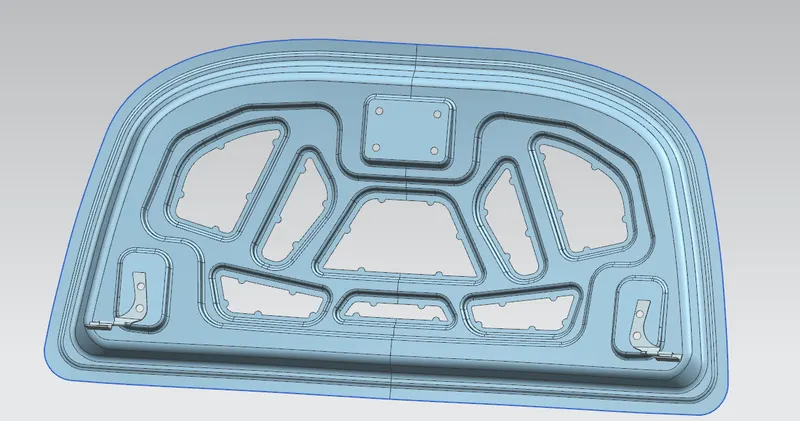
- created an emboss for the striker by taking the reference from the back side of the striker and using law extension and trim & extend.
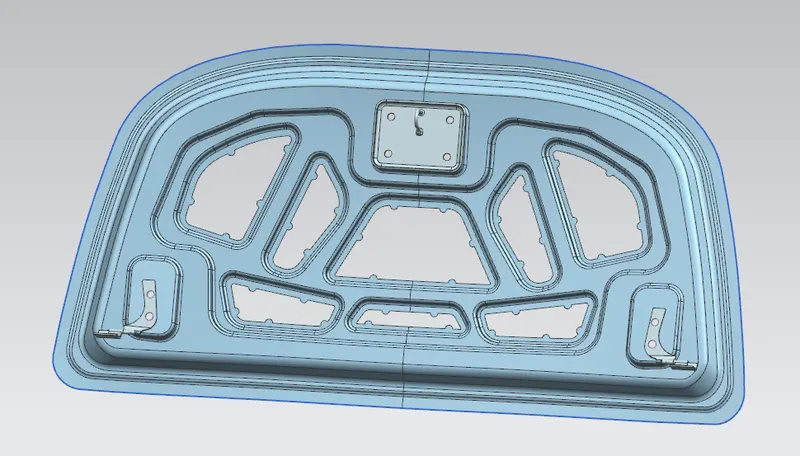
- attached the striker using contact and align and parallel constrains.
final result :