Hood design-Week 2
HOOD DESIGN USING CATIA V5
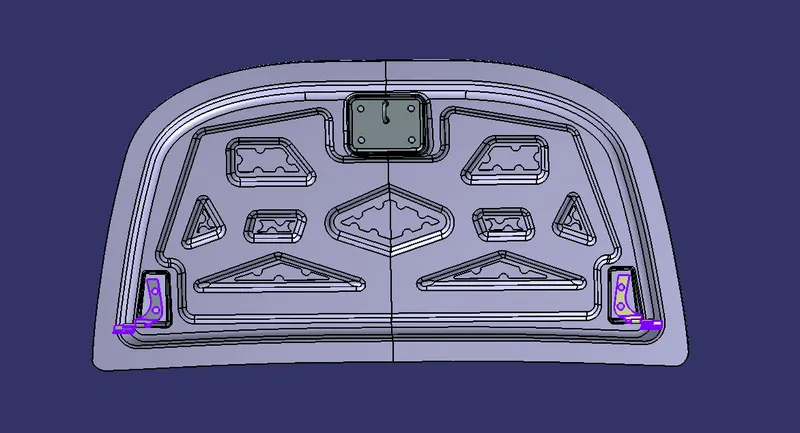
Objectives:
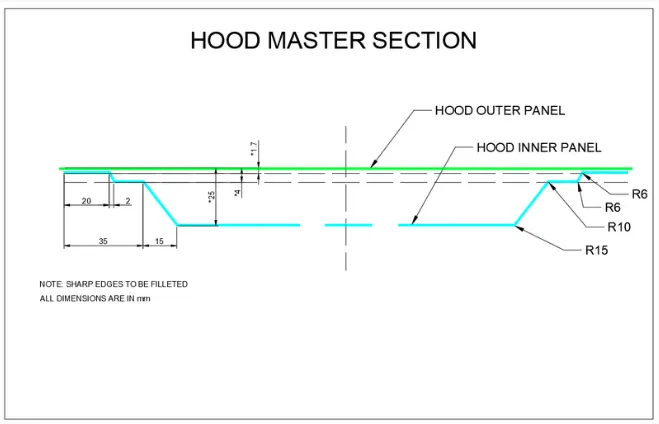
Design hood outer panel,inner panel and reinforcements with the given outer hood skinn,master section and design parameters.
HOOD:
Hood is the component which is placedn over the engine compartment. The design of the hood is not only to enchance the look of the car, It is also improves the aerodynamics of the car and the proper design which ensure the pedestrain safety.
For serciceability and maintanence of the car, hood is used to access the components like, engine, battery, etc.,
Over the period of the time, designers has continously improving the hood design inorder to minimize the injuries of the pedestrain when he/she hits the hood while accident occurs. So it depents upon the material design and structure of the hood.
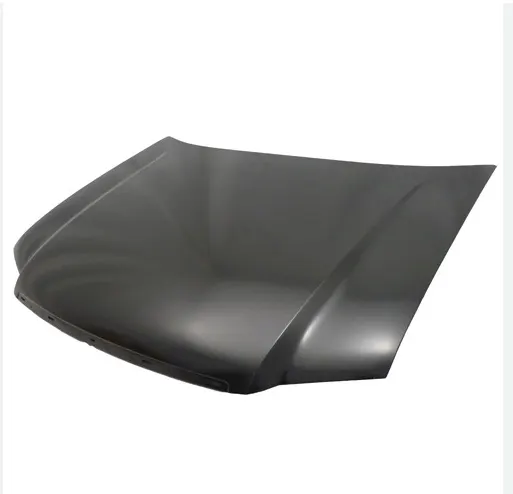
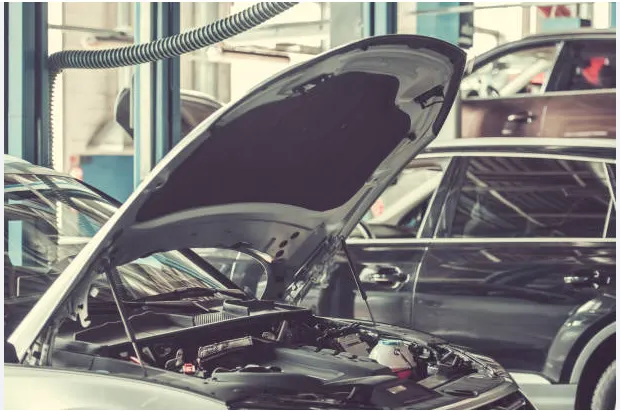
Car hood has the following components:
Outer Panel
Inner Panel
Striker and Hinge assembly
Reinforcement
Hood Support
Mastic's.
Hood has designed by the process by using the following sheet metal Operations:
Hemming
Embossing
Deep drawing
Piercing
Design parameters:
Hood thickness information
Outer panel thickness = 0.75mm
Inner panel thickness = 0.75mm
Reinforcement thickness = 1.5mm
Master section:
Car Hood Components:
1. Outer panel
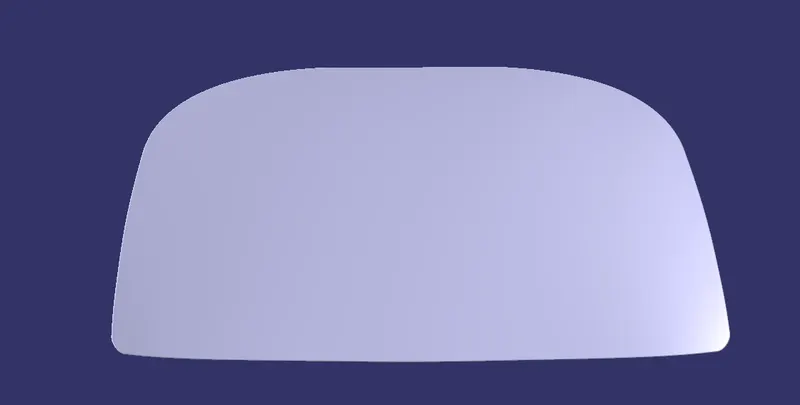
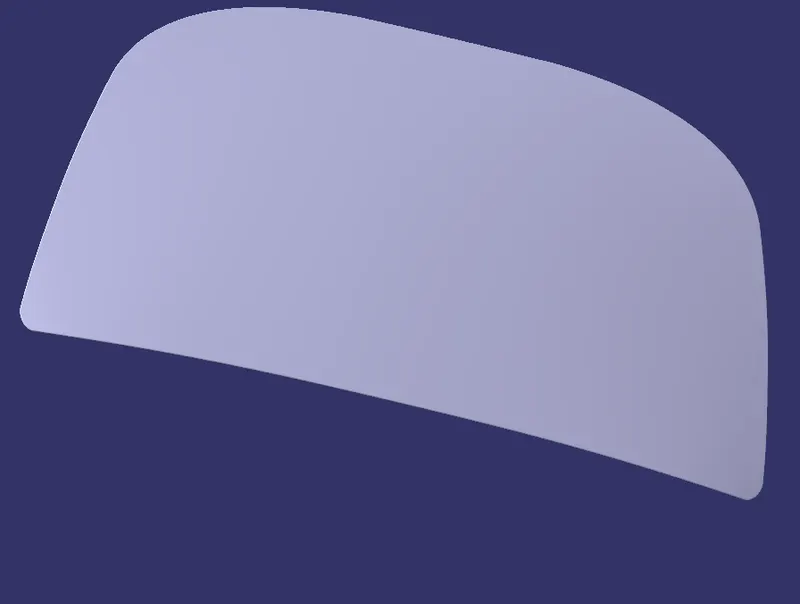
Outer panel is the most important part of the hood to makes the car in a very good aesthetic proption. So that the outer panel is perfectly made insense to achieve the aesthatic requirement. So that, the sheet metal operation results which is visible on the outer panel or it reduces the aesthatic value means, those operations are strictly no to be followed tp make the outer panel. That's why the hemming process is used to join the outer panel with the inner panel, instead of using welding meyhods.
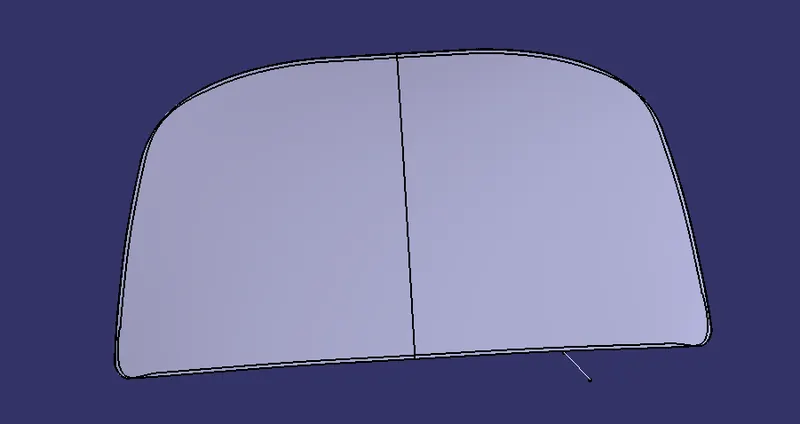
By considering the given Outer Panle thickness (0.75mm) and using outer panel styling surface the outer panel has been made as below,
2. Inner Panel:
Inner plane is the major part that ensures the rigidity of the hood and it is used to delives the impact to outwards of the hood however possible when the collision occurs. It is can be acheived by the good inner panel design and the emboss direction in the inner panel.
Lot of the design changes and researches are done and being carried out in the inner panel only to achieve the pedestrain safety and the passengers safety abd the passengers safety.
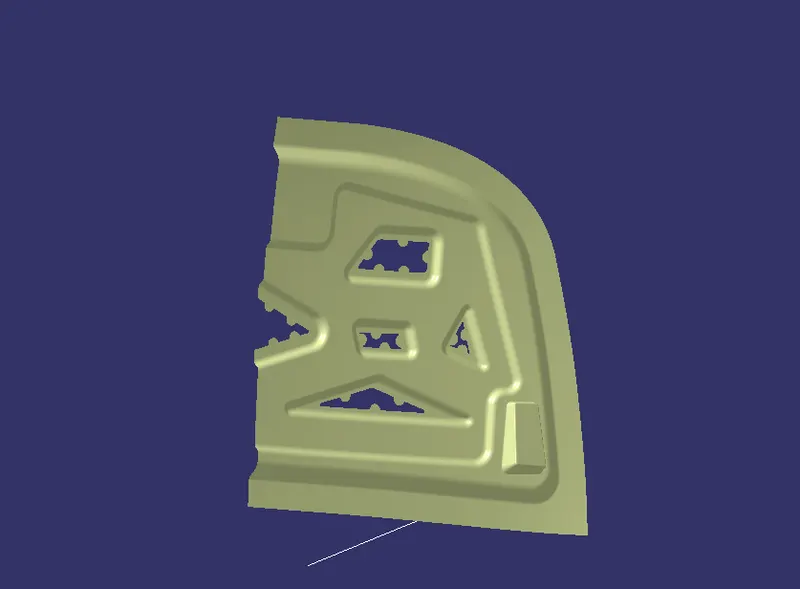
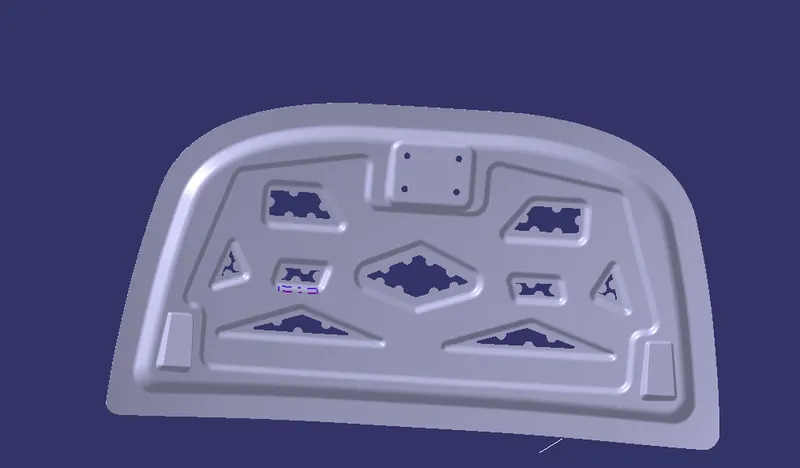
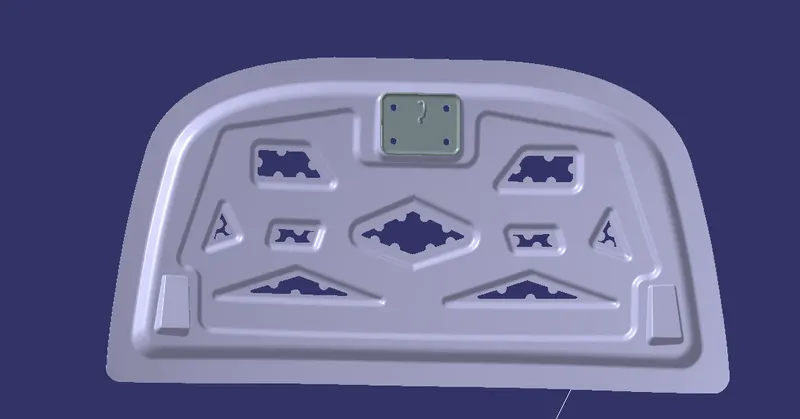
In this inner panel, the required holes are made to transport the hood from one station to other and fix the hood in fixtures by using this hole as building holes. As the inner panel has the embosses and mastic points.
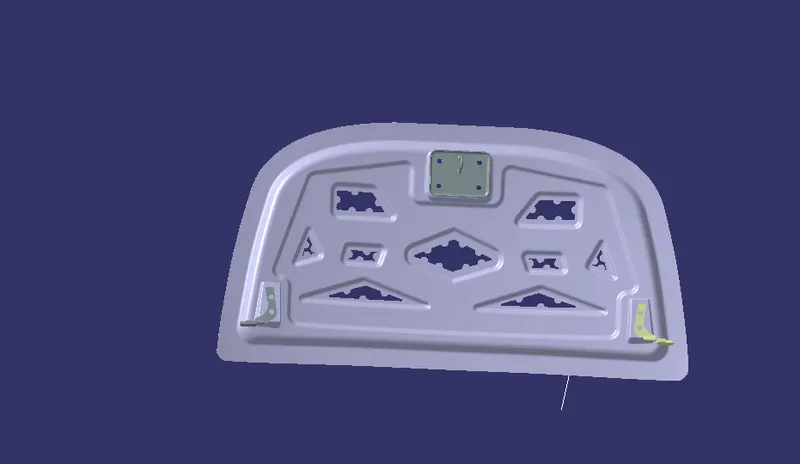
By considering the given Inner Panel thickness (0.75mm) and offseting the outer panel styling surface with the given offset data,the inner panel has been made with the embosses and mastic points as below.
3.Reinforcement:
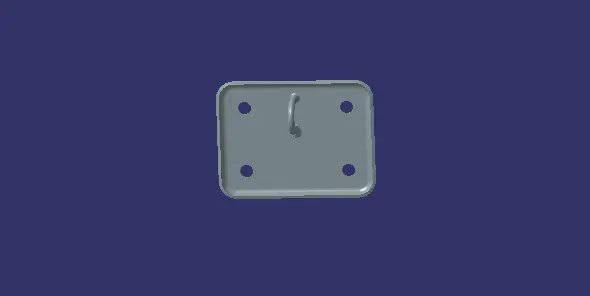
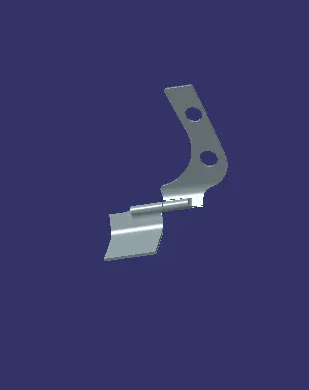
The Strikes and Hinges are attached at the lower side of the inner paned. If it can be done by directly then more stress can act at the particulr area in the iner pabnle,it may cause deformation of the inner panel at the particular region. So that the reinforcement comes in and placed area in the inner panel, it may cause deformation of the inne panel at the particular region. So that the reinfrocement comes in and placed between the striker and the hood, hinge and the hood. It can able to reduce to deformation and strengthening the inner panel at that particular region.
According to the design requirement here it is given 1.5mm thickness to both hinge and latch reinforcements.
Striker-Latch and Hinge Assembly :
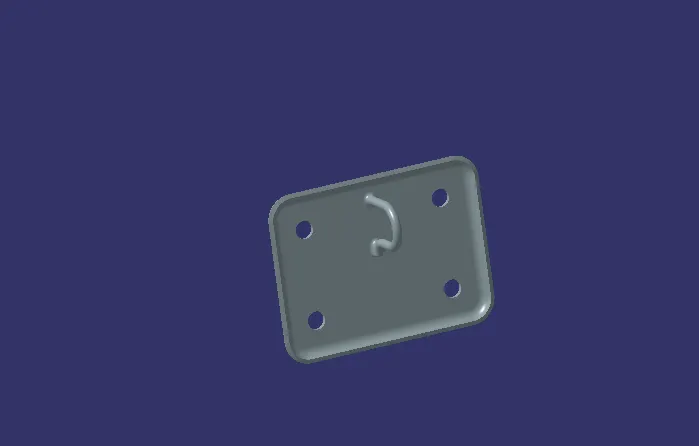
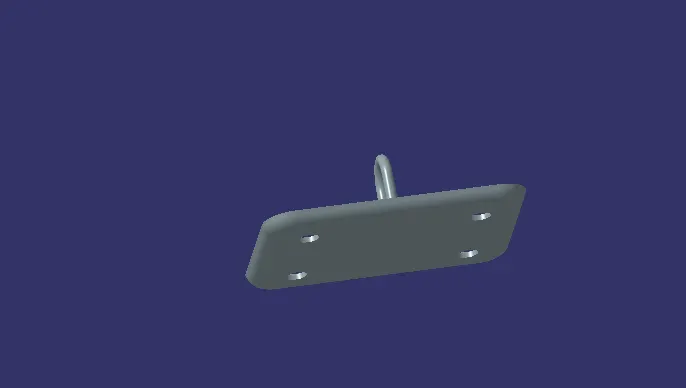
Striker-Latch
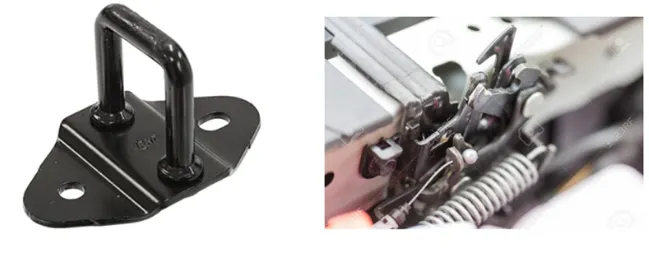
Striker is the part which is used to hold the hood with the engine compartment by using the latch which it is the engine compartment, when the hood not required to open up. The striker is attached to the bottom of the inner panel and it hits the latch and locked with it, when the hood is dropped down.
There is lever which is provided inside the cabin to the driver to release the latch pressure. Once it can be done, the hood will opens up in a inch, then we can able to open the hood.
Hinge Assembly:
It is used to fix the hood to the engine compartment.
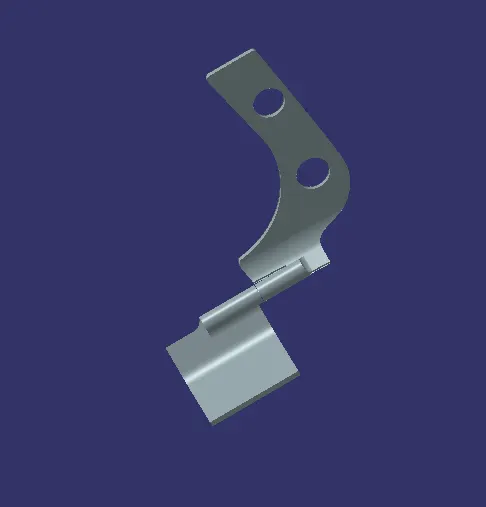
For any components has to be open and close with an axis, then hinge plays a major role. It has two simple parts (one is hood side hinge, another one is engine compartment side hinge) and assembled with the side single axis.
Hinge Assembly is attached at the each outwards end of the hood and the engine compartment.
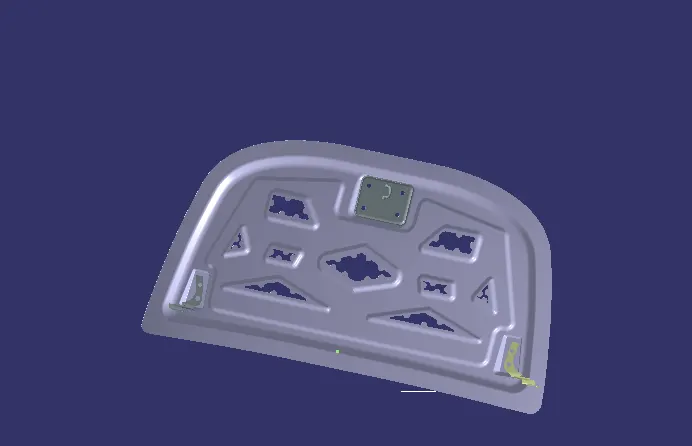
Position of Striker and Hinge Assembly
The attachment of the inner panel of the hood is done by following the certain steps.
For that initially the hinge is roughly attached/assembled to the each outwards end of the innert panel through the hinge reinforcement.
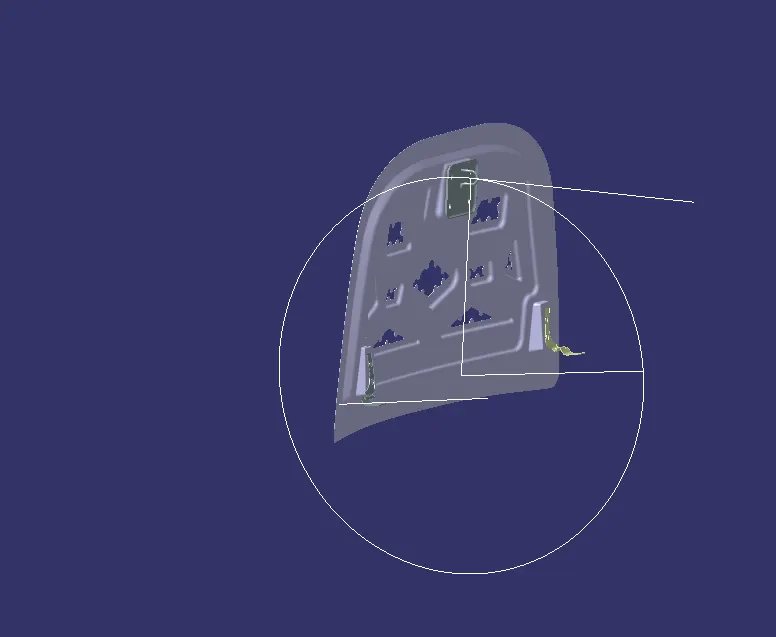
A circle is created at the midpoint of that line and another line is created tangent to this circle and then the reference line has created within the circle with particular angle. After that based on the required striker position the circle diameter and the hinge angle has been changed. Also an another line has been created parallel to the striker hook from the striking point of the striker.
Then the assemble the both lines and striker to the inner panel through striker reinforcement using the assembly constrain.
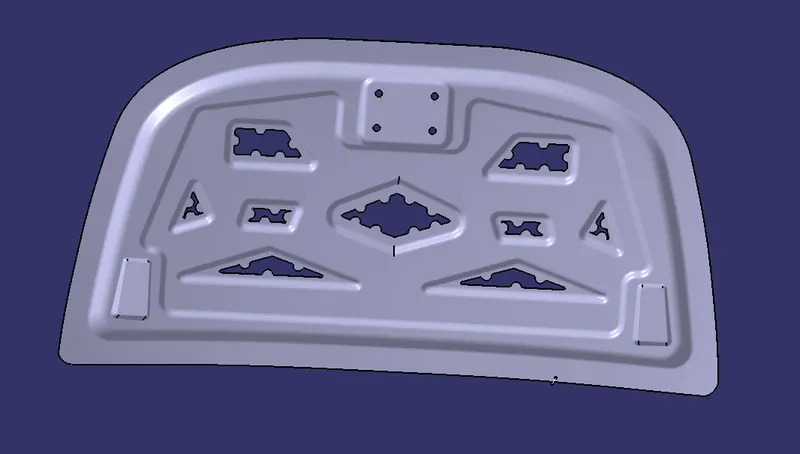
Emboss definition:
Throughout the inner panel we provide different embosses. We can increase the stiffness of the inner panel through these embosses. The shape and size of the embosses also determines the direction of the force distribution resulted from frontal collision. The force should be always distributed away from the passengers. Here in the figure the embosses are designed in such a way that the force is directed to either sides of the car.
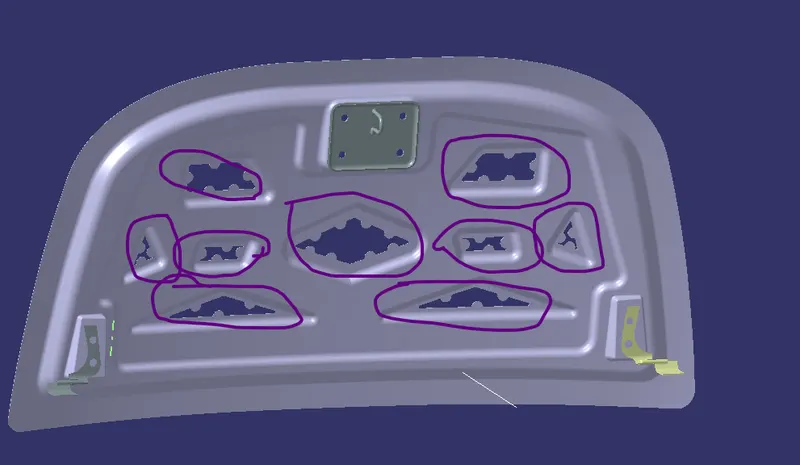
Mastic Data:
Hood commonly possess large surface area and hemming can only be provided through its boundary. We cannot use other joining techniques like welding, riveting etc because they leave marks on the outer panel which spoil its aesthetic appearance. So, mastic sealants are used to stick the inner surfaces of outer panel and inner panel. Mastic sealants are elastic compound that behave like rubber. It is applied between the inner and outer panels at specified spots. Each spot of mastic sealants has its effect around a circular region of 80mm diameter. Thus, the mastic points are arranged in such a way that it covers the areas away from the hemming which are more vulnerable to vibrate.
Deep Drawing:
Deep drawing is one of the most widely used processes in sheet metal forming. Apart from its use in many other sectors, it is applied in the automotive industry for the manufacturing of car body parts. The deep drawing process is a forming process which occurs under a combination of tensile and compressive conditions.
Sheet metal blank is radially drawn into a forming die by the mechanical action of a punch. It is thus a shape transformation process with material retention. The process is considered "deep" drawing when the depth of the drawn part exceeds its diameter. This is achieved by redrawing the part through a series of dies. The flange region (sheet metal in the die shoulder area) experiences a radial drawing stress and a tangential compressive stress due to the material retention property. These compressive stresses (hoop stresses) result in flange wrinkles. Wrinkles can be prevented by using a blank holder, the function of which is to facilitate controlled material flow into the die radius.
Hemming:
- Hemming is used to fit the parts togather. It can be done by the edges of one part is to be folded over the other part to fix within it. This operation is done by using the roller.
- Hoods, Doors, Boot lids of the automobile components are made by the hemming operation.
- There are two types of hemming process are there,
Conventional die hemming _ In this method the hemming process is done by using the hemming die to fold the sheet metal edges by the entire lenght.
Roll Hemming - In this method rollers are used to done the process and at the same time two rollers are fold the sheet metal from the different locations of the sheet metal edges to achieve the hemming which is close to accurate.Most of the automobile manufacturer are following the Roll hemming method due to its easier method when compare to the conventional die hemming.
- In hood, the outer panel is siubjected to the hemming operation which means that the outer panel edges is folded and roll it back to the underneath of the inner panel. The corner of the outer panel edge has to be trimmed, because while hemming process the roller transfer pressure to the outer panel edge to fold it and roll it back, so that it may cause the problem that the sheet metal may be break.
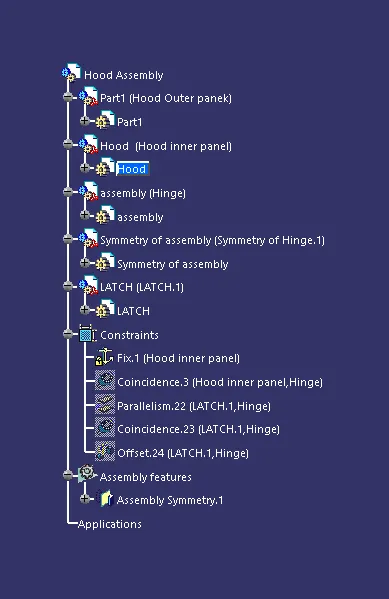
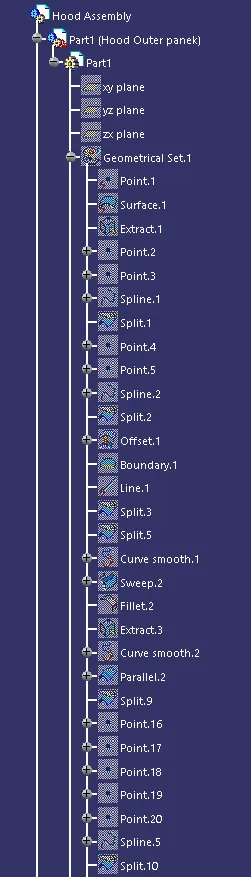
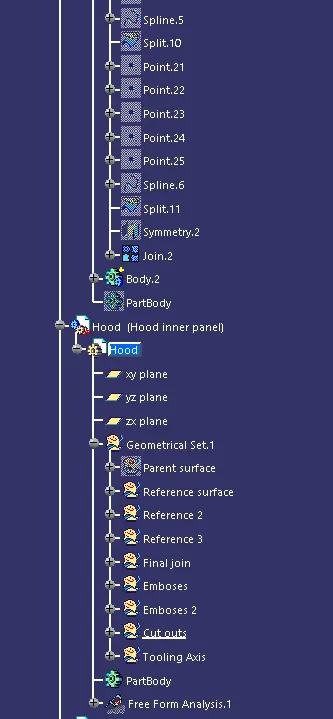
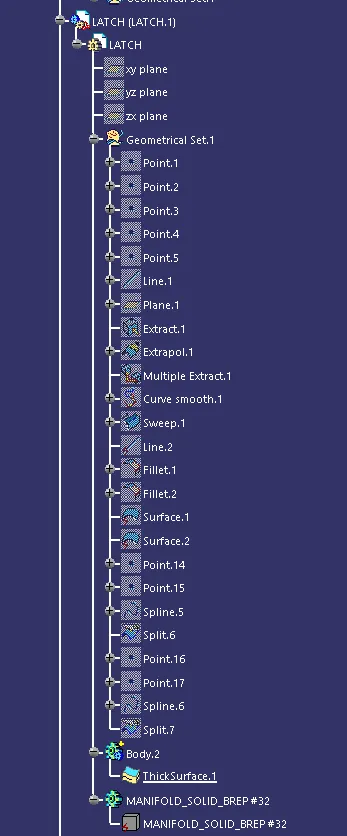
Tree Structure:
Final Assembly:
Conclusion:
Finally, the hood design has been completed by considering the criteria, dimentions, procedures and standards. By process of this design, have learnt about the hood mountings, sheet metal operations like hemming,embossing, deep drawing, Pedestrain safety and its ratings.