Hood design-Week 2
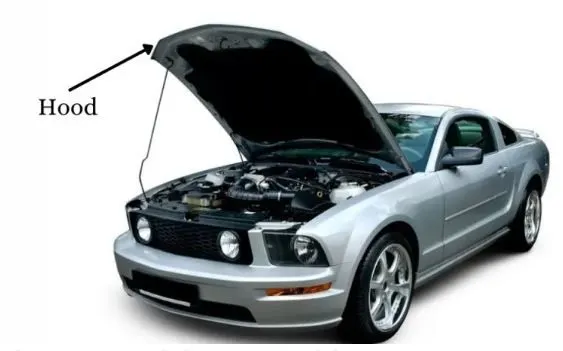
The hood of a car also known as a bonnet in some countries is basically a thin sheets assembly which rests over the engine compartment of a front engine vehicle. Its purpose is to protect the engine from dust and water. It is hinged from one side which helps us to reach the engine if required when a breakdown or in maintenance. It is made up of various materials mainly the hood or bonnet is made up of steel, other materials used are aluminium, carbon fibre and fibreglass to reduce the weight of a vehicle.
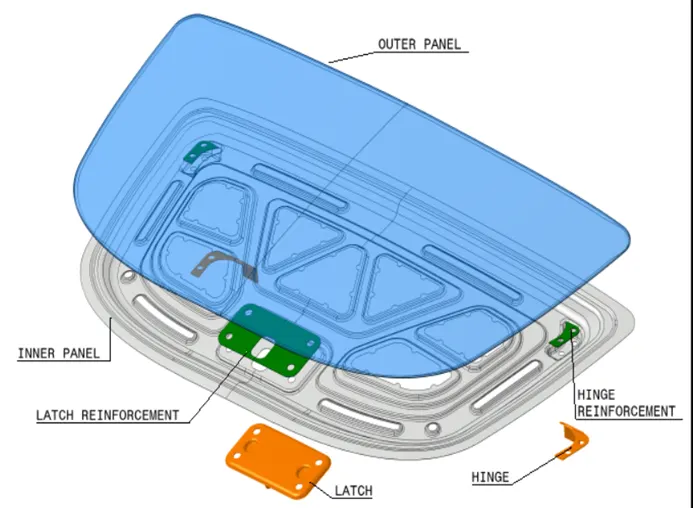
Hood assembly consists of various parts they are
- Hood outer panel
- Hood inner panel
- Latch and Striker assembly
- Hinge assembly
- Reinforcement sheet for hinge and striker assembly
- Hood stays
- Mastic pads
Details of Hood components-
- Hood outer panel- It is a sheet metal part which is usually visible to us when we see a hood or bonnet its thickness lies between 0.65 to 0.75mm.
- Hood inner panel- It is a sheet metal part which is made up of various manufacturing processes like embossing, deep drawing, blanking, hemming, etc. it gives strength to the hood and other components are assembled on the hood inner panels such as mastic pads, hinge assembly and latch and striker assembly.
- Latch and striker assembly- There are two latches present in a vehicle one is under the driver’s seat which partially unlocks and another is under the hood assembly which unlocks fully. And one striker is present to engage inside the latch.
- Hinge assembly- It enables us to open and close the hood assembly, it rotates about its own axis called the hinge axis.
- Reinforcement sheet for hinge and striker assembly- It is generally a piece of the sheet which is placed under the hinge and latch and striker assembly to provide stiffness or rigidity.
- Hood stays- It is used to keep the hood assembly in open condition to reach out to the engine compartment during repair or maintenance.
- Mastic Pads- These are generally of hard rubber material sealed between the hood's outer panel and the inner panel. It reduces the noise and vibration in the car.
Images show the hood assembly which is fixed in the car.
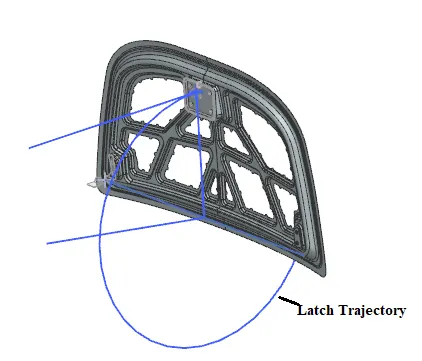
Latch Trajectory
It is the path at which the hood assembly opens and closes, it is generally used to view the placement of the latch and striker assembly. A circle is drawn from the centre of the hinge axis which must be perpendicular to the striker this will help to ease engagement and disengagement of assembly.
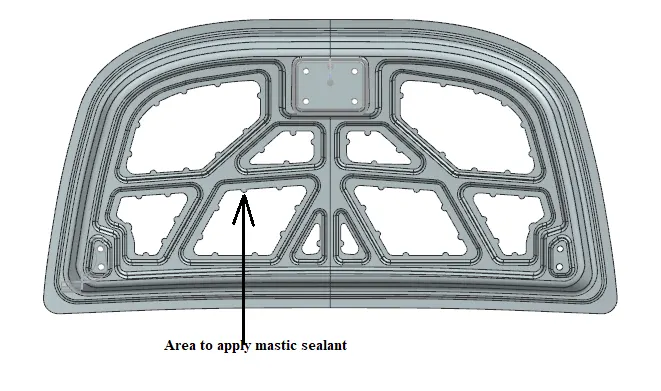
Mastic Data
These are generally of hard rubber material sealed between the hood's outer panel and the inner panel. It reduces the noise and vibration in the car. It oozes out and helps to hold the outer and inner panels together, it is placed in such a way that it covers the maximum area of the hood panel. It gives strength of around 80mm in the local area.
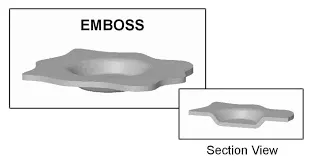
Emboss
Sheet metal embossing is a stamping process for producing raised or sunken designs or reliefs in sheet metal. This process can be made by means of matched male and female roller dies, or by passing a sheet or a strip of metal between rolls of the desired pattern.
Deep Drawing
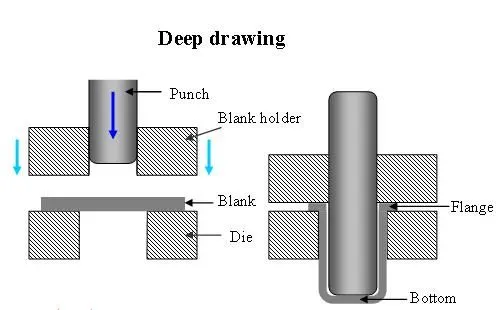
The deep drawing process is a forming process which occurs under a combination of tensile and compressive conditions. A flat sheet metal blank is formed into a hollow body open on one side or a hollow body is formed into a hollow body with a smaller cross-section.
Deep Drawing is carried out by using rigid tools in the automotive industry.
The image shows the process of deep drawing
It consists of Punch, blank holder, Die and blank.
The Blank holder holds the blank and then punches the blank in the vertically downward direction by using a punching press after which the blank and punch go inside the die to form the desired shape.
Hemming
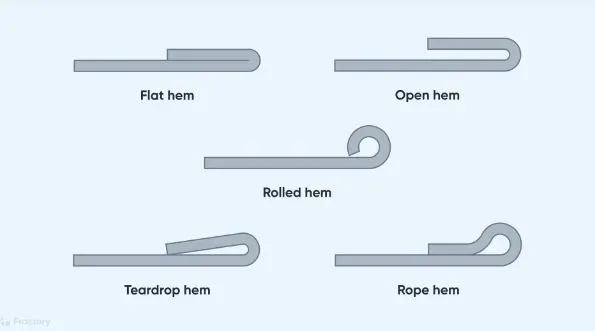
It is a manufacturing process of bending the sheet from the corners into itself. The hemming process is used to provide stiffness, hide sharp edges and connect two parts together. It is carried out in two stages; the first stage creates acute bends (V bends) using V tooling and dies and in the second stage flattening of the bent flange is carried out by using flattening tooling and dies. In hood assembly, an open hemming process is used to join the inner panel and an outer panel.
Hemming Types
- Flat or Closed Hem
- Open Hem
- Teardrop Hem
- Rope Hem
- Rolled Hem
Conclusion
By considering all the above-mentioned criteria the hood assembly is designed and is attached below.