Hood design-Week 2
Hood Design Challenge
Design hood outer panel, inner panel and reinforcements with the given outer hood skin, master section and design parameters.
- Introduction
The hood is the cover for the engine compartment of Automobiles. Hoods allows to access the engine compartment for maintenance and repair. In design perspective hood should meet some specific conditions like pedestrian safety, hood head zone for the lock striker, force distribution when subjected to occupant safety, manufacturability etc.
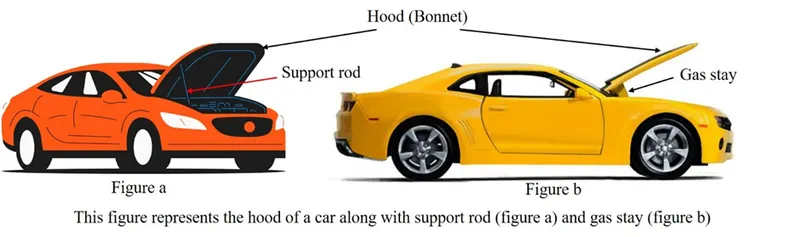
A hood assembly consist of Outer panel, Inner panel, striker and Latch, hinge Assy Hood Stay. The reason of opening the engine hood is for inspecting engine compartment, cooling water and engine oil, changing parts and repairing etc. Common types of hood stays are Support Rod and Gas Stay. Support rods are manually operated and they are cost effective and simple to design while Gas stay requires no manpower but they are costly. Hoods are typically made of the same material of the car body. This may include steel and aluminium. Deep drawing, hemming, blanking and piercing are the common sheet metal operations that are used in manufacturing hoods in Automotive Companies.
- Design Considrations
Outer Panel Thickness = 0.75mm
Inner Panel Thickness = 0.75mm
Reinforcement Thickness = 1.5mm
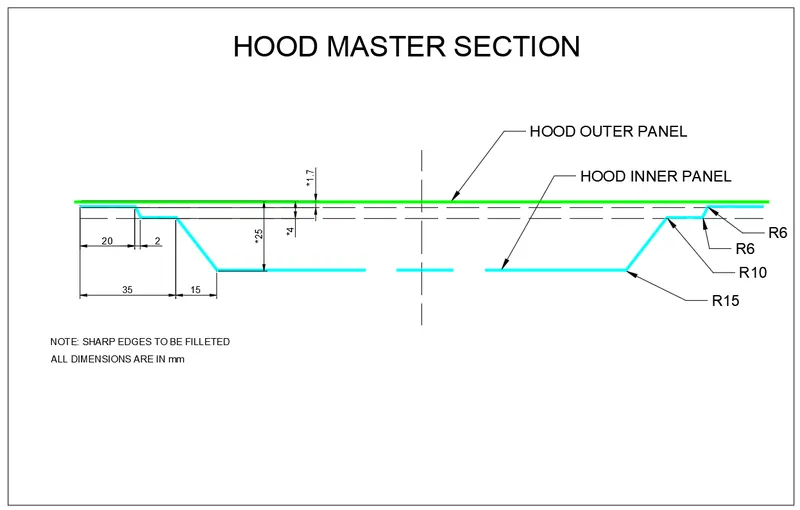
Master Section
-
Parts of a Hood
- Outer panel
- Inner panel
- Latch & sticker and its reinforcement
- Hinge & its reinforcement.
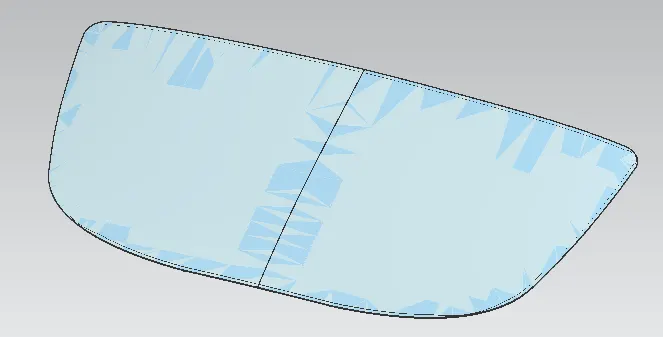
1.Hood outer panel
Outer panels are the aesthetic elements of a Vehicle.the styling team who gives the skin for the outer panel. The position ,shape and size of the hood should satisfy the safety parameter. So that while designing the hood we must provide importance to pedestrian safety. The outer panel is linked to the inner panel by hemming process becuase can not use welding aur riveting because of its aethestic look. So, it is necessary to provide required hemming flange and reliefs for the hemming operation. We also provide mastic data of sealants between outer panel and inner panel to reduce vibration.
2.Hood inner panel
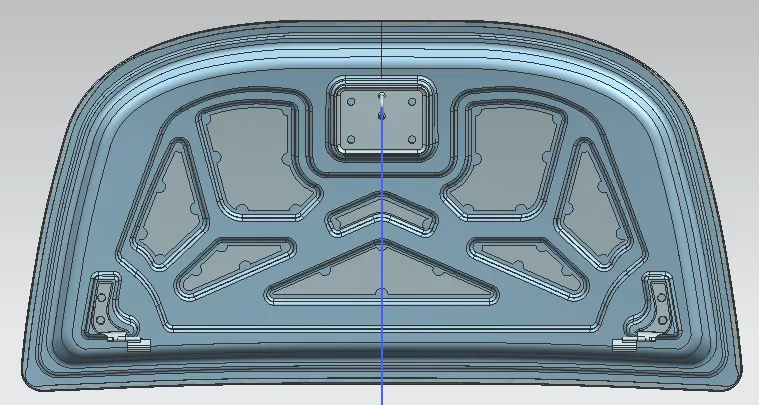
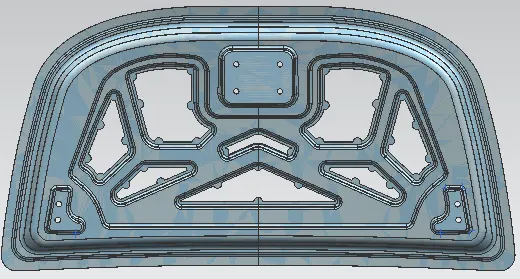
Inner panel is nothing but reinforcement for the outer panel. The master section indicates the initial emboss size and shape. Then we provide the emboss for the hinge and latch elements after fixing the location.
3.Reinforcement
Reinforcements are given as per to the design requirements. Mainly it is given at the hinge and latch areas to increase the strength. thickness of reinforcements will be higher than that of the inner panels and the value varies according to cost and requirement. According to the challenge it is given 1.5mm thickness to both hinge and latch reinforcements.
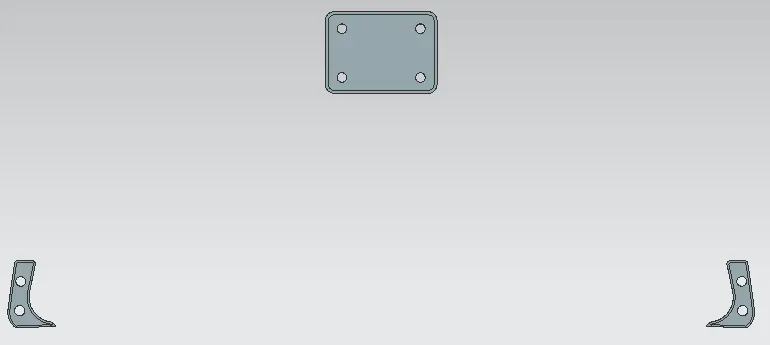
Support Rod : A hood rod is designed to hold hood whenever you need to do any work in car's engine compartment. it must be firmly secured to ensure that it gives a stable hold on the hood. Meanwhile, when not in use, it must be kept stable in place and must not move around. The hood rod clip is the part assigned with that function. This clip clamps onto the rod and ensures that it is firm in its place when not in use. It keeps the rod from moving around under the hood and from causing trouble
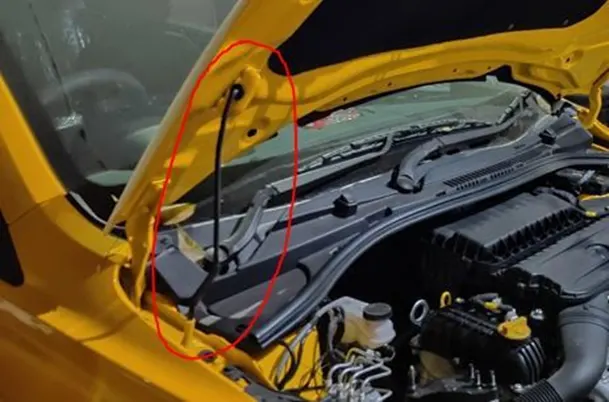
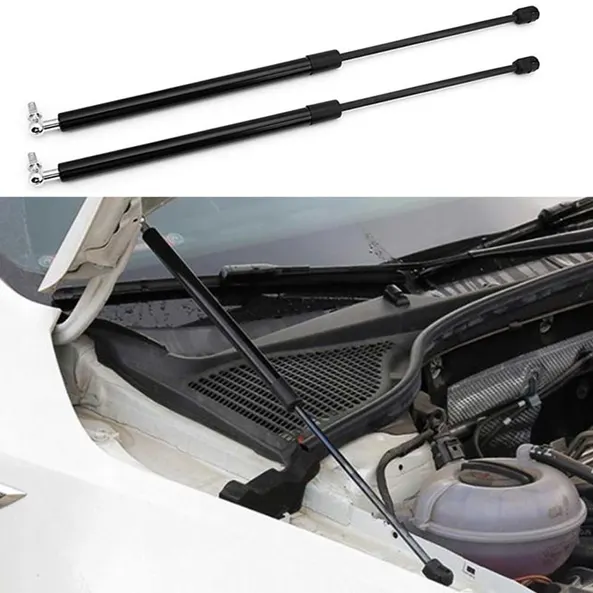
Gas Stay : This is used to open the car hood by just applying little lift force. A small effort is needed and other work is done by gas pressure by its owen. It is normlly found in high-end vehicles where the weight of hood is more than usual.
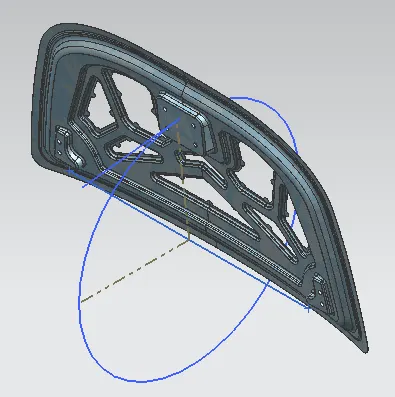
Latch Trajectory
Latch trajectory is provided through the circle drawn from the axis point of hinge. Axis point is the center point of the hinge axis. We can fix either the latch or the hinge. Now we have fixed the hinge position then we need to plot the Trajectory for the latch. For proper mating condition the striker axis through the tip of the striker might be align to the latch trajectory.
Emboss definitions
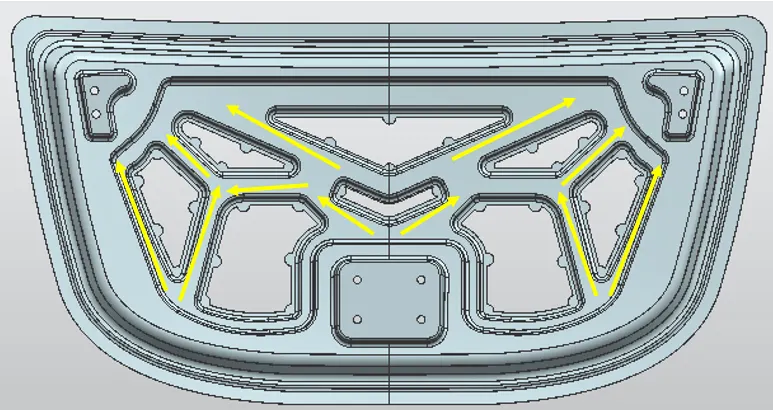
In inner panel we provided different embosses. So thatwe can increase the stiffness of the inner panel through these embosses. The shape and size of the embosses also determines the direction of the force distribution resulted from frontal collision. The force should be always distributed away from the person. In the figure the embosses are designed in a way that the force is directed to another sides of the car.
Mastic Data
Hemming can only be given at its boundary. We cannot use other joining process like welding, bolting, riveting etc. Because they leave marks on the outer panel which demolish its aesthetic appearance. So that mastic sealants are proveded to stick the surfaces of outer panel and inner panel. Mastic sealants are elastic compound which act like rubber. It is applied between the Outer and Inner panels at specified points. Each point of mastic sealants has its effect around a radius of 80mm diameter. So, the mastic points are maanged in a way that it covers the areas away from the hemming which are more sensitive to vibrate.
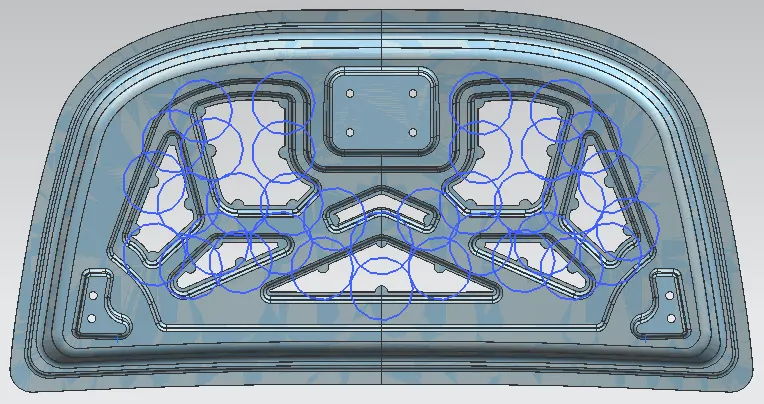
Figure 7: Mastic regions
Deep Drawing
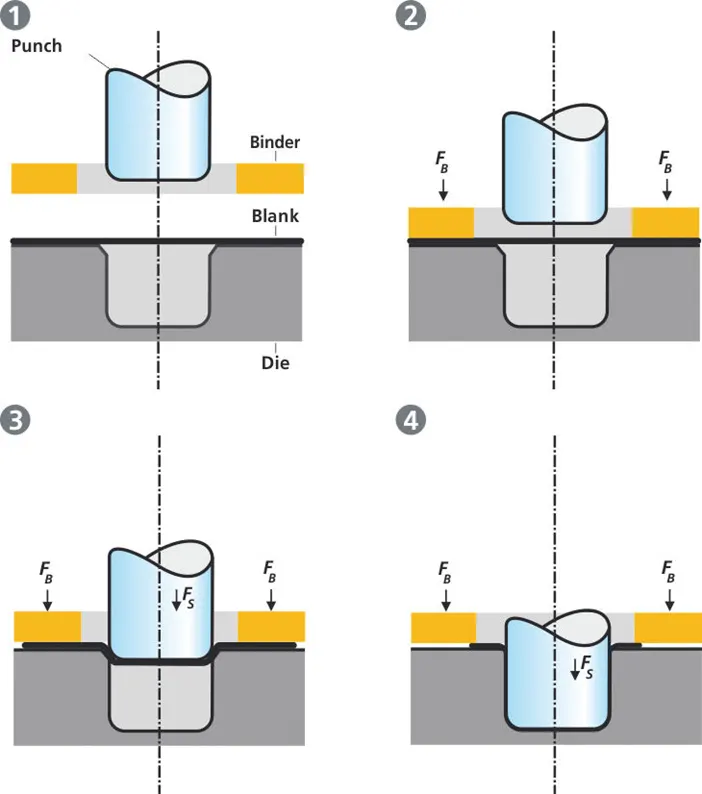
Deep drawing is widely used process in sheet metal forming. it is applied in the automotive industry for the manufacturing of car body parts. it is a forming process which occurs under a combination of tensile and compressive conditions.
Sheet metal blank is radially drawn into the die by the action of punch.So that shape transforms with material retention. The process is considered "deep" drawing because of the depth of the drawn part exceeds its diameter. This is acomplished by re-drawing the part through a list of dies. Sheet metal in the die shoulder area experiences a radial drawing stress and a tangential compressive stress due to the material property. These stresses result in flange wrinkles. Wrinkles can be avoided by using blank holder, the function of which is used to facilitate controlled material flow into the die radius.
Hemming
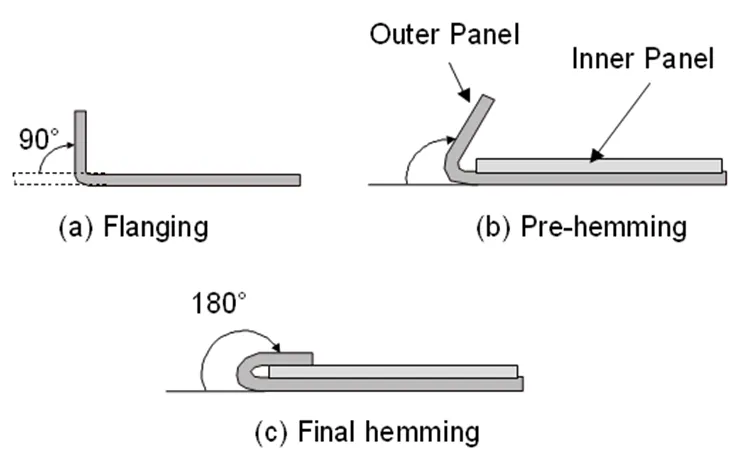
Hemming is a forming operation in which the edges of the sheet are folded over another part in order to obtain a tight fit. usually hemming operations are used to join parts together and improve the appearance of a part and reinforce part edges.
In car part production, hemming is used in assembly as a joining operation after deep drawing, flanging and trimming operations to join two sheet metal parts (outer and inner) together. Usually this type of parts are hoods, doors, trunk, lids and fenders.
The accuracy of the hemming operation is most important since it affects the aethistic appearance of the surface. Material deformation, which occurs during the hemming process, can lead to dimension variations. Typical hemming defects are wrinkles or splits in the flange, material overlaps in the corner areas or material roll-in.
Types of Hemming
- Conventional die Hemming
In conventional die hemming, the flange is folded along entire length with help of hemming tool.
- Roll hemming
It is used for automotive sheet metals. Roll hemming is carried out incrementally with a roller. An industrial robot guides the hemming roller and forms the shape. Roll hemming operation can be classified into several pre-hemming and final hemming process steps.
Final Assembly