Hood design-Week 2
Automotive Hood Design
OBJECTIVE -To comprehend the design philosophy and considerations that go into planning and developing an automobile hood in order to provide optimal safety for everyone inside and outside the vehicle.
With this information, an industry-standard hood panel that can be manufactured and assembled has to be created. In other words, the design must adhere to both Design for Manufacturing and Design for Assembly standards
INTRODUCTION TO HOOD -The hood can be hinged at the front or back edge, or both in previous versions. It is possible to divide it into two portions, one on each side, each hinged along the centerline. Another variation merges the bonnet and wheel arches into a single piece, allowing the entire front bodywork to tilt forwards around a pivot towards the front of the vehicle.
The hood is designed to be aerodynamic in shape in order to decrease air effect and is used to beautify the front area of the automobile and offer a nice aspect to cars.
Hoods are commonly used to cover automobile engines, radiators, and other equipment; thus, the hood must be built in such a manner that all engine maintenance may be performed.When automobiles are involved in an accident from the front, the hood system is often damaged and absorbs some of the impact energy.
Hoods are usually constructed from the same material as the rest of the vehicle. Steel and aluminium may be included. To make the vehicle lighter, various aftermarket businesses provide fibreglass or carbon fibre replacements for steel hoods.
Hood is one of the other major closure systems in a vehicle and is fundamentally a reinforced skin with many design quality and safety regulations
The hood may have various subcomponents, but the two most essential are the outer and inner panels. The inner panel acts as a framework for the car to disperse and channel shock waves in the case of an accident, but the outside panel serves more as an aesthetic for the overall presentation of the automobile and to channel airflow over the vehicle. As a result, both demand vital precision as well as a committed approach from design ideation through production. Before it sees the light of day, the basic design undergoes iterative design change based on structural study such as fatigue analysis and crash analysis
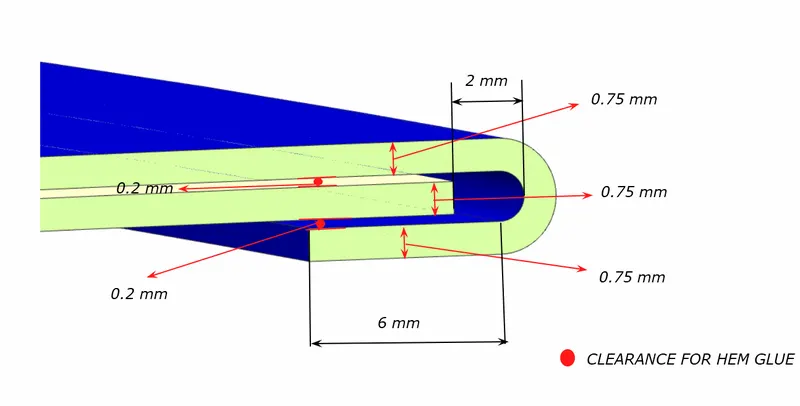
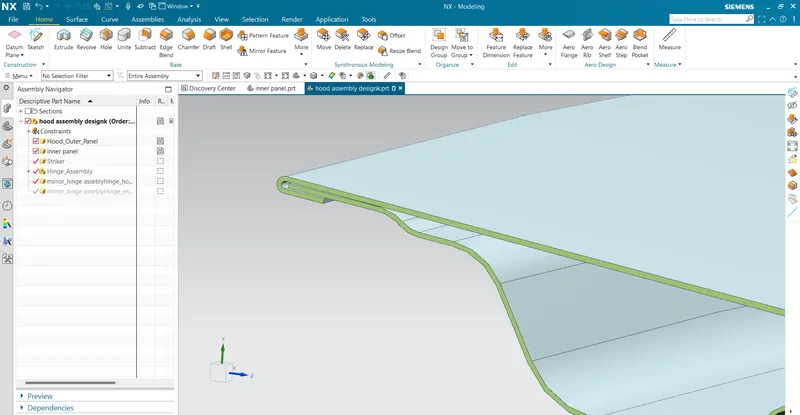
The production process begins after the design for the two subcomponents is completed. The deep sketching approach is commonly used to create the inner panel. After being made, the outside and inner components are joined to create one unit using one or a combination of several joining methods such as hemming, riveting, glueing, and spot welding, to mention a few. Hemming was used to link these two components in this project. After the components have been deep drawn, trimmed, and flanged, they are hemmed. The outside overlap section is folded over the inner panel and pressed using hemming rollers to preserve a uniform surface joining.
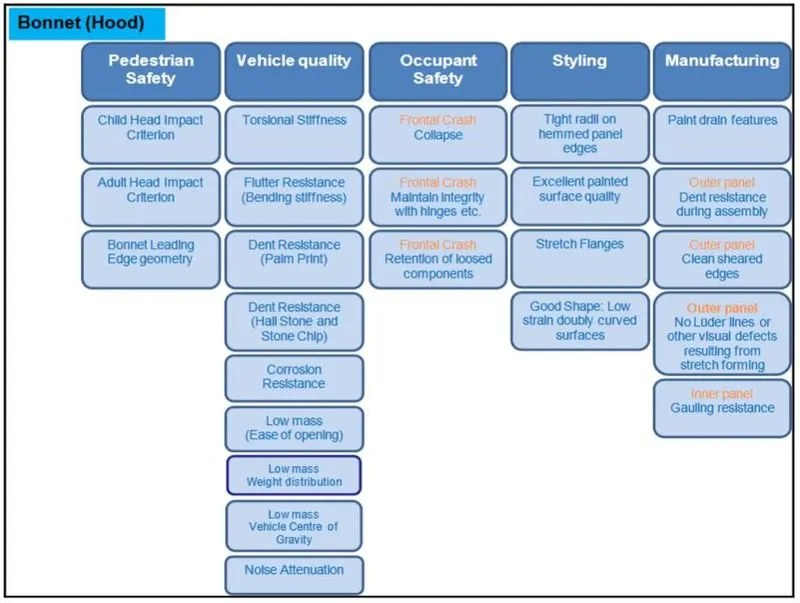
Design Boundary Conditions for Bonnet fig. 1.
Hood Design Assembly Material Selection:
- Although hoods are normally built of steel or aluminium, aftermarket manufacturers may produce hoods made of fibreglass, carbon fibre, or dry carbon.
- The outside and inner panels are made of Grade 304 stainless steel and Grade 302 mild steel.
- Latch can be reinforced with flex fibre or a vinyl ester composite.
- Mastic seal made of elastomer/silicon polymer and silicon copper paste.
Design Consideration
The first and most critical safety necessity to consider while designing the Bonnet is pedestrian safety in the case of a frontal collision.
The European New Automotive Evaluation Program (Euro NCAP) is a European car safety performance assessment programme that has produced test requirements and grading systems for measuring pedestrian injuries in front-end collisions. A set of experiments employing impactors designed to simulate a collision at a speed of 40 km/h is one example. They depict a scenario in which a pedestrian is positioned laterally and an automobile strikes one of his legs first. Tests are performed on the leg, upper leg, and, most significantly, the brain, as head trauma is the leading cause of fatalities.THe below image shows the Pedestrian crash dummy
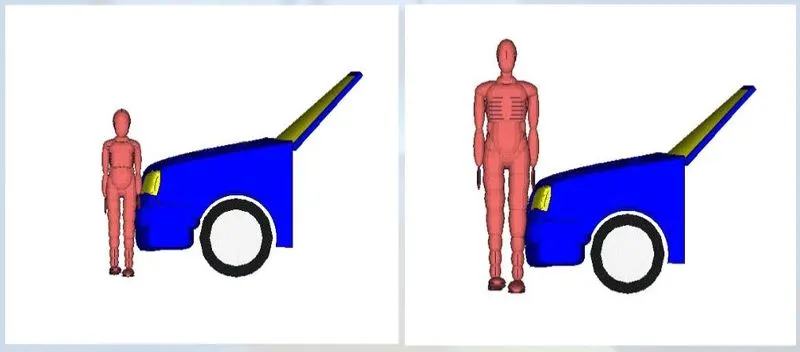
Fig 2. Pedestrian Crash Dummy Placement - Child (Left) & Adult (Right)
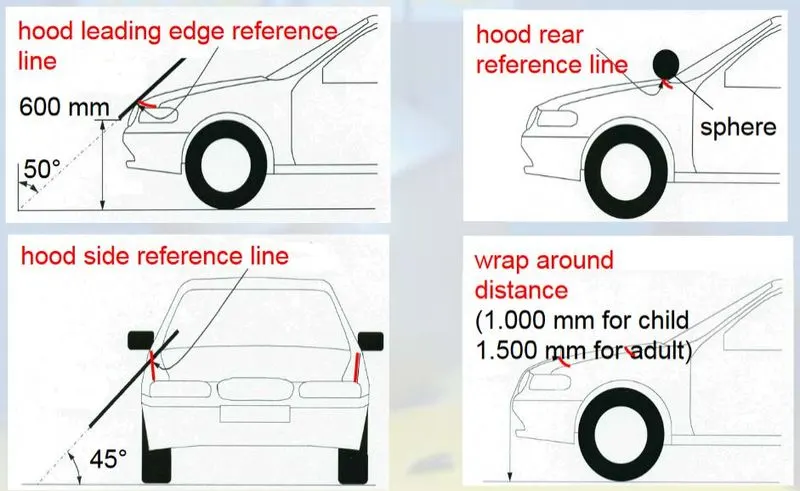
Fig 3. Shows the Head Impact Region
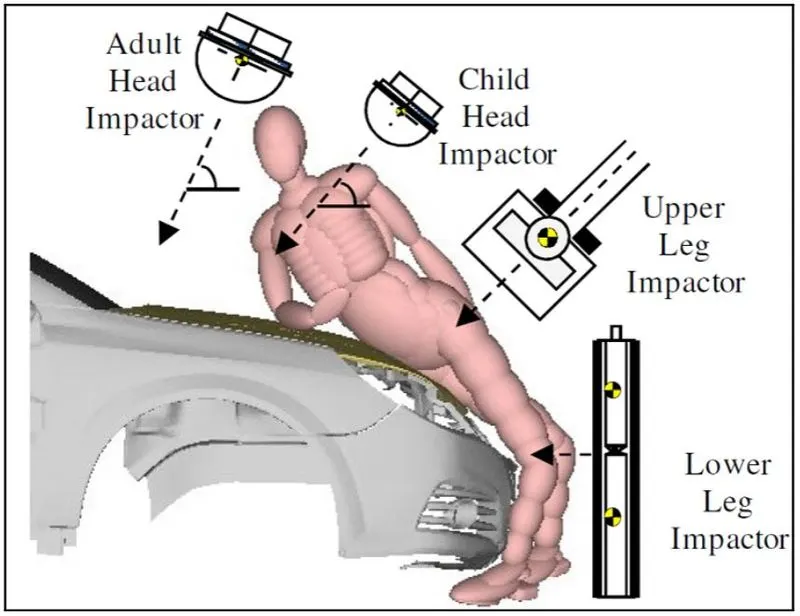
Fig 4 shows the Body-Bonnet Interaction.
As we can see from the impact region, the thickness of the hood in particular areas is lowered to allow for a softer landing and lower impact. Upon pedestrian collision, the hood in specific locations should absorb and distribute the energy, enabling deformation and therefore collapse, resulting in a decreased impact on the pedestrian.
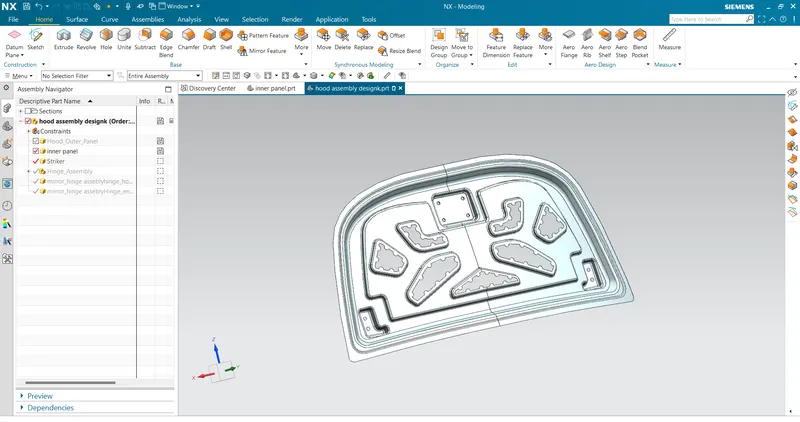
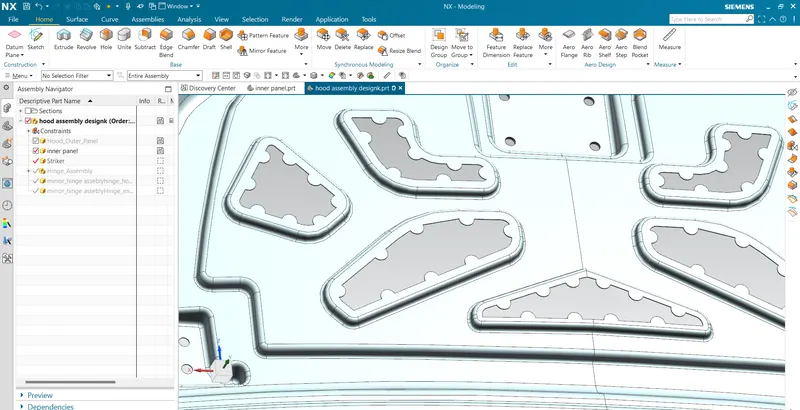
Simultaneously, the impact on the car should be diverted outside the vehicle to protect the occupants from serious injury. Based on these factors, the inner panel should be embossed with strategized channels and empty cut-outs to provide for optimal absorption of such shocks.
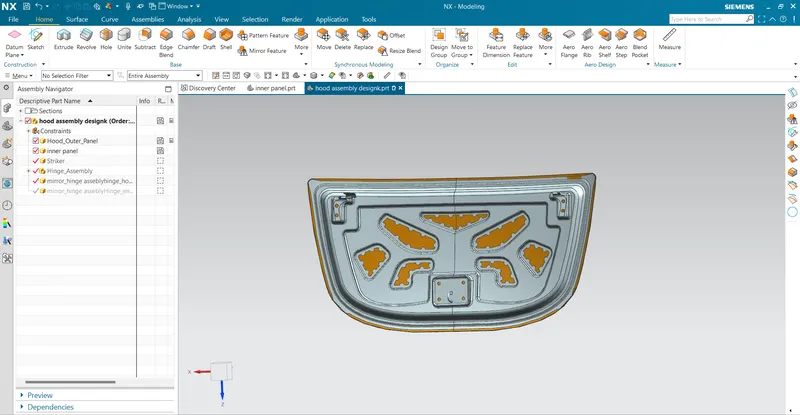
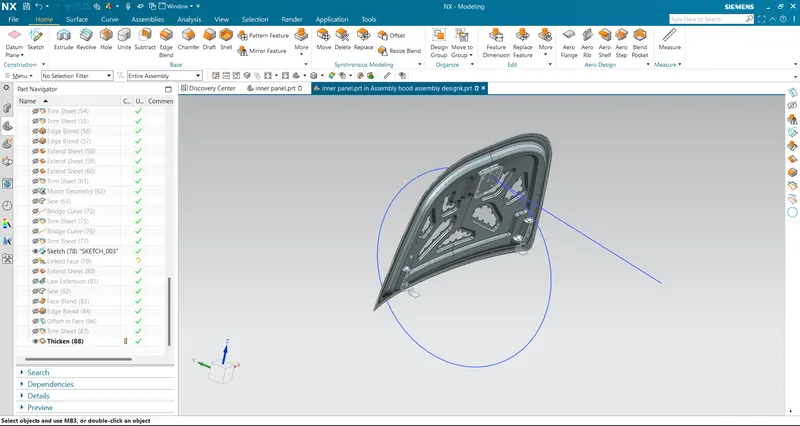
With this information, the design presented below was carried out using Siemens NX 11.
Designing of Hood.
Master Section
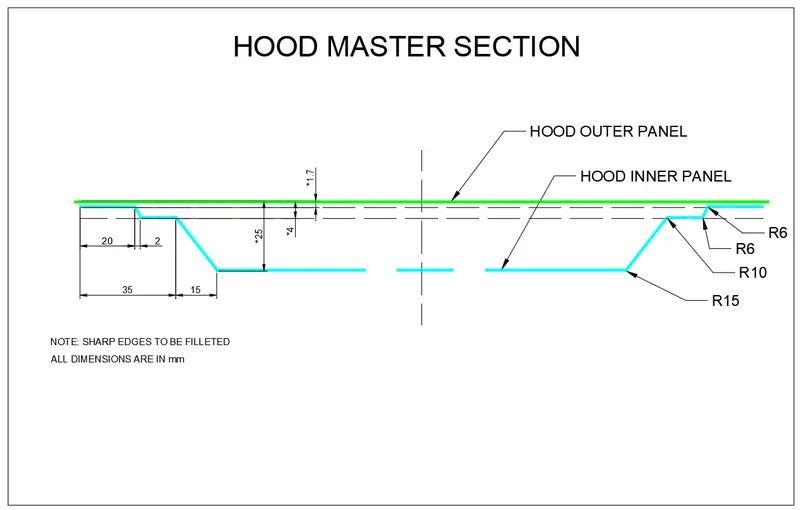
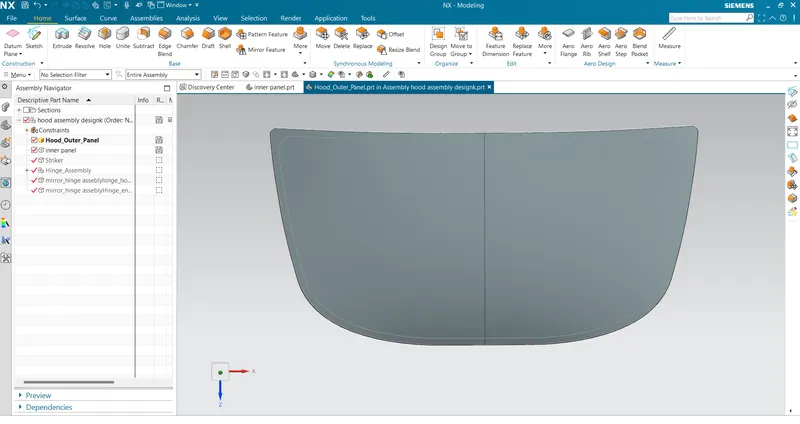
Outer pannel
INNER PANNEL
EMBOSSED SHAPE
HEM
REINFORCEMENTS
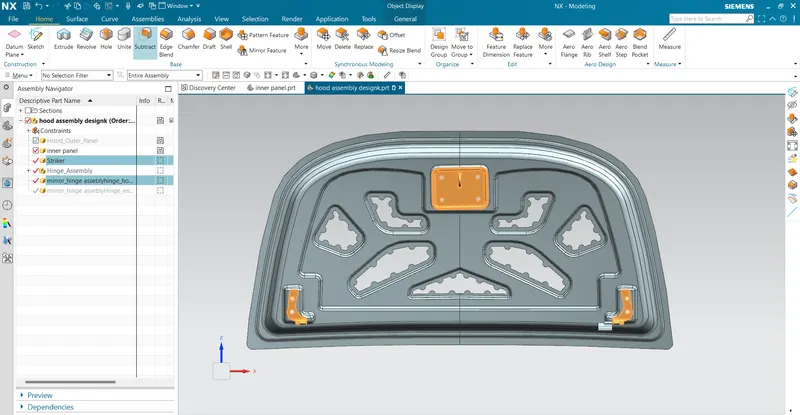
Trajectory of Hood Opening and Closing
The trajectory for opening and shutting is deemed to be correct when the striker's axis is coinciding with the hood centre axis. The hinges on either side are used to pick the perpendicular line from this axis.
FINAL DESIGN