Hood design-Week 2
AIM: To Design Hood Outer Panel, Inner Panel and the necessary reinforcements by following the Master Section mentioned with the Design parameters.
TOOL USED: SIEMENS NX 12
HOOD:-
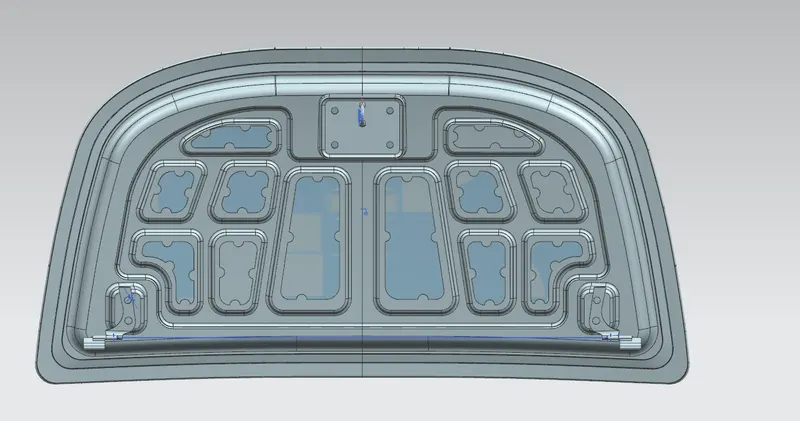
A car hood also referred to as a bonnet in some other countries is the hinged cover that rests over the engine of a front-engine vehicle. Its purpose is to provide access to the engine for repair and maintenance. Car hoods are typically constructed from steel and sometimes from aluminum.
The hood release system is common on most vehicles and typically consists of an inner hood latch/lock handle, a hood release cable, and a hood lock assembly. The hood lock handle is usually located under the steering wheel, next to the driver’s seat, or in the door frame.
The Hood consists of an outer panel and an inner panel. The inner panel provides strength and support, where the outer panel is a metal cover that has styling factors. While designing the hood, a design engineer needs to make sure that the following design requirements are followed.
- Pedestrian safety
- Occupant safety
- Vehicle quality
- Styling
- Ability to manufacture
Functional and Safety Requirements:
The 1st and most important safety requirement to be considered while designing the Bonnet is the frontal collision requirements.
In this image, you can see the deformation on a hood that underwent a frontal collision:
It is clear that the design intention of the hood according to the frontal collision requirement is that the hood crushes and dissipates forces in the upward direction and to the hard points on the hood thereby deflecting the force on to the body and not the passengers.
Regarding the safety of the pedestrians, the above image from Euro NCAP shows the area of impact for a child and an adult. It is of utmost importance that we make sure not to place re-enforcement on the areas prone to high head impact. Also, the child impact area is designed with lesser thickness than the adult impact area so that in the event of a frontal collision where a child is involved, the bonnet will absorb the impact of the crash and crumble to protect the child’s head from absorbing the force.
COMPONENTS OF HOOD:-
The components of the Hood includes Hinge, Latch and Reinforcements which are attached to the inner panel of the Hood. The basic definitions of these parts are given below:
Hinge: A hinge is a piece of metal, wood, or plastic that is used to join a door to its frame or to join two things together so that one of them can swing freely.
Latch: The hood latch helps to keep your hood closed. When the hood is closed, the latch slides over what is called a catch, and the spring covers the latch to keep it snug. When you pull the knob inside the car to open the hood, the hood latch cable opens the latch, allowing it to bypass the catch and open. There is, however, a second hood latch, to keep the hood from flying up if accidentally unlatched. That latch will need to be opened with your hand to get the hood fully open.
Reinforcements: The purpose of reinforcement is to provide additional strength for the hood where it is needed. When the latch and striker attached to the panel, the strength will be reduced in that area. To improve the strength in that area the reinforcement is added.
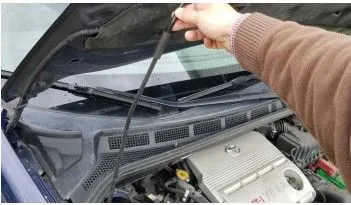
Hood Stay: A hood stay rod for a vehicle is provided to use conveniently, and to prevent pollution by installing and releasing a hood stay rod automatically according to opening and closing a hood without using a hand.
Hood Stay are of two types:
A) Support Rod
A device for supporting the engine hood of a motor vehicle in its open position by means of a rod.
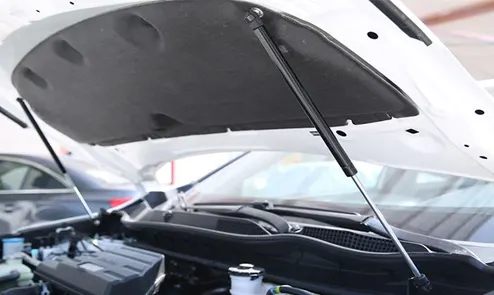
B) Gas Stay
A device supporting the engine hood of a motor vehicle in its open position by means of an actuator which is activated by gas.
Latch Trajectory:
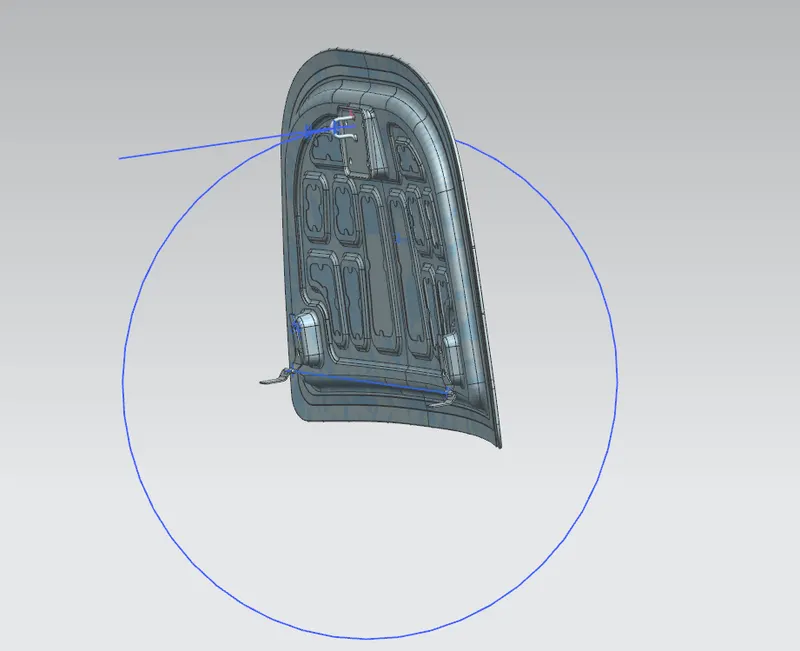
Latch Trajectory is the orbital path in which the latch should be positioned to the lock hole. The trajectory is drawn based on the reference of the Hinge joint central axis.
Mastic Data:
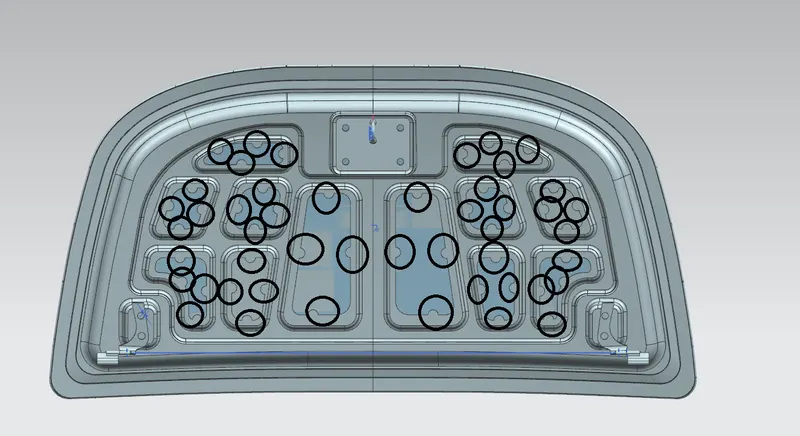
Mastic is common as an adhesive and sealant. A mastic sealant is a type of liquid sealant that cures in an elastic state, thus making it flexible while holding the bond of the surfaces that have attached. It adheres to just about any material making an all-purpose type of sealant. Wood, aluminium, glass, marble, and even duct board are all standard applications for mastic sealant.
Embossments:
Embossing is an operation used in making raised figures on the sheets, with corresponding relief on the other side. The process essentially involves drawing and bending the metal. The die set consists of a die and punch with the desired contours so that when the punch and die meet the clearance between them is the same as that of the sheet thickness. Embossing operation is generally used for providing dimples on sheets to increase their rigidity and for decorative sheet work used for panels in houses and religious places. Stretch forming operation is a relatively less severe operation.
Manufacturing Process:
The manufacturing process involves turning raw materials into finished products which are used for some purpose. The economics of the manufacturing operation is a very important consideration. To be viable in the modern environment, a product has to be competitively priced besides having functional and aesthetic appeal. There are different processes available for manufacture. These are classified as Casting Process, Forming Process, Fabrication Process, Material Removal Process.
Deep Drawing:
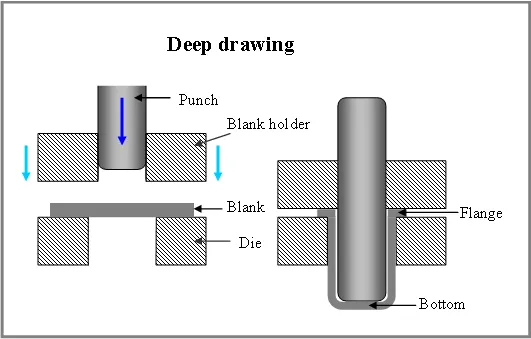
Deep drawing is a sheet metal forming process in which a sheet metal blank is radially drawn into a forming die by the mechanical action of a punch. It is thus a shape transformation process with material retention. The process is considered "deep" drawing when the depth of the drawn part exceeds its diameter. Deep Drawing is the process of making cuts, shells, and similar articles from metal blanks.
The deep drawing process is a forming process which occurs under a combination of tensile and compressive conditions. A flat sheet metal blank is formed into a hollow body open on one side or a hollow body is formed into a hollow body with a smaller cross-section. [DIN 8584]
Deep drawing processes are divided into three types:
- Deep drawing with tools
- Deep drawing with active means
- Deep drawing with active energy
In the automotive industry, deep drawing is usually carried out using rigid tools.
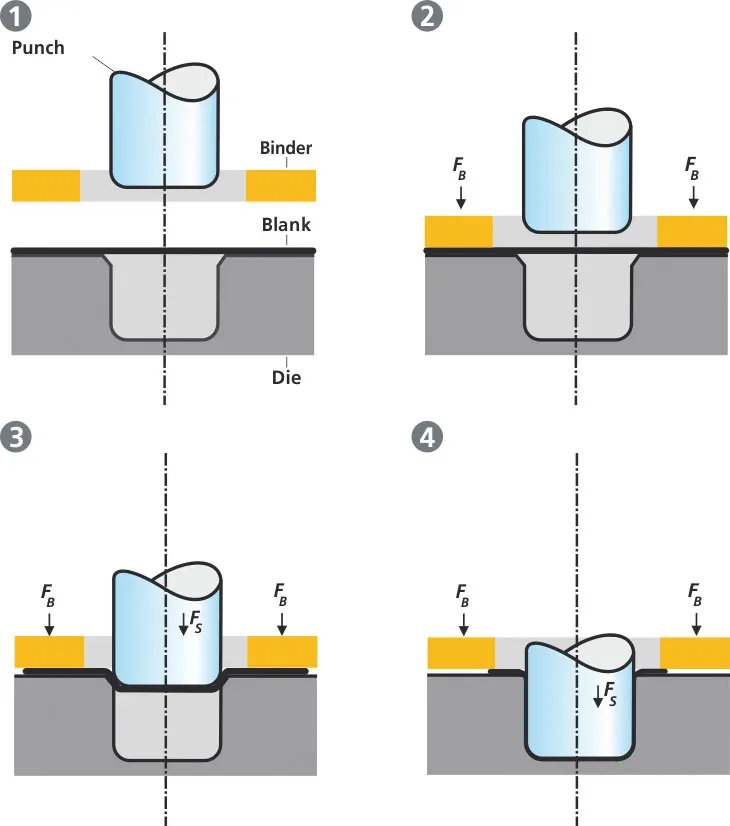
The figure illustrates the deep drawing process. The rigid tools consist of a punch, die and binder. In deep drawing, the plate holder closes after the metal sheet blank has been inserted.
Next the sheet is clamped between the die and the binder. This process slows down the flow of the sheet while it is being drawn and thereby prevents wrinkles from forming under the binder. The punch stretches the sheet over the die radius and forms it in the die. The amount of punch force necessary for forming is thereby continually increased up to the lower dead center of the punch.
Whereas in pure deep drawing there is no reduction of sheet metal thickness, forming is achieved in stretch forming purely as a result of a decrease in sheet metal thickness. Stretch forming is extensively used for the forming of only slightly curved parts with low depth of draw (e.g. roofs, doors).
When drawing complex car body parts in practice, there is usually a combination of stretch and deep drawing involved. It is necessary that the sheet metal is stretched as well as possible without reaching the material’s limits (e.g. splits, wrinkles).
Hemming:
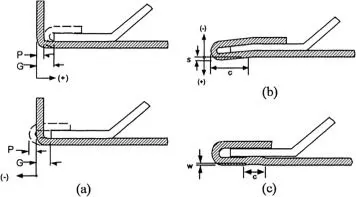
Hemming is a forming operation in which the edges of the sheet are folded or folded over another part in order to achieve a tight fit. Normally hemming operations are used to connect parts together, to improve the appearance of a part and to reinforce part edges.
In car part production, hemming is used in assembly as a secondary operation after deep drawing, trimming and flanging operations to join two sheet metal parts (outer and inner) together. Typical parts for this type of assembly are hoods, doors, trunk lids and fenders.
The accuracy of the hemming operation is very important since it affects the appearance of the surface and surface quality. Material deformations, which occur during the hemming process, can lead to dimensional variations and other defects in parts. Typical hemming defects are splits or wrinkles in the flange, material overlaps in the corner areas or material roll-in. This is why it is important to use simulation tools in order to, on the one hand, better understand the hemming process and, on the other hand, significantly reduce the number of “trial and error” loops during tryout und production.
There are various types of hemming operations:
- Conventional die hemming
- Roll hemming
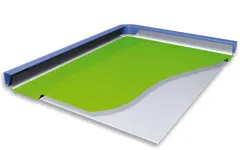

Conventional die hemming
Conventional die hemming is suitable for mass production. In die hemming, the flange is folded over the entire length with a hemming tool. Normally the actual hemming is a result of a forming operation in which the flange is formed with a hemming tool after the drawing and trimming operations have been completed. The formed flange is then hemmed in several process steps. These steps include, for example, the pre-hemming and final hemming depending on the respective opening angle of the flange. Production plants for conventional die hemming are very expensive, but the cycle times are very low.
Roll hemming
Roll hemming is carried out incrementally with a hemming roller. An industrial robot guides the hemming roller and forms the flange. Roll hemming operation can also be divided into several pre-hemming and final hemming process steps. Roll hemming is very flexible to use and tool costs are significantly lower as compared to those of conventional die hemming. However, the cycle times are much higher since the hemming is realized using a hemming roller which follows a defined path.