Hood design-Week 2
AIM:
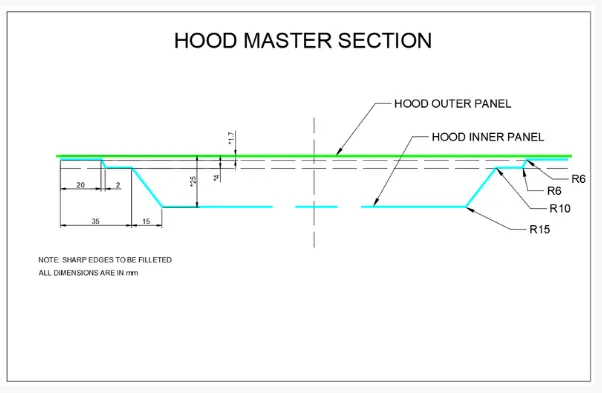
Design Hood Outer Panel, Inner Panel and the necessary reinforcements by following the Master Section mentioned with the Design parameters explained in the videos.
INTRODUCTION:
HOOD
The hood (American English) or bonnet (Commonwealth English) is the hinged cover over the engine of motor vehicles. Hoods can open to allow access to the engine compartment for maintenance and repair.
Hoods are typically made out of the same material as the rest of the body work. This may include steel, aluminum, fiberglass or carbon fiber. However, some aftermarket companies produce replacements for steel hoods in fiberglass or carbon fiber to make the vehicle lighter.
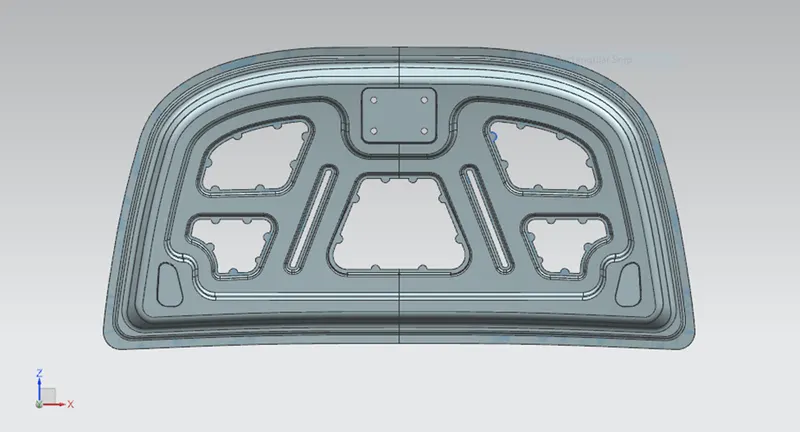
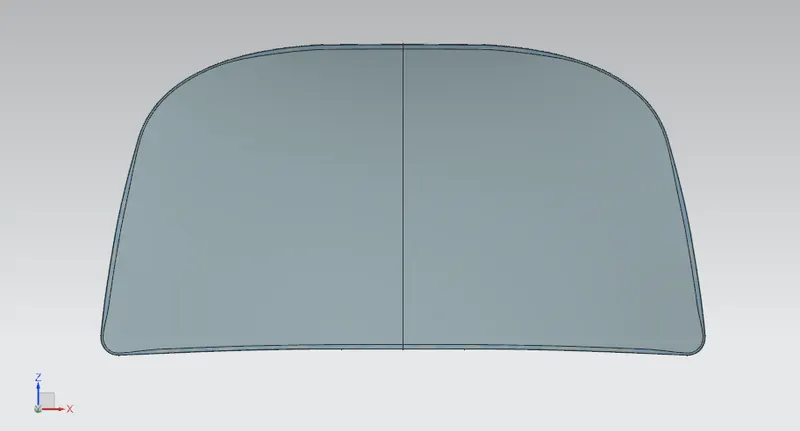
Hood may come with several subcomponents, but the two most important ones are the outer and inner panels. The inner panel serves as a structure for the vehicle to dissipate and channel shock waves at the event of a crash while the outer panel serves more as an aesthetic for the automobile’s overall presentation and to channel airflow over the vehicle. Hence, both require critical precision as well as a dedicated strategy right from the design conceptualization to the production step. The initial design goes through iterative design modification based on structural analysis such as fatigue analysis and crash analysis.
INNER PANEL
OUTER PANEL
LATCH
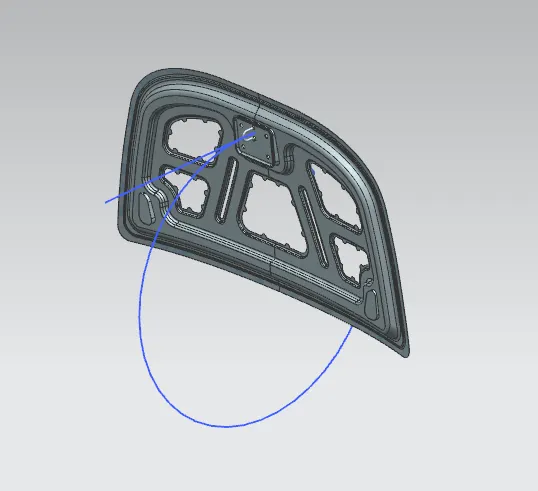
The latch, also known as a striker is a locking mechanism for closing the hood. The placement and the trajectory of this striker is determined by the circle drawn with pivotal axis of the hinge as its center. This is called 'latch trajectory'.
LATCH TRAJECTORY
The latch trajectory is the path which the striker will follow when the hood is open/closed while pivoting on the hinge axis. The latch trajectory is taken as a circle with the hinge axis as the center of the circle. The striker is placed 90 degree such that it is tangent to the circle.
MASTIC DATA
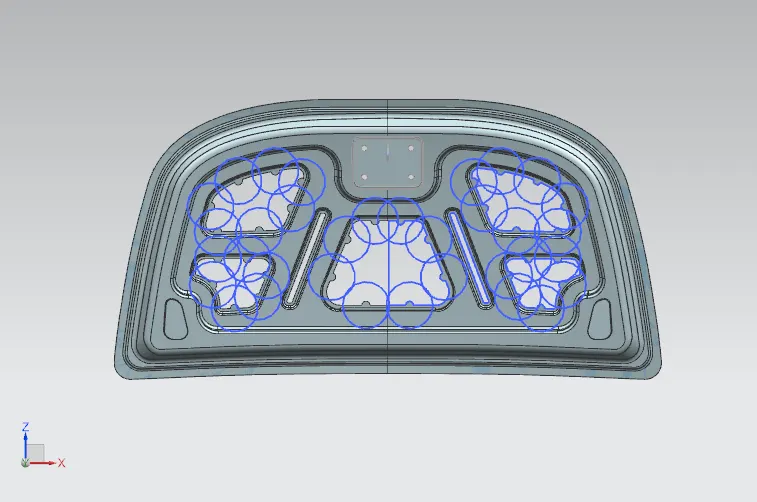
Mastic data should be provided in between hood upper panel and inner panel to achieve better NVH Range, to avoid the spot weld, to maintain the upper hood-surface regularity
Generally, mastic diameter should be about 80 mm which called strengthen diameter of the mastic rubber.
EMBOSS
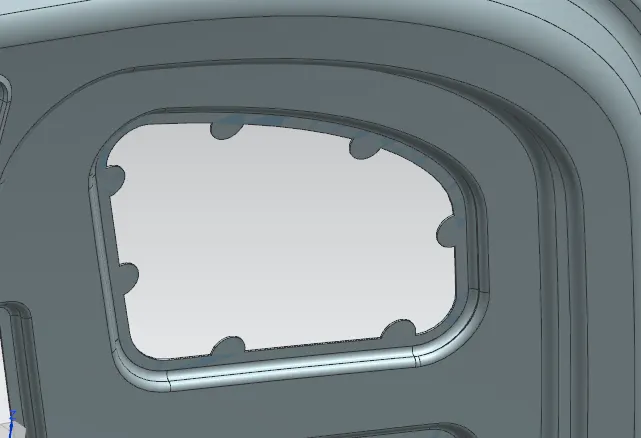
Emboss is created such that when force induced in middle of the hood which directly transmitted to the hinge point to provide better safety. If this type of emboss not provided the force transmission towards the center of hood or vehicle which causes serious damage.
Embosses are the projections made on sheet metal using deep drawing techniques. the operation is carried out the mostly for the purpose of stiffening flat surface and design in the inner panel. the major function of embossing is to dissipate the force acting on the hood during the collision of the car toward the hinges as early as possible. this helps to reduce the impact of the force on the passenger sitting inside.
DEEP DRAWING
Deep drawing is one of the most widely used processes in sheet metal forming. Apart from its use in many other sectors, it is applied in the automotive industry for the manufacturing of car body parts. The deep drawing process is a forming process which occurs under a combination of tensile and compressive conditions.
Sheet metal blank is radially drawn into a forming die by the mechanical action of a punch. It is thus a shape transformation process with material retention. The process is considered "deep" drawing when the depth of the drawn part exceeds its diameter. This is achieved by redrawing the part through a series of dies. The flange region (sheet metal in the die shoulder area) experiences a radial drawing stress and a tangential compressive stress due to the material retention property. These compressive stresses (hoop stresses) result in flange wrinkles. Wrinkles can be prevented by using a blank holder, the function of which is to facilitate controlled material flow into the die radius.
HEMMING
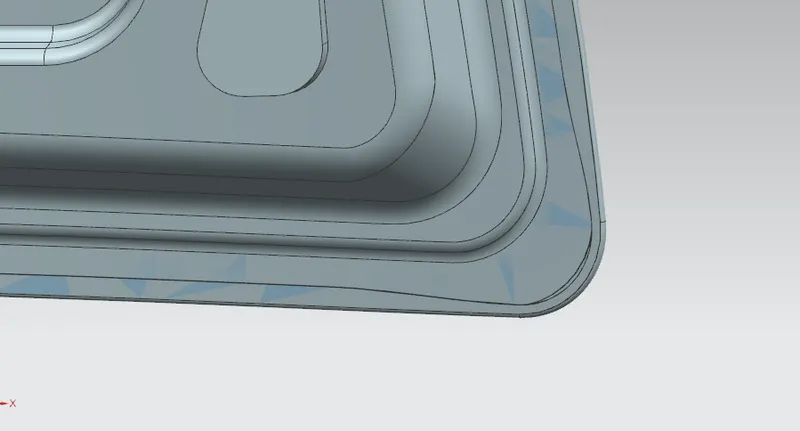
The outer panel & Inner panel can't join by any welding process if we did it will leave a spot on the outer panel. Hence, Hem is provided to the upper panel of the hood at the corner to provide the better grip between inner panel and outer panel of hood. The clearance between Hem and inner panel should be near about 0.2 mm
Corner Relief: - There are many types of Hemming process but in Hoods Roller hemming is used. In this process the roller will be rolling over the edges of the Outer panel to close it with the inner panel. These rollers will be rolling over 2-3 time for perfect closing. so, the certain force is being used by rollers to all the corners but there are some areas where the roller cannot tighten the part properly so that’s why we give some relief to the corners.
DESIGN PARAMETERS:
Hood Thickness Information
Outer Panel Thickness = 0.75 mm
Inner Panel Thickness = 0.75 mm
Reinforcement Thickness = 1.5 mm
MASTER SECTION
COMMANDS USED
- Sketch: to make a drawing on the datum plane
- Datum: to make a reference plane using original plane.
- offset curve in face: to make curves from the edges of the face.
- Projected curve: to project a sketch on the face of the workpiece.
- Emboss: To create rise or a dent in the workpiece.
- Wave geometry linker: to copy curve/face of one part to another part.
- Mirror assembly: to copy/mirror an assembly
- mirror: to mirror the workpiece on an axis or a plane.
- create new: to make a new part in the assembly
- add: to add an existing part to the assembly
- Extract body: to extract a copy of an already existing work part.
- Trim sheet: This command is used for removing unwanted material from the work part
- curve on surface: this command is used to create composite curves on a surface.
- offset surface: this command is used to offset an already existing surface.
CONSTRAINED USED IN ASSEMBLY OF HINGE AND INNER PANEL
- Parallel axis
- Touch/Align
FINAL ASSEMBLY
CONCLUSION:
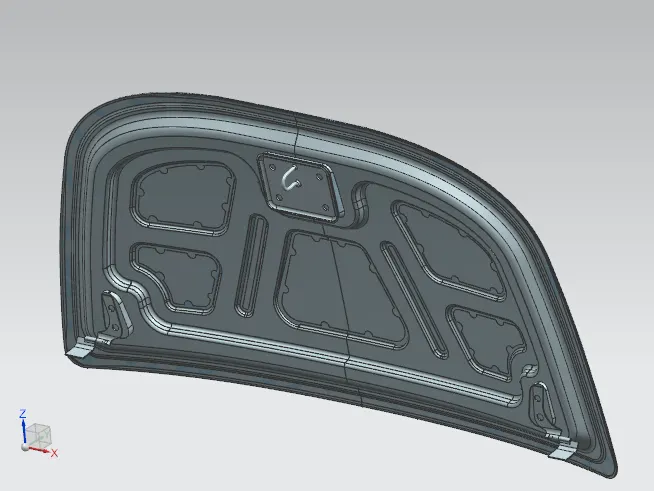
The hood was designed using the given master sketch and all the other parameter using NX CAD. Both the outer and inner panel were designed. All re-enforcements for the striker and the Hinge were created. The final hood was assembled in the assembly.