Gate Valve Parametric Study (ANSYS FLUENT)
AIM: To perform parametric study of a gate valve.
Objective:
- Parametric study on the gate valve simulation by setting the opening from 10 % to 80%.
- Obtain the mass flow rates at the outlet for each design point.
- Calculate the flow coefficient and flow factor for each opening and plot the graph.
- Discuss the results of the mass flow rate and flow coefficient.
THEORY:
Flow Coefficient:
The flow coefficient of a device is a relative measure of its efficiency at allowing fluid flow. It describes the relationship between the pressure drop across an orifice valve or other assembly and the corresponding flow rate.
Mathematically the flow coefficient Cv (or flow-capacity rating of valve) can be expressed as :

where:
- Q is the rate of flow (expressed in US gallons per minute),
- SG is the specific gravity of the fluid (for water = 1),
- ΔP is the pressure drop across the valve (expressed in psi).
The use of the flow coefficient offers a standard method of comparing valve capacities and sizing valves for specific applications that is widely accepted by industry. The general definition of the flow coefficient can be expanded into equations modeling the flow of liquids, gases and steam using the discharge coefficient.
For gas flow in a pneumatic system the Cv for the same assembly can be used with a more complex equation. Absolute pressures (psia) must be used for gas rather than simply differential pressure.
Flow Factor:
A Flow Factor (Kv) is the flow coefficient in metric units that is defined as the flow rate in cubic meters per hour (m3/h) of water at a temperature of 16ºC with a pressure drop across the valve or any other restricting device of 1 bar. The Kv is related the head drop (Δh) or pressure drop (ΔP) across the valve with the flow rate (Q).
Kv = 0.865 * Cv
Critical Flow Factor:
Critical Flow Factor, often referred to as “Cf” is a coefficient that defines how pressure will recover after it drops to its lowest point inside the control valve.Cf is a factor needed in order to calculate Flow Coefficient (Cv) or Flow Rate for valve sizing purposes.
Below is an illustration of how Cf is determined.
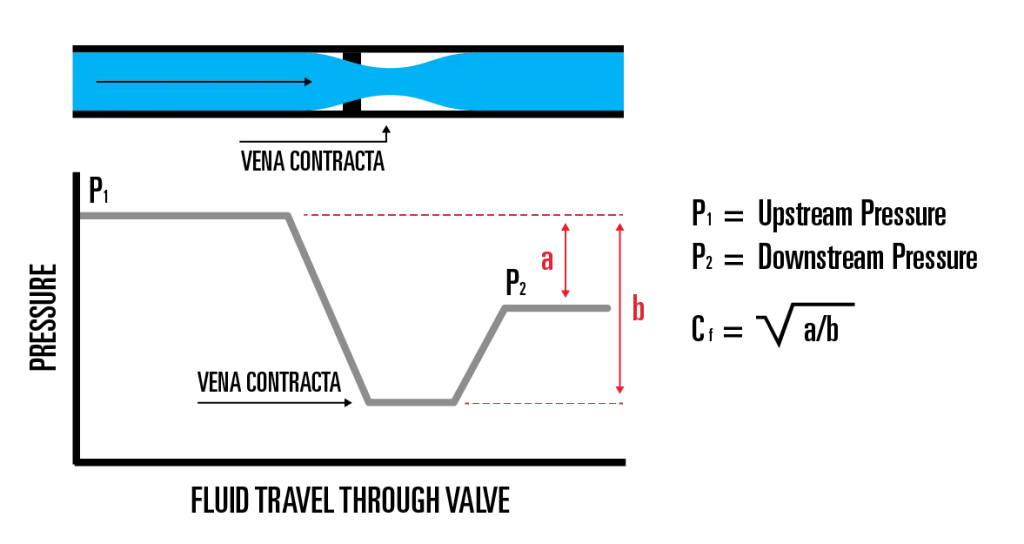
First, fluid or gas (shown here in light blue) enters a control valve. This results in the pressure droping until it reaches the vena contracta, or its lowest point. Then it continues downstream and the pressure bounces back (or recovers).
Parametric study :
Parametric studies allow you to nominate parameters for evaluation, define the parameter range, specify the design constraints, and analyze the results of each parameter variation. A parametric study requires the following: Design Objective is set to Parametric Dimensions. Parameters nominated for use in the simulation. In this perticular simulation the parameter set is the height of the gate valve.
Case Setup:
Geometry:
- Open space claim and inport the geometry.
- hide the 'bottom' part of the geometry, this will expose the gate valve.
- Use the 'move' command to move the gate disk by 10mm, click on the 'P' to set this as a parameter for the parametric study.
- Use the 'pull' tool to extend the inlet and outlet of the valve by 800mm. This will allow us to get a better flow visualisation.
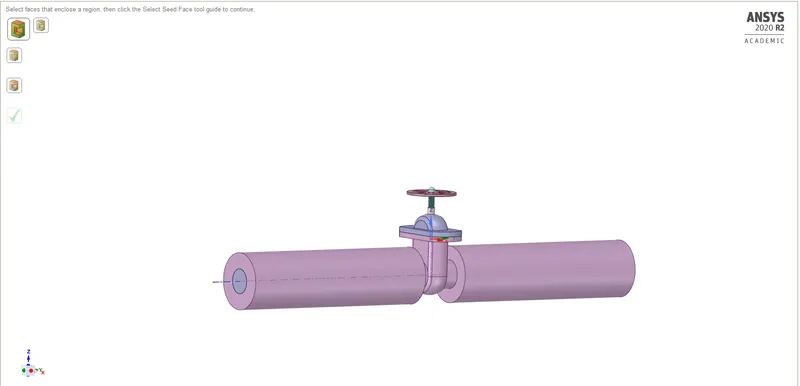
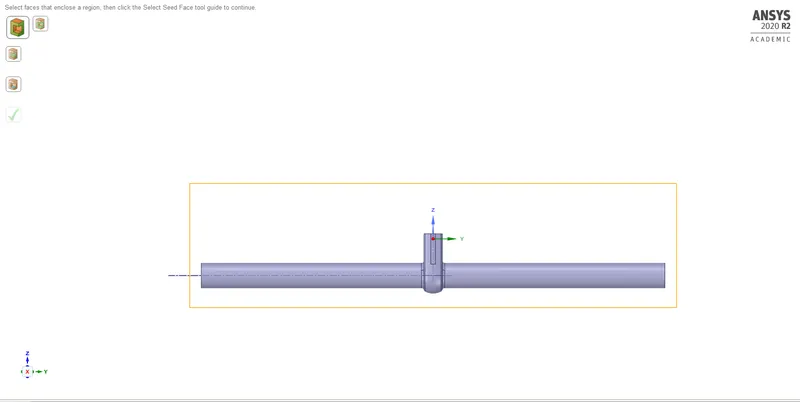
- use the 'volume extract' tool with edge selection to extract the fluid volume to conduct the analysis.
- Suppress the physics of the outer model leaving only the fluid volume, to carry out the simulation.
Meshing:
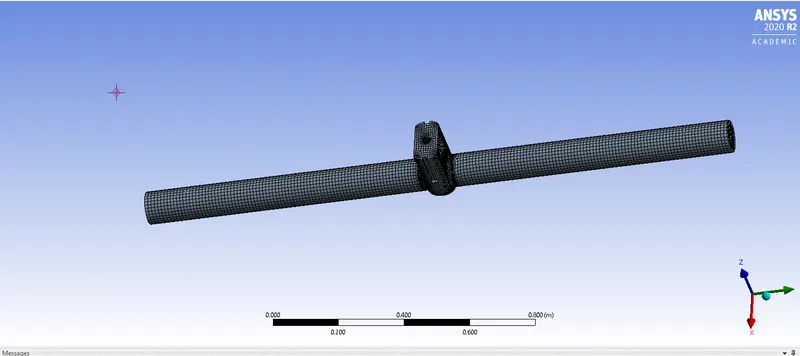
- Open the Meshing interface and click on generate mesh.
- Create named selections of inlet and outlet.
- Update the mesh.
FLUENT:
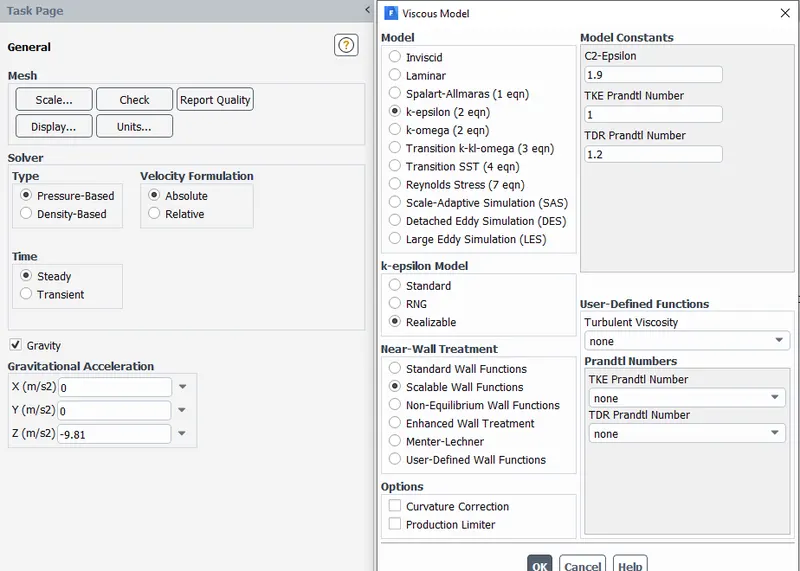
This simulation is run with the following general and viscous model settings.The flow through a pipe is turbulent thus the k-epsilon model is used.
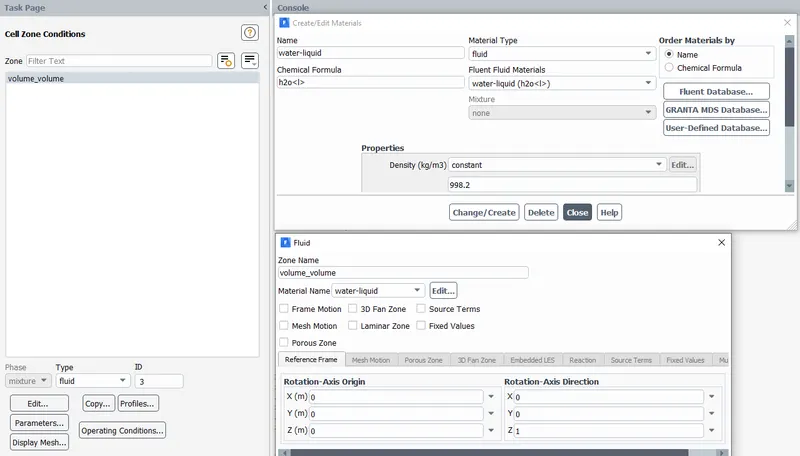
The material definitions and the cell zone conditions are set up as follows
The boundary conditions for the problem is as follows. The inlet and outlet conditions are shown. We are using a pressure inlet and pressure outlet condition. thus the value of pressure drop is 10 pascals.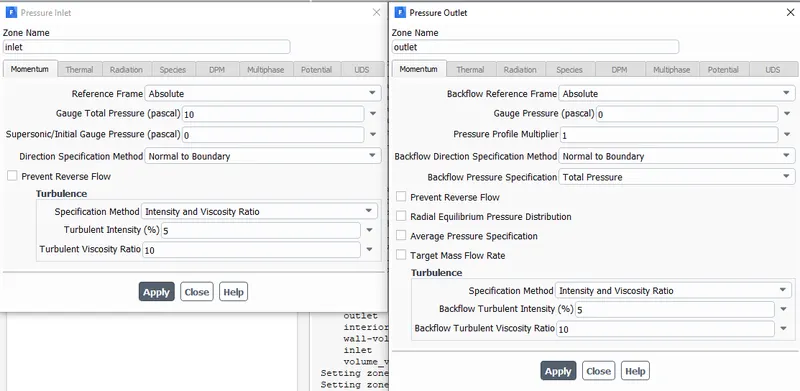
After the above set up criteria have been defined we need to create the plots that we require, enter the number of iterations for the problem and hit calculate!
For the parametric study we need to add design points that corresponds to the change in the gate valve that we wish to see, and click on 'update design points' this will run the parametric study(image is shown below in results).
RESULTS:
The parametric study was run for the following design points:
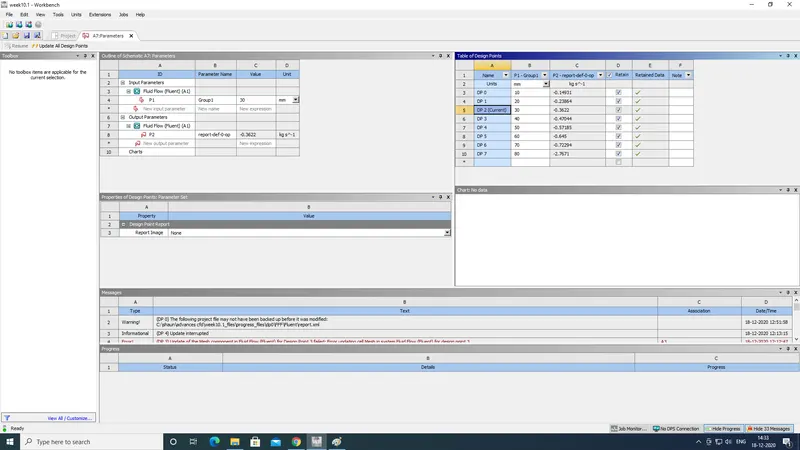
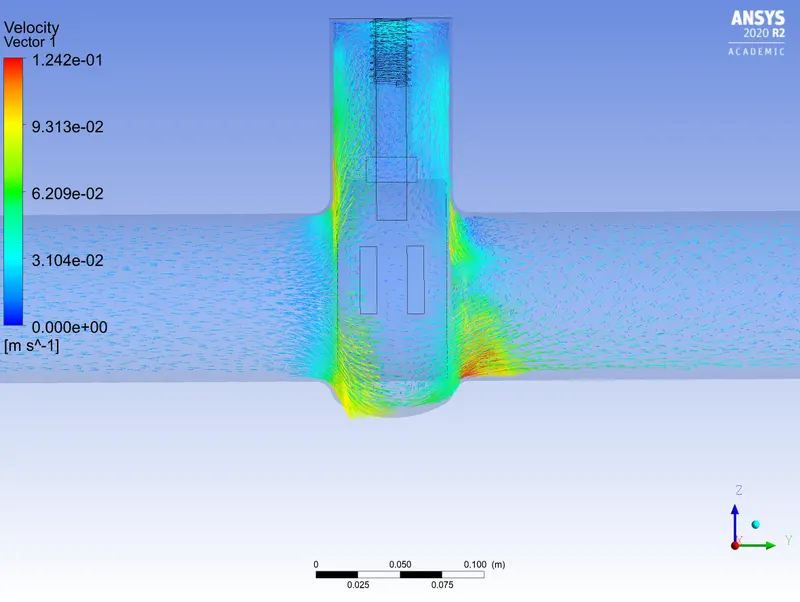
The velocity vector plot for one of the cases is shown below(10mm case):
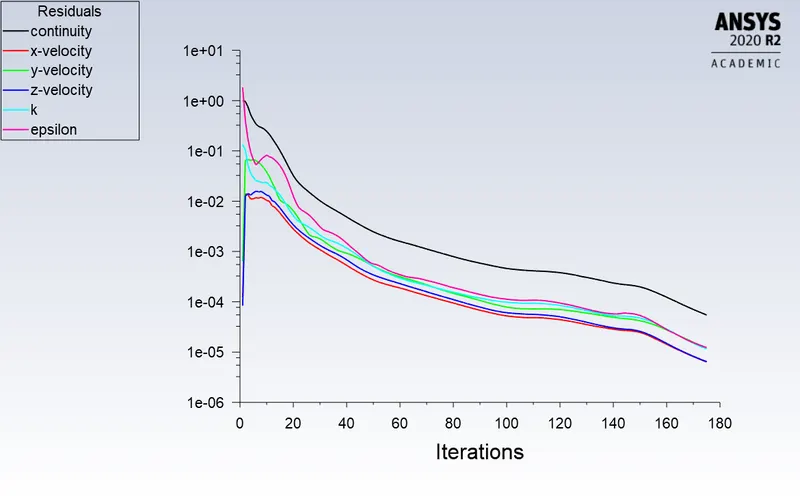
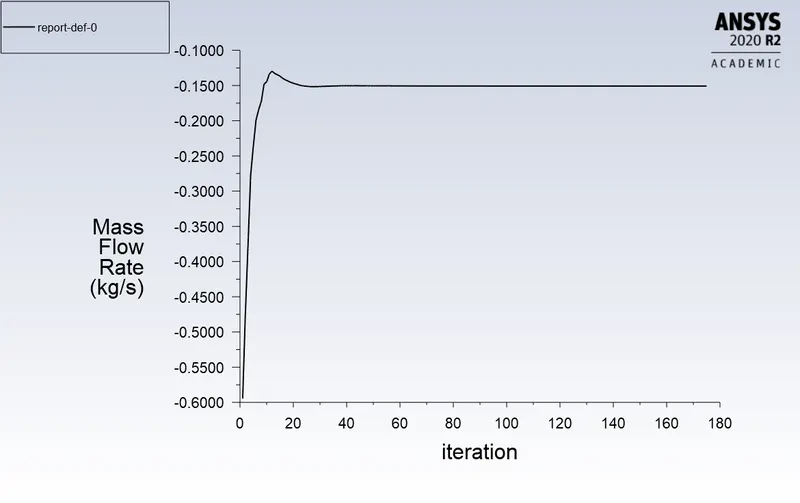
The plot for the residuals and the mass flow rate is as shown below (for the 10 mm case)
Calculations:
flow factor (10mm)= mass flow rate *3600/1000*sqrt(1/10*10^-5)= mass flow rate *360;
flow factor (10mm)= 0.14931*360 = 53.75
Flow coefficient = flow factor/0.865;
Flow coefficient = 53.75/0.865 = 62.138
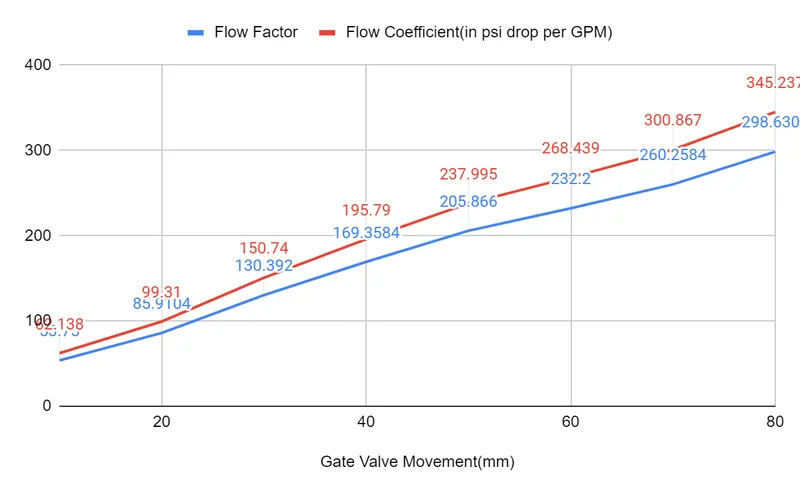
The table with the calculated flow coefficient and flow factor is given below.
| Serial Number: | Gate Valve Movement(mm) | Mass Flow Rate (Kg/s) | Flow Coefficient(in psi drop per GPM) | Flow Factor  |
| 1 | 10 | 0.14931 | 62.138 | 53.75 |
| 2 | 20 | 0.23864 | 99.31 | 85.9104 |
| 3 | 30 | 0.3622 | 150.74 | 130.392 |
| 4 | 40 | 0.47044 | 195.79 | 169.3584 |
| 5 | 50 | 0.57185 | 237.995 | 205.866 |
| 6 | 60 | 0.645 | 268.439 | 232.2 |
| 7 | 70 | 0.72294 | 300.867 | 260.2584 |
| 8 | 80 | 0.82953 | 345.237 | 298.6308 |
Given below is the plot of flow coefficient and flow factor for each opening
CONCLUSIONS:
- Mass flow rate increases with increase in gate valve opening
- The pressure at the inlet side is high and reduces across the valve
- As the valve opening increases the flow velocity increases.
- The outlet pressure boundary is given as zero.
- The parametric study helps us analyse different position of valve opening and the gives us quick simulation results.
- When the valve is fully open the mass flow rate, flow coefficient and the flow factor becomes maximum.