Frequency Analysis of a rotating shaft
Introduction:
An object's natural frequency is the frequency or rate that it vibrates naturally when disturbed. Objects can possess more than one natural frequency and we typically use harmonic oscillators as a tool for modeling the natural frequency of a particular object.
We can apply an unnatural or forced frequency to an object that equals the natural frequency of an object. In cases such as this, we are in effect creating resonance, i.e., oscillations at the object’s natural frequency. If this occurs in certain structures, the oscillations will continue to increase in magnitude, thus resulting in structural failure.
When a system’s oscillations are equivalent to its natural frequency, it forms motion patterns. We call these certain characteristic frequencies an object’s normal mode. Moreover, natural frequency consists of various primary factors and they are as follows:
-
We call the frequency in which an object naturally vibrates, its natural frequency.
-
We can utilize harmonic oscillators as tools to model an object’s natural frequency.
-
Natural frequencies are those that occur naturally when we disturb an object in a physical manner, whereas objects that vibrate in accordance with the application of a particular rate are called forced frequencies.
-
If we apply a forced frequency that is equivalent to an object’s natural frequency, the object will encounter resonance.
Modes of Vibration:
The terms mode shapes or natural vibration shape are used in structural dynamics. A mode shape describes the deformation that the component would show when vibrating at the natural frequency. However, the vibration and deformation do not occur until there is an excitation. Depending on this excitation, the result is the total vibration of a structural component, which is basically comprised of the individual vibration shapes.
Modes are the properties of a particular structure that depends on:
- Material properties (such as the stiffness, damping, etc)
- Boundary conditions applied to the structure
Effective mass participation factor:
The effective mass participation factor represents the percentage of the system mass that participates in a particular mode. It provides a measure of the energy contained within each resonant mode. A mode with a large EMPF is usually a significant contributor to the dynamic response of a system.
Objectives:
- To perform Frequency analysis of rotating shaft by finding out the critical frequencies by determining different mode shapes.
- To List the Resonant Frequencies and Effective mass participation factors.
Procedure:
The entire process of FEA analysis is divided into three parts:
1. Pre-Processing
- Geometry Creation
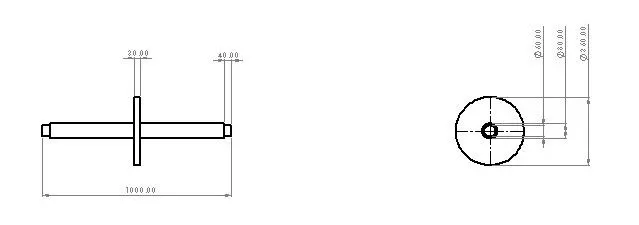
The following dimensions are used to create a CAD Model of a Roller:
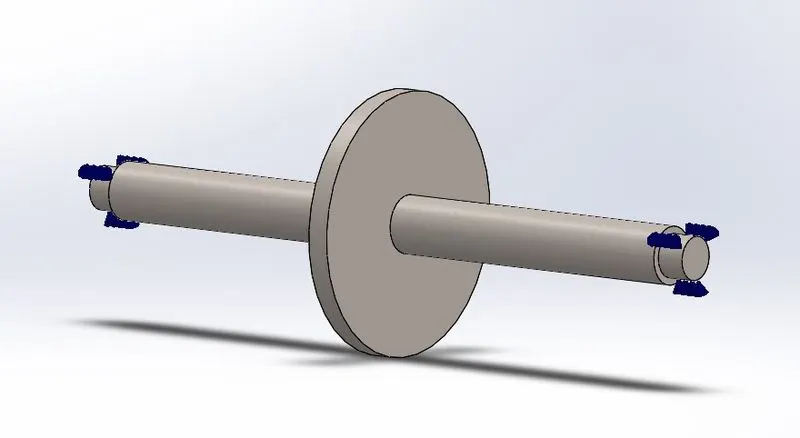
The following model has been created using tools such as Revolve, Boss Extrude etc.
- Generation of Mesh
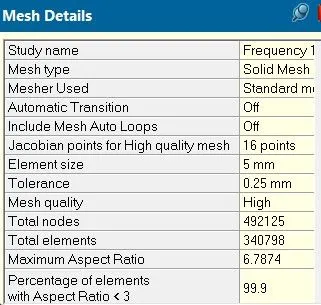
Mesh details are given in the below:
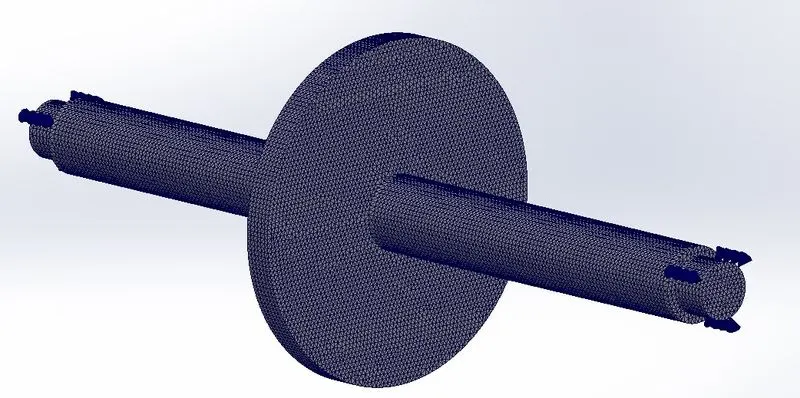
The mesh is applied to the model:
- Assignment of Material properties
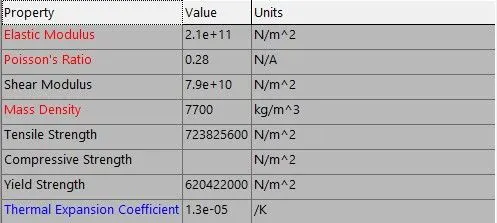
Alloy Steel is applied to the Roller and the following table illustrates the material properties:
- Boundary Conditions
Bearing fixtures are applied to the ends of the stepped ends of the rod.
2. Processing
- The governing equations are applied to the discretized elements and selected variables at selected points are calculated.
3. Post-Processing
- Contours and Modes obtained:
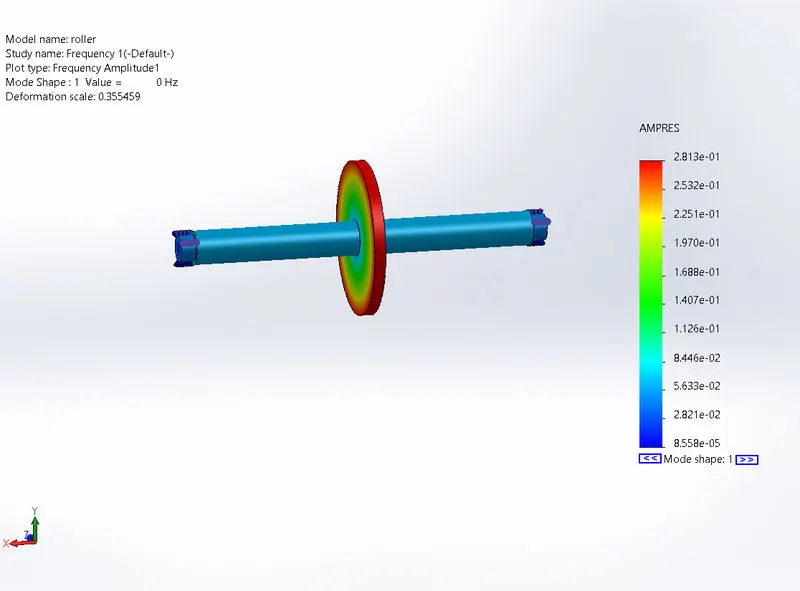
1st Mode:
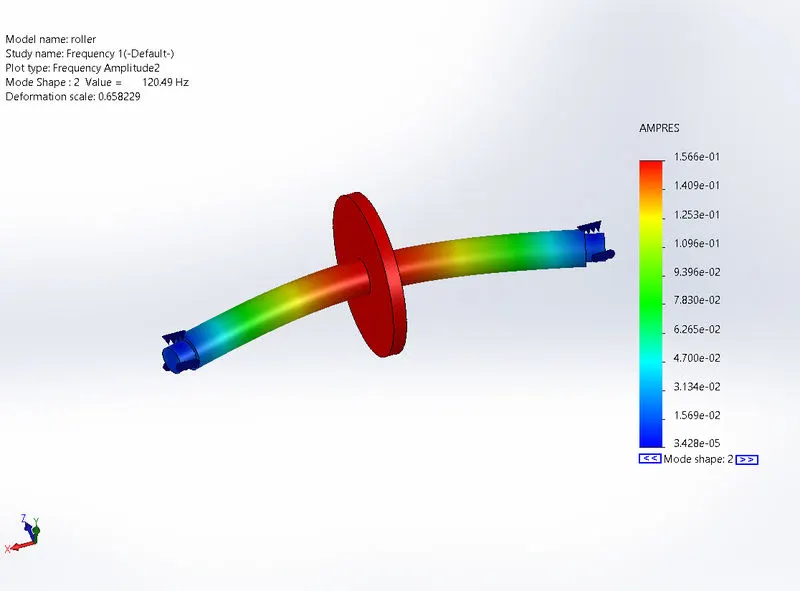
2nd Mode:
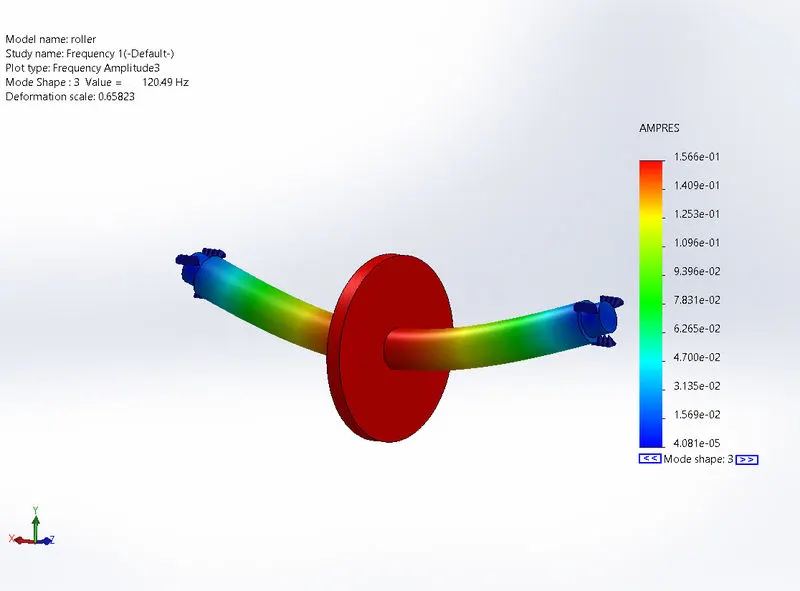
3rd Mode:
4th Mode:
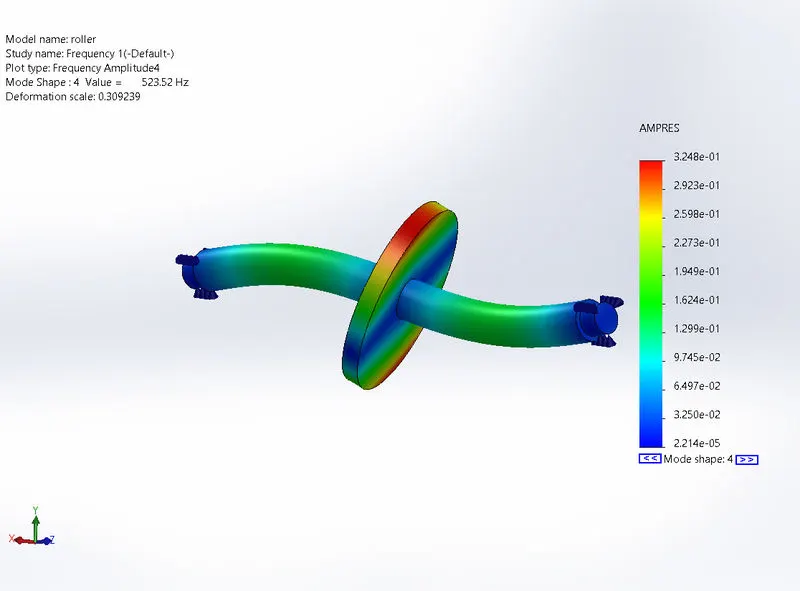
5th Mode:
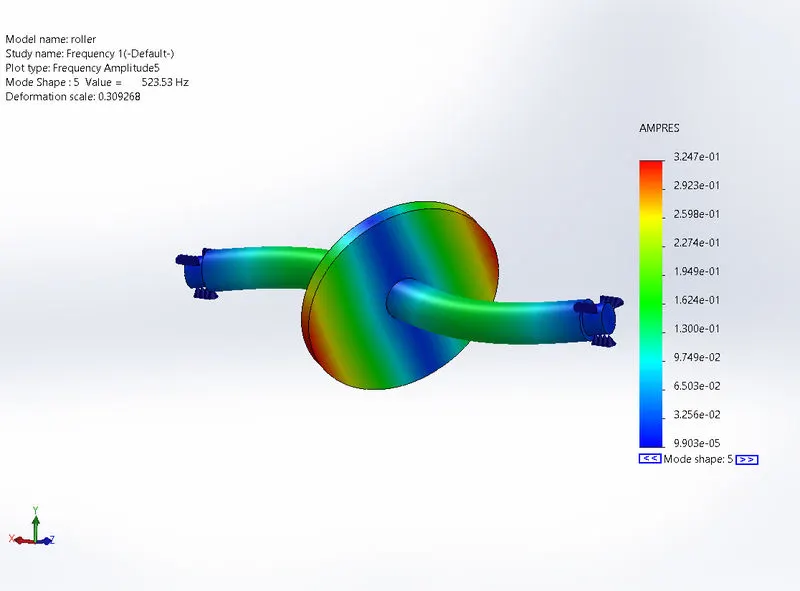
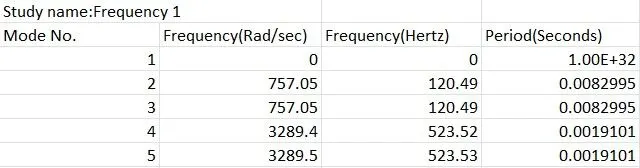
The following tables depict the list of resonant frequencies and the EMP Factors:
Resonant Frequencies:
EMP Factors:
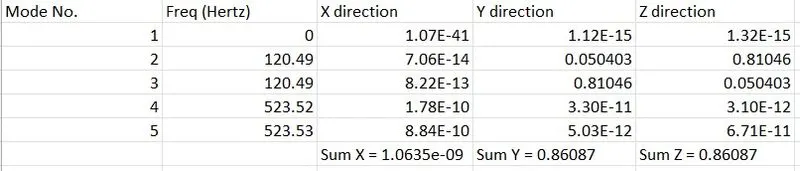
- Interpret the Results
The next section will talk about the conclusions and the results obtained.
Conclusions:
- The first mode shape has very low critical frequency because the plate at the center is placed at one of the antinodes and hence which is not allowing it to have movement in any direction.
- The 2nd mode shape is half-wave and gives the 1st critical mode shape with movement in Y direction which has 2 nodes and 1 anti-node.
- The 3rd mode shape is half-wave and gives the 1st critical mode shape with movement in X direction which has 2 nodes and 1 anti-node.
- The 4th mode shape is full-wave and gives 2nd critical mode shape with movement in the Y direction which has 3 nodes and 2 antinodes. Here with mode shape 4 (the full-wave), the motion is all in the global Y direction.
- The 5th mode shape is full-wave and gives 2nd critical mode shape with movement in the X direction which has 3 nodes and 2 antinodes. Here with mode shape 4 (the full-wave), the motion is all in the global X direction.