Flow over a cylinder
AIM :
- To calculate the baseline case Reynolds number.
- To run a baseline simulation and then calculate the Reynolds number and then to increase the Reynolds number by a factor of 20%, 40%, and 100% then run the transient flow simulation.
- To calculate simulation end time properly
- To create animations for pressure-velocity for all the three Reynolds number.
- To explain the observations.
THEORY :
Reynold's number:
The Reynolds number helps predict flow patterns in different fluid flow situations. At low Reynolds numbers, flows tend to be dominated by laminar flow, while at high Reynolds numbers flows tend to be turbulent
Re = rho*U_inlet*D/mu
D = cylinder diameter
mu = dynamic viscosity
rho = density
External flow:
The flow of an unbounded fluid over a surface is treated as external flow.
Parameters:
| Diameter of cylinder | 0.02 m |
| Lenght of cylinder | 0.04 m |
| Initial velocity | 10 m/s |
| Dynamic viscosity of sir | 1.81 × 10⁻⁵ kg/(m·s ) |
| Density of air | 1.225 kg/m^3 |
Calculation:
Re = (ρVL)/μ
= (1.225 × 10 × 0.02) / (1.81×10⁻⁵ )
| Re = 13535.91 |
Velocity = 10m/s
Flowtime = domain lenght / velocity
=0.04/10
=0.004 s
Endtime = Flowtime × 2
= 0.008 s
If the reynold's number is by 20% ;
Re = 13535.91 × 1.2
= 16243.092
Velocity = 12 m/s
Flowtime = domain lenght / velocity
=0.04/12
=0.0033s
Endtime = Flowtime × 2
= 0.0066 s
If the reynold's number is by 40% ;
Re = 13535.91 × 1.4
=18950.27
Velocity = 14 m/s
Flowtime = domain lenght / velocity
=0.04/14
=0.0028 s
Endtime = Flowtime × 2
= 0.0057 s
If the reynold's number is by 100% ;
Re = 13535.91 × 2
= 27071.82
Velocity = 20 m/s
Flowtime = domain lenght / velocity
=0.04/20
=0.002 s
Endtime = Flowtime × 2
= 0.004 s
Procedure:
STEP 1:
Open a new part workpage and set the plane . Set the unit in mks
STEP 2:
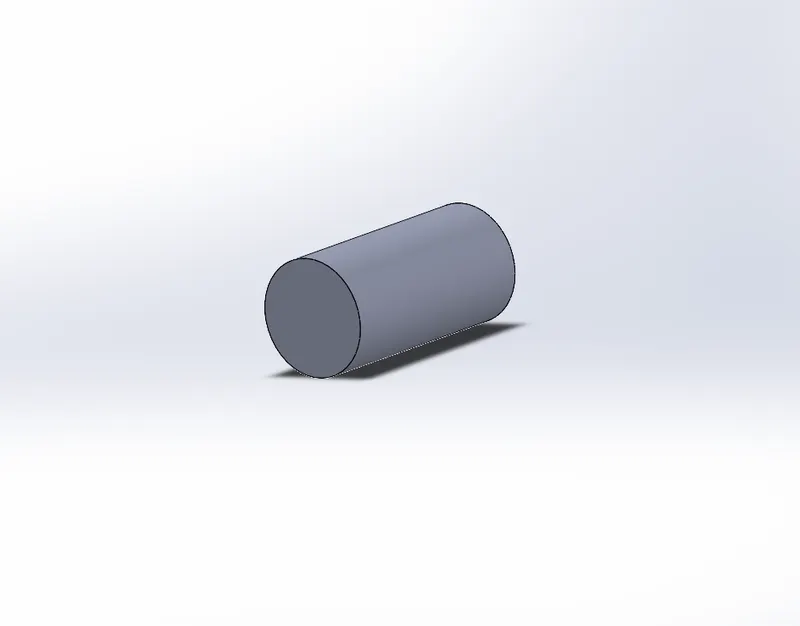
Design a cylinder of lenght 0.04 m and diameter 0.02 m
STEP 3 :
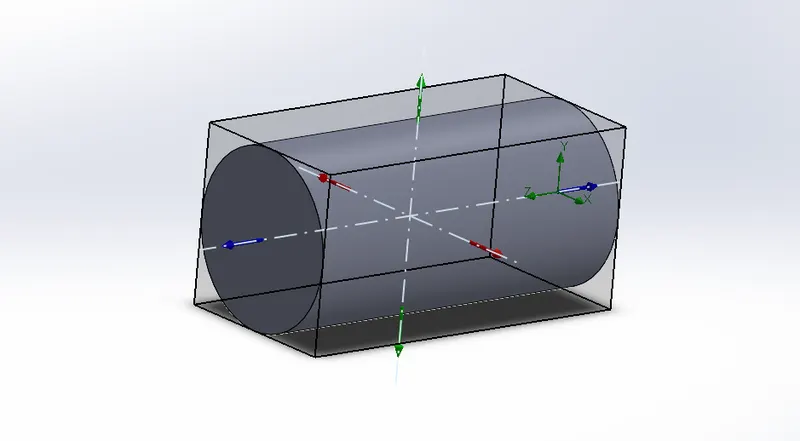
Open flow simulation in solidworks. And now we have to define the project in flow simulation.To achieve that we are using wizard option . The following table is being defined using wizard option,
| Project name | flow over a cylinder |
| Analysis type | external |
| Type of fluid | air |
| Type of flow | Laminar and turbulent |
| Time dependent | Total analysis time =0.08s Output time setup= 0.08s |
| Velocity parameter | velocity in x direction = 10 m/s velocity in y direction = 0 velocity in z direction = 0 |
| Thermal condition | Adiabatic wall |
| Roughness | 0 micrometer |
STEP 5:
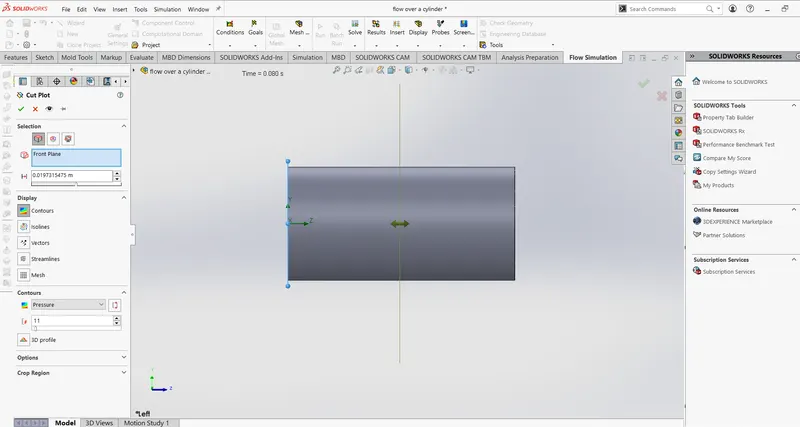
Creating cut plane at the middle of the cylinder.
STEP 6:
Run
RESULT:
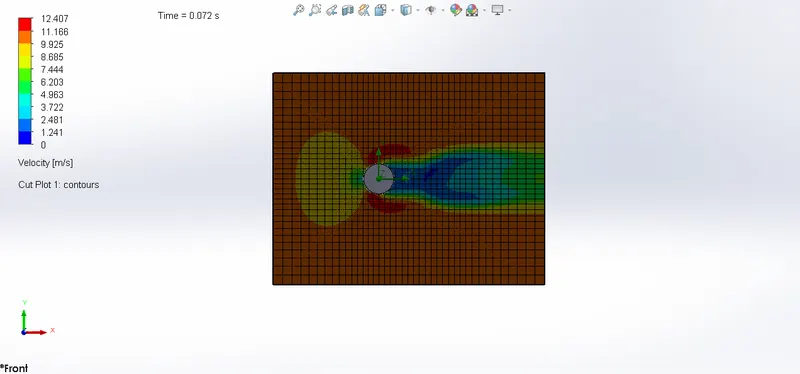
For baseline study
VELOCITY ,
animation,
Pressure;
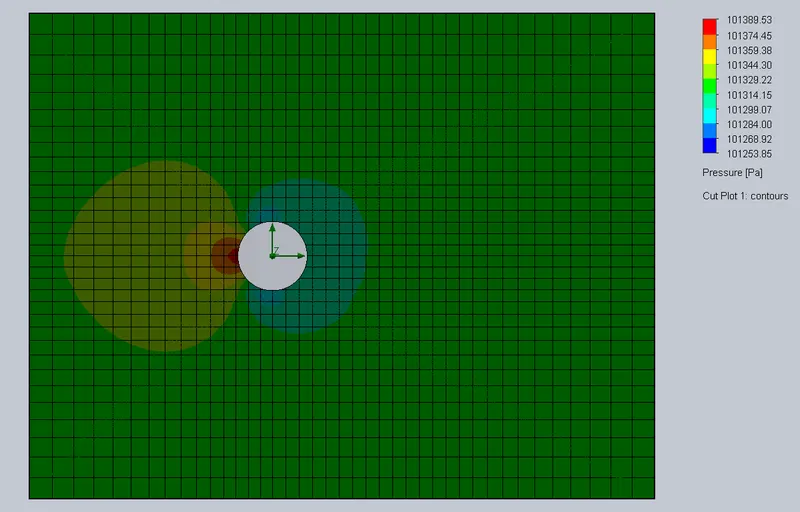
animation ;
CASE 1
If the reynold's number is by 20%
Velocity;
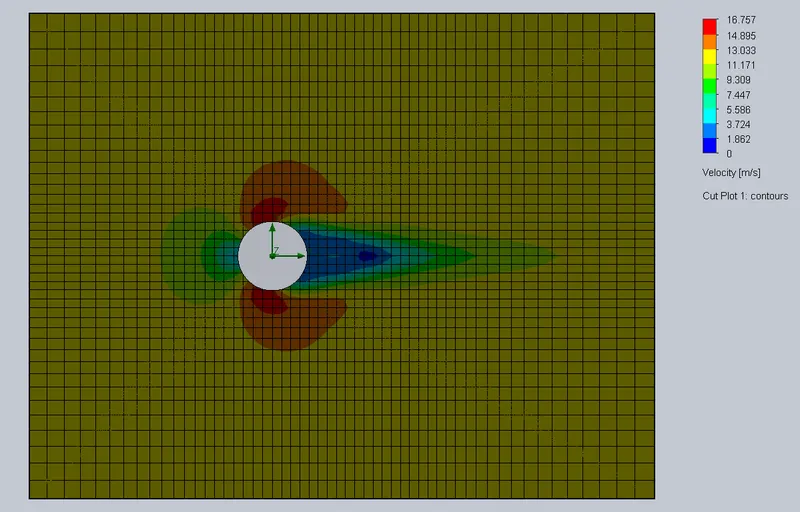
animation;
Pessure;
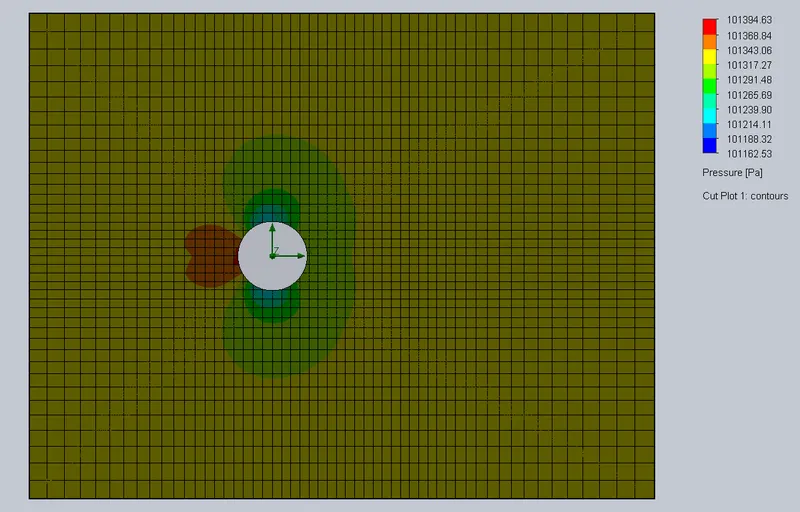
animation;
CASE 2
If the reynold's number is by 40%
Velocity;
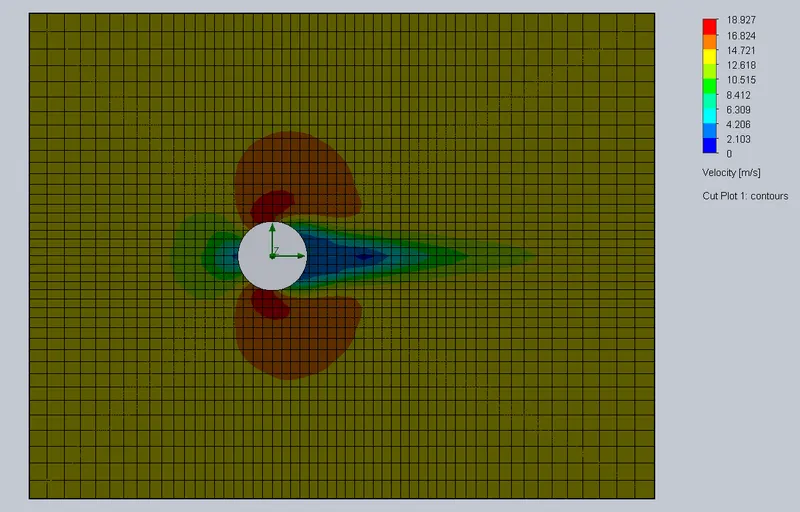
animation;
Pessure;
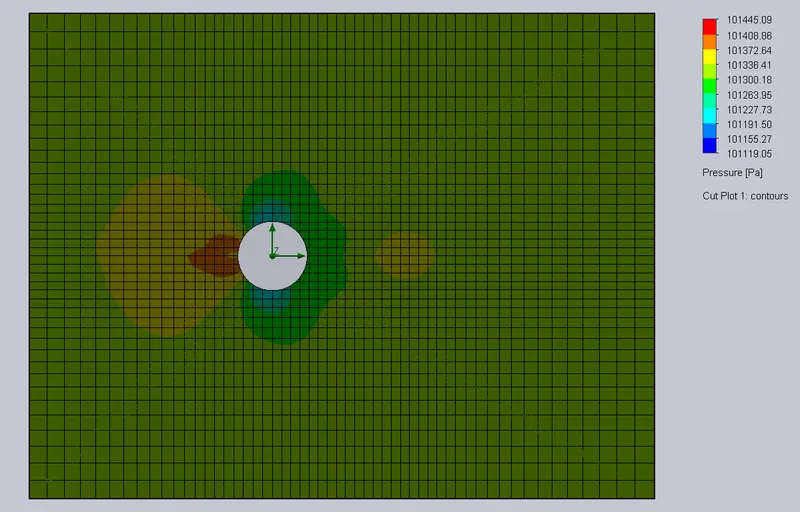
animation;
CASE 3
If the reynold's number is by 100%
Velocity;
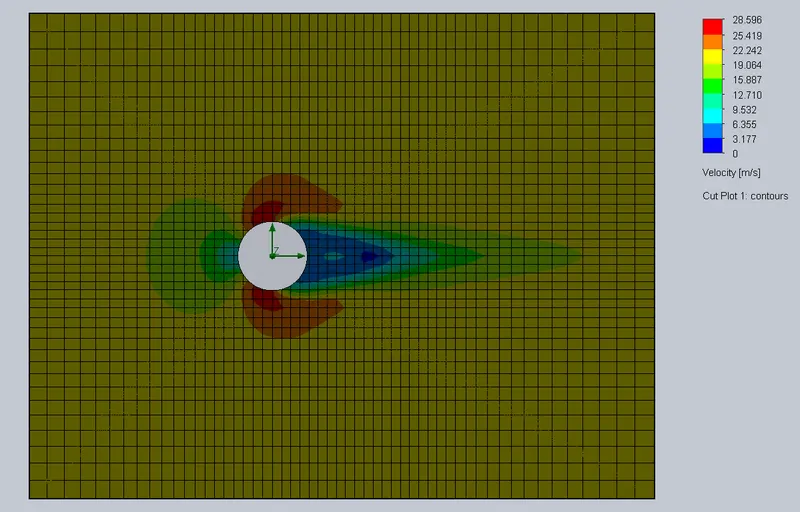
animation;
Pessure;
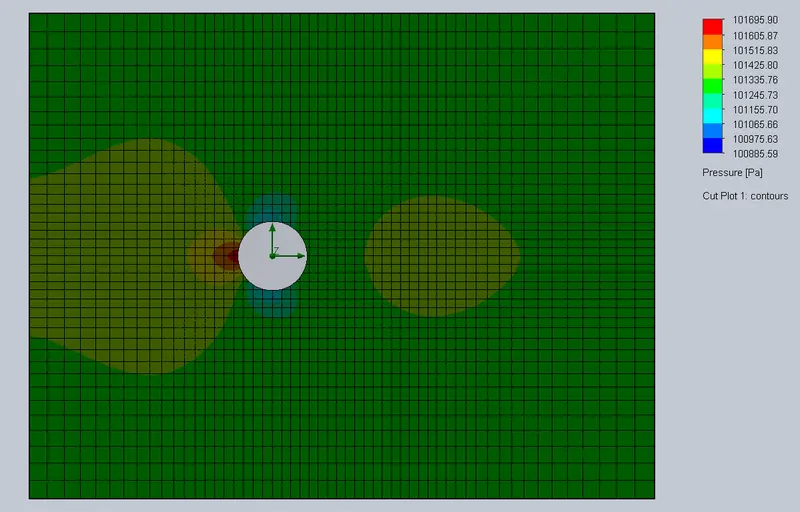
animation;
CONCLUSION :
- As the Reynold's number increases the velocity increases and the flowtime decreases.
- Pressure are higher near the wall of the cylinder and becomes less as it goes away from the cylinder
- As the Reynold's number increases the flow over a cylinder becomes steady flow . That is when the Reynold's number is increased by 20% , 40% the flow is unsteady and when the Reynold's number is increased by 100% the flow becomes steady.