Final Project: Electric Rickshaw modelling
MATLAB Modelling of an Electric rickshaw
AIM
To Create a detailed MATLAB model of an electric rickshaw (three wheel passenger vehicle) as per details below:
Rear wheels driven by PM brushed type motor
Assume efficiency points of motor controller and motor
Make an excel sheet of all input and assumed data
Results: For any three standard driving cycles show energy consumption, temperature rise of motor and controller for 100 km constant speed driving at 45 kmph.
DESCRIPTION
An auto rickshaw is a motorized version of the pulled rickshaw or cycle rickshaw. Most have three wheels and do not tilt. They are known by many terms in various countries including auto, auto/auto rickshaw, baby taxi, pigeon, bajaj, chand gari, lapa, tuk-tuk, Keke-napep, 3wheel, pragya, bao-bao or tukxi.
The auto rickshaw is a common form of urban transport, both as a vehicle for hire and for private use, in many countries around the world. They are especially common in countries with tropical or subtropical climates, since they usually are not fully enclosed, and in many developing countries because they are relatively inexpensive to own and operate. As of 2019, Bajaj Auto of Pune, India is the world's largest auto rickshaw manufacturer, selling 780,000 during the fiscal year.[1]
There are many different auto rickshaw designs. The most common type is characterized by a sheet-metal body or open frame resting on three wheels; a canvas roof with drop-down side curtains; a small cabin at the front for the driver (in India, the auto-wallah or tuktuK-wallah), with handlebar controls; and a cargo, passenger, or dual purpose space at the rear. Another common type is a motorcycle that has an expanded sidecar or, less often, is pushing or pulling a passenger compartment.
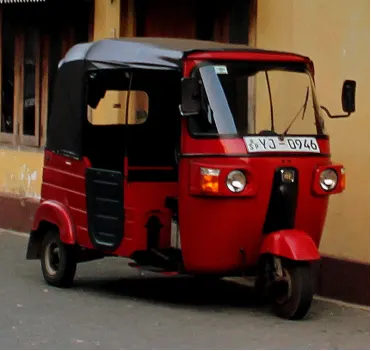
Instead of going with the regular IC engines. By using the the Electric motor for Torque we can convert the Rickshaw to an electric rickshaw.
MODELING
To model Any Vehicle we need to Calculate power required to run the vehicle. Here are th assumption and calculation of power requirement of the vehicle. Click here to get the Excel of power calculations.
| Power Calculation | |
| Rollong resistance calculations | |
| Kerb Weight (kg) | 680.00 |
| payload(kg) | 370.00 |
| total weight(kg) | 1050.00 |
| coefficient of rolling resistance | 0.013 |
| rolling resistance force(N) | 133.77 |
| speed(KMPH) | 45.00 |
| power for rolling resistance(KW) | 1.67 |
| air drag calculations | |
| air density (kg/m^3) | 1.18 |
| width (m) | 1.37 |
| height(m) | 1.73 |
| frontal area | 2.36 |
| Drag coefficient | 0.30 |
| air drag force (N) | 65.36 |
| air drag power | 0.82 |
| hill climbing calculations | |
| hill climbing angle | 10.00 |
| speed during hill climbing | 15.00 |
| hill climbing force | 1786.84 |
| power for hill climbing | 7.45 |
| acceleration calculations | |
| top speed | 70.00 |
| time | 40.00 |
| acceleration | 0.49 |
| power for acceleration | 4.96 |
| Total Power(Kw) |
14.90 |
From the Above calculation motor capacity as below
|
Motor Specifications |
|
|
Voltage |
48V |
|
max Power |
15 KW |
|
speed at peak power |
5000 RPM |
|
Type |
Permenent Magnet DC motor |
|
Battery Specifications |
|
|
Voltage |
48V |
|
Capacity |
250 Ah |
Now we have the required capacity for different parts of the vehicle lets model the Rickshaw as below
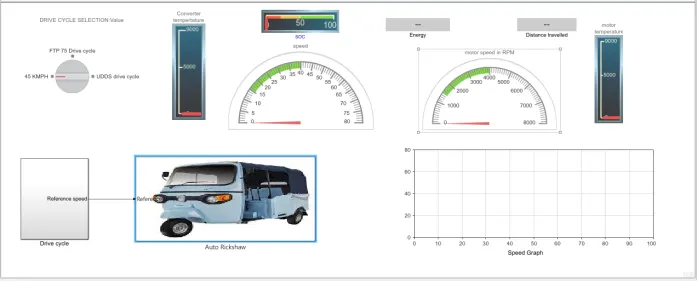
In the dash board there are Drive cycle, Auto rickshaw model, Knob for changing the drive cycle, Motor temperature reader , speedometer, SOC indicator, energy consumed display, motor RPM indicator, Distance Travelled display and converter temperature indicator.
Inside the drive cycle system is as below.
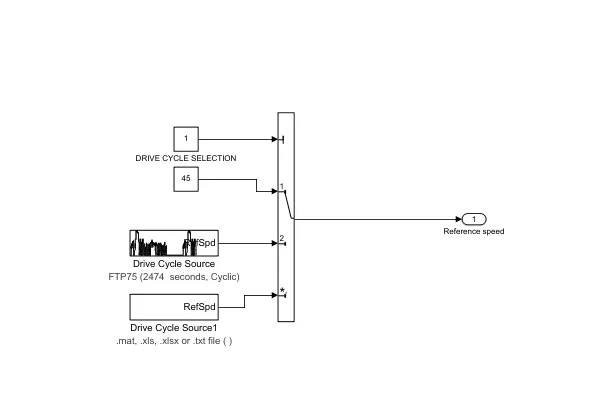
By varying the drive cycle knob we can select the drive cycle required.
In the model of the auto rickshaw there are various sub systems as below
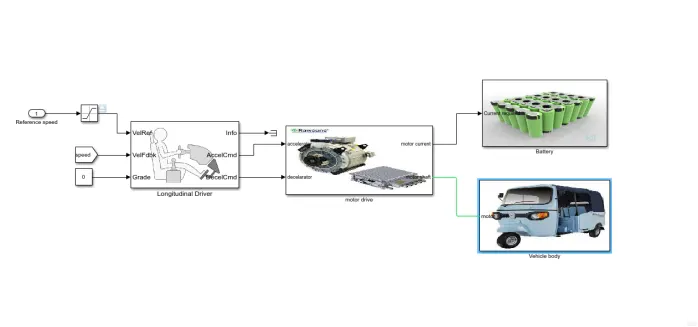
In the Auto rickshaw there are
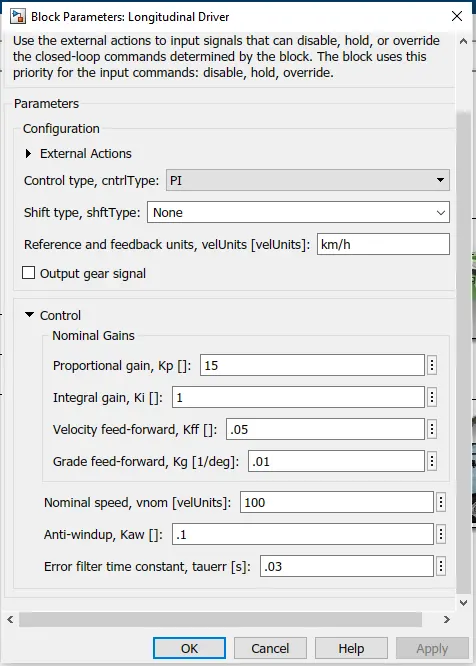
- Longitudinal driver: longitudinal driver block will generate the accelerator command and deceleration command based on the input speed, reference speed and grade.
Block parameters are as shown below
- Motor drive subsystem:
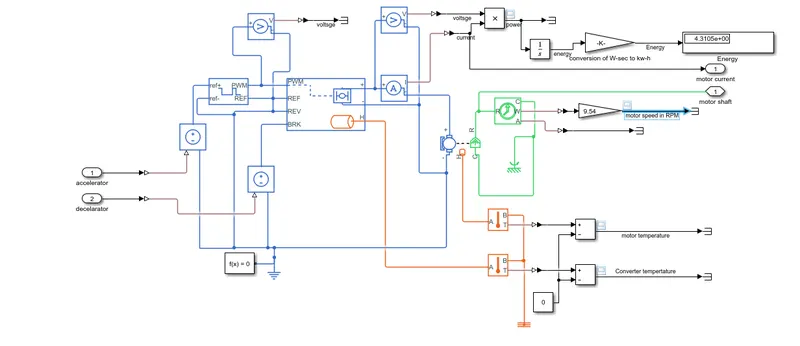
Motor drive Mainly has three components
> PWM generator: it will generate the PWM pulses based on the driver accelerator command.
>H bridge: it will work as DC DC converter and changes the voltage based on the pwm pulses from PWM generator.
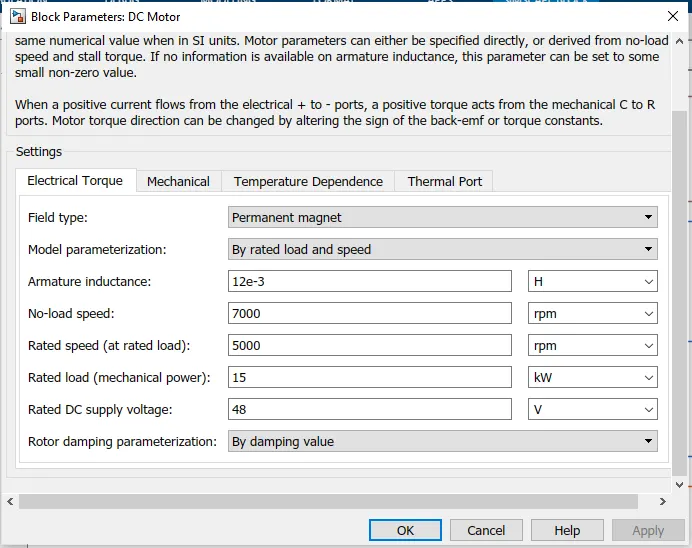
>Motor: this block will convert the electric energy to the rotational energy. For the traction power requirement. Motor block parameters are as shown below.
Outputs from the motor drive system are motor shaft output and Current required for motor.
- Vehicle Body:
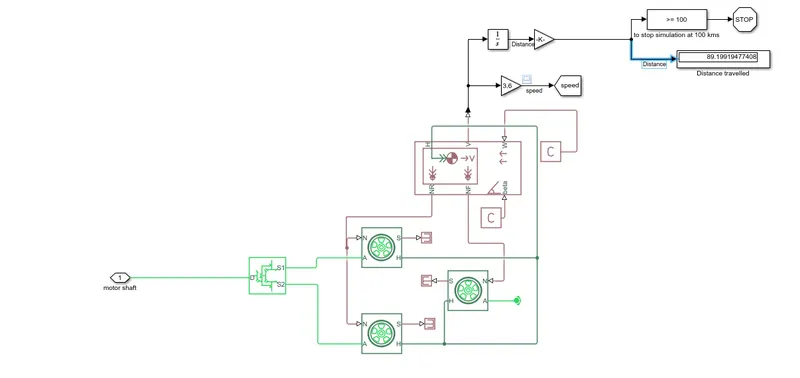
Vehicle body will have the differential gear, tires and vehicle body.
Shaft output from the motor is given to the Differential gear from which rear wheels will get the traction power.
Front wheel will given to the free end. All the wheels are connected to the vehicle body.
From the vehicle body we will get the Velocity in m/sec. Which need to converted into KM/h.
Here I am used the compare and stop simulation block to stop the simulation if the distance is 100 KM
SIMULATION
Simulation will run in three modes.
- With constant 45kmph speed for 100 km
> After running the simulation results are as shown below
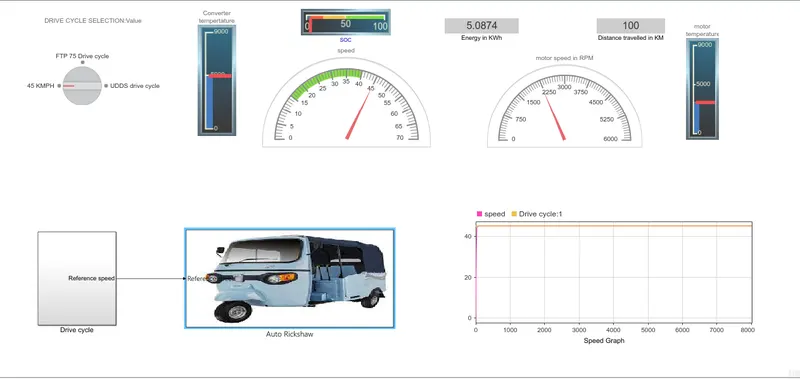
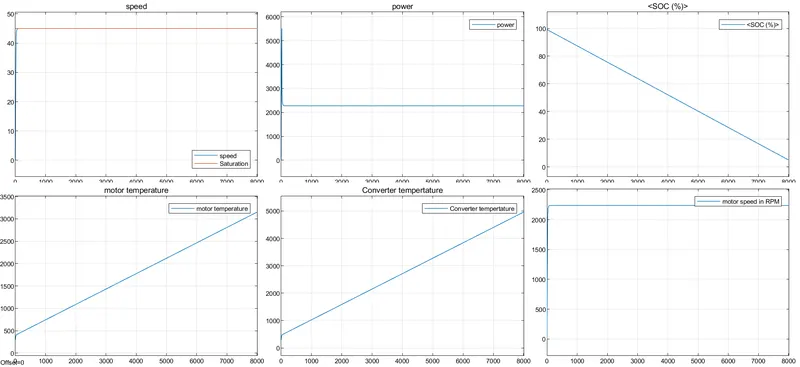
From the above simulation we can observe that at a constant speed after the 100 KM covered the there is still some charge left in the battery. Since we don’t have the cooling system the temperatures of motor and converter is raised above the limits.
- Simulation with FTP-75 drive cycle
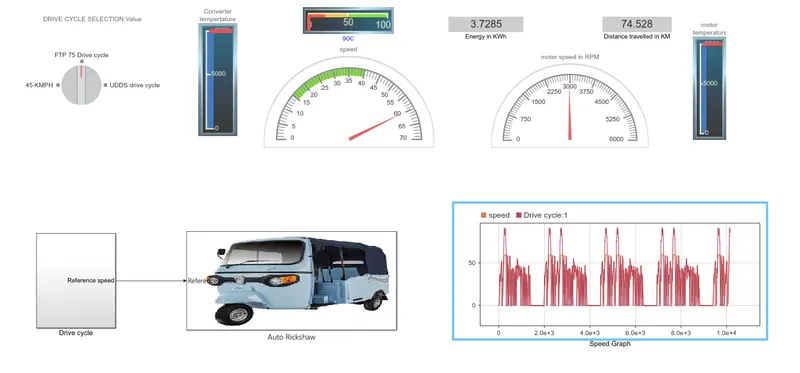
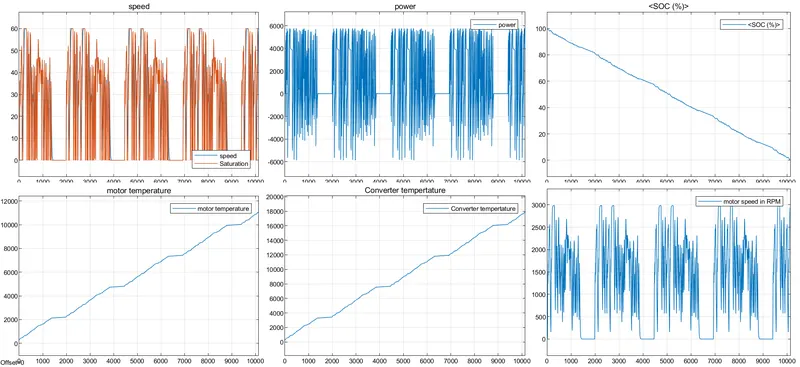
From the above results we can notice that at the higher speeds efficiency of the motor is low. The motor and converter temperature is also raising very high.
- Simulation with UDDS drive cycle
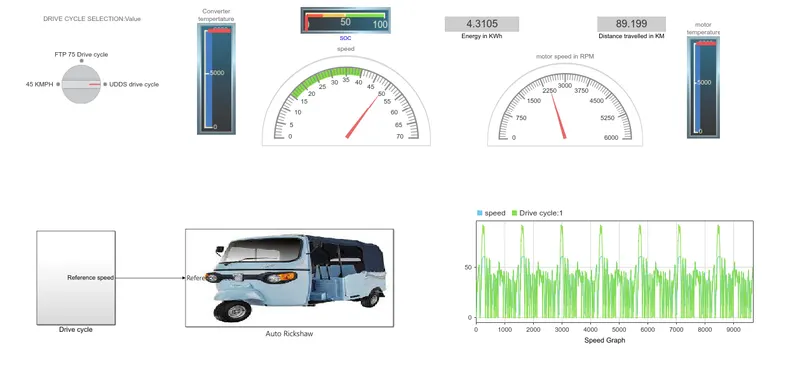
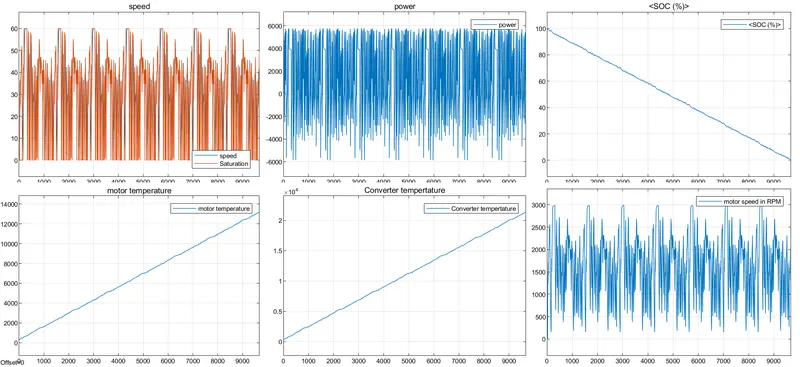
From the above three simulation results we can observe that with constant 45 kmph simulation the range is above 100km but practically speed is not constant. With the Ftp75 drive cycle the range is 74 km and range with the UDDS drive cycle range is 89 km. So we can conclude that the electric auto is best in urban areas.
RESULTS
Create a detailed MATLAB model of an electric rickshaw (three wheel passenger vehicle).
LINK FOR PROJECT FOLDER
https://drive.google.com/drive/folders/1GuXFL-rJOKIAO1TLnsB2MP5UGPqZYNyB?usp=sharing