Fender Design - Wheel Arch Challenge
What Is a Fender on a Car?
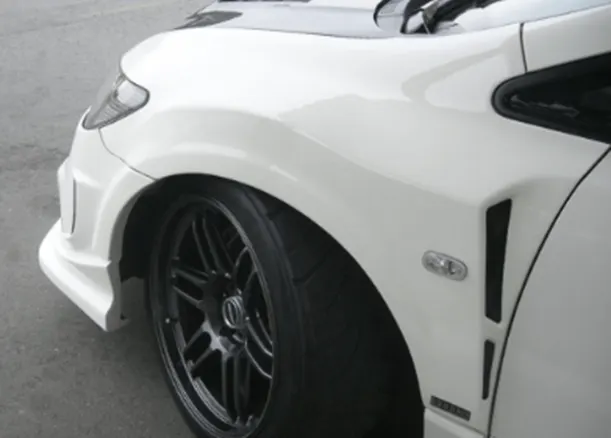
- A fender is the part of a car, truck, motorcycle, or other vehicles that frames or covers a wheel well. Its main purpose is to prevent debris, rocks, mud, liquids, sand, and other road debris from getting thrown in the air while the tires rotate.
- The “fender” typically refers to the front panel that covers the front wheels, and the “quarter panel” typically refers to the rear panel that covers the wheel that also includes the roof pillar. The “bumper” is the front and rear ends of a motor vehicle to absorb impact in a minor collision.
How Car Fenders Offer Protection
Driving will be very messy if your car doesn’t have fenders that house the wheel wells. The tires of your car spin fast when you drive. As they rotate, they catch moisture and debris from the pavement and spray them into the air.
The tire’s kinetic energy ejects these foreign matters into the air at high velocities. As this thing is happening, the moisture and debris that fly in the air can cause the following to happen:
- Get other vehicles or pedestrians on the road side dirty
- Hurt pedestrians
- Scratch the bodies of other vehicles
- Cause minor, and even major damage to other vehicles
These are some of the reasons why your car should have fenders. They catch the dirt, moisture, and debris and prevent them from hurting people and causing damage to other vehicles on the road. Fenders are there to contain these foreign materials within the confines of your car.
Wheel Arch Design Regulation
Japan Regulation: -
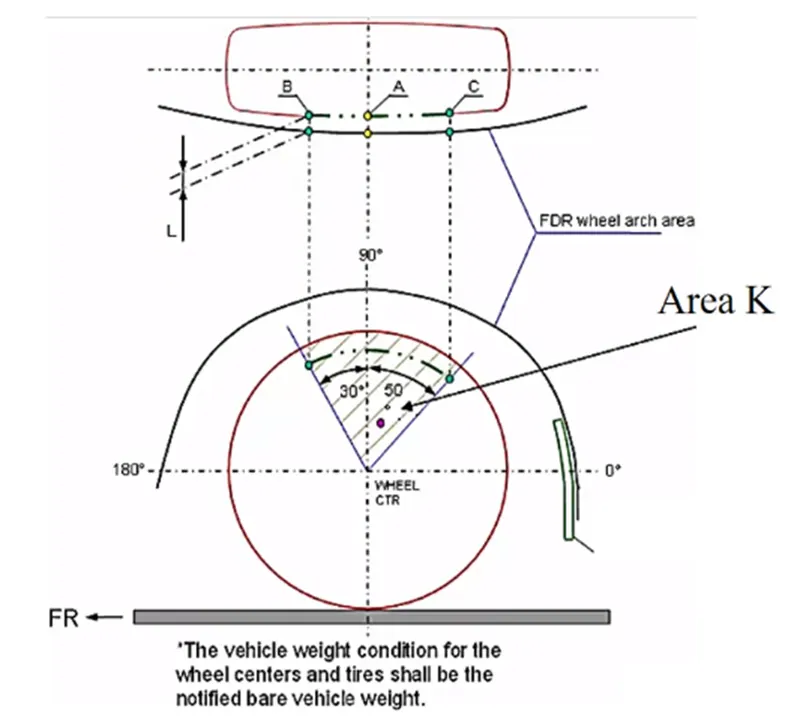
- Measure clearance L of tire, hub, cap and fender in three different positions within area K and produce clearance check chart to validate.
- Clearance must be greater than 5mm in all the three positions.
- Wheel guard requirement: The value of a shall be more than 5mm min at a line 30° forward and 50° rearward from the central vertical axis of axis of wheel.
European Regulation: -
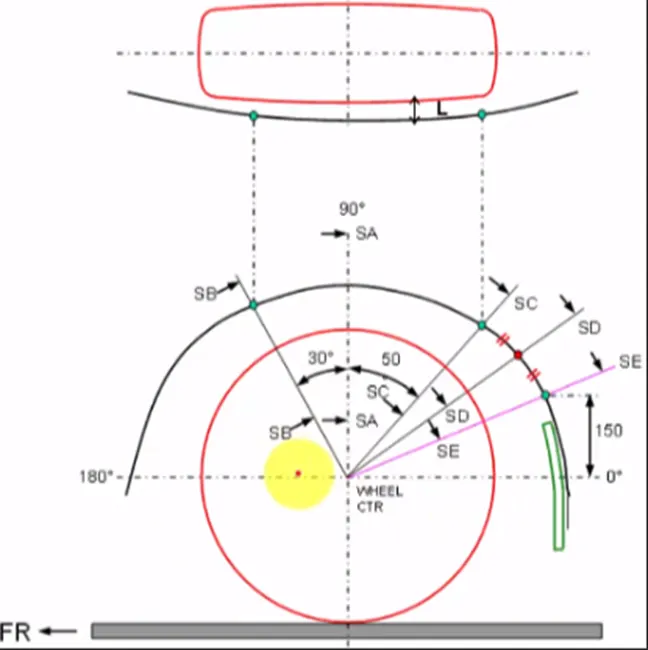
- Measure CL L at sections SA-SA SB-SB SC-SC SD-SD SE-SE and produce CL check chart to validate.
- At all five sections the CL L value should be greater than 10 mm to satisfy the European regulations.
- Wheel guard requirement: The value of A shall be more than 5mm at a line 30° forward and 50° rearward from the central vertical axis of axis of wheel.
US Regulation: -
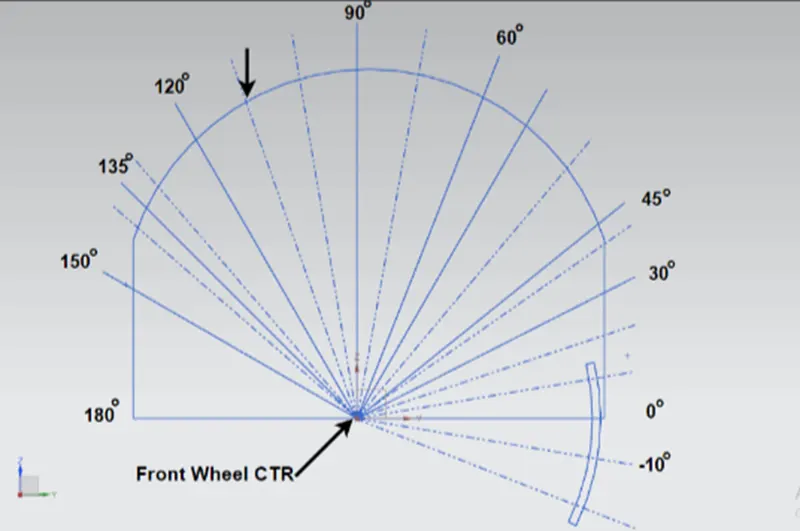
Challenge Analysis
Commands used for analysis: -
- Datum Plane: - To create datum plane at our most surface of tyre for sketch.
- Line: - To draw line with desire dimensions.
- Point: - To give point for geometry where required.
- Geometry Constraint: - To match line with centre of tyre surface
- Derived Lines: - To draw line which is equally distance between other two lines.
- Project curve: - To project points on Fender Wheel arc surface.
- Measure Distance: - To measure distance between points.
Sketch according to European Standard Criteria: -
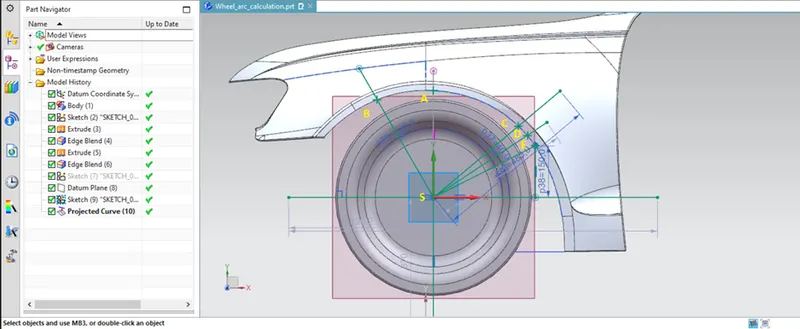
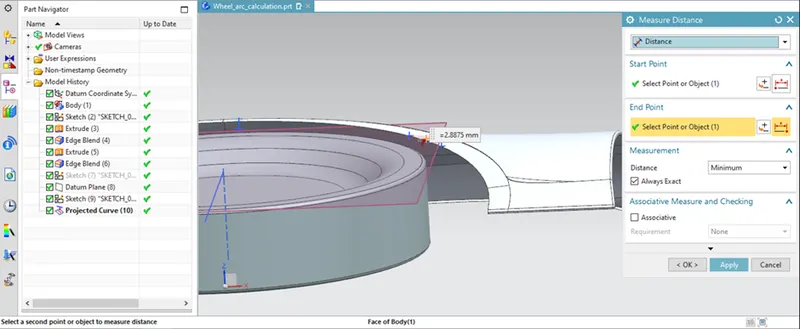
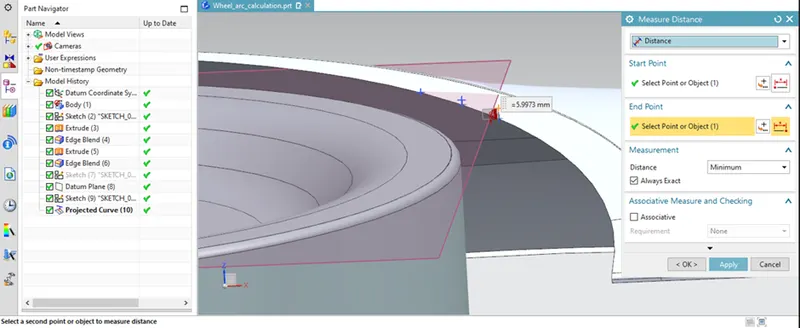
Image of Distance measured between Arc and Wheel: -
- SA
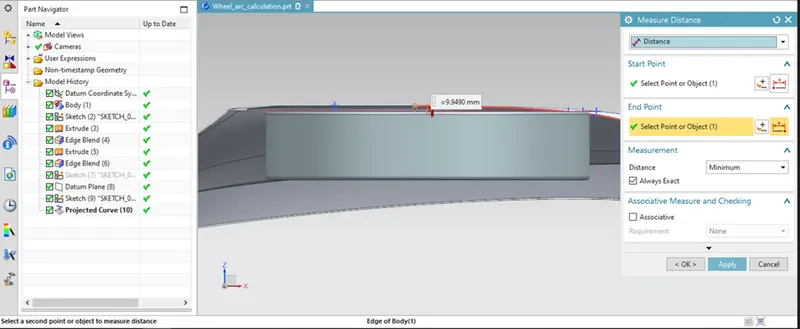
- SB
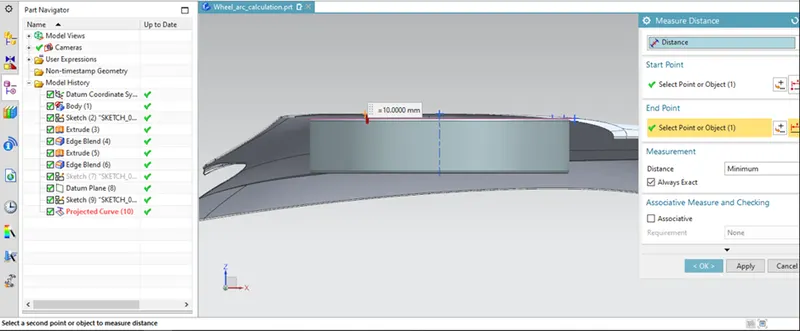
- SC
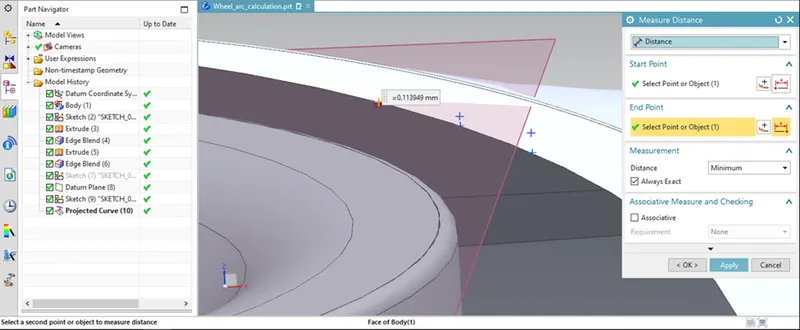
- SD
- SE
Dimension Table: -
| Sr No. | Point Name | Distance (L) |
| 1 | SA | 9.9490mm |
| 2 | SB | 10.0000mm |
| 3 | SC | 0.1139mm |
| 4 | SD | 2.8875mm |
| 5 | SE | 5.9973mm |
Conclusion: -
- As per European Standard we must need distance between wheel arch and tyre above 10mm.
- Here we can see that distance is near 10mm for point A and B only.
- But for point C and D distance is going below 10mm.
- While for point E, distance is definitely less than 10mm and also it is negative value because tyre outer surface is at outside of wheel arch. So, it is also not OK as per standard requirement.
- After above all statement we can conclude that given Fender design is not follow European Standard Regulation for Fender Wheel Arch.