Fender Design - Wheel Arch Challenge
Fender Design - Wheel Arch gap calculation
INTRODUCTION
- Fender-
Fenders are panels on a car that are located on the sides of the car in front of the doors. They serve a number of functions, not least of which is aesthetic. Drivers may be most familiar with the fender in the context of a “fender-bender,” a minor accident in which the fenders of a car are dented or damaged as a result of a collision. Many cars have been designed with easily replaced fenders because such collisions are quite common.
One of the primary functions of a fender is to keep dirt, dust, and road debris away from the wheel and front braking system. Many have small flaps or wings that are designed to enhance this protective function. The fender will also help to keep debris off of the rest of the car as well, which be useful when a car throws up a rock or stick from the road.
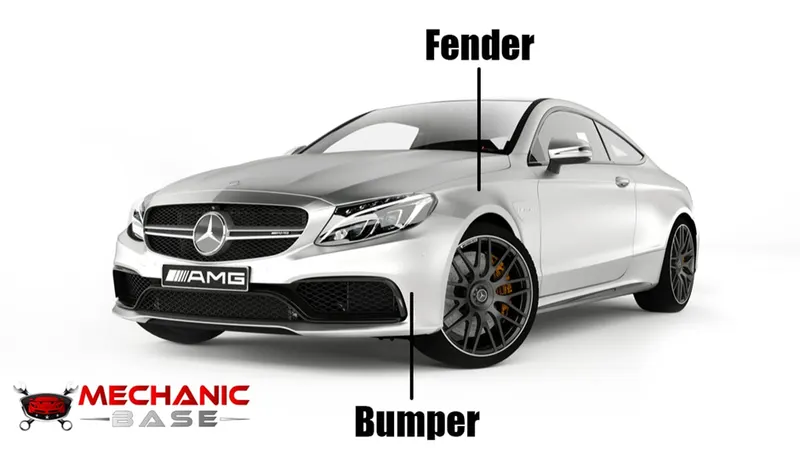
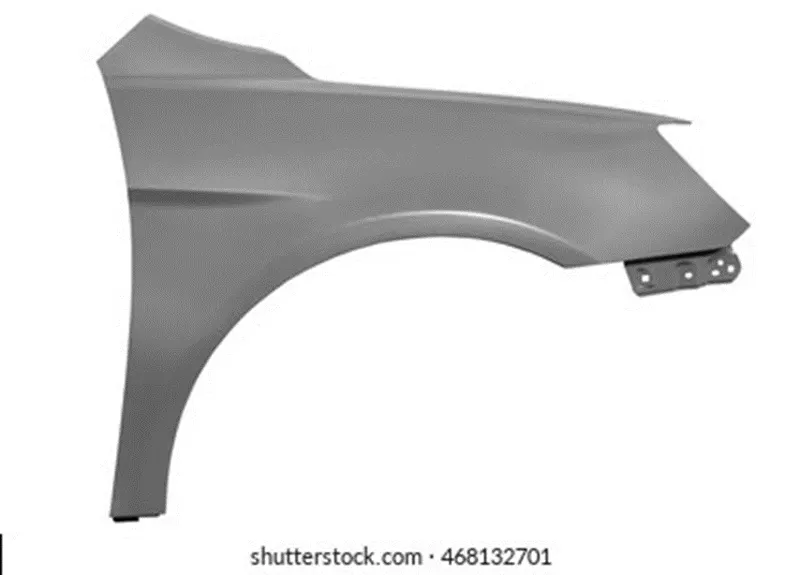
- Wheel arch-
The wheel arch is an arch-shaped cavity in the body of a vehicle, which houses a wheel. It has two important functions. It serves for the safety of pedestrians and other cars because the wheel is situated in the body of a vehicle.
The second function is to protect the car from the sticky materials, such as mud, may adhere to the smooth outer tire surface, while smooth loose objects, such as stones, can become temporarily embedded in the tread grooves as the tire rolls over the ground. These materials can be ejected from the surface of the tire at high velocity as the tire imparts kinetic energy to the attached objects. For a vehicle moving forward, the top of the tire is rotating upward and forward and can throw objects into the air at other vehicles or pedestrians in front of the vehicle.
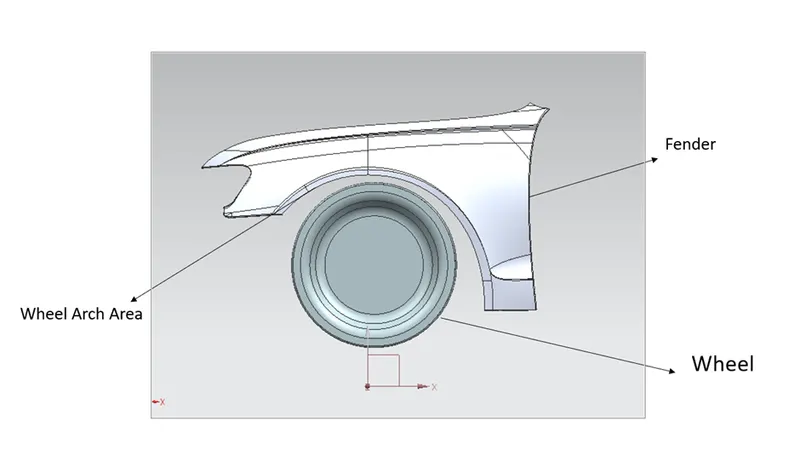
Fender wheel arch regulation-
- Japanese standard-
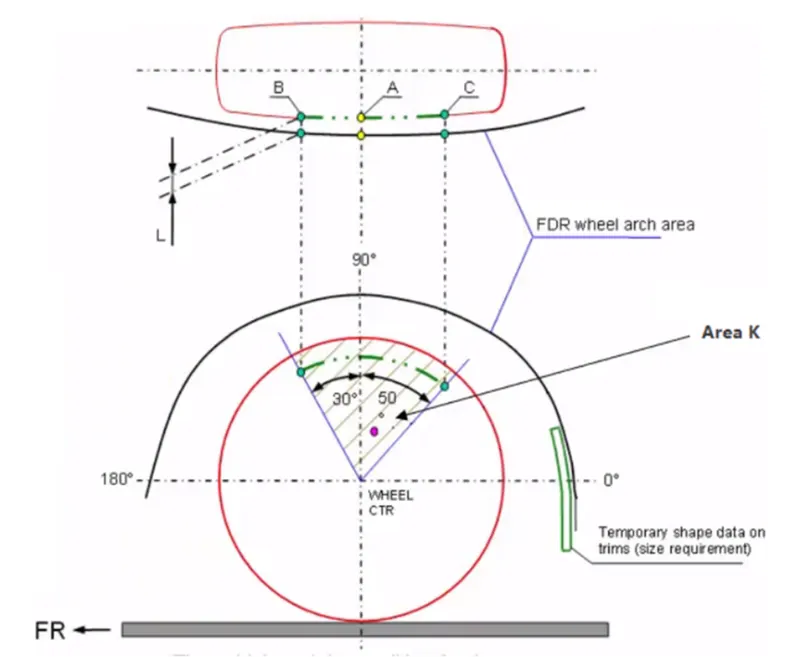
- The clearance "L" for tire, hub, cap and fender is to be measured within area K and create clearance check chart to validate.
- The value of L should be greater than 5mm at all positions.
- Wheel guard requirement : The value of "a" should be more than 5mm at line 30degree forward and 50degree rearwards from the central vertical axis of the wheel.
- European regulations-
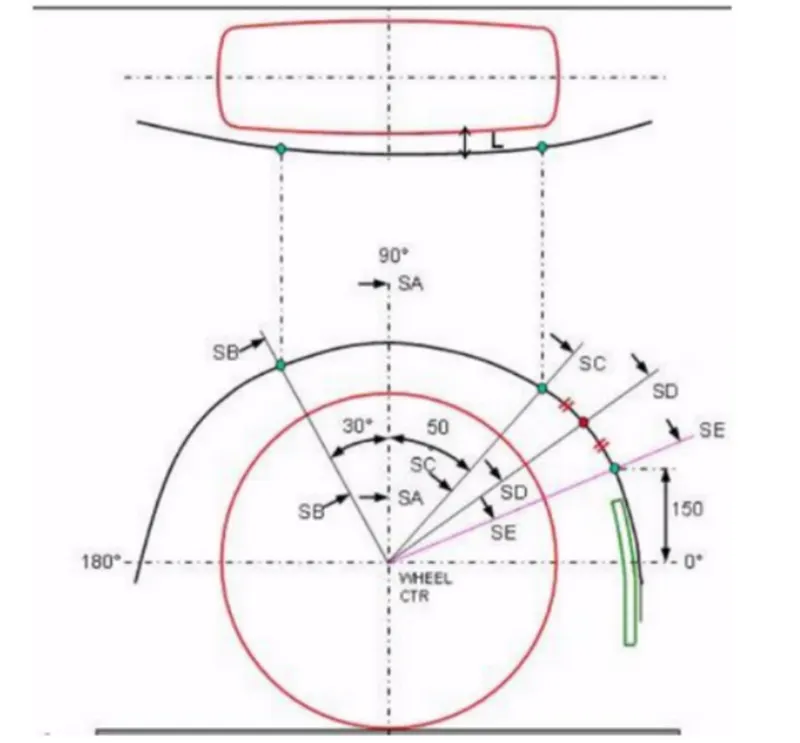
- The clearance "L" should be measured at sections SA-SA, SB-SB, SC-SC, SD-SD and SE-SE and create clearance check chart to validate.
- At all the five sections the value of L should be greater than 10mm to satisfy the European Regulations.
- Wheel guard requirement : The value of "a" should be more than 5mm at line 30degree forward and 50degree rearwards from the central vertical axis of the wheel.
- US Regulations-
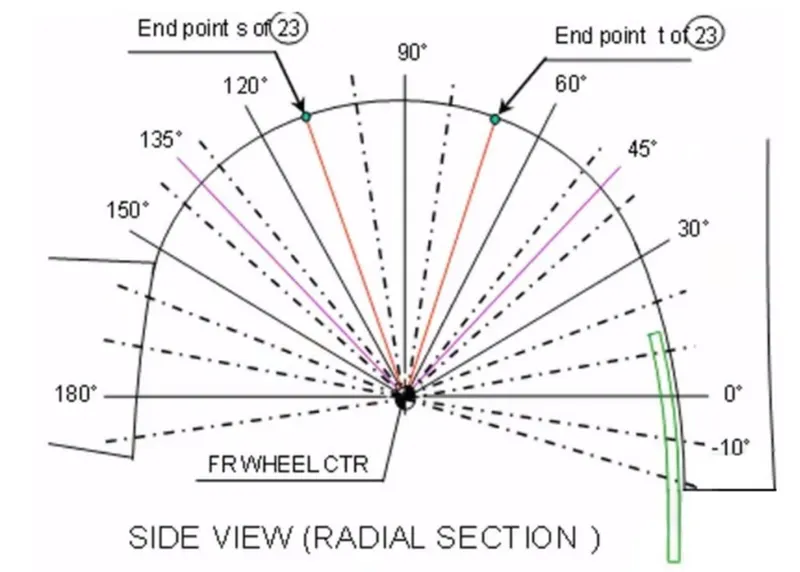
- Clearance "L" is to be checked at all positions from -100degree to 100degree and create clearance check chart to validate.
- The value of L should be greater than 5mm to satisfy the regulations.
- Wheel guard requirement : The value of "a" should be more than 5mm at line 30degree forward and 50degree rearwards from the central vertical axis of the wheel.
Now we will Calculate the Wheel Arch gap at required points and will check whether the car passes the European standard.
Here I have created a sketch for wheel arch gap calculation. In this sketch I have created five lines and five intersections points between the wheel arch curve and lines. And the lines named as A,B,C,D and E respectively.
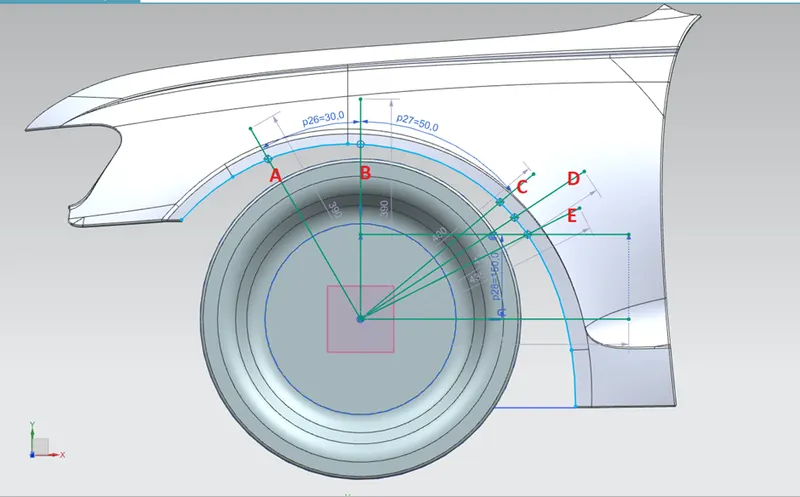
- First of all I have created the Datum plane on the outside surface of wheel.
- Then after I have created a horizontal and vertical lines.
- After that I have created two lines A and C and constrained it with respect to B Line as 30Degree and 50 Degree angle respectively.
- Then after I have taken a offset 150mm of horizontal line on upper direction and projected the wheel arch curve and created a intersection point between these two lines. And create a line on this point.
- After that I have created a bisecting line C and E line.
- Then after I have created the intersection points between lines and wheel arch curve.
- Then after I have projected these 2D points to wheel arch area.
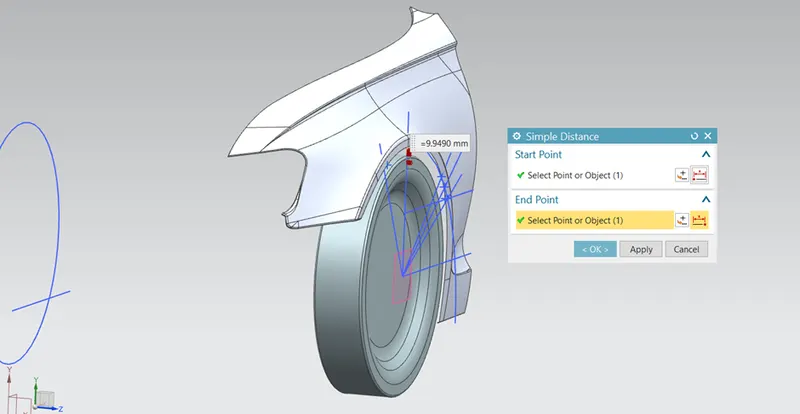
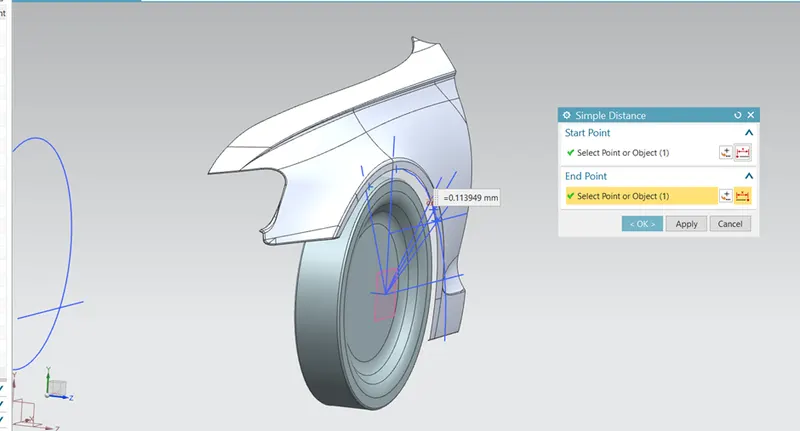
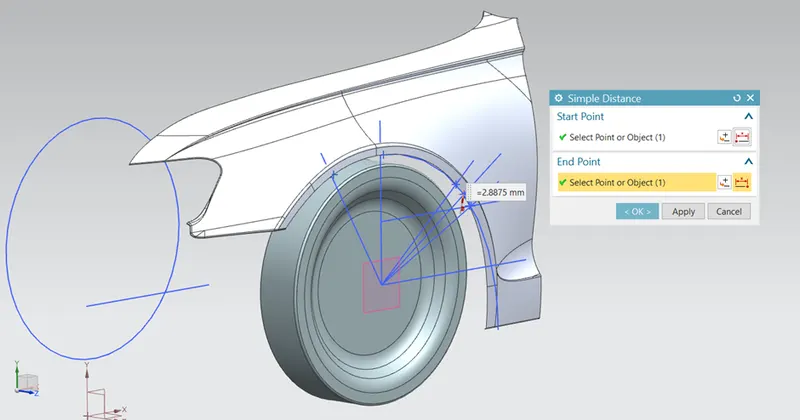
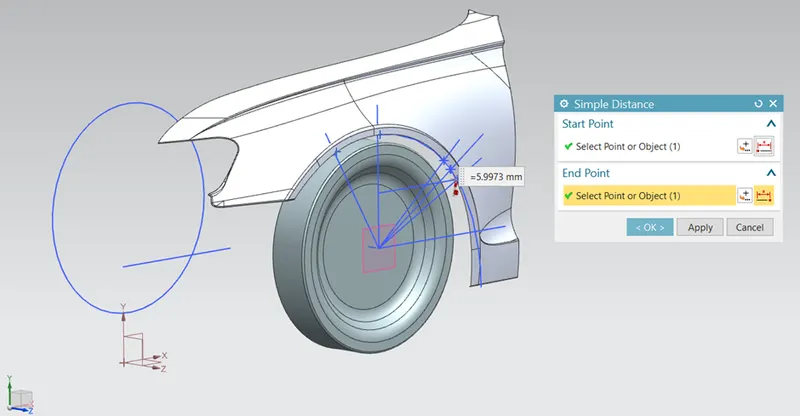
After this measuring the distance then I have got these value which is given below.
- Distance of A-
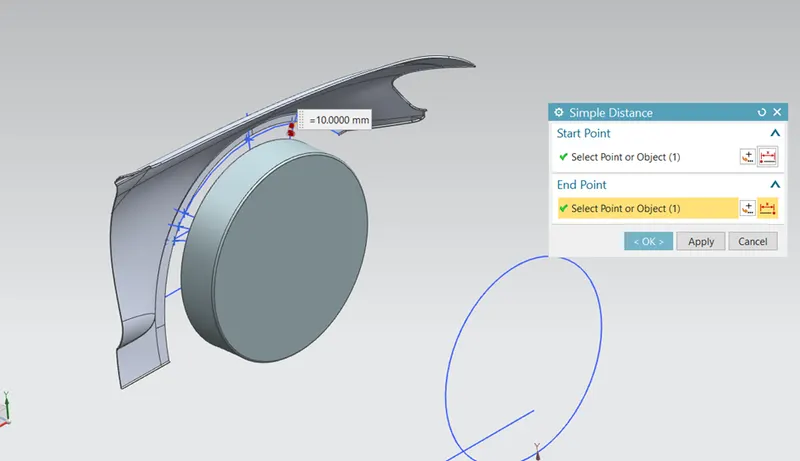
- Distance of B-
- Distance of C-
- Distance of D-
- Distance of E-
- Conclusion
Table of calculations-
|
Name |
Distance in mm>10mm |
Result |
|
A |
10 |
Pass |
|
B |
9.9490 |
Fail |
|
C |
0.113949 |
Fail |
|
D |
2.8875 |
Fail |
|
E |
5.9973 |
Fail |
This value does not lie on the required value then it can not follow the European regulation. It means fender fails.