Fender Design - Wheel Arch Challenge
AIM - To analyisis the Wheel Arc gap and check whether the car passes the European standard.
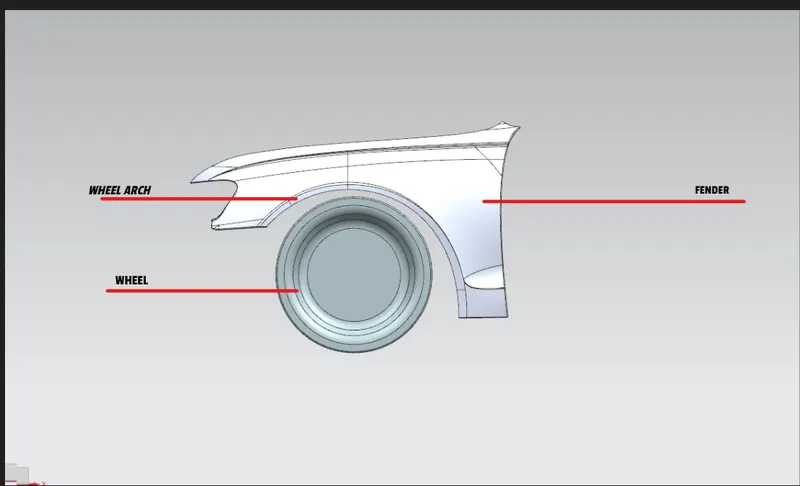
FENDER -
- Fander is an aesthetic part, which is located over The wheels of the vehicles.
- It is used to protect and frames its wheel.
- It keep mud, stones pieces away from tire and pedestrian.
WHEEL ARCH
- It is a semi circular part which is located above the tyre.
- The wheel should be always inside wheel arch
- This will prevent damage to the exterior component of car and engine compartments and also prevent injuries to pedestrian.
DESIGN REGULATIONS REQUIREMENTS FOR THE WHEEL ARC
- For the safety of pedestrian there are different regulation set by different countries.
- This regulation will depend on the condition of roads.
- Sum of regulation are
- Japan regulation
- European regulation
- United State regulations
- In this regulation the common thing is that the tires will always inside the fender but the distance between them will vary for different countries.
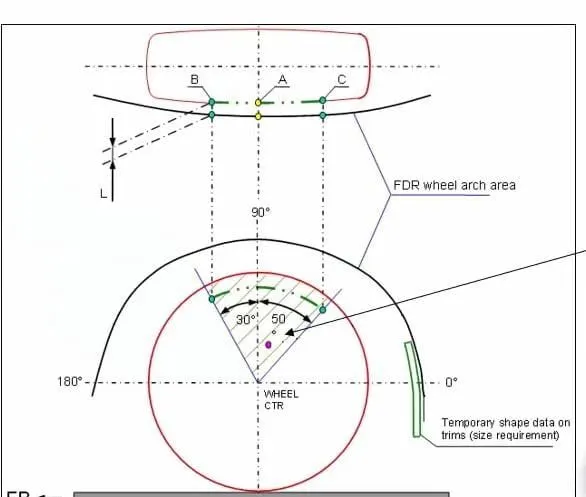
- As per Japanese regulation the gap should be 5 mm or more at 3 points(BELOW IMAGE).
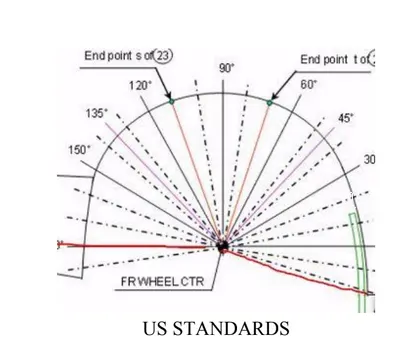
- As per US regulation the distance should be 5 or more but the points will lie after every 10° between -20° to 180°(BELOW IMAGE).
EUROPEAN REGULATIONS REQUIREMENT
- As per European regulation da minimum distance should be 10 mm or more.
- Since the gap is 10 mm so if the fender pass this regulation, it feel also pass JAPAN AND US regulation
- We count the distance at 5 different point as soon in below image.
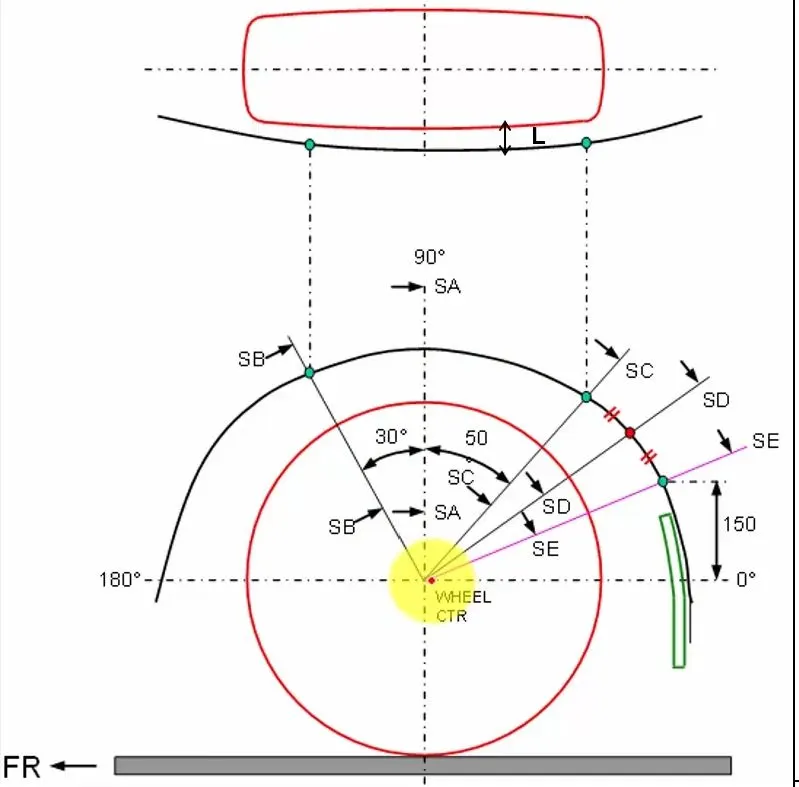
- As we can clearly see that there are five lines so we will find the difference at these lines and will see whether the gap is 10 mm or not.
- The gap is denoted by L
- So We Will Find L value at sections SA-SA SBS-B SC-SC SD-SD SE-SE
Procedure
- First we will make a plane on edge of the wheel.
- Then we will draw horizontal and vertical line.
- We will make a line which is 30° and 50° to vertical line as shown in below image
- Draw a point at wheel arc at 150mm from horizontal line.
- Now join this point with origin
- Make bisector of above line and 50 degree line.
- With the help of intersection make a points at 4 lines .
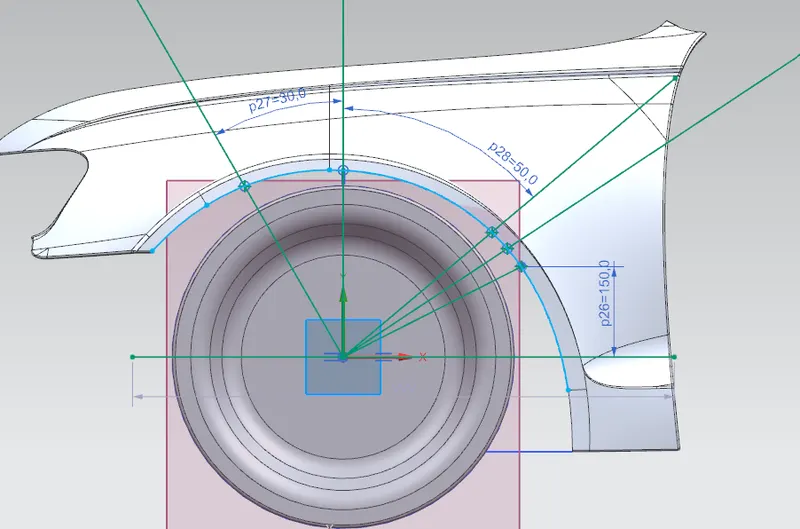
- Now use project curve and project points on fender.
- Next step is to find the gap " L" .
Figure 1(Measurement of L at section SB-SB or at 30° line) L=10mm
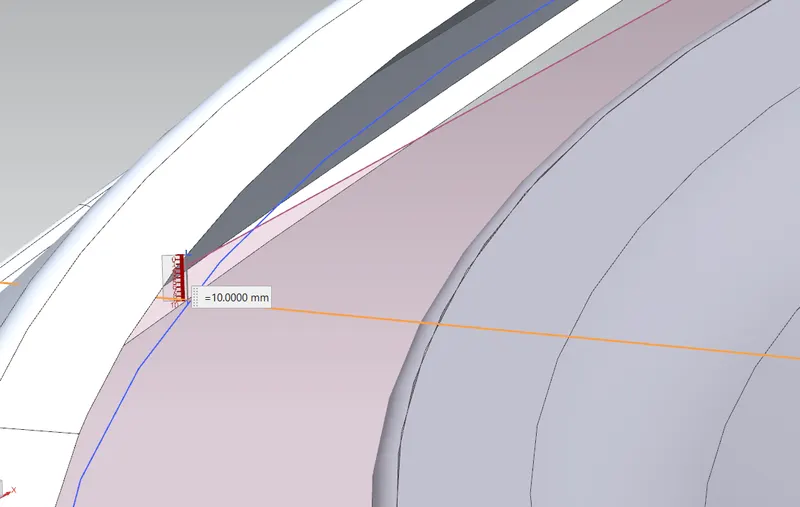
Figure 2(Measurement of L at section SA-SA or at VERTICAL line) L=9.9499mm
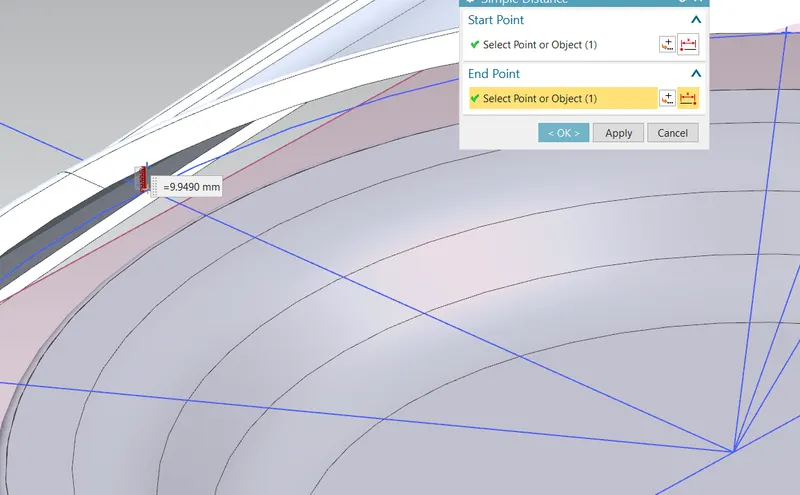
Figure 3(Measurement of L at section SC-SC or at 50° line) L=-0.113949mm
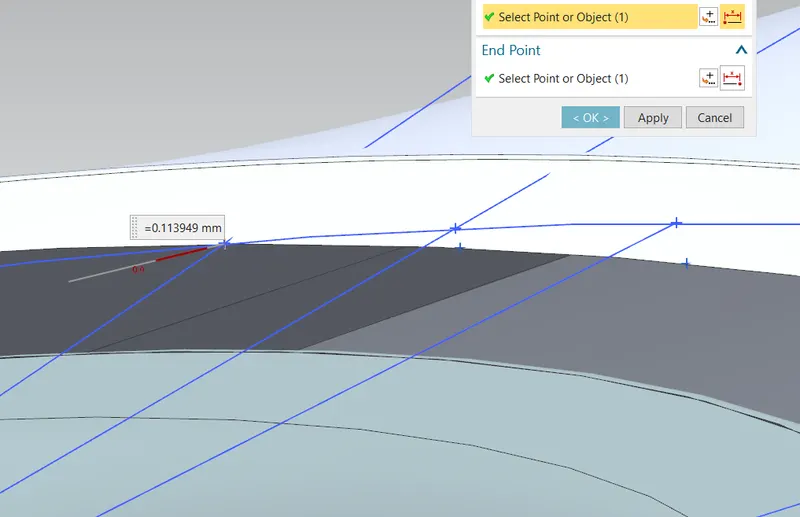
Figure 4(Measurement of L at section SD-SD or at BISECTING line) L=-2.8875mm
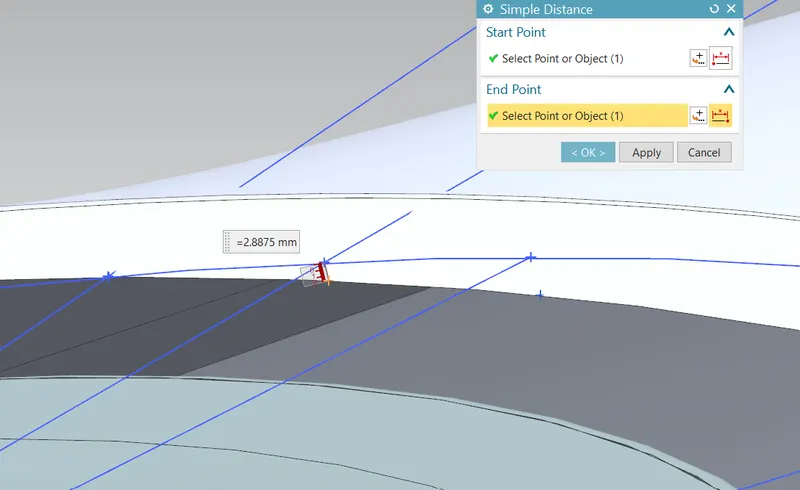
Figure 1(Measurement of L at section SE-SE or at 150mm line) L=-5.9973
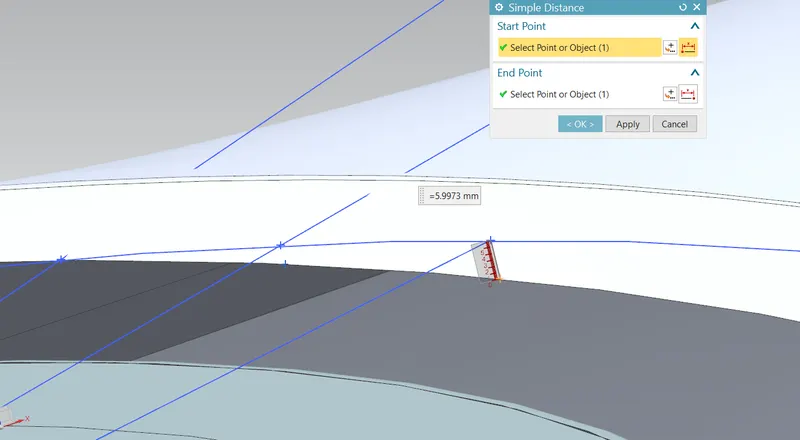
| SECTION | REQUIRED DISTANCE(MM) | L=MEASURE DISTANCE(MM) | RESULT |
| SA-SA | 10 | 9.9499 | FAIL |
| SB-SB | 10 | 10 | PASS |
| SC-SC | 10 | -0.113949 | FAIL |
| SD-SD | 10 | -2.8875 | FAIL |
| SE-SE | 10 |
-5.9973 |
FAIL |
Wheel Guard Clearance "A "
- The value of "A" should be more than 5 mm at AB-AB and AC-AC.
FIGURE 6 (Value of A at AB-AB)
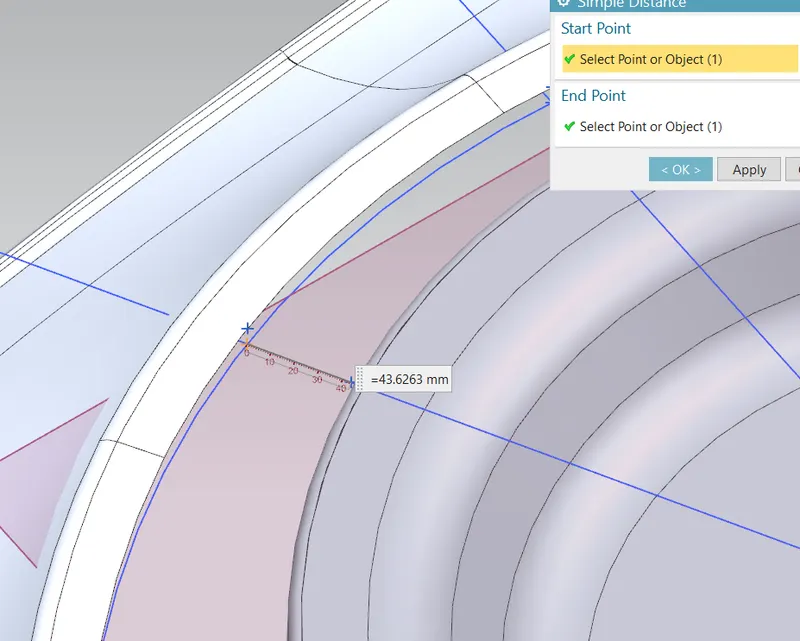
FIGURE 7(Value of A at AC-AC)
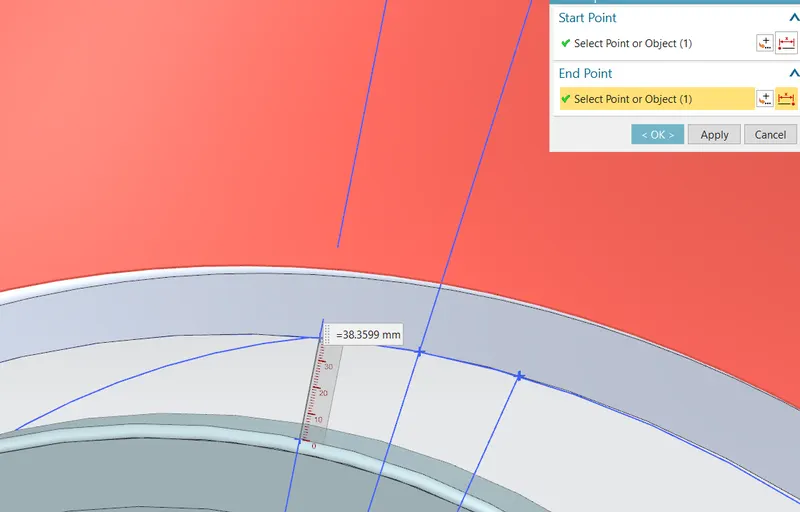 )
)
| SECTION | REQUIRED VALUE(MM) | MEASURE VALUE(MM) | RESULT |
| AB-AB | 5 | 43.6263 | PASS |
| AC-AC | 5 | 38.3599 | PASS |
CONCULSION
After analyzing the data we can say that
- Minimum CLearance "L" is not achieved
- Minimum CLearance "A" is achieved
- So,the model don't fit the european standards.