Fender Design - Wheel Arch Challenge
Wheel Arch Challenge :
Fender :
Fender covers a wheel, traditionally to prevent water and mud spray, but also for aerodynamic purposes. When the vehicle is moving tyre picks up stones & others and hurl them in all direction thus in order to prevent pedestrians from these stones fenders are used.
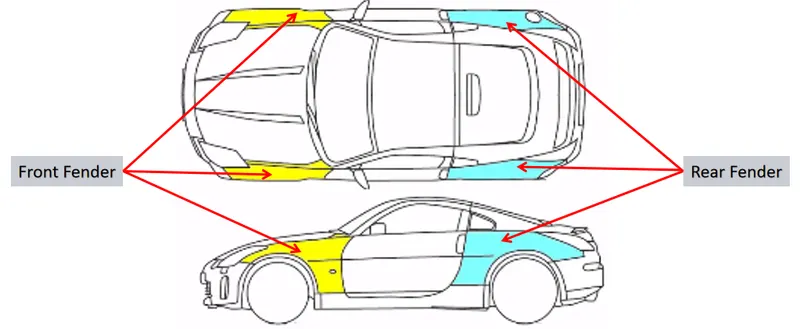
Wheel Arch :
The wheel arch is the semicircular part positioned above the wheel of a vehicle.
Cladding :
The wheel well cladding is used to minimize road noise, especially during highway cruising . There are various variations: No cladding at all, metal is exposed. Partial cladding, usually towards the passenger compartment. These claddings are also used in sports car, SUVs and cross overs to increase the track width of the vehicle also it is used in the custom modified cars. There are many other types which are used only for aesthetics and scratch prevention.
Benefites of Cladding :
- Low maintenance. Compared to common timber cladding, PVC wall cladding is extremely low maintenance due to its durability and easy cleaning features.
- Aesthetics.
- Internal insulation.
- Protection and safeguarding of the structure.
Regulations of Wheel Arch Design :
Find the given Wheel Arch Design pass the European Regulations or not:
In Fig 1.3, Design of Fender with Wheel Arch is given. We have to verify this whether this design is fits in European Std or not.
1) European Standard :
The European regulation requires a pre determined clearance or a minimum distance of 10mm. to be maintained between the Fender and the respective tyre at particular points(5 points/Sections to be exact) along the tyre profile as shown below:
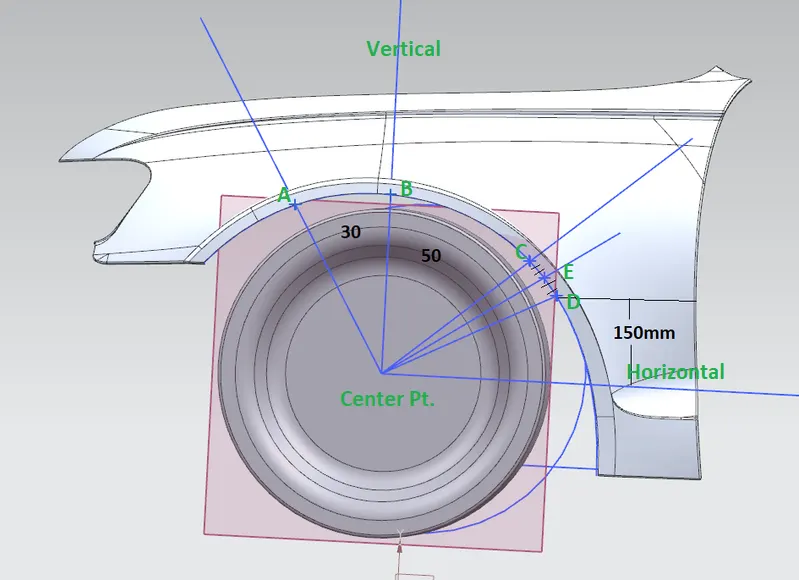
Fig : 1.3
Steps for calculate the gap between Wheel Arch and Tyre perticular 5 points.
- Create 1 parallel Datum plan on wheel outer surface. Draw a vertical and horzontal line from centre point.
- Now, From centre point, draw 2 line. one is left side from the vertical and 2nd right side at an angle of 30 and 50 degree respectively.
- Then, mark point on wheel arch, which is 150mm above from the horizontal line and draw line between pt. C and D. Name it pt. E.
- Project the 2D curve of wheel arch and mark the intersection pt. Project points on both sides.
- Measure the distace between points on wheel arch and point on projected curve.
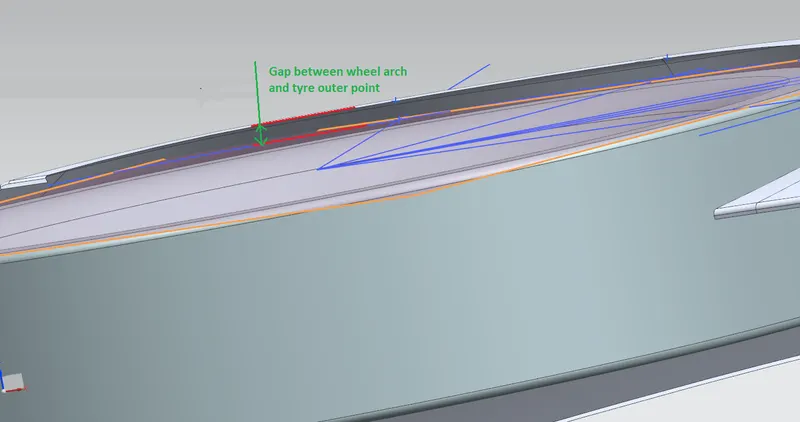
Fig : 1.4
Above fig shows the gap need to be calculate to know whether design satisfy the european regulation or not.
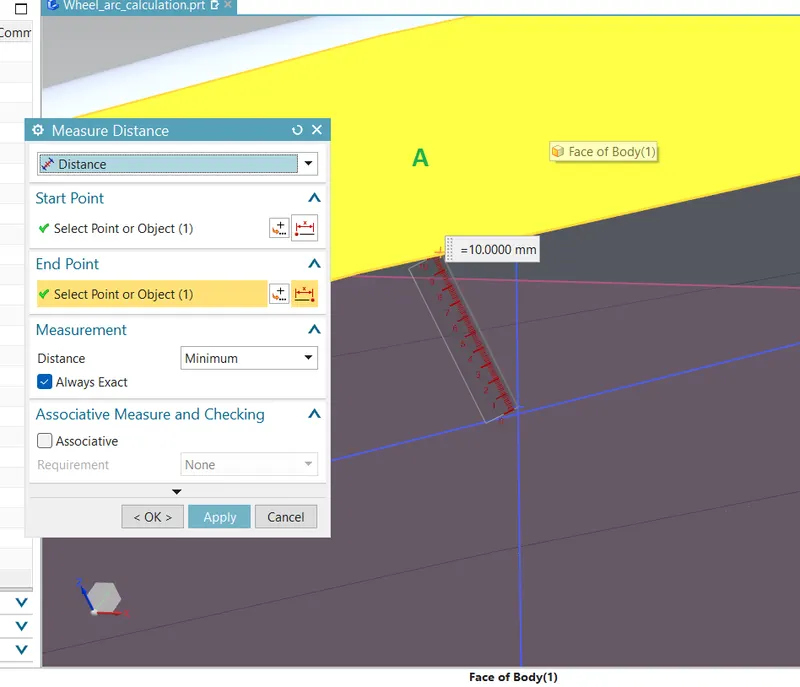
Fig : 1.5
fig:1.5 shows how to calculate the distace.
| Point | A | B | C | D | E |
| Distance | 10 | 9.9490 | -1.6293 | -5.9975 | -2.8875 |
| Remark | Pass | Fail | Fail | Fail | Fail |
2)US Regulation:
As per US regulation, the clearance between tyre and fender must be greater than 5mm. The projected points to be measured are at an angle 0° forward to 100° respectively. Thus each position is divided into 10°. Thus the projected distances are measured at around 21 different points.
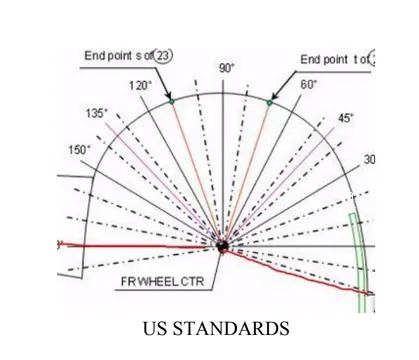
Fig : 1.6
3)Japanese Regulation:
As per Japanese regulation, the clearance between tyre and fender must be greater than 5mm The projected points to be measured are at an angle 30° forward & 50° rearward respectively.
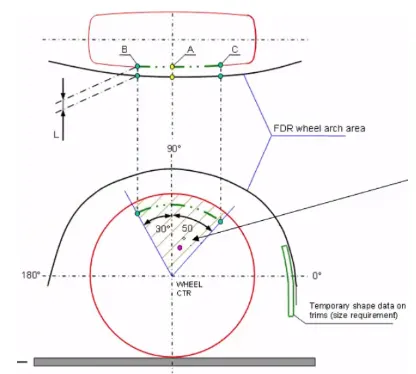
Fig : 1.7
Conclusion :
The European regulation requires a minimum of 10 mm clearance, this condition is not satisfied. To fulfill the regulation, need to change design.
In this challenge, understood design of fender, wheel arch design, cladding and its benefits. Studied the different country regulations for wheel arch fender design.