Fender Design - Wheel Arch Challenge
FENDERS
- Fender is the American English term for the part of an automobile, motorcycle or other vehicle body that frames a wheel well.
- Its primary purpose is to prevent sand, mud, rocks, liquids, and other road spray from being thrown into the air by the rotating tire.
- When vehicle is moving, tires pick up stones and others and hurl them in all directions. Fenders are basically present to prevent any injuries to pedestrians and contain the motion of these particles.
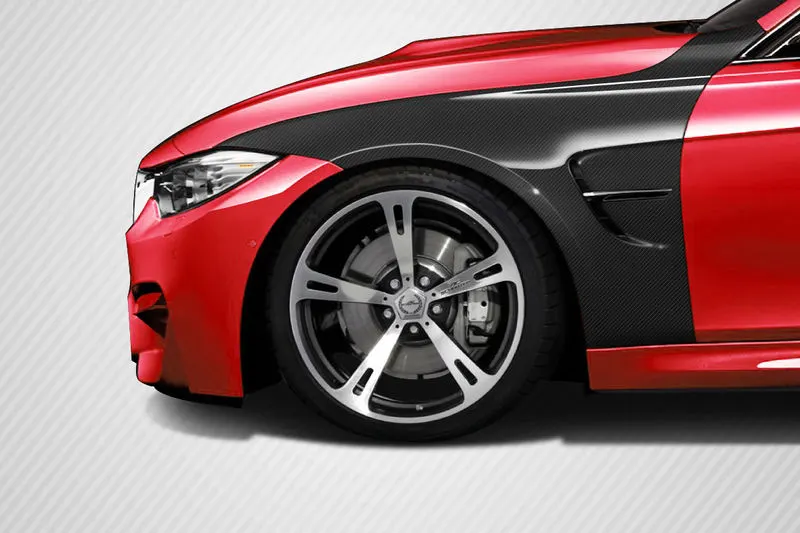

Types : There are two types of fenders used in cars. They are :
- Full bumper type and
- Half bumper type.
Full bumper type : In full bumper type, the fender covers the entire wheel area from the front to the body side. This type is widely used by the OEMs and automotive industries in early days.
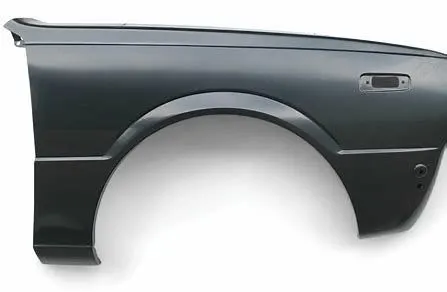
Half bumper type : In half bumper type, the fender only covers the one-third area of the wheel from the bodyside to front. This is because to reduce the production cost and material wastage compared to the full bumper type. This type is widely used by the OEMs and automotive industries nowadays.
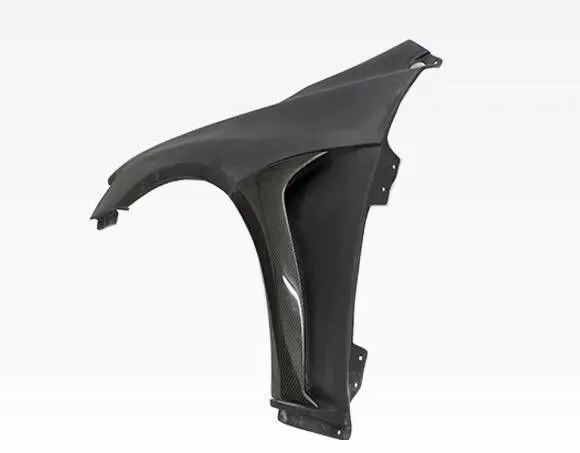
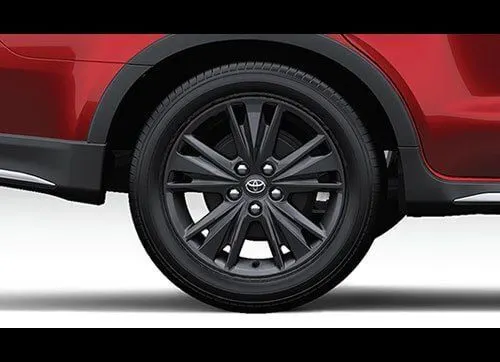
Fender wheel arch : The area which is above the wheel and the edge connecting the fender and its underside is said to be the fender wheel arch area.
FENDER REGULATIONS
- Sticky materials, such as mud, may adhere to the smooth outer tire surface, while smooth loose objects, such as stones, can become temporarily embedded in the tread groves as the tire rolls over the ground. These materials can be ejected from the surface of the tire at high velocity as the tire imparts kinetic energy to the attached objects.
- For a vehicle moving forward, the top of the tire is rotating upward and forward, and can throw objects into the air at other vehicles or pedestrians in front of the vehicle. To avoid this, some standards are followed by the OEMs, where the vehicle going to be operated (like country or region) for pedestrians safety.
- These standards are structured by the observational results according to the road condition, traffic, average speed of the vehicle etc.
- The fender wheel arch area is calculated according to the wheel clearance, suspension clearance and turning radius clearance of the vehicle while in rest and moving conditions.
- The design of the wheel arch of a fender should be such that it must have shield wheels and protect both passengers compartment and pedestrians from the projection of Water, Mud, and Stones.
DIFFERENT FENDER REGULATIONS
There are three regulation standards for fender wheel arch design. They are :
- Japan Regulation Standard
- European Regulation Standard
- U.S. Regulation Standard
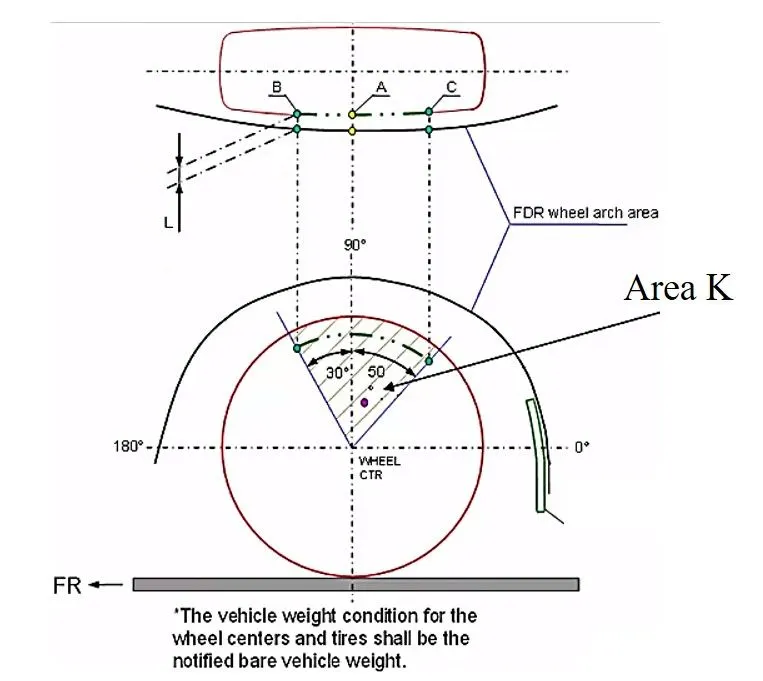
Japan Regulation Standard : The clearance between the wheel and fender wheel arch must be greater than 5mm in all the three positions A, B & C .Wheel guard requirement: the value of ‘a’ shall be more than 5mm at a line 30º forward and 50º rearward from the central vertical axis of wheel.
To validate, measure the clearance L of tire, hub, cap & fender in three different positions within area K and produce the clearance check chart according to the requirements of Japanese regulation standard.
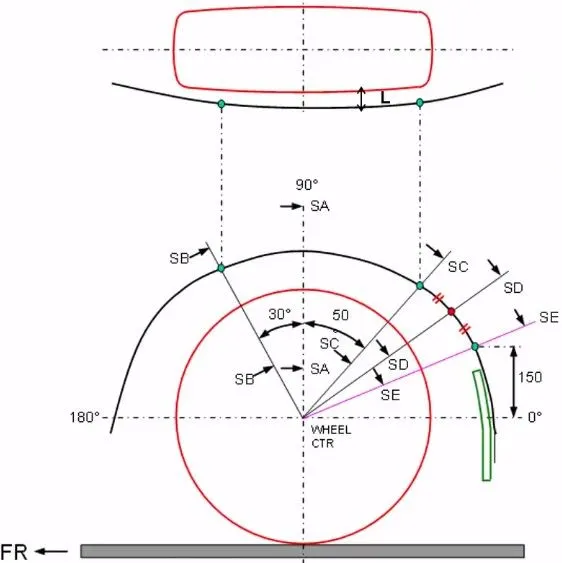
European Regulation Standard : The clearance between the wheel and fender wheel arch must be greater than 10mm in sections SA-SA, SB-SB, SC-SC, SD-SD and SE-SE to satisfy the European regulations.Wheel guard requirement: the value of ‘a’ shall be more than 5mm at a line 30º forward and 50º rearward from the central vertical axis of wheel.
To validate, measure the clearance L at sections SA-SA, SB-SB, SC-SC, SD-SD and SE-SE and produce the clearance check chart according to the requirements of European regulation standard.
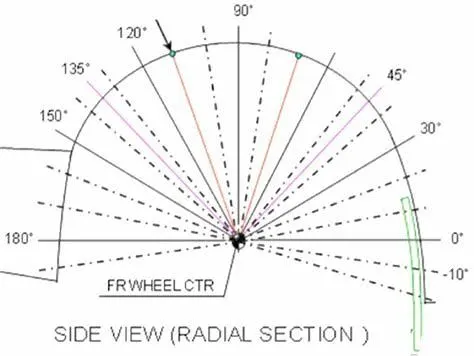
U.S. Regulation Standard : The clearance between the wheel and fender wheel arch must be greater than 5mm in all positions.The value of ‘a’ shall be more than 5mm at a line 30º forward and 50º rearward from the central vertical axis of wheel.
To validate, measure the clearance at every 10º from -20º to 180º and produce the clearance check chart according to requirements of U.S regulation standards.
FENDER REGULATION OF MODEL AS PER EUROPEAN STANDARDS
- As per the standards, lines were created in the specified angles and distance to create points.
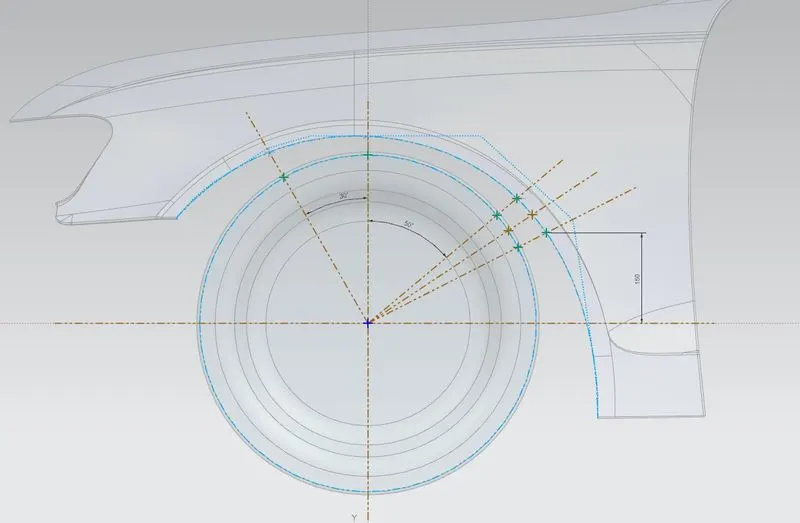
- These points are then projected onto the fender and wheel outer faces.
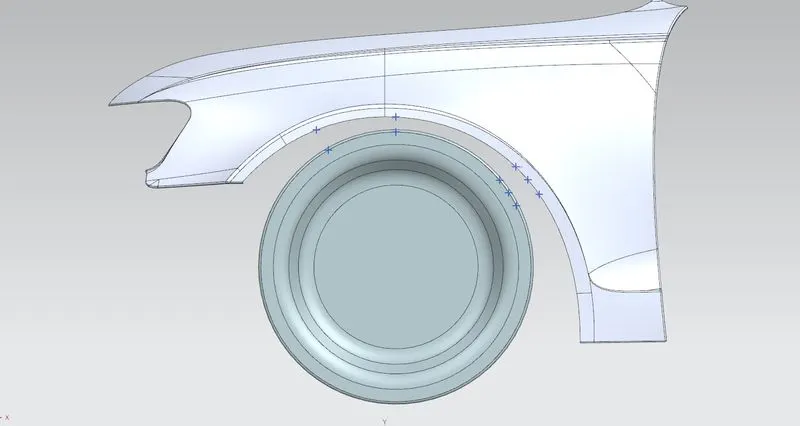
- The distances between the corresponding points on the wheel and fender were measured.
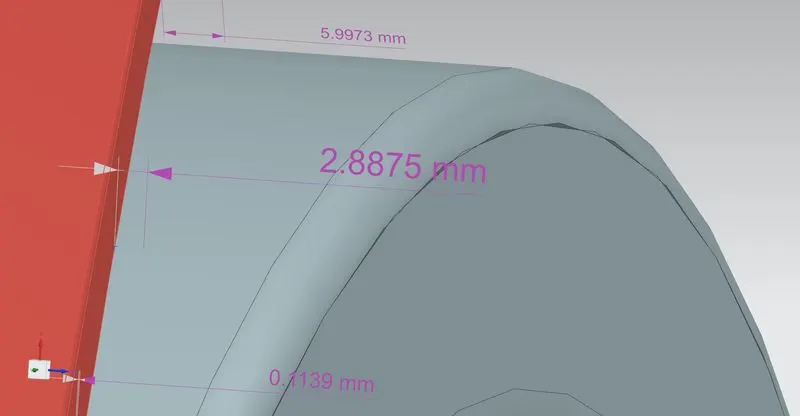
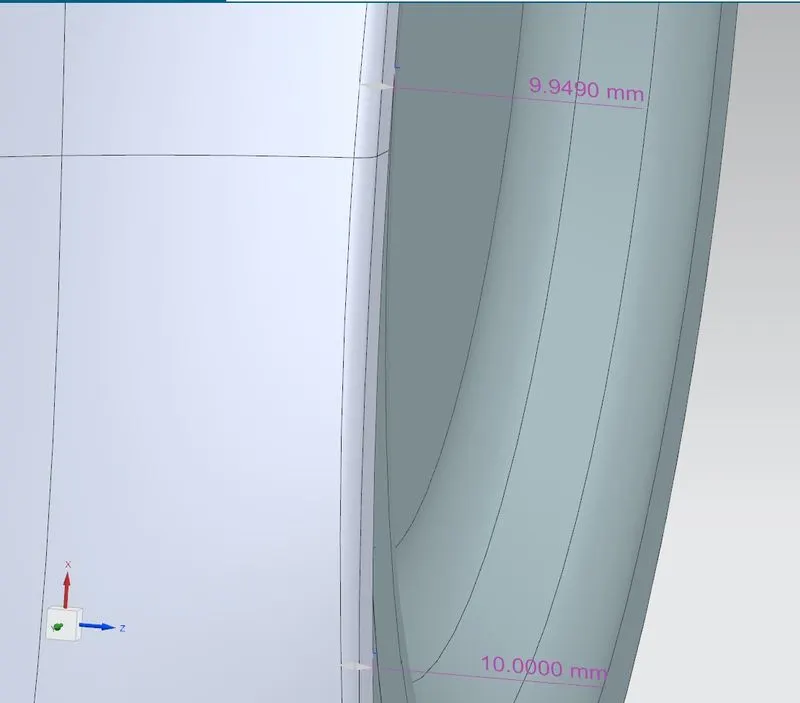
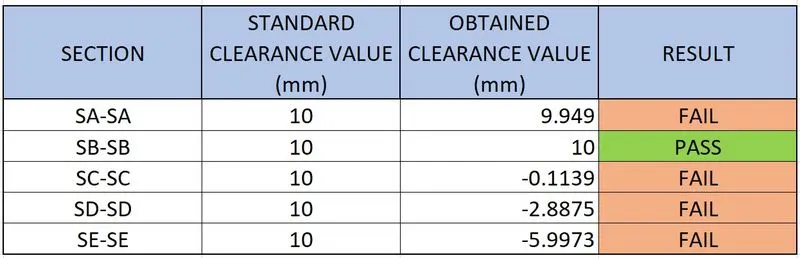
- These measurements were then used to create a table in which the obtained values were compared to the European standards.
INFERENCE
After analysing the output table, it was found out that :
- Out of the 5 sections only SB-SB section were upto European standards.
- Section SA-SA was short only by less than 0.1mm
- For the rest of sections, the fender was not even covering the outer surface of the wheel, therefore the negative values.
So, a car with this fender won't be able to clear the European Standards.