Fender Design - Wheel Arch Challenge
AIM:--To Calculate the Wheel Arch gap at required points and check whether the car passes the European standard.
ANSWER:--
BEFORE GOING TO EUROPEAN REQUIREMENTS FIRST WE WILL LOOK IN TO DIFFRENT WHEEL ARCH FENDER REGULATIONS:--
- JAPAN REGULATION REQIREMENTS.
- USA REGULATIONS REQUIREMENTS.
- EUROPEAN REGULATION REQUIREMENTS.
- JAPAN REGULATION REQIREMENTS:--
As per Japanese regulation, the clearance between tyre and fender must be greater than 5mm The projected points to be measured are at an angle 30° forward & 50° rearward respectively.
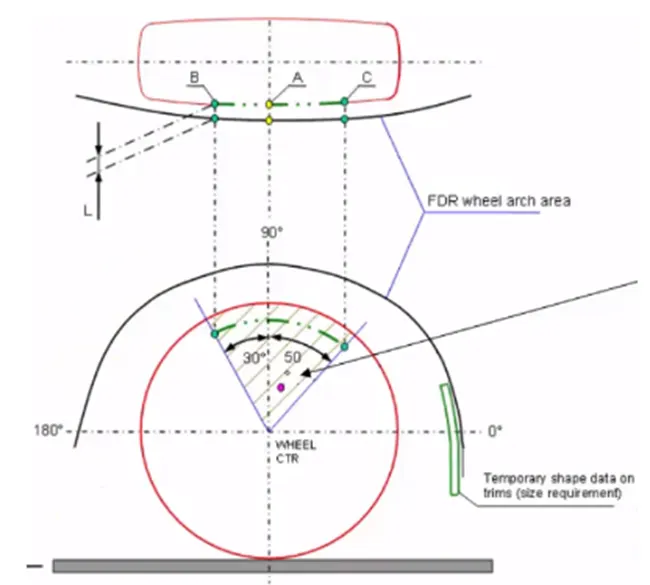
As per Japanese regulation, the clearance between tyre and fender must be greater than 5mm The projected points to be measured are at an angle 30° forward & 50° rearward respectively. Thus at point c, the clearance value is in negative value which denoted interference and hence the modifications are to be carried out.
- USA REGULATIONS REQUIREMENTS:--
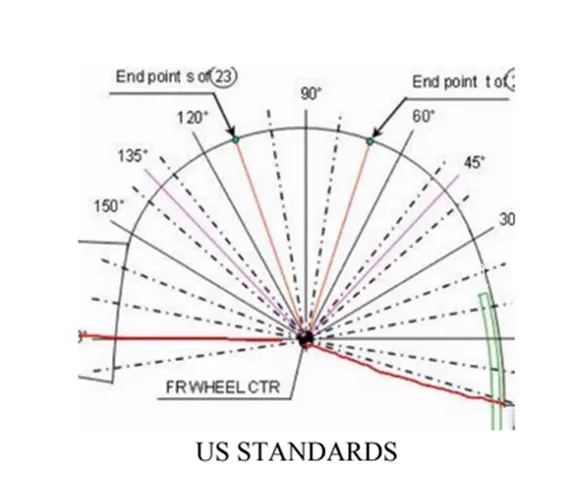
As per US regulation, the clearance between tyre and fender must be greater than 5mm. The projected points to be measured are at an angle 0° forward to 100° respectively. Thus each position is divided into 10°. Thus the projected distances are measured at around 21 different points.
- EUROPEAN REGULATION REQUIREMENTS:--
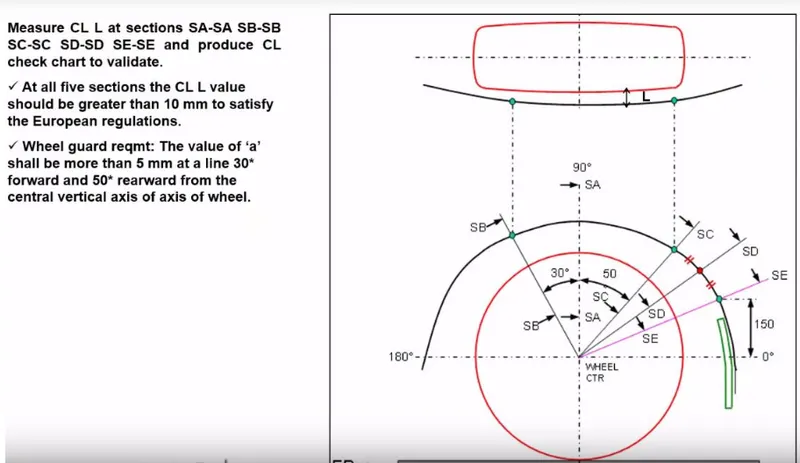
As per European regulation, the clearance value between fender and tyre profile must be greater than 10mm. The value is measured in projected point at an angle 30° forward and 50° rearward respectively. The measurement took in five different positions of the tyre at point a & b the clearance is acceptable. But at point c, d & e there is a negative sign which denoted the interference of wheel arch with a tyre.
STEPS TO CALCULATE WHEEL ARCH:--
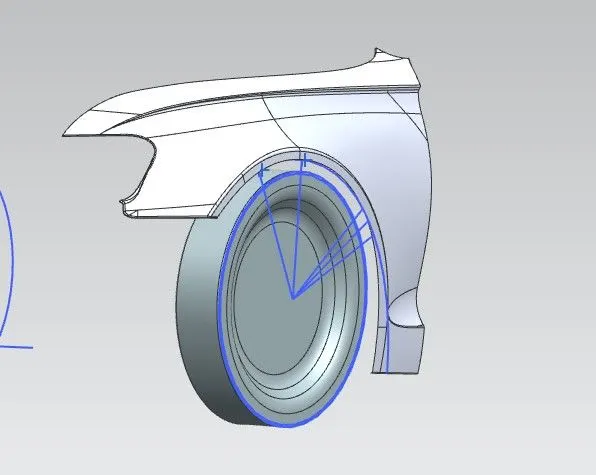
- To sketch the outline of the wheel and the fender
- Create a center point to the circle
- Draw horizontal and vertical perpendicular axes from the centre of the wheel circle
- Now take `30^@` angle from center point to the left side of the circle(SB)
- Them take `50^@`angle from the center point to the right side of the circle(SC)
- Make a point on the fender line at 150mm from the horizontal.
- Extend a line to this point from the centre.
- Then make a line that is exactly between the 50-degree line and the line made on the 150mm point.
- Measure the distances between the points on the wheel circle and fender curve. All of these should be greater than 10mm to satisfy the European regs.
- Secondly, the horizontal distances from SA, SB, and SC points to the fender curve should be at least 5mm.
- Check whether the design passes these conditions and then we can tell whether it can pass the european requirements or not.
Now Lets Check the L secction:--
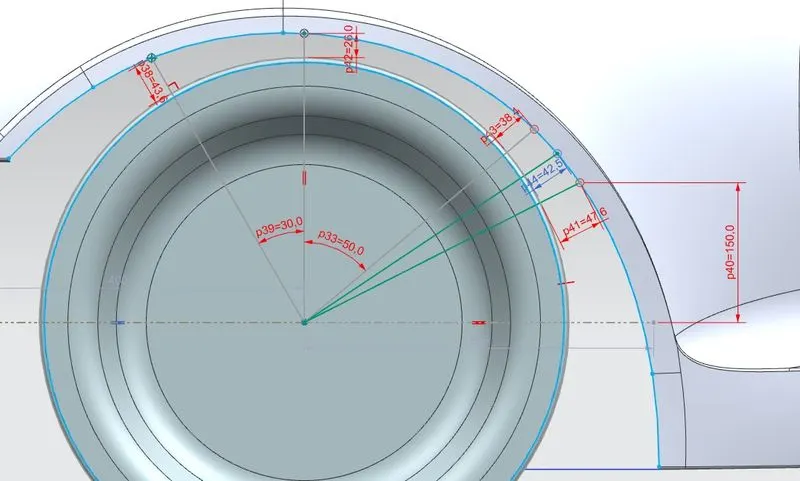
From The above we can See All the L section
`therefore`
SA-SA = 26.0 ie, >10 (Pass)
SB-SB = 43.6 ie,>10 (Pass)
SC-SC = 38.4 ie,>10 (Pass)
SD-SD = 42.5 ie,>10 (Pass)
SE-SE = 47.6 ie,>10 (Pass)
Now to find the horizontal distance between the wheel and the fender. This distance should be at least 5mm from SA point, SB point, and SC point.ie,(a)
Project the made sketch onto the plane of the wheel.
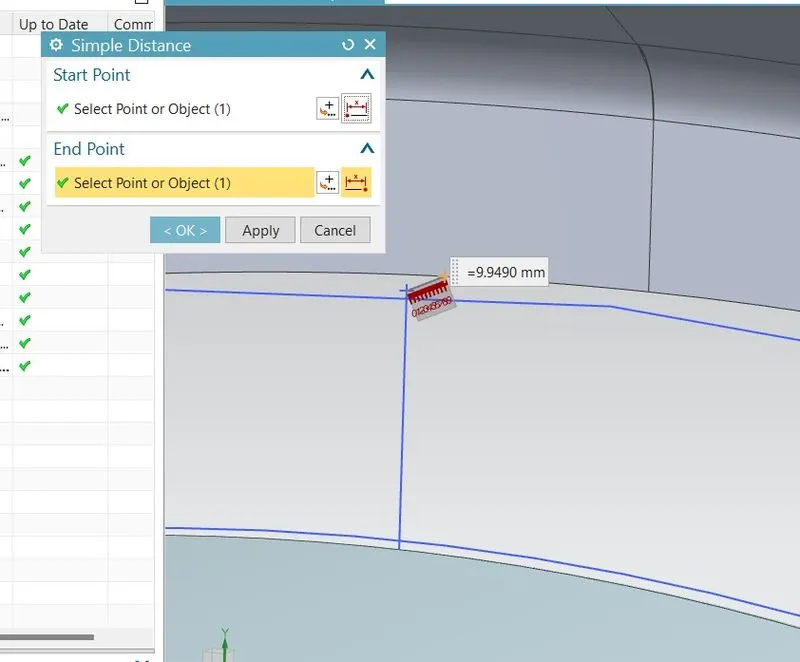
Distance between SA point and fender outer curve = 9.9490 mm (pass)
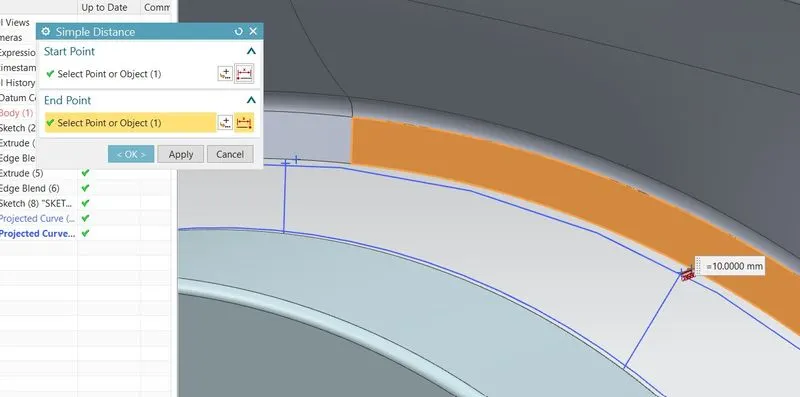
Distance between SB point and fender outer curve = 10 mm (pass)
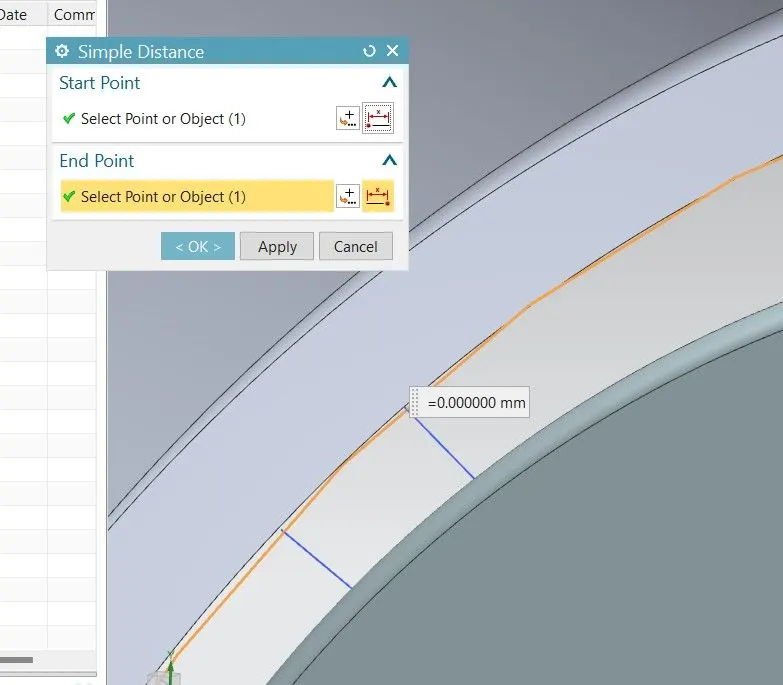
Distance between SC point and fender outer curve = 0.0000mm (fail)
TABULATION:--
| SECTION | DISTANCE | RESULT |
| SA-SA | 26.0 | PASS |
| SB-SB | 43.6 | PASS |
| SC-SC | 38.4 | PASS |
| SD-SD | 42.5 | PASS |
| SE-SE | 47.6 | PASS |
| EDGE OF THE FENDER TO THE EDGE OF THE TYRE | DISTANCE | RESULT |
| SA | 9.490 | PASS |
| SB | 10.000 | PASS |
| SC | 0.000 | FAIL |
CONCLUSION:--
The given design satisfies all European standards but one, i.e. the distance from SC point to the fender curve (which is just 0.000mm), which is way below the recommended 5 mm minimum distance. Therefore, this fender cannot pass the European standards. The design should be reverted back to the class A designer telling him to modify the design and increase the gap there.