Week 4.1 - Genetic Algorithm
Basic code for Stalagmite
%code for basic stalagmite
clear all
close all
clc

%Defining the search space
x = linspace(0,0.6,150);
y = linspace(0,0.6,150);

%creating 2D mesh
[xx yy] = meshgrid(x,y);

%creating 3D stalagmite fuction

for i = 1:length(xx)
    for j = 1:length(yy)
        input_vector(1) = xx(i,j);
        input_vector(2) = yy(i,j);
        f(i,j) = stalagmite(input_vector);
    end
end

surfc(xx,yy,-f)
xlabel('x values')
ylabel('y values')

shading interp

[inputs,fval]=ga(@stalagmite,2)
code for stalagmite function
%code for stalagmite function
function [f]= stalagmite(input_vector)
f1x = (sin(5.1*pi*input_vector(1)+0.5))^6;
f1y = (sin(5.1*pi*input_vector(2)+0.5))^6;
f2x = exp((-4)*log(2)*(input_vector(1)-0.0667)^2/0.64);
f2y = exp((-4)*log(2)*(input_vector(2)-0.0667)^2/0.64);
f = -f1x*f1y*f2x*f2y;
end
Output for basic stalagmite function
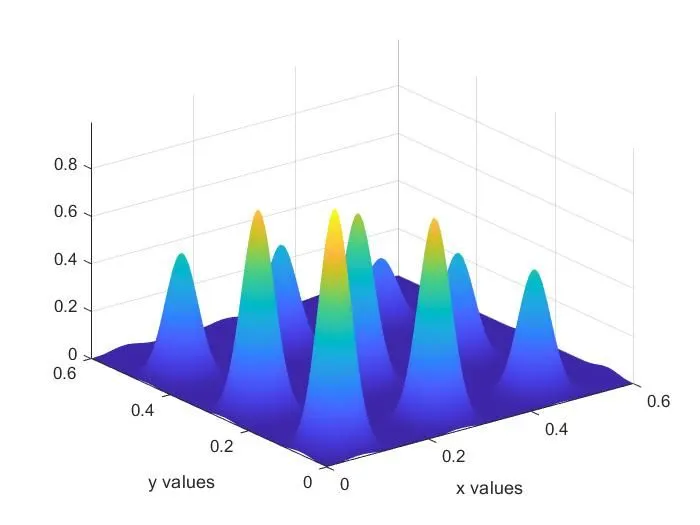
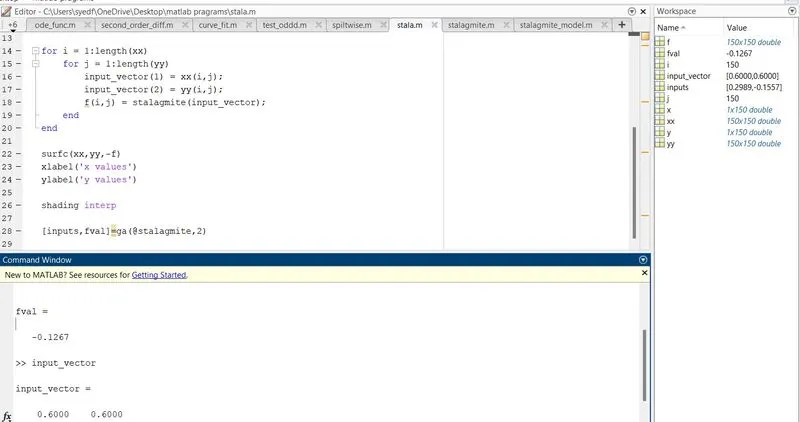
Code for optimization of random values and checking the stalagmite function study1(unbounded input)
clear all
close all
clc

x = linspace(0,0.6,150);
y = linspace(0,0.6,150);
[xx yy]=meshgrid(x,y);
num_cases = 150;
for i = 1:length(xx)
    for j = 1:length(yy)
        input_vector(1)=xx(i,j);
        input_vector(2)=yy(i,j);
 f(i,j)=stalagmite(input_vector);
    end
end
surfc(x,y,f)
shading interp


tic
%study1-satisticial behaviour
for i=1:num_cases
    [input,fopt(i)]=ga(@stalagmite,2);
    xopt(i)=input(1);
    yopt(i)=input(2);
end
study1_time=toc


figure(1)
subplot(2,1,1)
hold on
surfc(xx,yy,-f)
shading interp
plot3(xopt,yopt,-fopt,'marker','o','markersize',5,'markerfacecolor','r')
title('unbounded input')
subplot(2,1,2)
plot(-fopt)
xlabel('iterations')
ylabel('function minium')
output for study1
and the study time is 7.4528sec
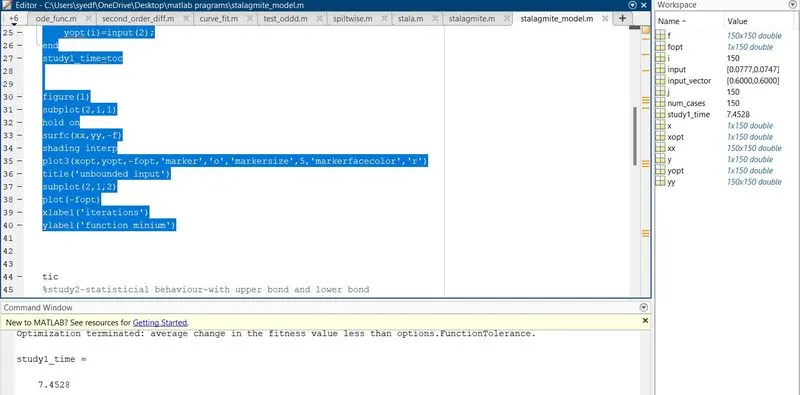
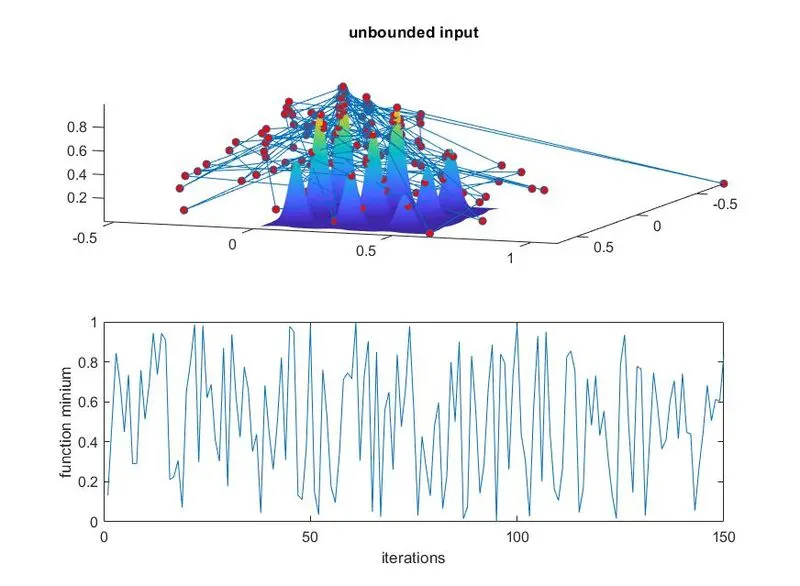
Code for optimization of random values and checking the stalagmite function study2(bounded input)
clear all
close all
clc

x = linspace(0,0.6,150);
y = linspace(0,0.6,150);
[xx yy]=meshgrid(x,y);
num_cases = 150;
for i = 1:length(xx)
    for j = 1:length(yy)
        input_vector(1)=xx(i,j);
        input_vector(2)=yy(i,j);
 f(i,j)=stalagmite(input_vector);
    end
end
surfc(x,y,f)
shading interp

tic
%study2-statisticial behaviour-with upper bond and lower bond
for i=1:num_cases
    [input2,fopt2(i)]=ga(@stalagmite,2,[],[],[],[],[0,0],[1,1]);
    xopt2(i)=input2(1);
    yopt2(i)=input2(2);
end
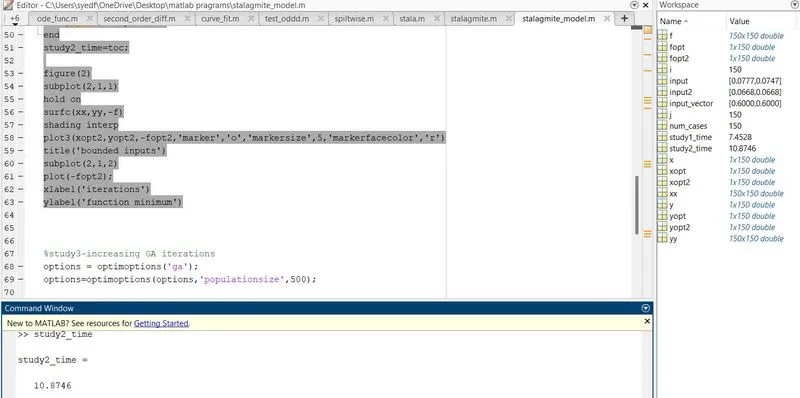
study2_time=toc;

figure(2)
subplot(2,1,1)
hold on
surfc(xx,yy,-f)
shading interp
plot3(xopt2,yopt2,-fopt2,'marker','o','markersize',5,'markerfacecolor','r')
title('bounded inputs')
subplot(2,1,2)
plot(-fopt2);
xlabel('iterations')
ylabel('function minimum')
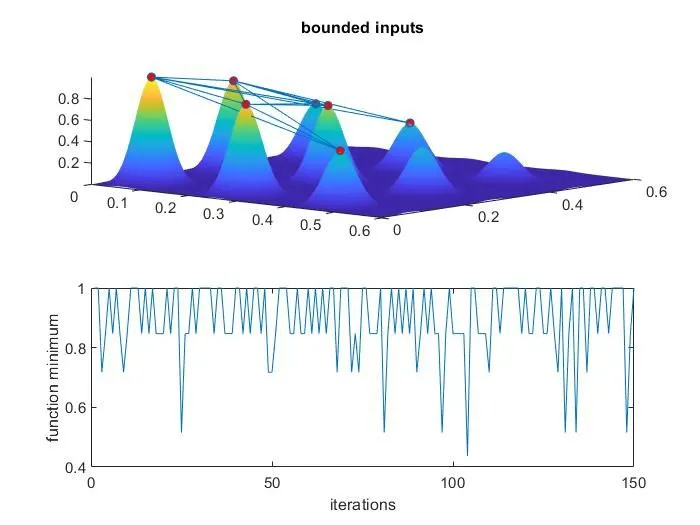
output for study 2
time for study 2 is 10.874secs
Code for optimization of random values and checking the stalagmite function study3(population bound)
clear all
close all
clc

x = linspace(0,0.6,150);
y = linspace(0,0.6,150);
[xx yy]=meshgrid(x,y);
num_cases = 150;
for i = 1:length(xx)
    for j = 1:length(yy)
        input_vector(1)=xx(i,j);
        input_vector(2)=yy(i,j);
 f(i,j)=stalagmite(input_vector);
    end
end
surfc(x,y,f)
shading interp

%study3-increasing GA iterations
options = optimoptions('ga');
options=optimoptions(options,'populationsize',500);

tic
for i=1:num_cases
    [input3,fopt3(i)]=ga(@stalagmite,2,[],[],[],[],[0,0],[0.6,0.6],[],[],options);
    xopt3(i) = input3(1);
    yopt3(i) = input3(2);
end
study3_time = toc;
figure(3)
subplot(2,1,1)
hold on
surfc(xx,yy,-f)
shading interp
plot3(xopt3,yopt3,-fopt3,'marker','o','markersize',5,'markerfacecolor','r');
title('populations bound')
subplot(2,1,2)s
plot(-fopt3)
xlabel('iterations')
ylabel('function minimum')
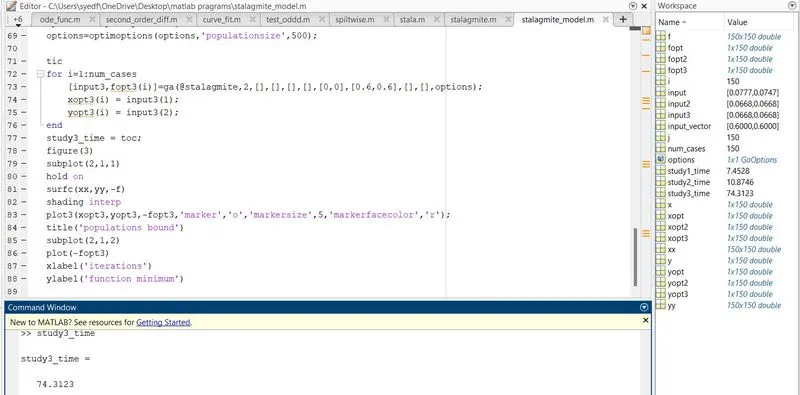
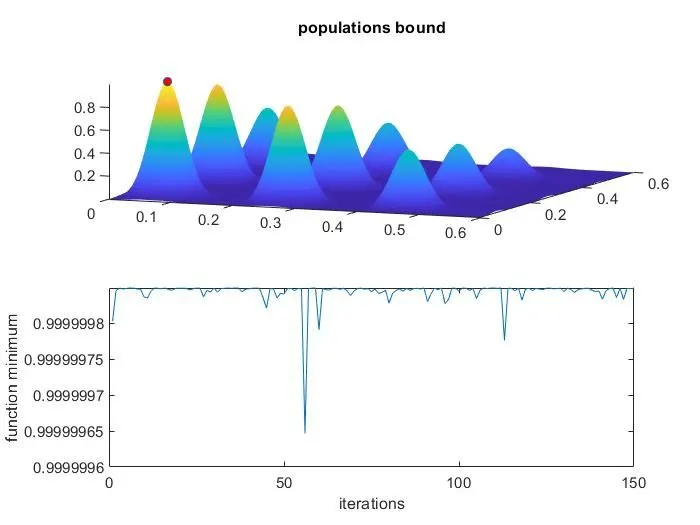
output for study 3
study time is74.3123sec
Combined code for all three studies
 %A code to optimise the stalagmite function and find the global maxima of the function

clear all
close all
clc

x = linspace(0,0.6,150);
y = linspace(0,0.6,150);
[xx yy]=meshgrid(x,y);
num_cases = 150;
for i = 1:length(xx)
    for j = 1:length(yy)
        input_vector(1)=xx(i,j);
        input_vector(2)=yy(i,j);
 f(i,j)=stalagmite(input_vector);
    end
end
surfc(x,y,f)
shading interp


tic
%study1-satisticial behaviour
for i=1:num_cases
    [input,fopt(i)]=ga(@stalagmite,2);
    xopt(i)=input(1);
    yopt(i)=input(2);
end
study1_time=toc


figure(1)
subplot(2,1,1)
hold on
surfc(xx,yy,-f)
shading interp
plot3(xopt,yopt,-fopt,'marker','o','markersize',5,'markerfacecolor','r')
title('unbounded input')
subplot(2,1,2)
plot(-fopt)
xlabel('iterations')
ylabel('function minium')


tic
%study2-statisticial behaviour-with upper bond and lower bond
for i=1:num_cases
    [input2,fopt2(i)]=ga(@stalagmite,2,[],[],[],[],[0,0],[1,1]);
    xopt2(i)=input2(1);
    yopt2(i)=input2(2);
end
study2_time=toc;

figure(2)
subplot(2,1,1)
hold on
surfc(xx,yy,-f)
shading interp
plot3(xopt2,yopt2,-fopt2,'marker','o','markersize',5,'markerfacecolor','r')
title('bounded inputs')
subplot(2,1,2)
plot(-fopt2);
xlabel('iterations')
ylabel('function minimum')


%study3-increasing GA iterations
options = optimoptions('ga');
options=optimoptions(options,'populationsize',500);

tic
for i=1:num_cases
    [input3,fopt3(i)]=ga(@stalagmite,2,[],[],[],[],[0,0],[0.6,0.6],[],[],options);
    xopt3(i) = input3(1);
    yopt3(i) = input3(2);
end
study3_time = toc;
figure(3)
subplot(2,1,1)
hold on
surfc(xx,yy,-f)
shading interp
plot3(xopt3,yopt3,-fopt3,'marker','o','markersize',5,'markerfacecolor','r');
title('population bound')
subplot(2,1,2)
plot(-fopt3)
xlabel('iterations')
ylabel('function minimum')
Output for all three studies
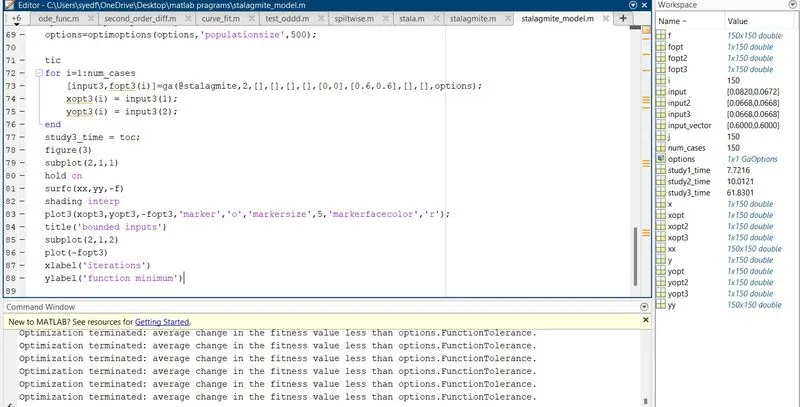
output for study 1 :- Unbounded input plot
Output for study2:- Bounded input plot
Output for study3:- population bound
Code for stalagmite Function
%code for stalagmite function
function [f]= stalagmite(input_vector)
f1x = (sin(5.1*pi*input_vector(1)+0.5))^6;
f1y = (sin(5.1*pi*input_vector(2)+0.5))^6;
f2x = exp((-4)*log(2)*(input_vector(1)-0.0667)^2/0.64);
f2y = exp((-4)*log(2)*(input_vector(2)-0.0667)^2/0.64);
f = -f1x*f1y*f2x*f2y;
end
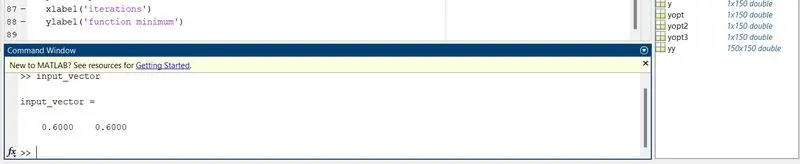
Results,
To solve stalagmite first we should understand some concepts like
- What is optimization
- What is Genetic algorithm(Ga)
- Where Genetic algorithm is used
Optimization:-
Optimization is nothing but its an decision making process and helps to find the best results and it compares various solutions till an optimum or satisfactory solution is found
Genetic algorithm:-
Genetic algorithm is one of the optimization process,The genetic algorithm is a method for solving both constrained and unconstrained optimization problems that is based on natural selection and Genetic algorithm is basically works on Darwin's theory of evloution
Applications of Genetic algorithm :-
Genetic algorithm are basically used in optimization process/problems of various kinds and they are also used in Vehicle routing problem (VRP),Financial markets,Manufacturing system, Mechanical engineering design,Economics,neural networks and many more
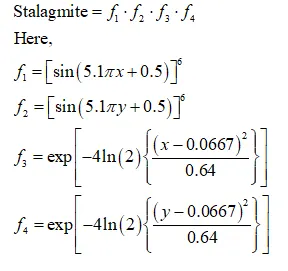
Now the stalagmite function is given by
Errors faced during code
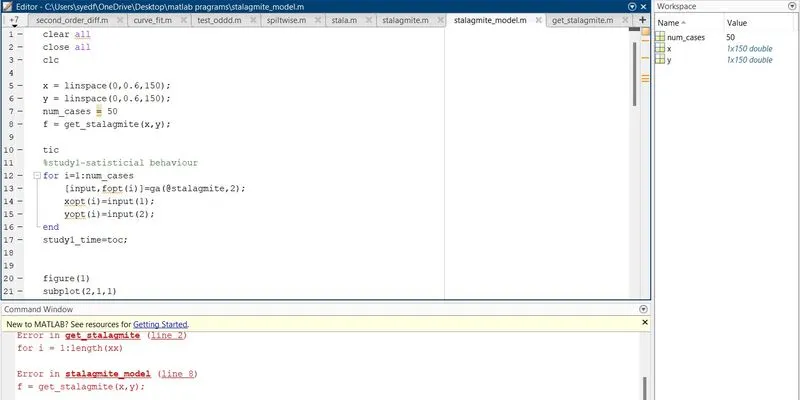
Error1:- in the above screen shots i got the error in function program because i had called some other function instead of stalagmite function
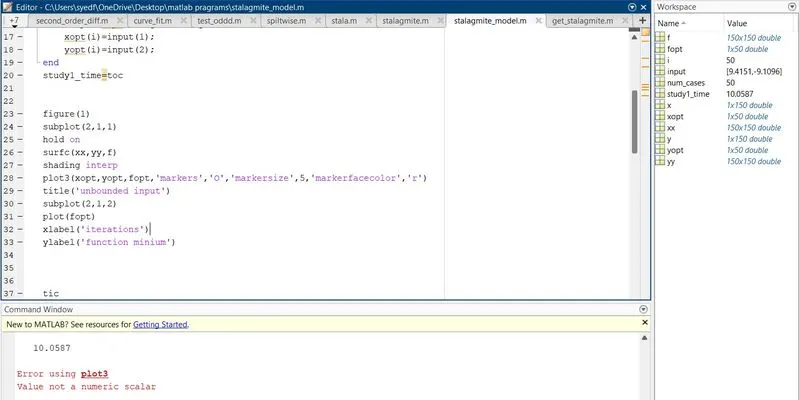
Error2:- In the above screenshot i have used "markers" insted of "marker" and i had not used for loops
Reffrences:-
https://skill-lync.com/knowledgebase/genetic-algorithm-explained
https://in.mathworks.com/search.html?c%5B%5D=entire_site&q=Genetic%20algorithm&page=1
https://in.mathworks.com/search.html?c%5B%5D=entire_site&q=optimization&page=1
https://mech.iitm.ac.in/nspch52.pdf
https://www.tutorialspoint.com/genetic_algorithms/genetic_algorithms_introduction.htm