Fender Design - Wheel Arch Challenge
FENDER WHEEL ARCH CHALLENGE
FENDER WHEEL ARCH
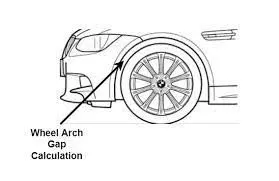
Wheel Arch is the semi-circular part of the fender positioned above the wheel of the vehicle. The design of the wheel arch of the fender should be such that it must shield wheels and protect both passengers compartment and pedestarians from the projection of watr, mud and stones.The wheel arch area of the fender is usually designed as a cover or shield over the tyre along its perimeter to stop any debris or stones ,dirt,sand,snow,etc,from getting thrown into the vehicle or the BIW area as well as outside the vehicle and onto other vehicles or pedestarians on the road.For the vehicle to has its permit in different countries,the wheel arch of fenders must be compliant with the standards and regulations set by respective countries.
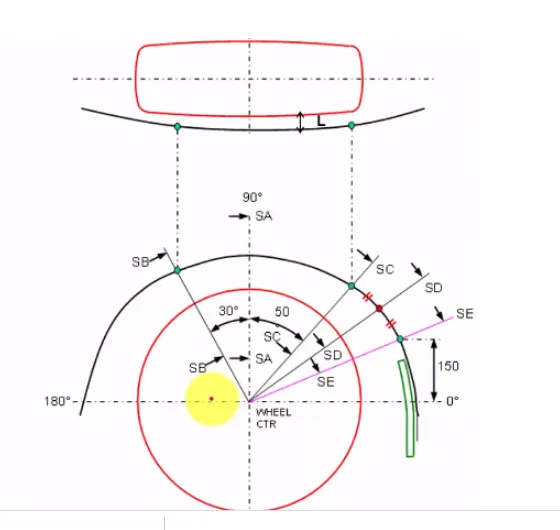
The European regulations requires a pre-determined clearance or a minimum distance of 10mm to be maintained between the fender and respective tyre at particular points, along the tyre profile as shown below:
Fender Safety:
- The fender is a part of the car, it is also used as a protecting the side of the engine compartment.
- Pedestrian safety is also considered while designing a wheel arch in a fender since the debris in the wheel shouldn't hit them in the motion of the car.
- Fender is also reduced pedestrian injury when there is a pedestrian-vehicle crash and prevent the throwing up of debris nearby vehicles.

Types of the fender:
There are two types of the fender. they are:
- Full Bumper.
- Half Bumper.
Full Bumper of the fender:
The full bumper is mostly cover the wheel part almost 18% as shown in the below.
Half Bumper of the fender:
Half Bumper helps reduce the weight of the fender at the same time it proves the safety of pedestrian moving motion as shown in the figure.

Fender design considerations:
- Drip Area.
- Wheel Arch.
- Baffle and ORVM mount area.
- Frontal crash regulation and requirements.
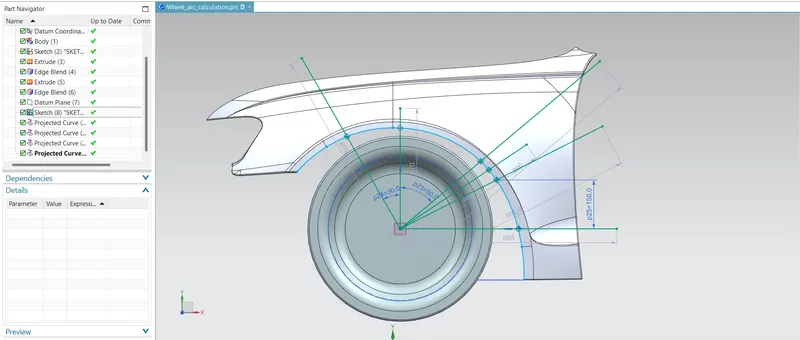
STEPS FOLLOWED IN CREATING THE SKETCH REQUIREMENT FOR EUROPEAN STANDARDS
- A Horizontal and vertical axis is drawn from the centre of the wheel.
- The vertical axis intersection point is labelled as A.
- Similar references are drawn at 30 degrees to left and 50 degree to the right and named it as B and C respectively.
- A line of 150mm is drawn perpendicular to the horizontal axis and normal from the normal point on fender which gives point E.
- The midpoint of the arc cut by the sections C and E results in a new section D.
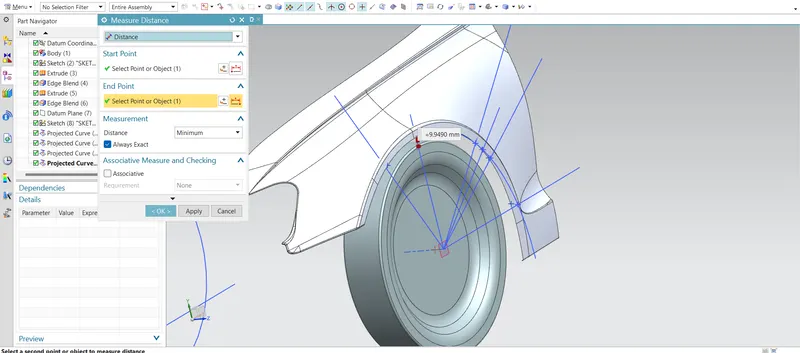
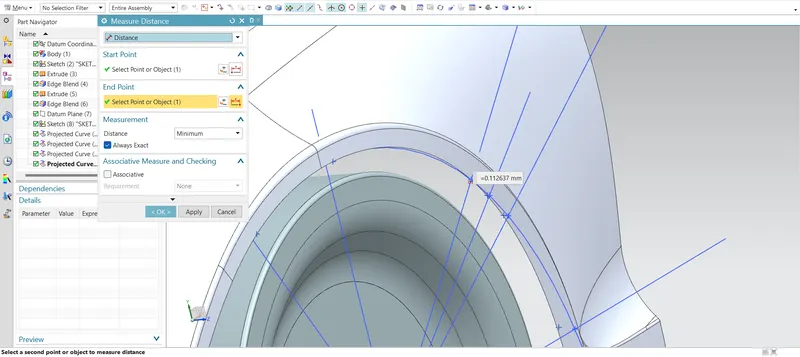
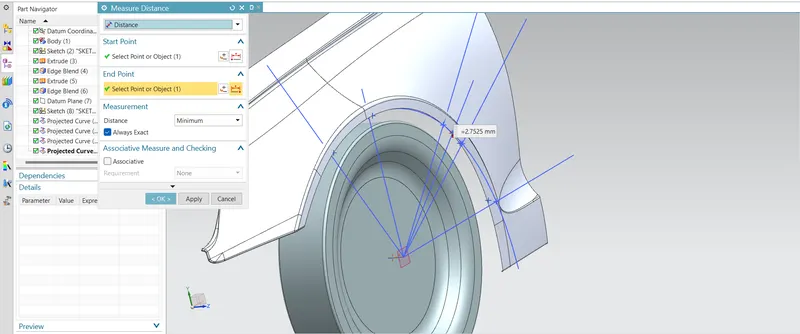
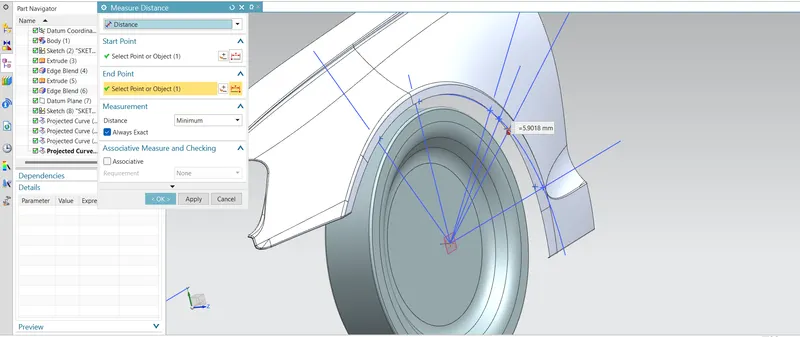
- The value of 'L' at each section and the value of 'a 'are found out to detrmine whether the fender satisfies the european standards as shown below.
VALUE OF L AT B SECTION
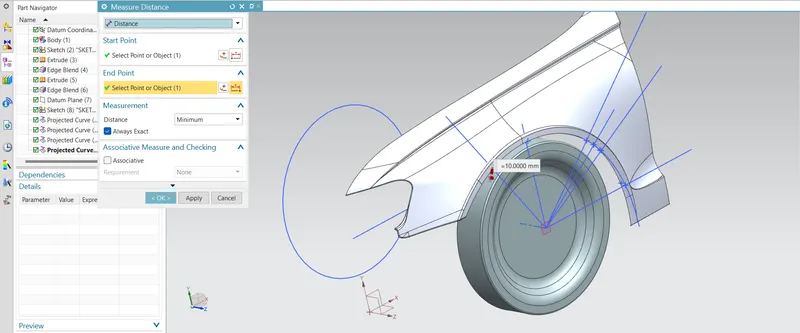
VALUE OF L AT A SECTION
VALUE OF L AT C SECTION
VALUE OF L AT D SECTION
VALUE OF L AT E SECTION
Observation tabular form mentioned below:
| Position | Required Clearance Value (mm) | Observed Clearance Value (mm) | The requirement Test |
| SA | 10 | 9.9490 | Failed |
| SB | 10 | 10 | Passed |
| SC | 10 | 0.112637 | Failed |
| SD | 10 | 2.7525 | Failed |
| SE | 10 | 5.9018 | Failed |
CONCLUSION
I will observed above calculation of the given fender wheel arch design will not pass the European standard in the position SA, SB, SC, SD and SE has a clearance less than 10mm which is the minimum requirement for European standards.