Fender Design - Wheel Arch Challenge
Fender Design - Wheel Arch Challenge
AIM: Calculate the Wheel Arch gap at the required points and check whether the car passes the European standard.
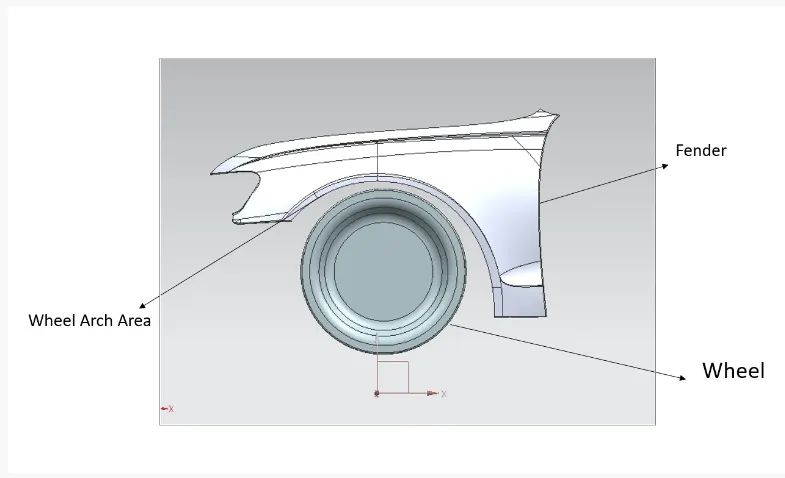
FENDER:
A fender is the curved portion of the car's body that sits over and houses the wheels.
The purpose of a Fender is pretty simple. Its purpose is to keep mud, rocks, and other road debris from being thrown around by the tires. In other words, the fender is a housing for the wheels that keeps road debris contained. If nothing was covering the wheels, the rotating tires would kick up all kinds of debris.
The fender not only protects your car from sustaining damage from road debris but it prevents this debris from being thrown up at other vehicles on the road. This is why vehicles with large, oversized tires are often required by law to install fender flares. from getting thrown into the vehicle or the BIW area as well as outside the vehicle and onto other vehicles or pedestrians on the road. For the vehicle, Different countries have different wheel arch regulations in place the wheel arch of fenders must be compliant with the standards and regulations set by respective countries. and the wheel arch design has to comply with them to be deemed usable in that country.
European rules require a pre-determined clearance of a minimum 10mm distance, which is to be maintained b/w the fender and respective tyre at particular points, along the tyre profile as shown below
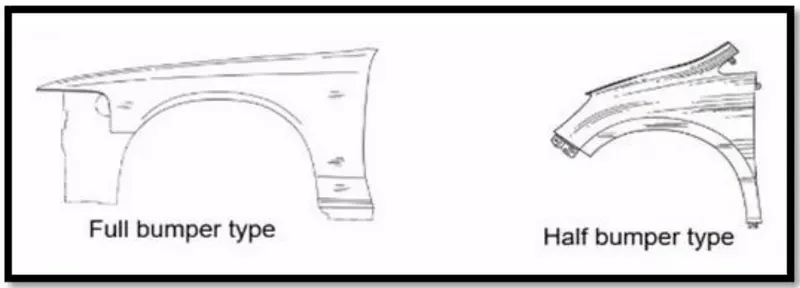
Type of Fenders
Wheel Arch:
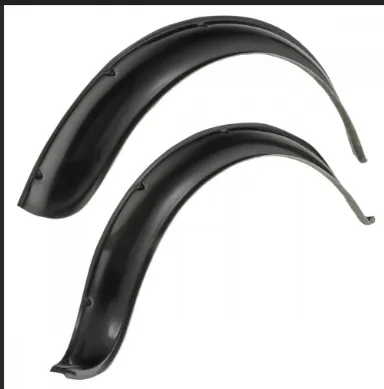
Parameters are considered for design purposes to avoid making design changes to the same vehicle to comply with various regulations.
Fender Wheel Arch Regulations :
Japan Regulations :
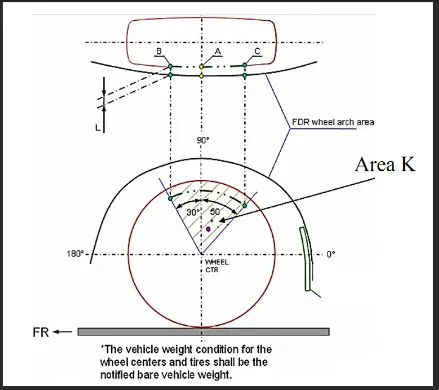
- The clearance "L" for the tire, hub, cap and fender is to be measured within area K and create a clearance check chart to validate.
- The value of L should be greater than 5mm at all points.
- Wheel guard requirement: The value of "a" should be more than 5mm at line 30° anticlockwise and 50° clockwise from the central vertical axis of the wheel.
European Regulations :
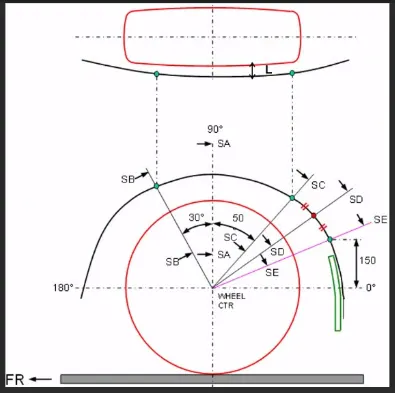
- The clearance "L" should be measured at defined sections SA, SB, SC, SD and SE and create a clearance check chart to validate.
- At all five sections the value of L should be greater than 10mm to qualify for the European Regulations.
- Wheel guard requirement: The value of "a" should be more than 5mm at line 30° anticlockwise and 50° clockwise from the central vertical axis of the wheel.
US Regulations :
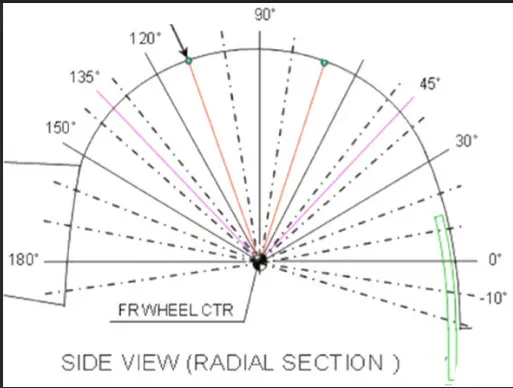
- Clearance "L" is to be checked at all positions from -100° to 100° and create a clearance check chart to validate.
- The value of L should be greater than 5mm to qualify the US regulations.
- Wheel guard requirement: The value of "a" should be more than 5mm at line 30° anticlockwise and 50° clockwise from the central vertical axis of the wheel.
Calculations of wheel Arch area - European Regulations:
We must sketch the outermost face of the wheel or tyre to calculate the clearance between the wheel arch and wheel, and the procedure is as follows.
We need to open the part file in NXCAD, and the part file contains the wheel and the fender. Therefore, we must now search for European standards. Now we must establish the Datum plane at the wheel's outermost face, as depicted in the figure.
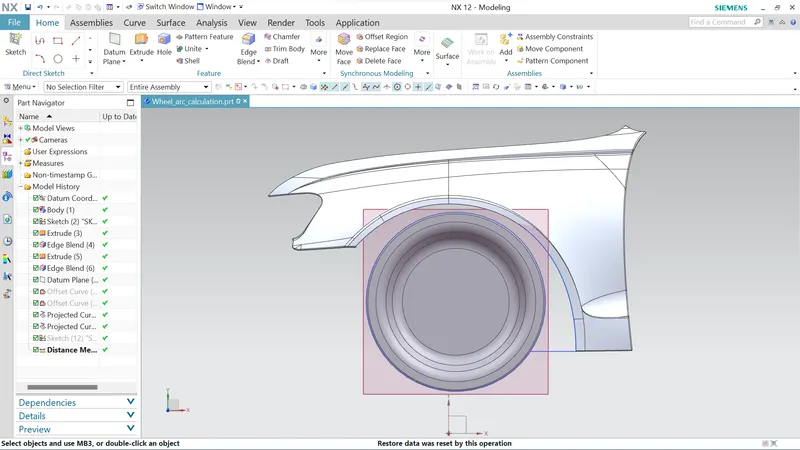
Following that, we sketch the lines in that plane and provide the required angle using the Rapid dimension from the reference of the European standard drawing, as depicted in the figure.
Additionally, as depicted in the figure, the European standard sets the dimensions. Give the lines the appropriate names using the text.
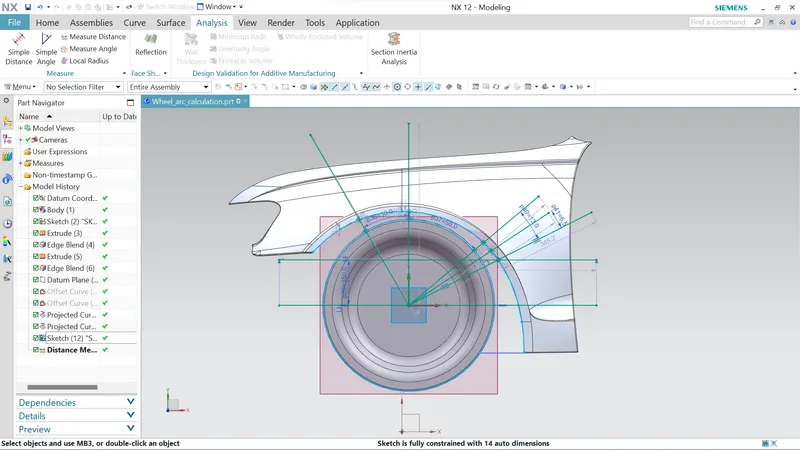
The next step is to add some points to the face and an angled line to determine the distance between the outermost wheel and the outermost wheel arch, as shown in the figure.
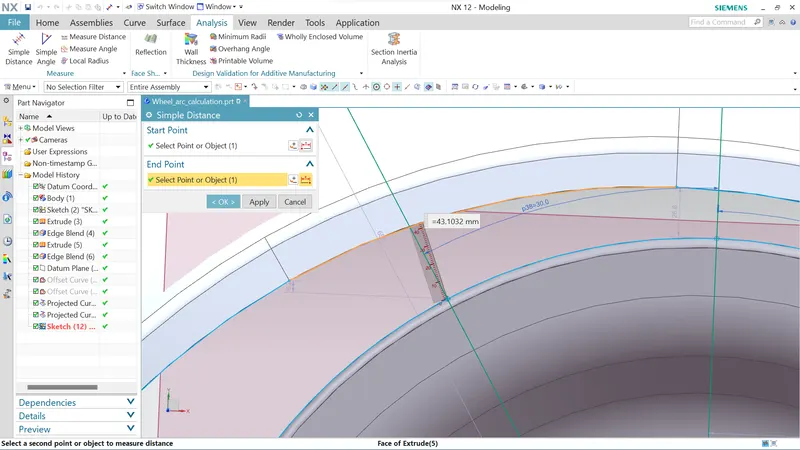
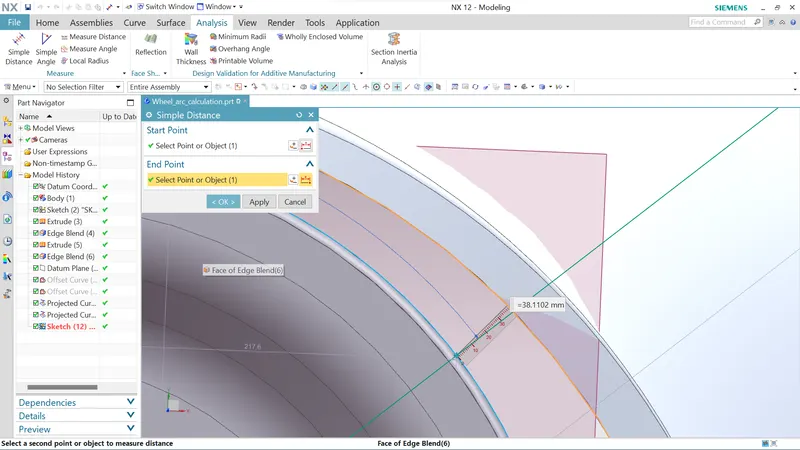
And now, as depicted in the figure, using the analysis tab in the NX Cad, select a simple distance to measure the required distances by the European standard. We measure a clearance distance of 43.1032 mm from the 30-degree SB line and 38.1102 mm from the 50-degree SC line, as shown in the figure.
standards :
- "a" should be more than 5mm at line 30 degree forward and 50 degrees.
- "L" should be greater than 10mm
The criteria for clarity are listed below.
for "a" values
SB = 43.1032 mm
SC = 38.1102 mm
for "L" values
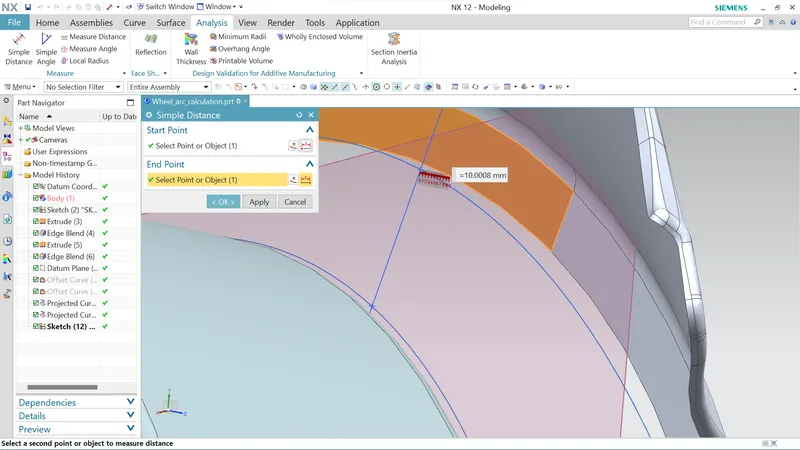
SB-SB = +10.0 mm
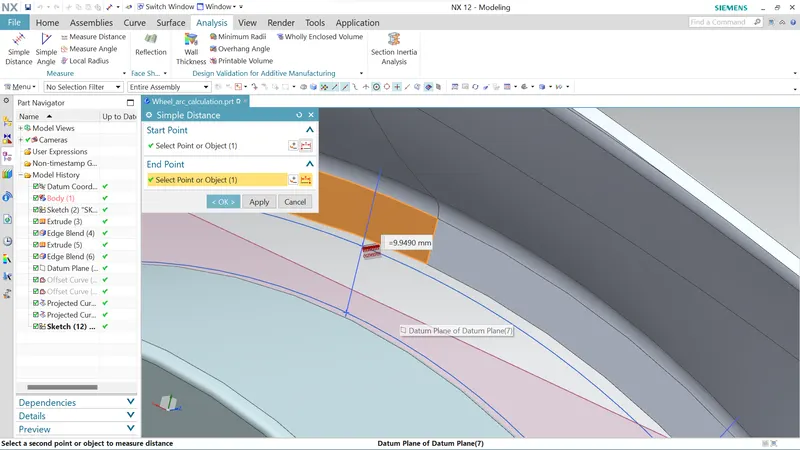
SA-SA = + 9.949 mm
SC-SC = - .1918 mm
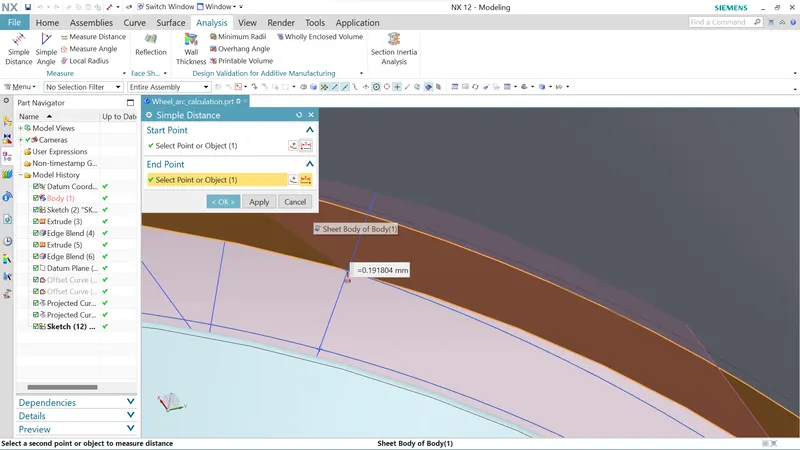
SD-SD = -2.8814 mm
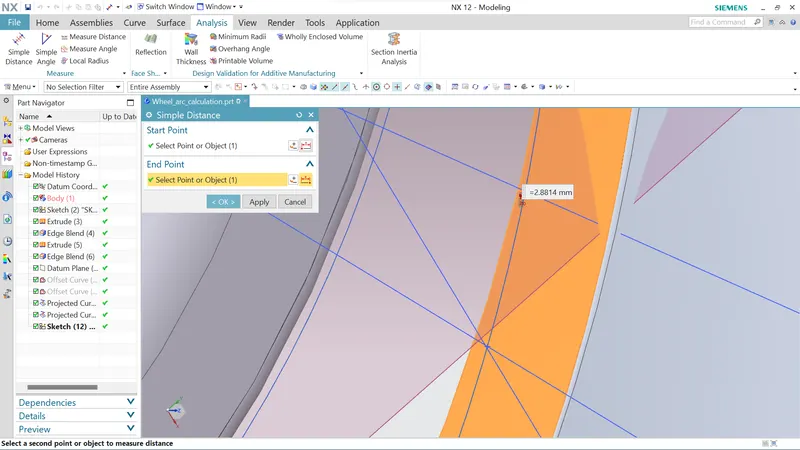
SE-SE = -5.8672 mm
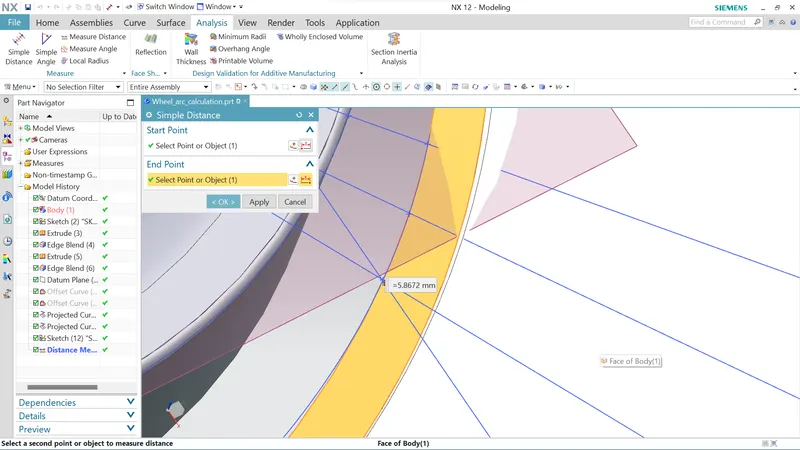
Additionally, a table of the results is provided below.
| Section | L>10mm | Result | a>5mm | Result |
| SB-SB | +10.0 mm | Pass | 43.1032 mm | Pass |
| SA-SA | + 9.949 mm | Fail | 38.1102 mm | Pass |
| SC-SC | - .1918 mm | Fail | ||
| SD-SD | -2.8814 mm | Fail | ||
| SE-SE | -5.8672 mm | Fail |
Conclusion :
As the minimum clearance between the arch wheel and the outermost wheel of the fender is 10 millimeters, and this design does not meet this minimum clearance, the aforementioned findings lead us to the conclusion that the fender does not comply with the European Regulations.