Fender Design - Wheel Arch Challenge
FENDER WHEEL ARCH CHALLENGE
- Fender regulations are the rules and standards that govern the design, installation, performance, and testing of fenders and their mounts on automotive vehicles. Fender regulations aim to ensure the safety, quality, and environmental compatibility of fenders and their mounts.
- Fender regulations vary depending on the type, category, and market of the vehicle. Some of the common fender regulations are: AIS-006 for bumper fitment on M1 vehicles in India, AIS-013 for spray suppression systems in India, UN R26 for external projections in international markets, FMVSS 108 for lighting and light-signalling devices in USA etc.
- Fender regulations specify the requirements and methods of tests for various aspects of fenders and their mounts, such as: dimensions, shape, clearance, location, attachment, strength, rigidity, durability, corrosion resistance, impact resistance, energy absorption, spray suppression, visibility, reflectivity, etc.
- Fender regulations also provide the technical information and documentation that have to be submitted by the vehicle manufacturer for approval and certification of fenders and their mounts. Some of the information and documentation are: drawings, specifications, test reports, certificates, labels, etc.
Europian Fender Regulation Requirements:-
- European fender regulations requirements are based on the United Nations Economic Commission for Europe (UNECE) regulations, which are adopted by many countries around the world. The UNECE regulations cover various aspects of fenders and their mounts, such as: external projections, spray-suppression systems, lighting and light-signalling devices, etc.
- European fender regulations requirements also include some specific EU regulations that complement or supplement the UNECE regulations in some aspects. For example, the EU has specific regulations for eco-design, energy efficient products, chemical safety, etc.
- European fender regulations requirements specify the requirements and methods of tests for various aspects of fenders and their mounts, such as: dimensions, shape, clearance, location, attachment, strength, rigidity, durability, corrosion resistance, impact resistance, energy absorption, spray suppression, visibility, reflectivity, etc. Some of the relevant UNECE regulations that the EU follows are: UN R26 for external projections, UN R91 for spray-suppression systems, UN R48 for lighting and light-signalling devices, etc.
- In the given figure below, a fender wheel arrangement is shown, side view and top view in bottom and top respectively. As per Europian Fender Regulation requirement, all points (SA, SB, SC, SD, SE) drawn on the outermost face of the wheel shown be 10mm away from outer most fender edge.
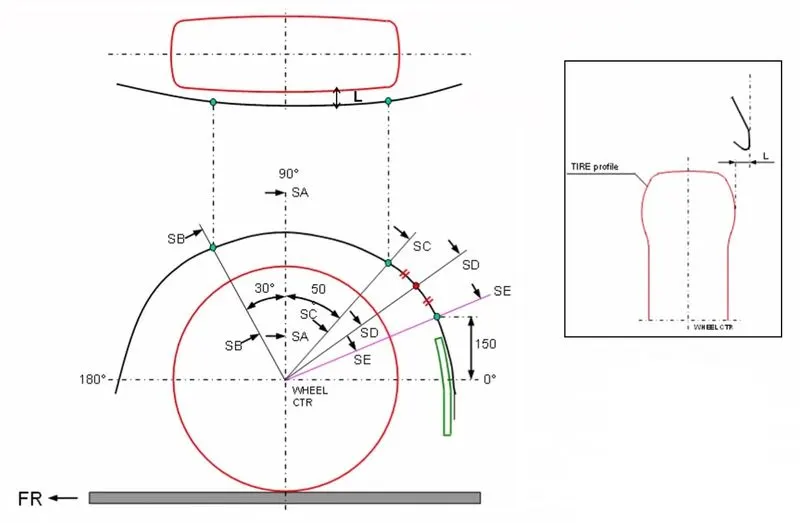
In the given challenge, a wheel-fender arrangement is given. We need to create a sketch as shown above and measure the corresponding points to varify whether the car passes Europian standard.
For that a datum plane is constructed inplane with an outermost edge of the wheel. Sketches are drawn as per europian standard and the intersection points on the fender is marked as A, B, C, D and E as shown in the figure below:
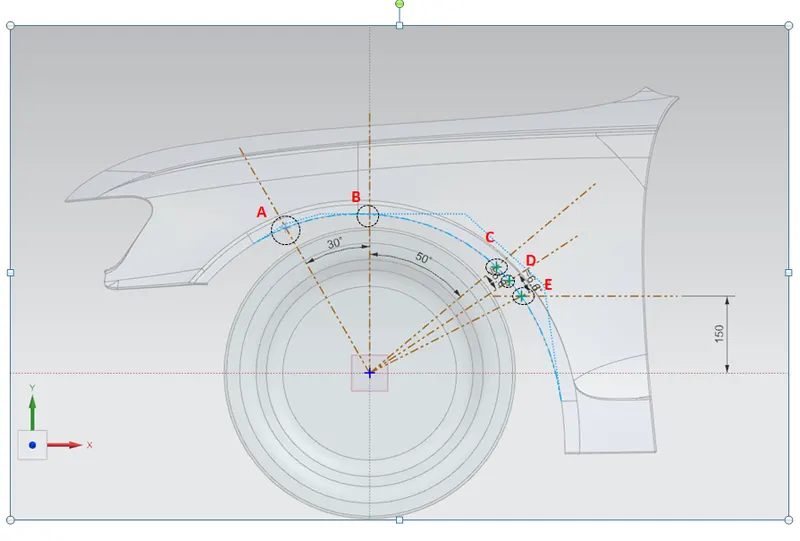
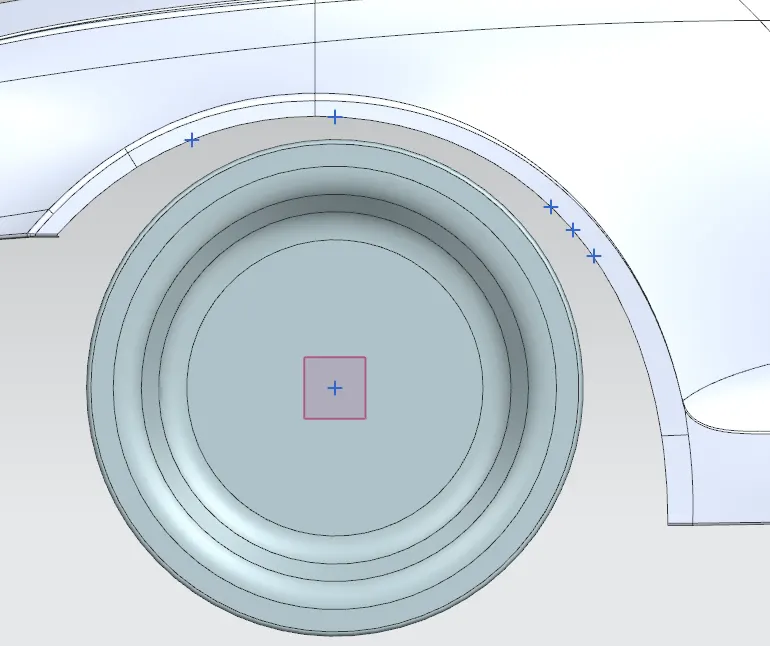
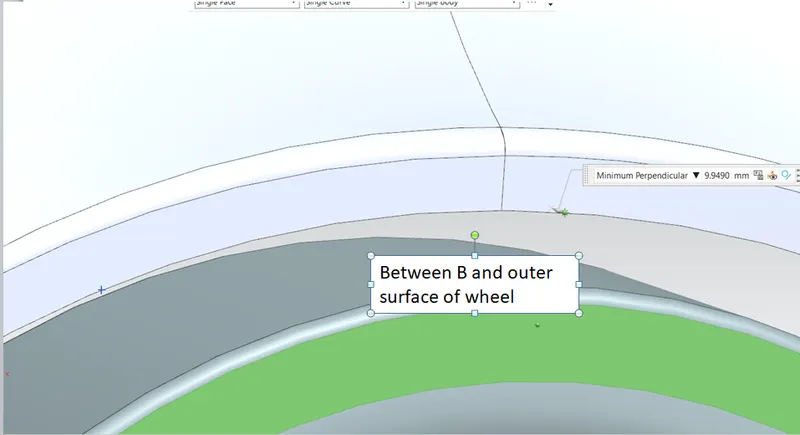
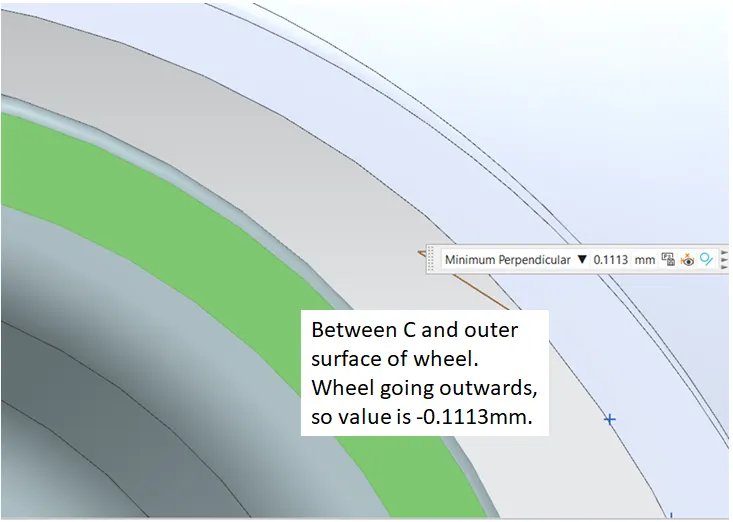
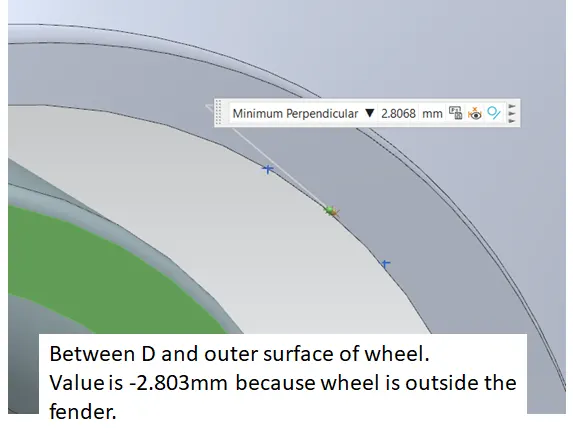
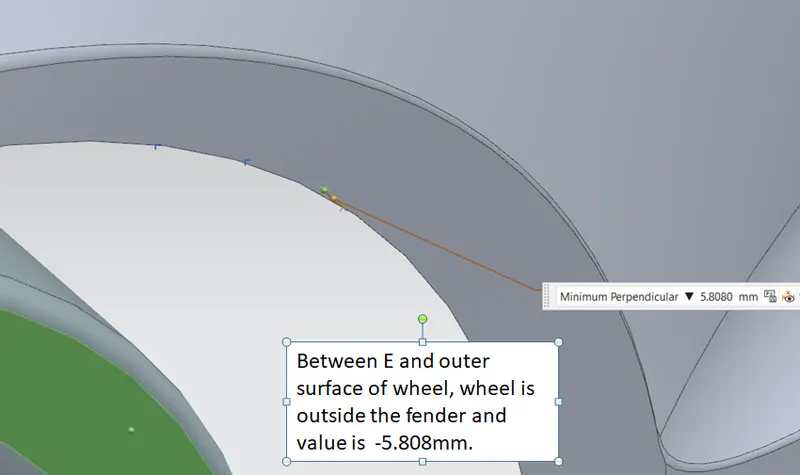
As per the Europian standard these points should be 10mm or greater away from the outer most edge of the wheel. The images of the measurements is shown below:
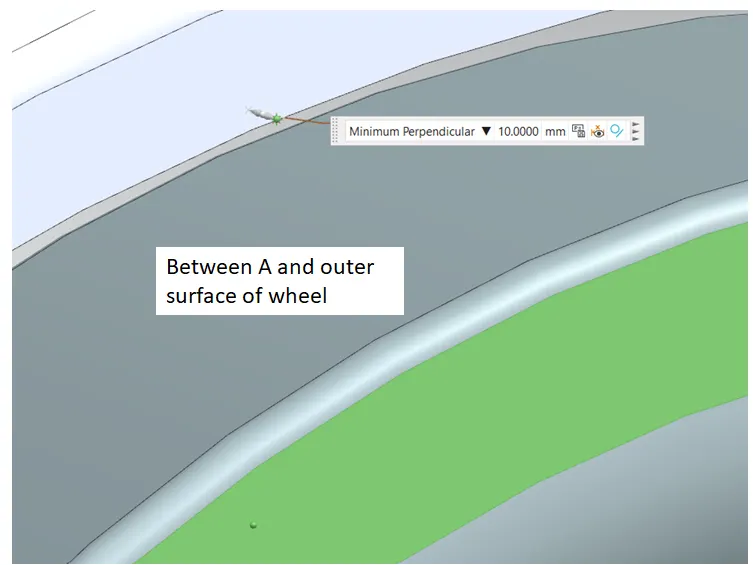
| POINT | VALUE (mm) | REMARKS |
| A | 10 | Matching the standard |
| B | 9.949 | Not matching the standard as value < 10 mm |
| C | -0.1113 | - value, which indicates wheel is outside the fender edge. |
| D | -2.803 | - value, which indicates wheel is outside the fender edge. |
| E | -5.808 | - value, which indicates wheel is outside the fender edge. |
From the measurements and the table, it can be concluded that the given arrangement is not meeting the Europian Fender Regulation requirements, as all the 5 points are not meeting the criteria of being at a distance of 10 mm or greater from the wheel edge.
Note: Please find the attached zip file for .prt file.