Fender Design - Wheel Arch Challenge
REPORT
AIM:
To create a report on fender regulation and to calculation the wheel arc area and prove whether the car will pass the standards or not by using the European standards.
FENDER
The fender of a car is a metal panel that covers and protects the wheel well and underside of the car. It also helps to prevent debris and water from splashing up onto the vehicle. Fenders can be made of various materials such as steel, aluminum, or plastic, and are often painted to match the color of the car. In some cases, fenders may also have additional features such as air vents or flares to accommodate larger wheels and tires.
There are several types of car fenders used in the industry. Some of the most common types include:
-
Full Fender: A full fender is a type of fender that completely covers the wheel well and extends to the side of the car. This type of fender is commonly used in classic and vintage cars.
-
Half Fender: A half fender, also known as a quarter fender, covers only the top portion of the wheel well. This type of fender is commonly used in racing cars.
-
Flared Fender: A flared fender is a type of fender that extends outward from the car's body, providing additional clearance for larger wheels and tires. This type of fender is commonly used in off-road and performance cars.
-
Wide Body Fender: A wide body fender is a type of fender that is wider than the car's body, providing a more aggressive look. This type of fender is commonly used in sports and performance cars.
-
Bumper Fender: A bumper fender is a type of fender that is integrated with the car's front or rear bumper. This type of fender is commonly used in modern cars and provides additional protection in the event of a collision.
-
Custom Fender: Custom fenders are designed to fit the specific needs and style of the car owner. They can be made from a variety of materials and can have unique shapes and designs.
In a fender, the wheel arch is the semicircular part that is positioned above the wheel of the vehicle. While designing the fender care must be taken that the wheel arch of the fender meets the required standards.
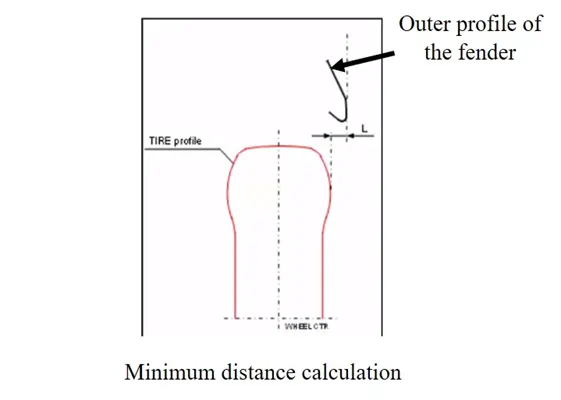
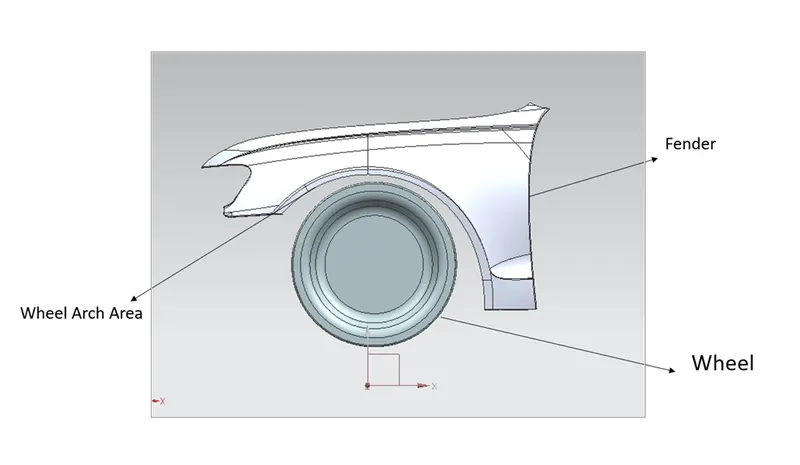
Different standards of the wheel arch area requirements:
- The wheel should be placed inside the fender or in other words, there should be a minimum distance between the outer surface of the fender and outer surface of the wheel.
- This helps to reduce the chance of chipping of the wheel with outer particles.
- It helps in increasing pedestrian safety.
- The distance ‘L’ as mentioned in the above figure should be a minimum value, which varies as per standards followed by different countries
Some of the different standards followed are:
- Japanese standards.
- European standards.
- US standards.
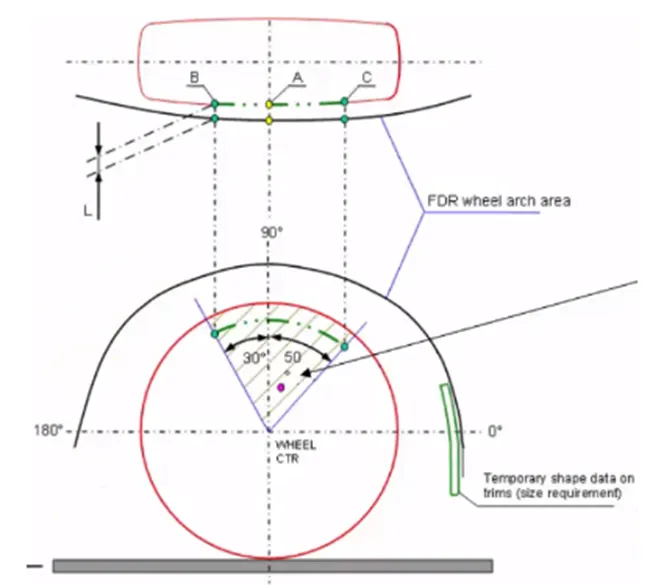
1.Japanese standards:
- Measure clearance L of the tire, hub, cap, and fender in three different positions within area K and produce a clearance check chart to validate.
- Clearance must be greater than 5 mm in all the three positions (i.e., at A, B, C from fender curvature)
- Wheel guard requirement: The value of 'a' shall be more than 5 mm at line 30* forward and 50* rearward from the central vertical axis of the wheel.
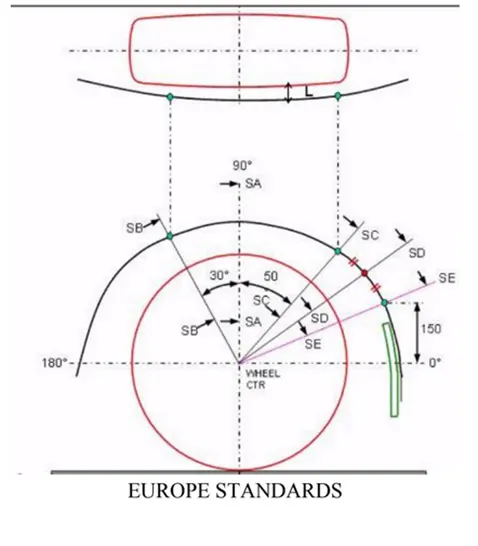
2.European standards:
- According to european requirements the distance is measured at 5 different points.
- Measure CL L at sections SA-SA SB-SB SC-SC SD-SD SE-SE and produce CL check chart to validate.
- At all five sections the CL L value should be greater than 10 mm to satisfy the European regulations.
- Wheel guard requirement: The value of 'a' shall be more than 5 mm at a line 30* forward and 50* rearward from the central vertical axis of axis of wheel.
3.US standards:
- The clearance ‘L’ at all positions (every 10o) from -20 deg to 180 deg should be greater than 5 mm to satisfy US regulations.
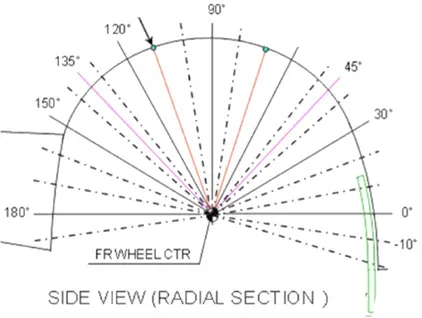
CHECKING WHETHER IT MEETS THE EUROPEAN STANDARDS
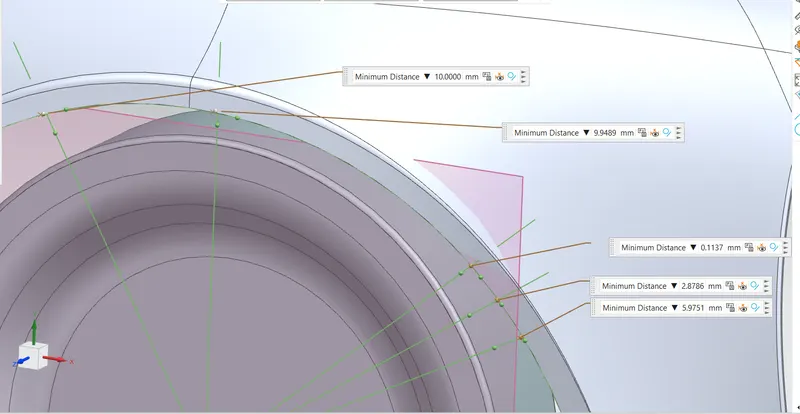
@SB: L=10 pass (L>=10)
@SA: L=9.949 fail (L<10)
@SC: L=0.1137 fail (L<10)
@SD: L=-2.8786 fail (L<10)
@SE: L=-5.9751 fail (L<10)
CONCLUSION
From the above results, we can conclude that the Fender does not pass the European Regulations, as the minimum clearance L between the Fender Wheel Arch and Wheel for vehicle and pedestrian safety is 10mm and this design does not meet the requirement.