Fender Design Challenge
Fender design
Introduction:
To create a detailed 3D model of Automobile Fender using siemens NX.
Introduction:
In this project a detailed model of an automobile fender is created using Siemens NX in-order to understand and familiarize with different tools and methods of modelling. The fender provides safety to the engine compartment from the pebbles and dirt coming from the front wheels. The hood panel consists of three main components.
- Fender mountings: The fender has specific points where the fender is attached to the rest of the body of the vehicle. There are various mountings such as the engine drip mounting, the a-pillar mounting, the sill mounting, bumper mounting and the fender splash mountings.
Design Methodology:
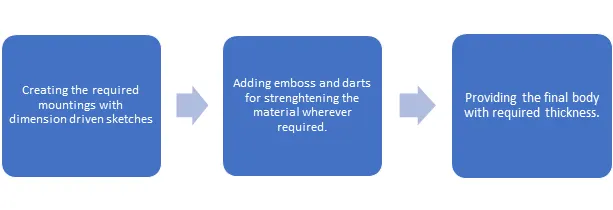
Description:
The fender is an aesthetic part of the vehicle which also helps prevent rubble damage to the engine compartment. The fender design is carried out in cad softwares and then the cad data is sent to the manufacturing plant for the manufacturing process.
- Fender manufacturing: The manufacturing process includes the following steps: unfolding and shearing are carried out on a plate, after that a proper cold roll specification is selected, a cold roll is unfolded, and then the unfolded cold roll is sheared to an iron plate of the corresponding size. Oil pressing and punching is carried out, wherein the iron plate is extended then side shearing and punching are conducted on the iron plate, folding and shaping are carried out on the iron plate, and finally the iron plate is reshaped. The mountings are machined into the specified locations.
- Fender design:
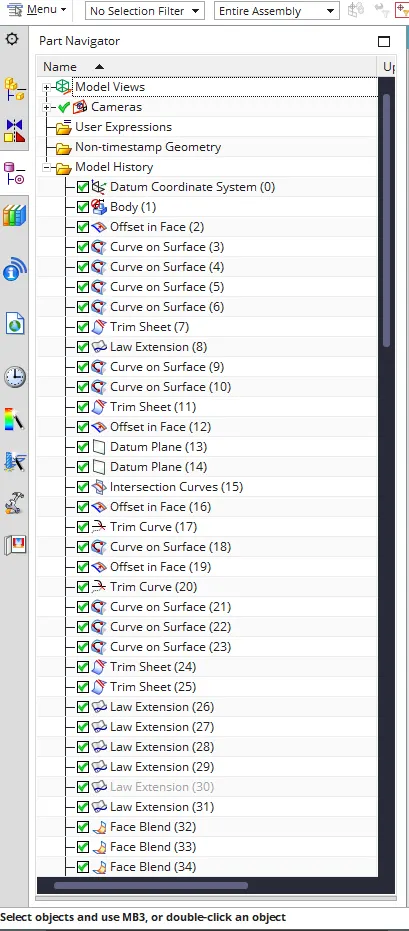
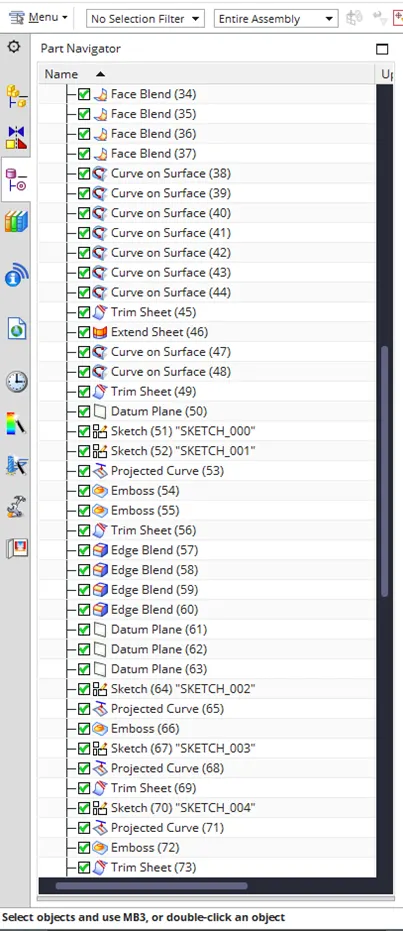
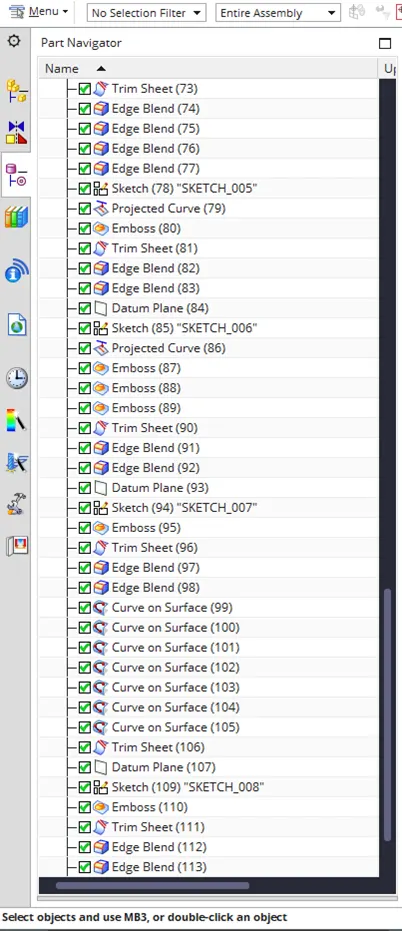
The fender can be designed using various softwares as per the user convenience. We design the fender using Siemens NX software. The following tools are used in designing the fender model.
- Offset curve on surface : The offset curve on surface tool creates a copy of the selected curve at a provided distance and direction on the same surface as the original curve.
- Emboss: The emboss tool creates a punched surface of the selected closed contour. The punch is created from a selected surface containing the contour sketch/curve. A draft can be provided for the punch from either the end cap or the base surface.
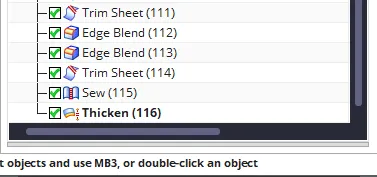
- Trim sheet: The trim sheet tool splits the target surface along the intersection curve of target surface and the tool surface. The part of surface on either side of the intersection can be either discarded or retained as per the requirement.
- Law extension: Creates an extended surface based on an open chain contour or a closed contour on the selected target surface. A draft can be provided for the extension.
- Face blend: Creates a curved blend or fillet along two selected surfaces in a provided direction vector. The curve of the blend can be adjusted in terms of radius, width and continuity.
- Edge blend: edge blend creates a curved surface of desired radius along the selected edge.
- Extend sheet: Creates an extension of the selected sheet up-to a provided distance.
- Bridge curve: Creates a, arc between two intersecting or non-intersecting curves. The start and end points of the arc can be adjusted by providing a distance value.
- Project curve: Creates a projection of a selected curve profile onto a target surface. The surface can be linear or curved. The direction of projection can be adjusted by providing a suitable vector.
- Sew: The sew tool merges two or more surface bodies into a single sheet or a solid based on the requirement. Any gaps between the surfaces can be closed if they are within the set tolerance range.
- Curve on surface: Creates a curve on a selected surface by providing the start and end points and their relation i.e., G1 Tangent or G2 curvature.
- Thicken: Creates a solid body with provided thickness and direction.
The below images show all the tools used for creating the box assembly model.
Design views:
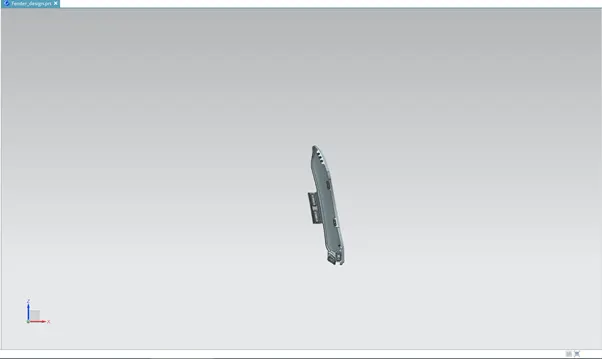
Front view
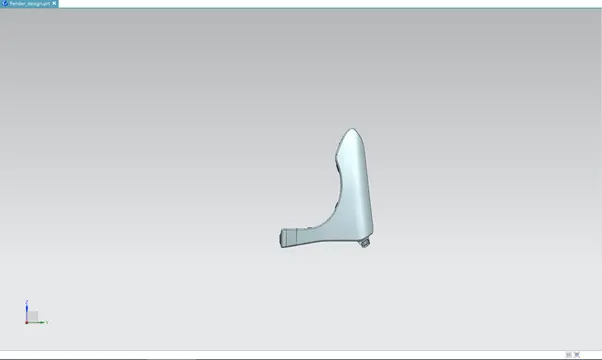
Side view
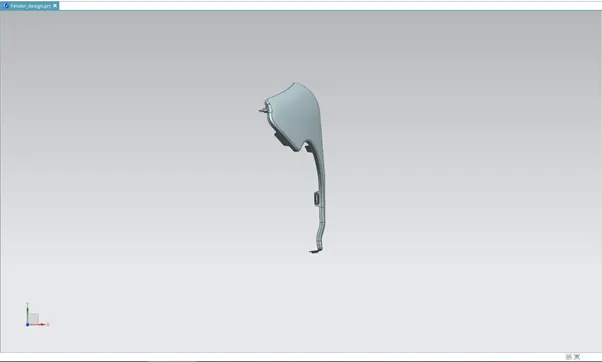
Top view
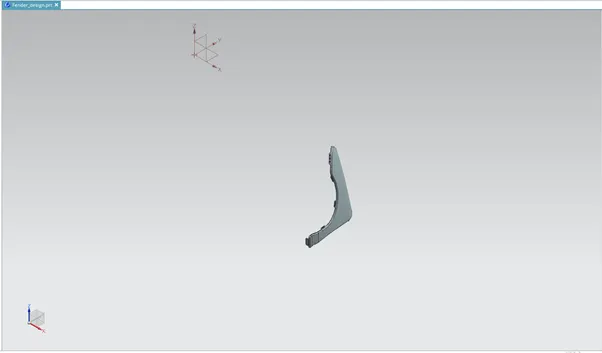
Isometric view
Conclusion:
Thus after following the steps mentioned in design methodolgy and using the tools shown above, the fender design is created.