Fender Design
What are Fenders?
Fenders are the curved strut which sits over the wheel well on a car and helps cover the top of the wheel. Most cars have fenders of one type or another to help cover their wheel wells, and these fenders are generally made of the same plastic, metal, or fiberglass material as the rest of the vehicle.
Fenders protect the sides of your car. The main purpose of fenders is to prevent the dirt and debris kicked up by your wheels from damaging the sides of your car. The fender catches anything brought up by your wheels and causes it to drop straight down instead of spattering against or scratching your vehicle.
Fenders also help protect your wheels. Fenders also provide some protection to the wheels against collisions with other cars, although this isn’t perfect. Generally, the fenders will get hit before the wheels do and, depending on how hard the impact is, will stop whatever hit your car from damaging your tires.
Types of Fenders:
There are two types of Fenders, which are
1) Full Bumper type
2) Half Bumper types
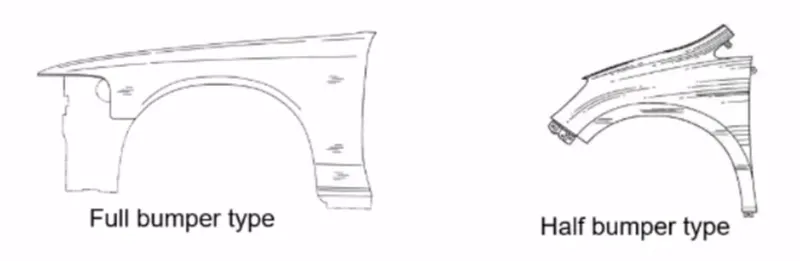
- Presently we are using the half bumper type, the reason for choosing the half bumper type is that blank sheet of sheet metal for full bumper type is very large and also has the lot of scrap, but in the case of the half bumper type we have the possibility to reduce the scrap. By this scrap and manufacturing cost reduced.
- In half bumper type we reduce the usage of the steel material and uses the lots of plastic on the bumper which in term decreases the cars weight and increases the performance.
Mounting regions for Fender:
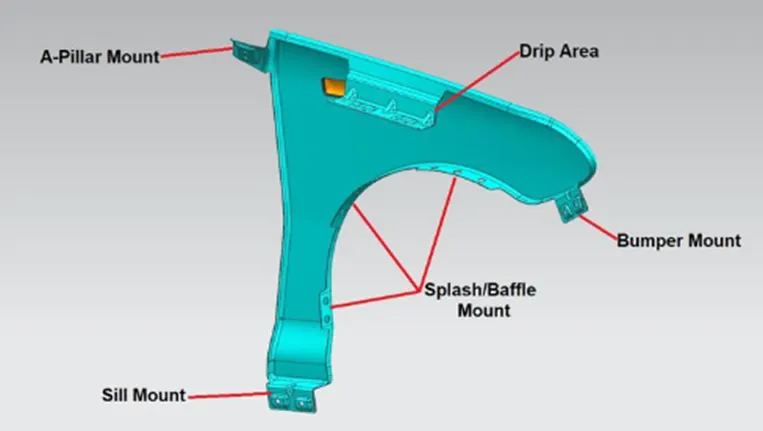
Mainly 5 mounting points for the Fender as below,
- A- pillar mounting
- Body mounting
- Sill mounting
- Bumper mounting
- Drip mounting
Manufacturing process of automobile Fender:
The invention discloses a manufacturing process for a car fender. The manufacturing process includes the following steps that firstly, unfolding and shearing are carried out on a plate, wherein a proper cold roll specification is selected at first, a cold roll is unfolded, and then the unfolded cold roll is sheared to an iron plate of the corresponding size according to production material specifications; secondly, oil pressing and punching are carried out, wherein the iron plate is extended at first, then side shearing and punching are conducted on the iron plate, folding and shaping are carried out on the iron plate, and finally reshaping is carried out on the iron plate; thirdly, small first parts of the fender are machined, wherein first of all, the iron plate is punched to a needed outer contour blank, then the iron plate completing the outer contour blank is further shaped, and the iron plate is punched at last; fourthly, installation and welding of a metal plate are conducted. The manufacturing process for the car fender is simple and high in production efficiency; a body of the fender and the small parts can be separately machined, so waiting time is shortened; working efficiency of production is improved.
Process: -
- Shearing Process
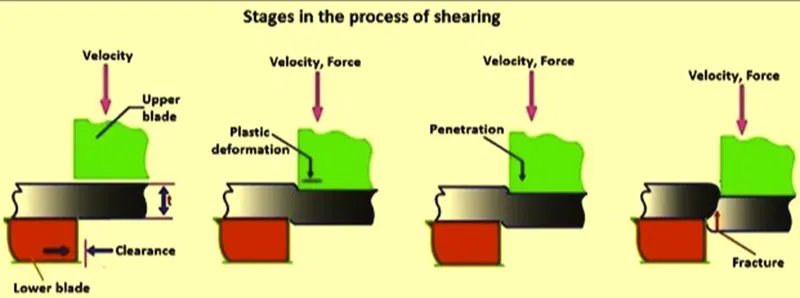
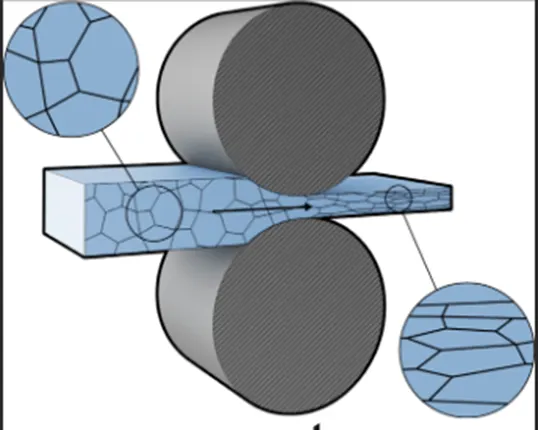
- Cold Rolling Process
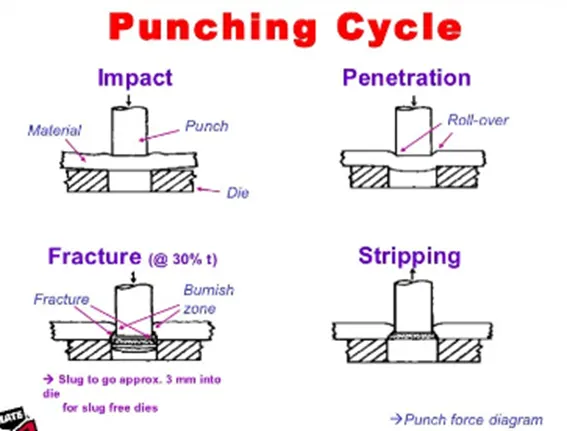
- Punching Process
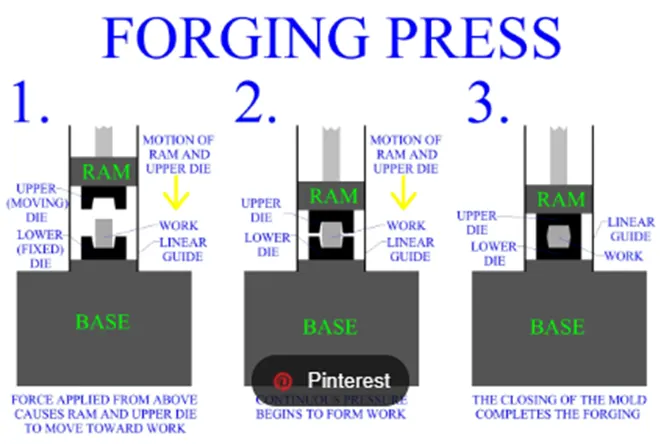
- Pressing Process
Design of Fender:
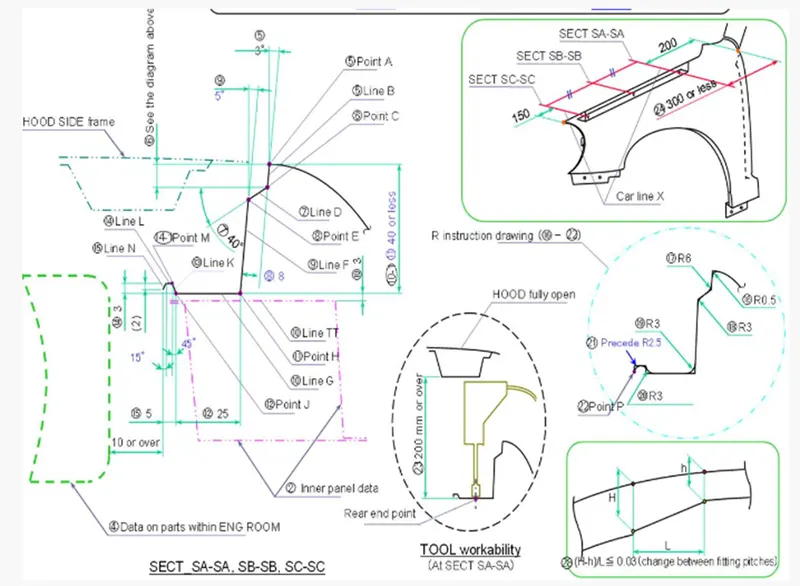
Master Section: -
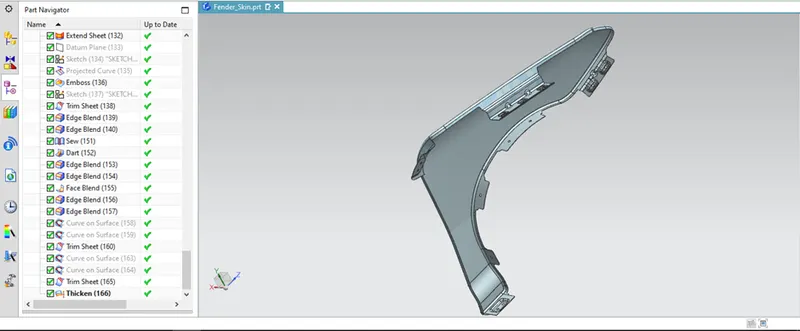
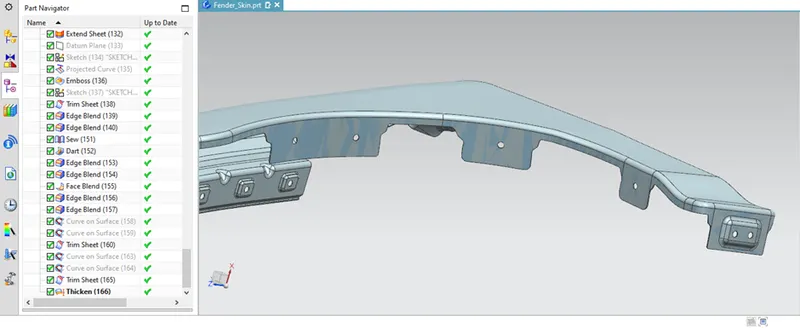
Commands used for Design: -
- Offset in Face: - To take curve offset on selected body face at desired distance.
- Curve on Surface: - To draw curve on Body face.
- Trim Sheet: - To remove selected region from body.
- Law of Extension: - To generate surface relate with another surface with desire dimension.
- Datum Plane: - To create datum plane at our most surface of tyre for sketch.
- Intersection Curve: - To get curve of intersection of two objects.
- Face Blend: - To create blends between two faces.
- Edge Blend: - To create radius or blend over a selected edge.
- Sew: - To join different objects.
- Dart: - To give surface strength for long plane surface.
- Extend Sheet: - To extend selected sheet with desired dimensions.
- Bridge Curve: - To draw curve between two edges.
- Emboss: - To create emboss.
- Projected Curve: - To project curve on selected surface.
- Thicken: - To give thickness to the Part or Object.
Different Five Mounting Region Design:
Drip Area: -
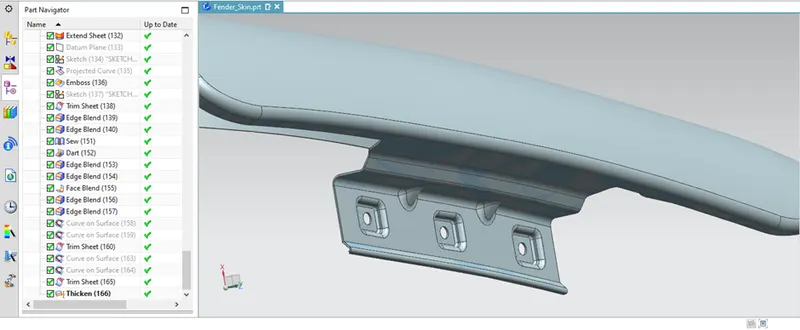
- It is the important mounting point of the fender. It is connected with the engine compartment. Therefore, the lot of design constraints are to be followed while designing the fender to ensure enough clearance between engine part and fender and also easy for assembly.
- While designing the drip area, initially leave 200-300 mm for cowl top according to master section.
- For placing the headlamp, leave 150 mm at the front while designing the fender as mentioned in design.
- Cowl top part consists of wiper motor and its instruments.
- Two darts are added on the longer side of the drip area in order to provide the stiffness and adds strength to the part. This helps the fender to do not vibrate and sustain impact forces outside of the fender during motion of the vehicle.
- Embossing is provided on the mounting to strengthen them during fastening and locate part at proper place for assembly.
- Also give radius to sharp surfaces to reduces flaws during manufacturing processes.
Sill Mounting Area: -
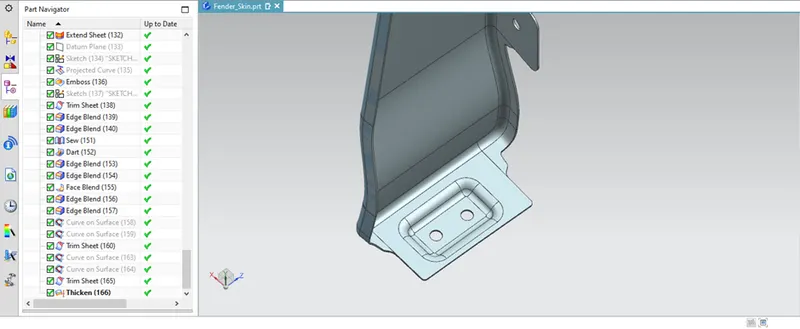
- Sill is the panel area which is below the bottom of the door supporting the floor and also be used to combine floor and the body.
- The bottom end of the fender is mounted on the sill body for reinforcement of the fender panel.
- That’s why Sill mounting position is designed with holes and emboss.
- Sill mounting area is less. For that dart is not require to strengthen surface.
Bumper Mounting Area: -
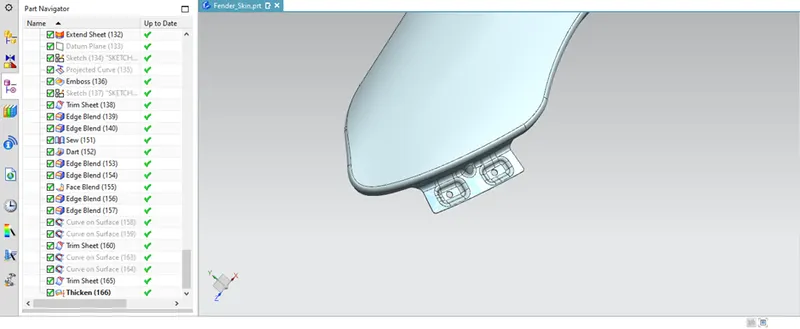
- Bumper mounting area is used to fix fender to bumper with the help of the fasteners.
- Here is also used emboss and holes for mounting.
- This portion is also very weak due to plane large surface. So, to strengthen them dart is placed.
- Moreover, sharp edges and corners remove to reduce component fatigue during manufacturing process.
A-Pillar Mounting Area: -
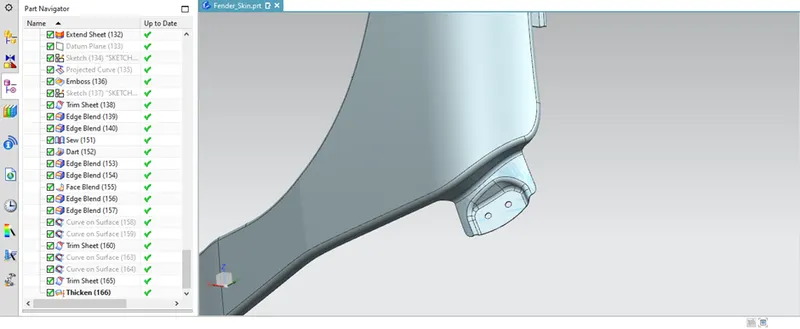
- The A -pillar is structural pillar that combines the body to the roof. This makes the sides of the windshield rest. Front fenders are fastened to the A -pillar to form a robust structure.
- Here is also used half cut emboss and holes for mounting.
- Also, sharp edges and corners remove to reduce component failure during manufacturing process.
- No dart requires due to small surface.
Baffle Mounting Area: -
- Baffle mounting or mudguard are clip fit type of mounting on the inner side of the fender arch over the Tyre.
- It protects the car engine compartment and pedestrians from causing injuries from chip out debris on the road when the car is in motion.
- It is mounted on the fender using a special type of locking clips which are made up of plastics.
- That’s why here we are not need emboss. Only holes are required for assembly.
- Also, there is no need of dart due to not requirement of strength. If we require then also, we are unable to create due to dart spoils aesthetical surface of fender.
- Also, sharp edges and corners remove to reduce component failure during manufacturing process.
Final Fender Design Isometric View: -