FAQ: Fundamentals of load transfer and ride frequency
1. What are the two types of tire-rod errors concerning the ride steer? And what is the effect of these on the toe curve?
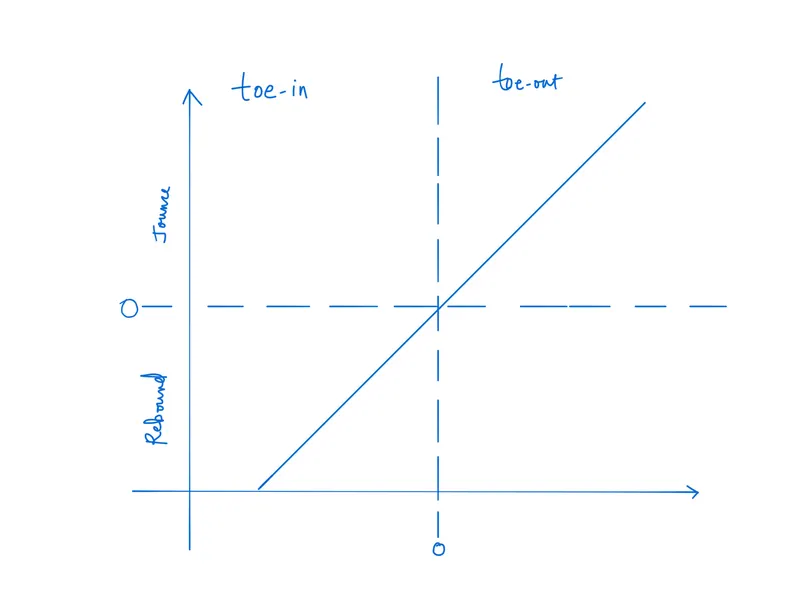
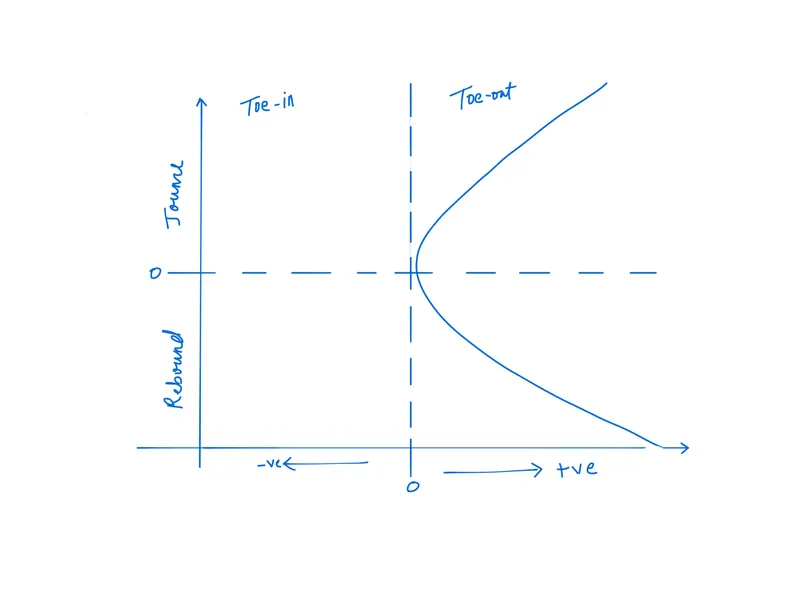
The two types of tire-rod errors are about its length and angle to the ideal centre of the steering arm ball travel. Curved ride steer plots are undesirable because the steering effect changes from understeer to oversteer depending on the wheel ride position.
- Error-1: Ideal length but, it does not intersect with the ideal centre. It causes the wheel to toe out while in jounce and toe-in when rebound.
- Error-2: The tie-rod pointed towards the ideal centre but, it's not of the correct length. It causes the wheel to toe out while in jounce and rebound.
2. If we have toe-out in rebound (due to bump steer) in the rear suspension, is this an understeer effect or an oversteer effect?
Toe-out in a rebound of the rear suspension leads to an oversteer effect.
3. If there were no bushings in the suspension (all components are hard mounted), would it still have compliance? If yes, where it is coming from?
Even if all the components in the system are hard mounted, there is structural compliance in the system. And it's provided by their stiffness and the tyres. Take a bicycle frame for an example. Each part (Seatpost, seat-tube, top tube, wheels, etc.) acts as springs and dampers because of the material stiffness!
4. In a front-mounted rack setup, if the suspension links are more compliant than the steering, would you have an understeer effect or an oversteer effect?
Such a steering setup would have an understeer effect as the lateral forces cause the wheel to deflect away from the turn due to lateral force steer compliance.
5. Why does the outer wheel almost always gain positive camber when subjected to a lateral force?
The lateral force acts at the ground at the contact patch of the tyre. Due to lateral force compliance and centrifugal force, the wheel gains positive camber.
6. Can you get an oversteer effect out of aligning torque compliance steer? Why or why not? If yes, how? (just a basic explanation)
It is only possible to get the oversteer effect out of aligning torque compliance steer at the rear axle and always understeer at the front. Because the aligning torque always tries to straighten out the wheels.
7. Why does the rear ride frequency have to be greater than the front ride frequency?
The rear frequency is greater than the front ride frequency to accommodate a flat ride. If not, it will cause pitching because the rear axle hits the bump after the front. Typically, the rear ride frequency is 1.2 times the front.
8. Can you use the same damping force for (why or why not)
(I). Low frequency and high frequency
To provide driver comfort, it is desirable to have a high damping ratio at low frequency and a low damping ratio at high frequency. Doing so reduces the vertical acceleration of the vehicle. Hence, we shouldn't use the same damping force for both cases when ride comfort is desired.
( II). Compression and rebound
Compression damping needs to be lower than rebound damping because during compression the spring absorbs energy. In rebound, energy is released. Hence it is undesirable to use the same damping force for both cases.
9. In a passenger vehicle, assume the front suspension has 30% anti-lift and the rear suspension has 25% anti-squat. By what percentage does the total longitudinal load transfer change?
0% change, as the total longitudinal load transfer is governed by the vehicle dimensions, vehicle mass and the location of the centre of gravity of the vehicle.
10. Let us say, theoretically you change the brake bias so that all the braking happens only in the front
I. What is the maximum possible anti-lift that you can get in the rear suspension
Zero. Because there is no braking moment generated at the rear to accommodate the longitudinal load transfer causing rebound travel in the rear suspension.
II. Is 100% pitch compensation possible with this setup?
Yes, it's possible theoretically. By obeying this condition: `e/d = (2h)/L` where h is the CG height and L is wheelbase length.