Design of backdoor
Design of car back door
INTRODUCTION:
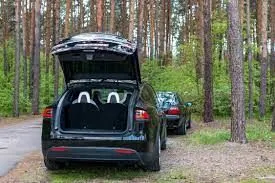
The Back Door of a car is the rearmost part of the vehicle which gives access to the trunk space of the vehicle.
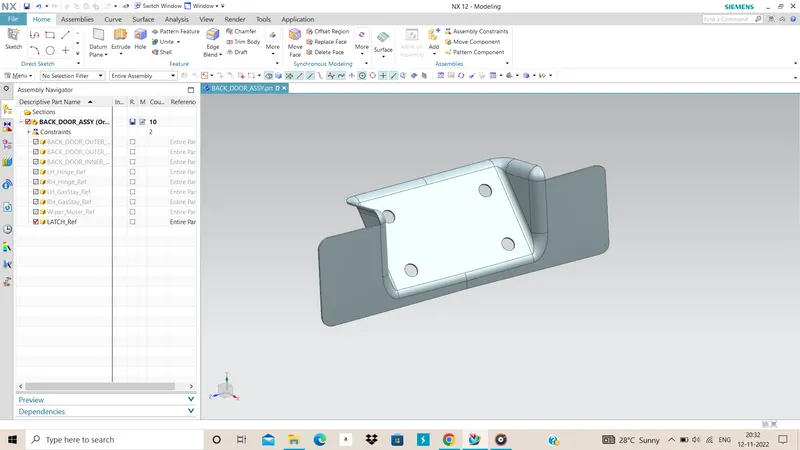
The rear door also supports the reinforcements and added weights of the Wiper Motor, Gas Stay, Tail Lamp, and Latch and Striker.
The backdoor has a lot of components inside and is designed to incorporate them easily. It affects the rear visibility and luggage area.A hinge allows the boot lid to be raised, while devices such as springs or gas cylinders hold it up in the open position.
OBJECTIVE:
i) From the given styling surface, develop a back door using appropriate design methodologies.
ii) The objective of this project is to design a BIW Back Door of a car with an Inner Panel, Outer Panel, and
Reinforcements for the Hinges, Gas stay, Wiper Motor, and Latch.
Major Parts and Reinforcements:
The backdoor consists of the following basic components:
1. Backdoor Outer Panel (Upper)
2. Backdoor Outer Panel (Lower)
3. Backdoor Inner Panel
4. Hinge Reinforcements (LH & RH)
5. Gas-Stay Reinforcements (LH & RH)
6. Latch and Striker Reinforcement
7. Wiper motor Reinforcement
Deep Drawing:
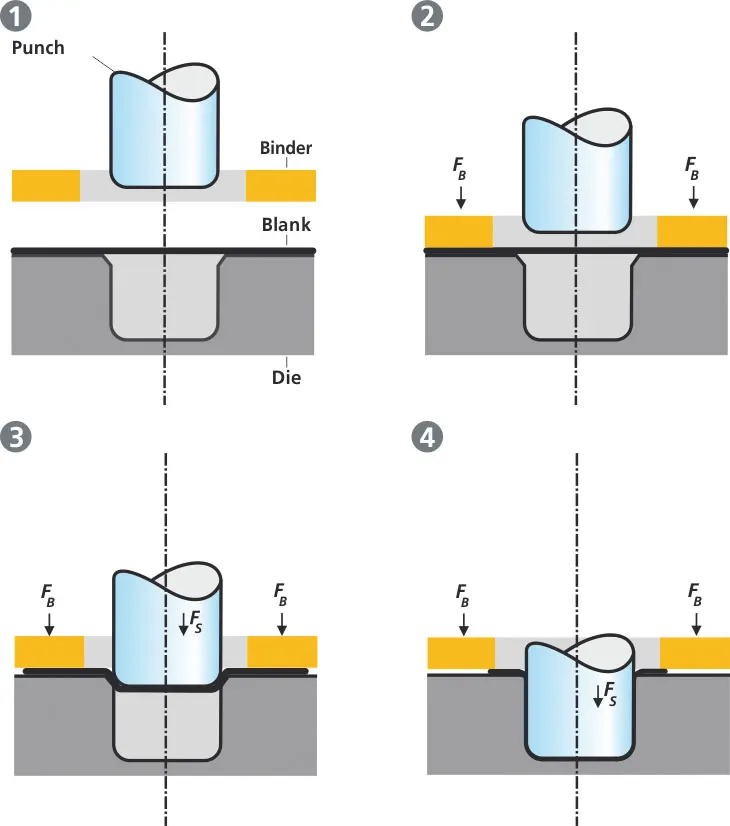
Deep drawing is a sheet metal forming process in which a sheet metal blank is radially drawn into a forming die by the mechanical action of a punch. It is thus a shape transformation process with material retention. The process is considered "deep" drawing when the depth of the drawn part exceeds its diameter.
Embossing:
Sheet metal embossing is a stamping process for producing raised or sunken designs or relief in sheet metal. This process can be made by means of matched male and female roller dies, or by passing sheet or a strip of metal between rolls of the desired pattern.
Materials commonly used in the metal embossing process include:
Aluminum alloys
Steel alloys
Copper etc.
Hemming:
Hemming is a sheet metal forming process in which sheets are joined by bending it to 180°. Automotive body panels and automotive parts such as deck-lids, trunk-lids, doors, hoods and tailgates are formed by hemming process. In this process, usually a sheet is bent with the help of inner sheet in three different stages.
DESIGN OF BACKDOOR:
The styling surface needs to be checked and analysed since it might have irregularities, hence it must be fixed first.
Then the back door was designed using the top-down approach.
Tooling Direction:
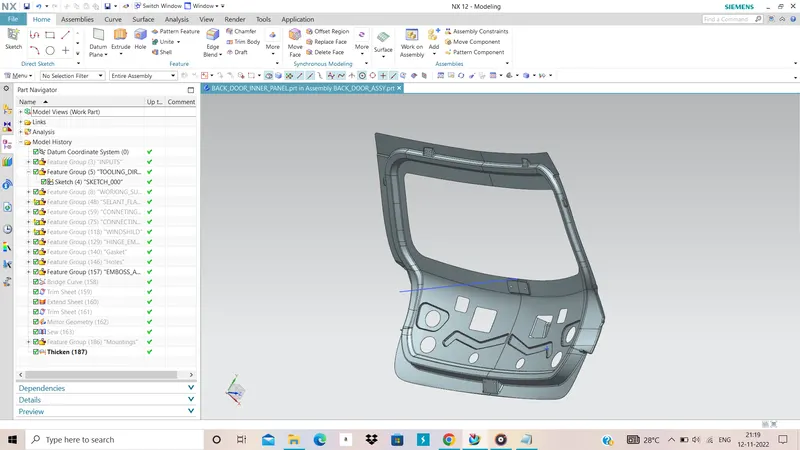
Before starting to design the inner panel of the back door the tooling direction for Deep Drawing
purpose should be created.
DESIGN OF BACKDOOR INNER PANEL:
After creating the tooling direction, the design of the inner panel will begin where we will first develop an effective sealing flange by checking all the boundaries and by following the shape of the inner panel design.
After the concept of the inner panel is developed, then the components like a hinge, latch, gas-stay locations, and their reinforcements must be designed.
The embosses were created in ‘V-Shape or Y-Shape' so that if the vehicle undergoes the crash, then the
force dissipates over it which reduces the damage transferred to the trunk space.
The outer panel was designed as two separate parts named as outer panel upper and outer panel
lower.
After designing the outer panel the Hemming was created by offsetting the surface with the help of face blend and swept surface.
CORNER RELIEF:
During the hemming process, when giving the Corner Relief helps to control sheet metal material behaviour and to prevent unwanted deformation during unbend operations and also helps to reduce the number of passes in hemming.
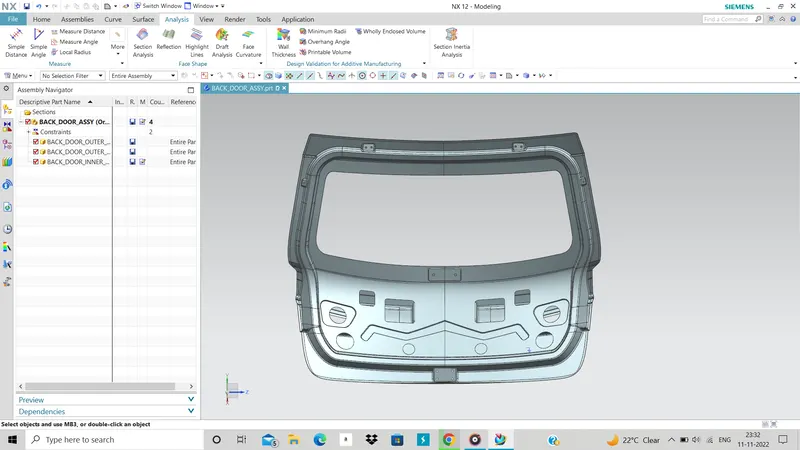
DESIGN OF BACKDOOR OUTER PANEL:
Outer Upper Panel:
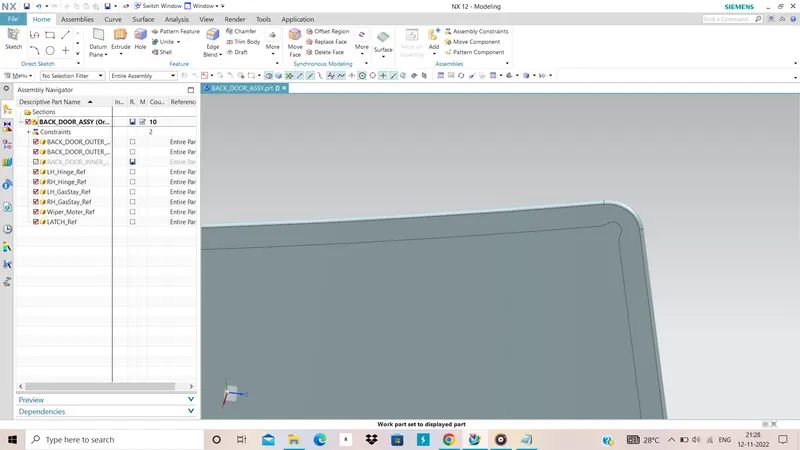
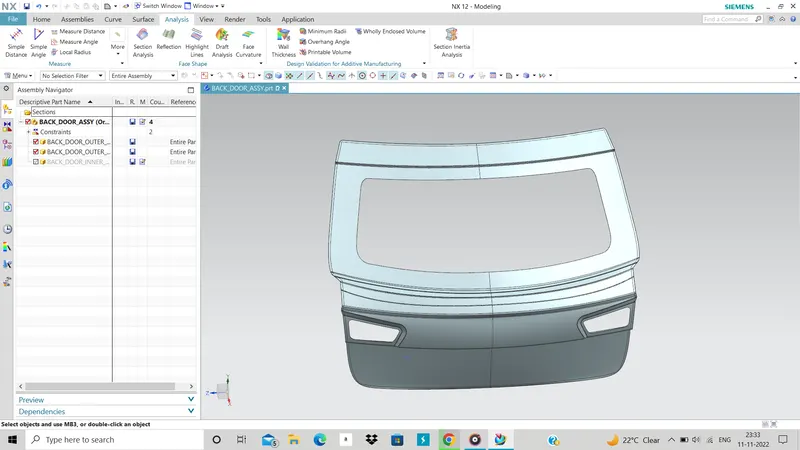
The Outer Upper Panel Extracted from a styling surface.
The thickness provided for the outer panel is 0.75 mm
Hemming is provided with the corner relief.
Outer Lower Panel:
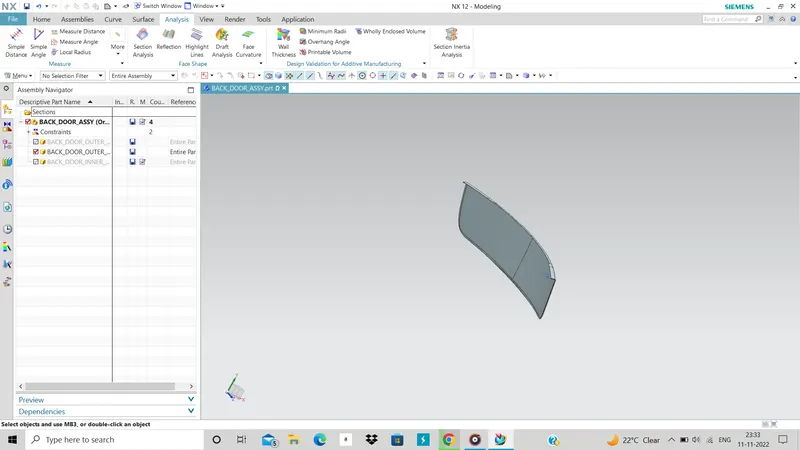
The Outer Upper Panel Extracted from a styling surface.
The thickness provided for the outer panel is 0.75 mm
Hemming is provided with the corner relief.
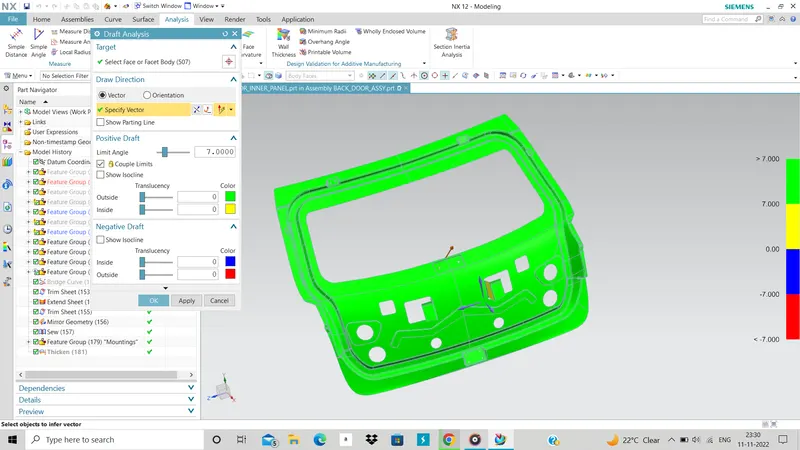
Draft Analysis for Inner Panel:
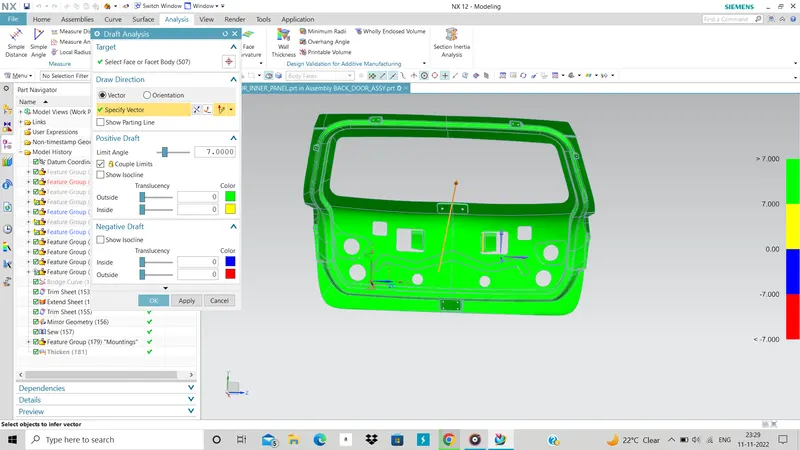
The Draft Analysis will be performed for the tooling direction created at first and checked that the model is suitable for manufacturing.
DESIGNING THE REINFORCEMENTS:
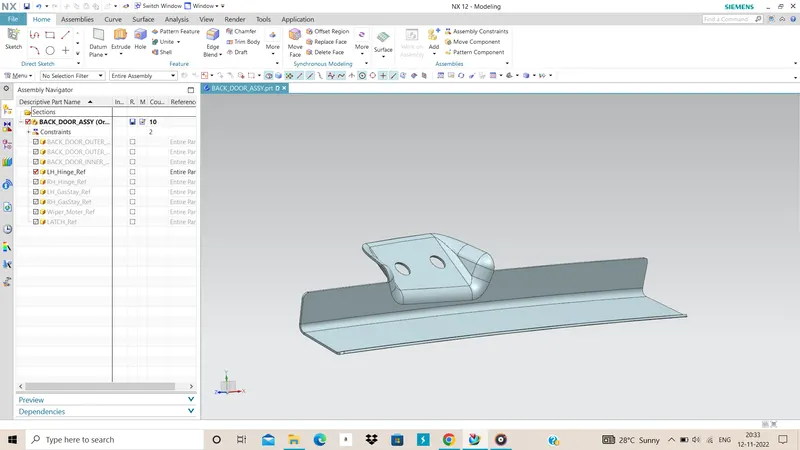
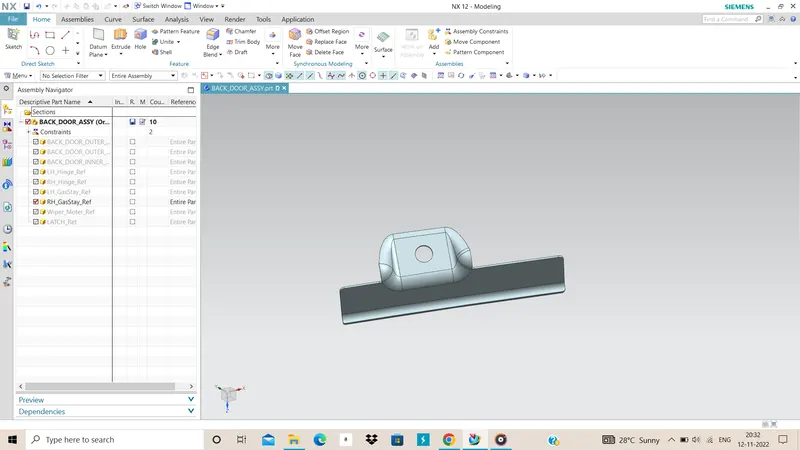
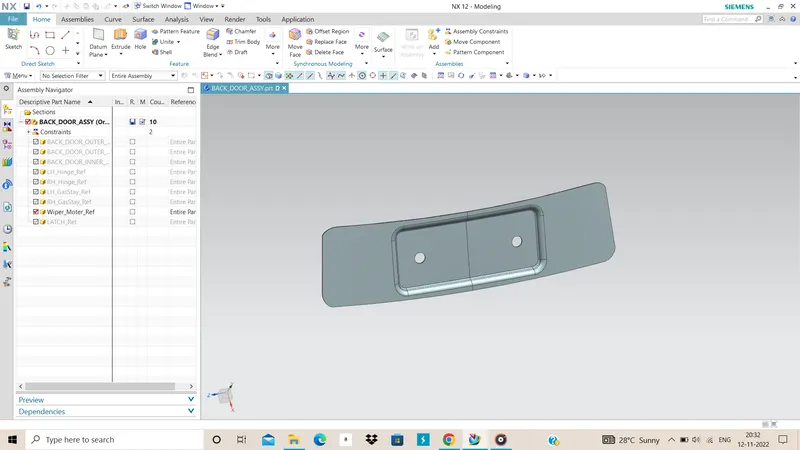
All the reinforcements were created using the same method, first, the linked body was created
separately for each with the help of extract geometry and then the required portion was trimmed out and
then thickened.
The thickness provided for all reinforcements is 1 mm.
1. HINGE REINFORCEMENT
2. GAS STAY REINFORCEMENT
3. WIPER MOTOR REINFORCEMENT
4. LATCH REINFORCEMENT
CONCLUSION:
Thus, the Back Door of a car was Designed following the engineering standards and also of Draft requirements were satisfied.