Design of backdoor
- Aim: To design the back door of an automobile using the styling surface along with necessary reinforcement and embosses.
- Method:
- Back door:
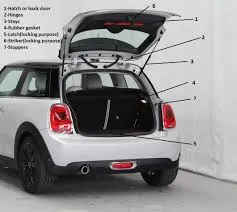
- A car door is a type of door, typically hinged, but sometimes attached by other mechanisms such as tracks, in front of an opening that is used for entering and exiting a vehicle. A vehicle door can be opened to provide access to the opening, or closed to secure it. These doors can be opened manually, or powered electronically.
- The exterior side of the door is designed of steel or other material like the rest of the vehicle's exterior. In addition, its decorative appearance, typically coloured with a design, is intended to match with the rest of the vehicle's exterior, the central purpose being to add to the overall aesthetic appeal of the vehicle exterior.
- Design requirements:
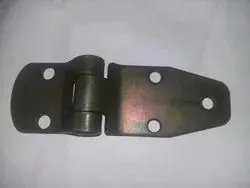
- Hinge mounting:
- These are used in order to join or attach the door panel with the roof attachment in order to open and close the door properly.
- A door mounting method for an automobile, comprising: a door hinge-attaching step of preparing door hinges each comprised of a body-side hinge arm, a door-side hinge arm, and a hinge pin which connects said hinge arms to each other for rotation relative to each other, and attaching said body-side hinge arms to an uncoated automobile body, a temporary door-fixing step of temporarily fixing uncoated doors to said door-side hinge arms of said door hinges.
- Gas stay mounting:
- In order to attach the door and provide a provision to open and close it gas stays are used to provide an opening and closing mechanism. This helps in opening the door with minimum efforts.
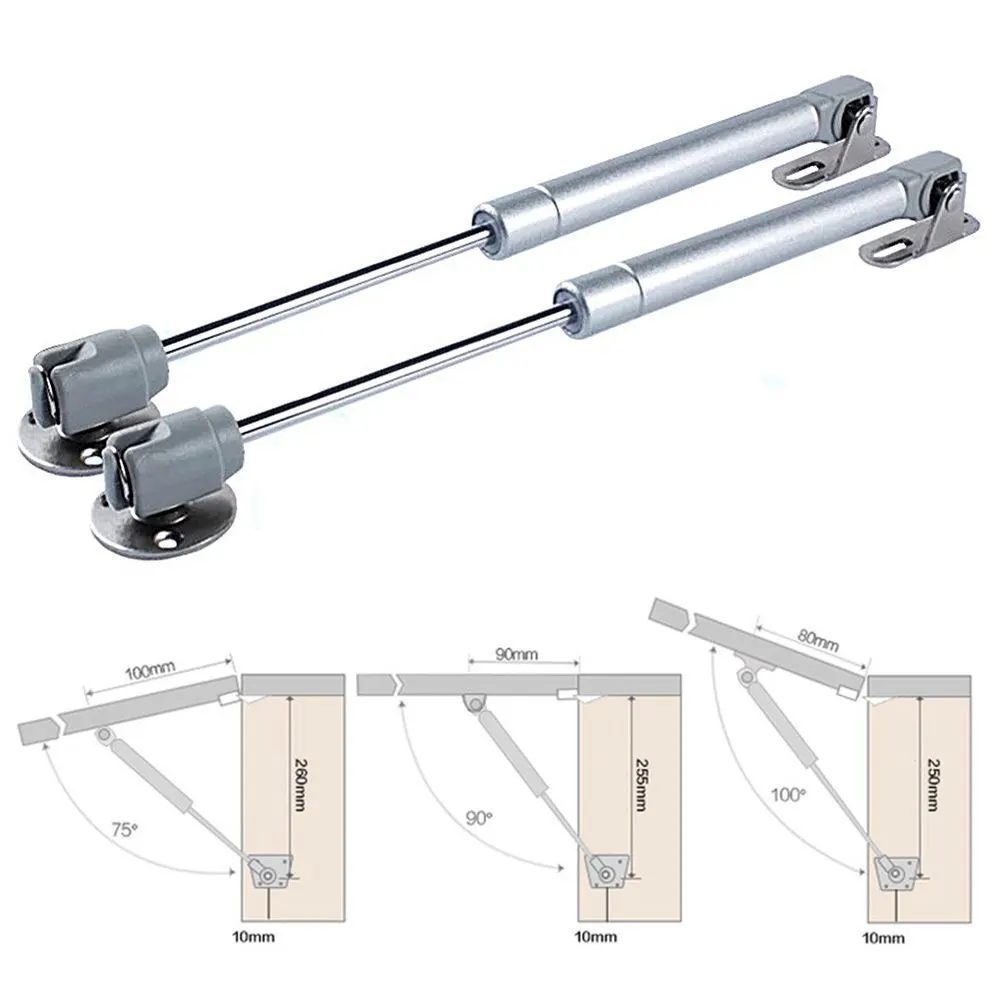
Different vehicle manufacturers prefer other ways to mount the door other than what is shown above, these kind of gas stay are mostly used in the rear door however some of these can be seen in the hood of premium cars.
- Latch mounting- in order to lock the door with the vehicle body and avoid any unnecessary opening of the door, a latch is provided to lock the door.
- Wiper motor:
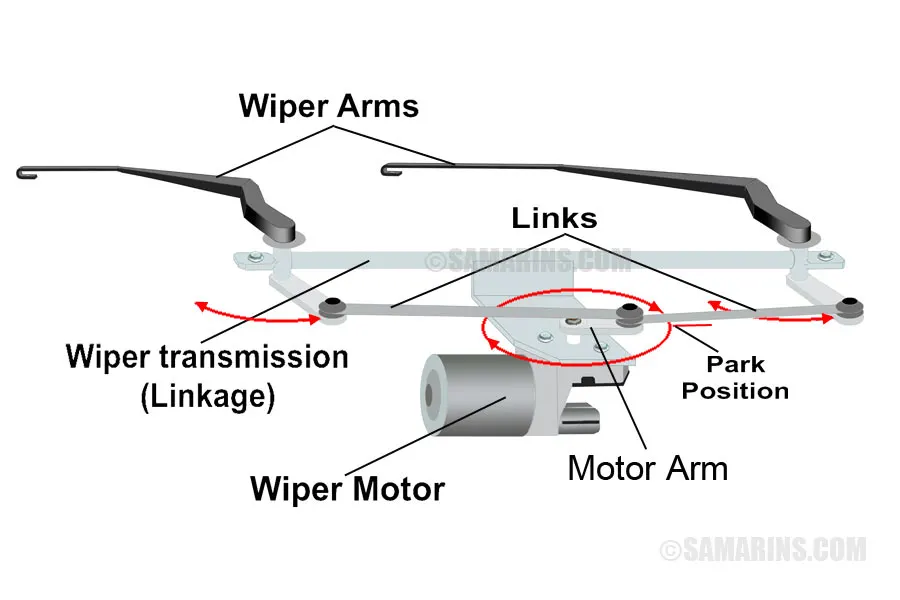
- Windshield wipers are powered by a small electric motor, usually mounted on the firewall or under the cowl (the area under the windshield's base). The motor activates linkage that moves the wiper arms back and forth. On vehicles with a rear window wiper, a separate motor powers the one in the rear.
- Embossing:
- Sheet metal embossing is a stamping process for producing raised or sunken designs or relief in sheet metal. This process can be made by means of matched male and female roller dies, or by passing sheet or a strip of metal between rolls of the desired pattern. It is often combined with foil stamping to create a shiny, 3D effect.
- Embossed metals are used in industry for two reasons: (1) aesthetic, and (2) functional. Aesthetic applications also include appliance panels, building products, elevator panels, garage door panels, automotive trim, metal office furniture, and others.
- Functional applications are those in which a performance characteristic is enhanced. This can include a metal products ability to disperse liquid more effectively, reduction friction and static, increase a metal panel’s stiffness and rigidity, increase a metal surface area for acoustic or heat transfer applications, and improve traction.
Hemming:
- Hemming is a process which is used to join the panels or surfaces without any joins or welding process. These are creating by bending the edges of the sheet
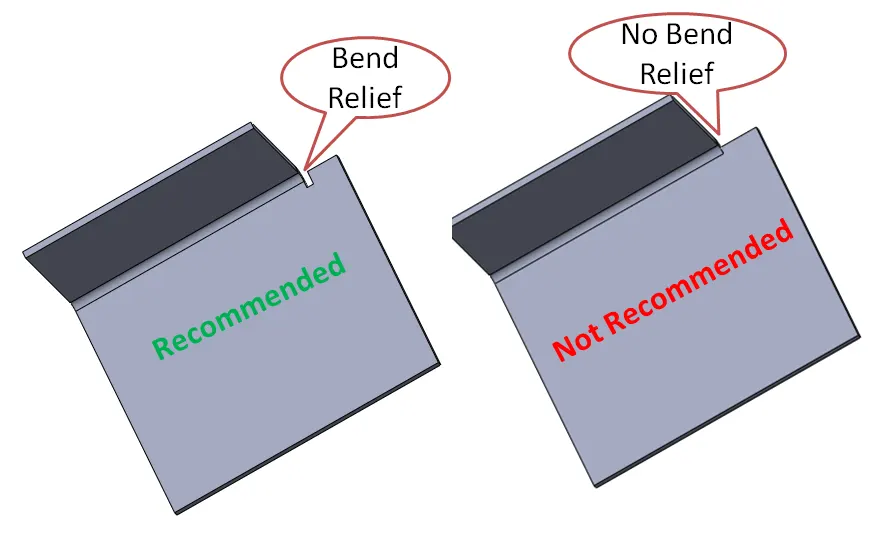
Hemming is a forming operation in which the edges of the sheet are folded or folded over another part in order to achieve a tight fit. Normally hemming operations are used to connect parts together, to improve the appearance of a part and to reinforce part edges.
- In car part production, hemming is used in assembly as a secondary operation after deep drawing, trimming and flanging operations to join two sheet metal parts (outer and inner) together. Typical parts for this type of assembly are hoods, doors, trunk lids and fenders.
- Hemming reliefs are required to provide at certain places once hemming is done. These reliefs are provided in order to avoid any stress concentration as the surfaces are getting sudden change in area.
- Design procedure:
- In order to design the door panel, there are 3 things that need to be designed. 1st is an outer panel, 2nd is an inner panel and 3rd is a lower panel.
- The given input surface is having several free edges and all these needs to be properly joined and form as one single surface.
- Also many joined surfaces are having tangency issues that need to be removed. As these tangency issues can cause errors while thickening the surface, and also while offsetting.
- Following are the images that show the step by step procedure to show how to design the given door panel.
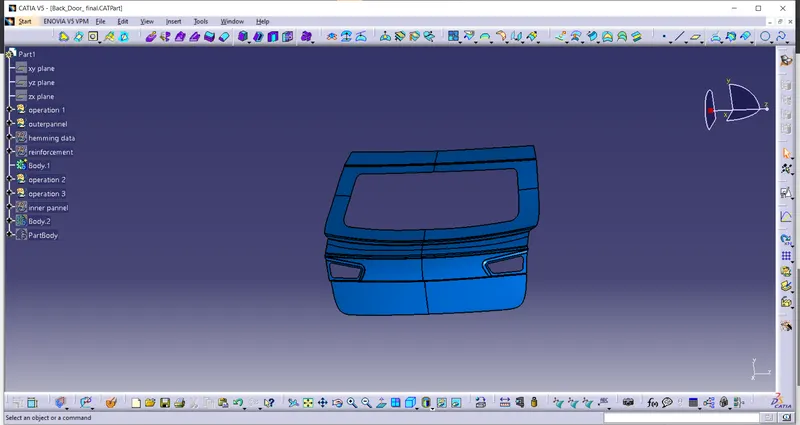
In order to capture inner panel we are going to form a smooth surface by providing the plane and axis system we form a smooth surface by exctrude command then we sweep the edges in order to form flangees
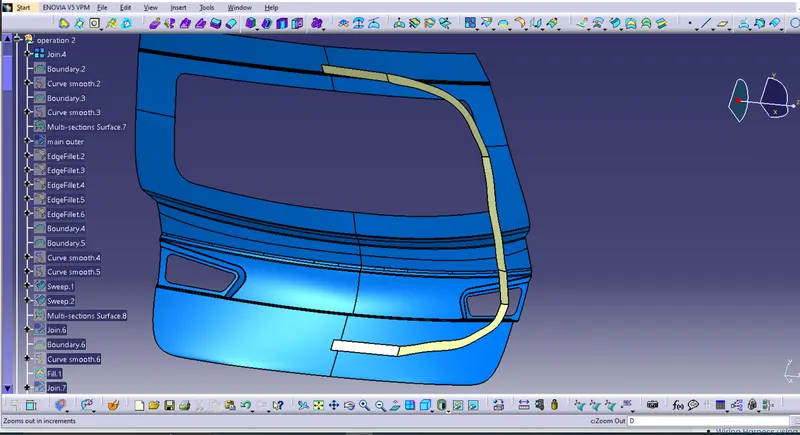
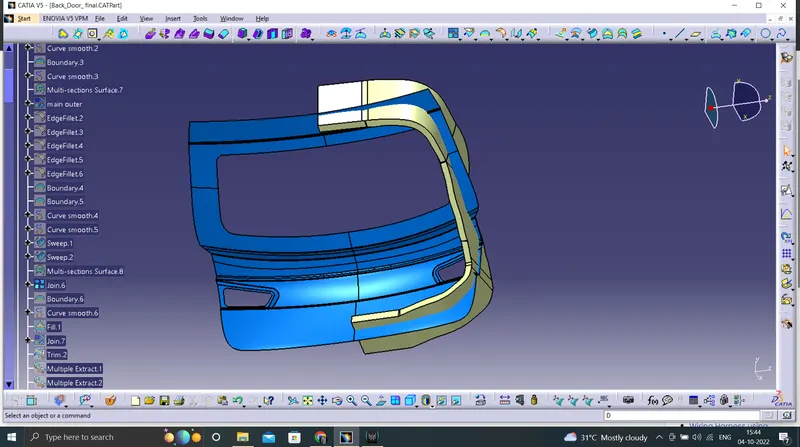
Then we cut the offset it surface of the main outer panel source to form the flanges and directional lines which then help us to form the inner panel we make a friend in our part and with the help of that
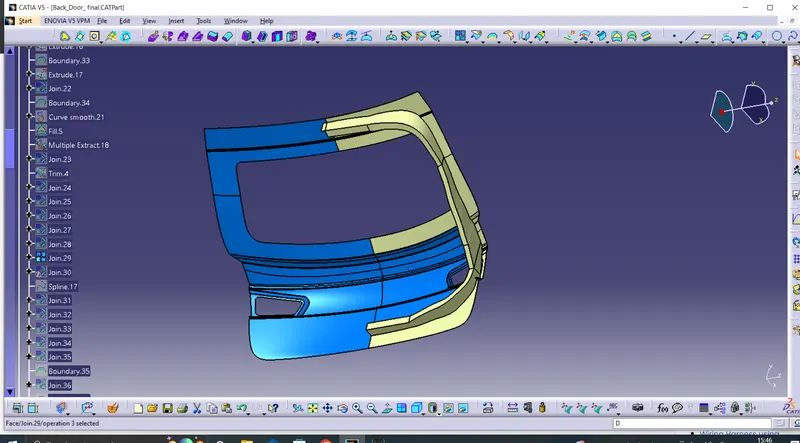
We will measure the window panel viper motor and other dimensions to form the inner pannel from the window
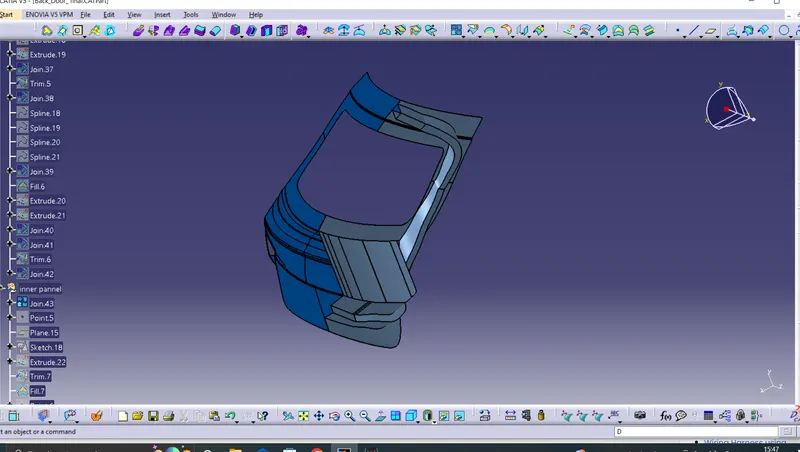
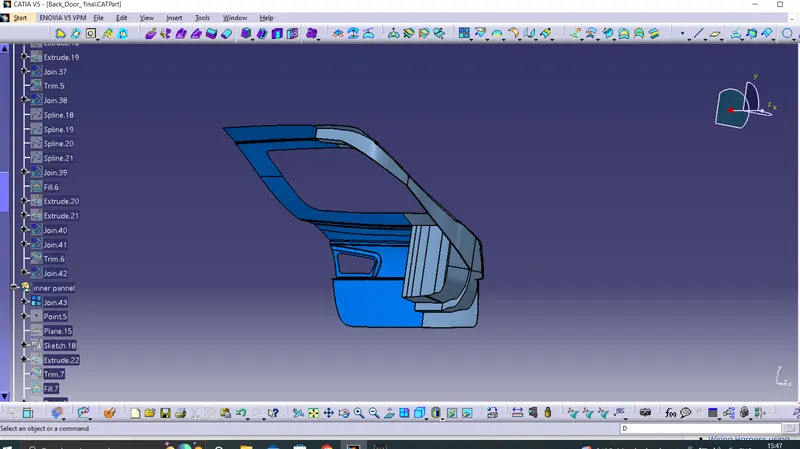
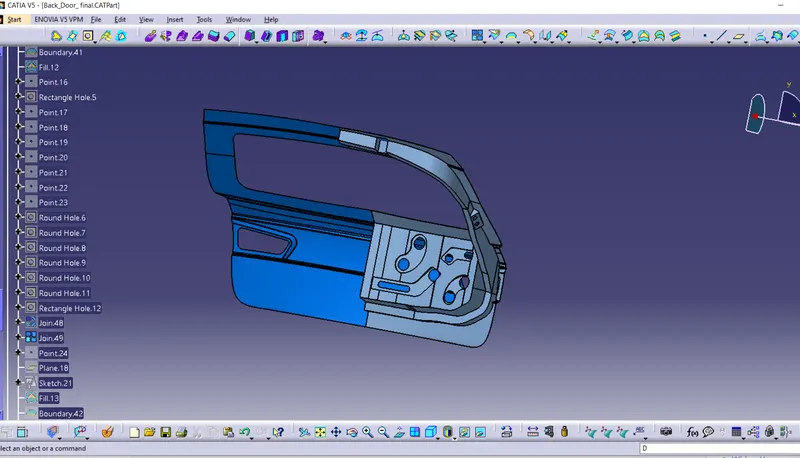
Tell me provide the embossing choice to make the body light weight
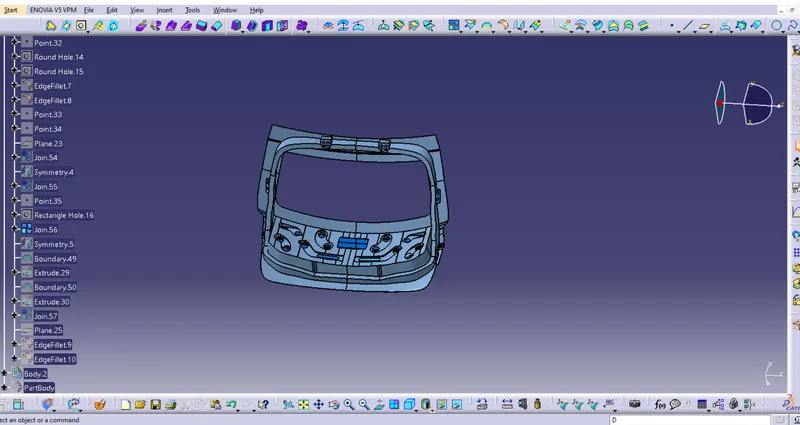 we then form symmetry
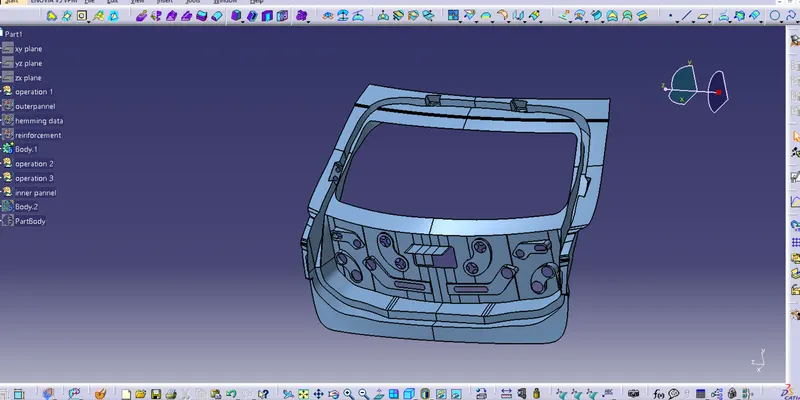
In order to form the centre emboss a sketch is created and that project and split to the surface as relief need to be provided to avoid stress concentration and the flange of the proper taken so as to avoid to deviate the force during impact
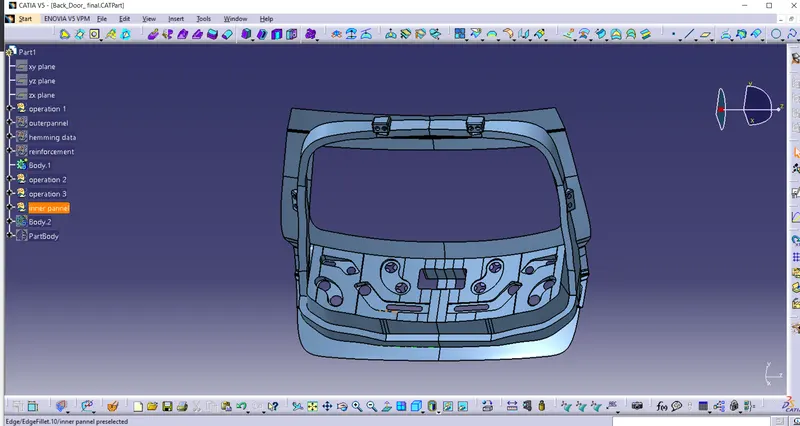
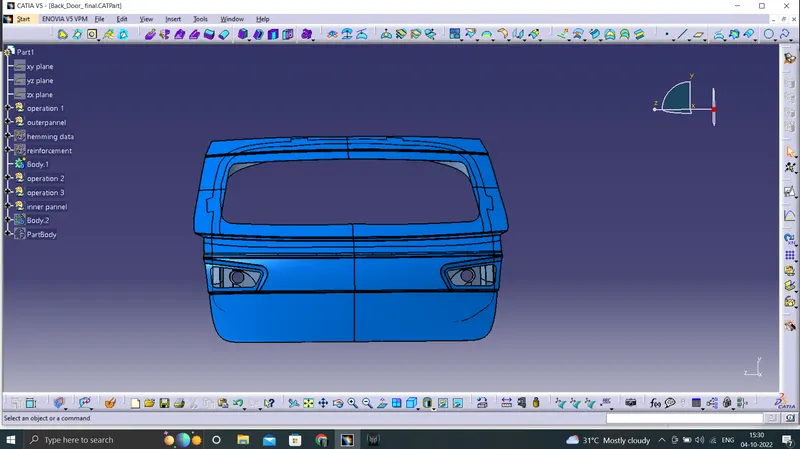
Cut outs helps in providing the wiring feasibility and also lesson the weight of the vehicle
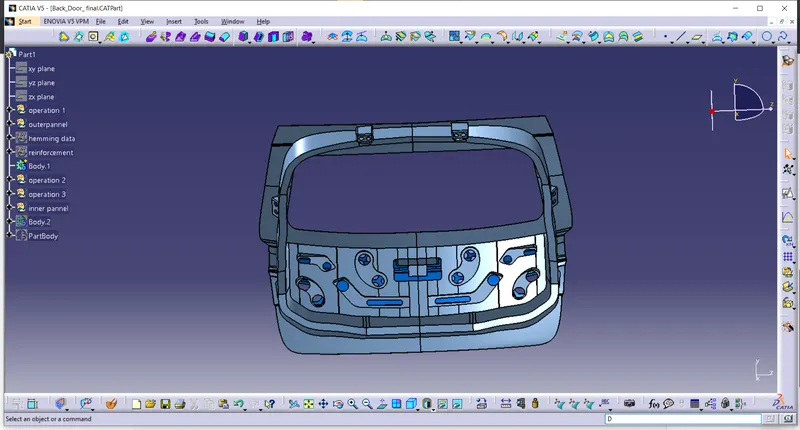
In the same way mountings are created for the gas stay and Hing mounting where the door is attached to the roof
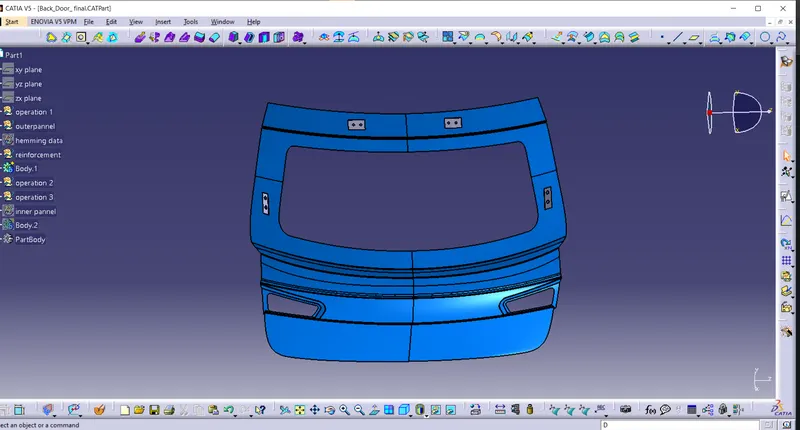
This is the reinforcement which provide support to the body
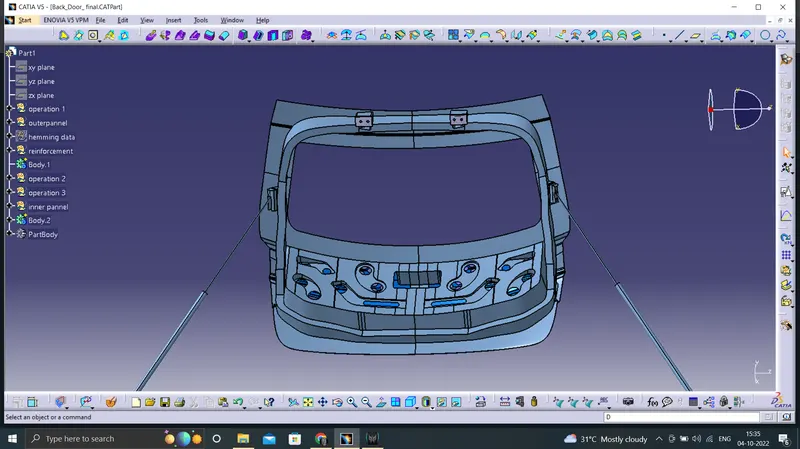
This is the demo model of gas stay
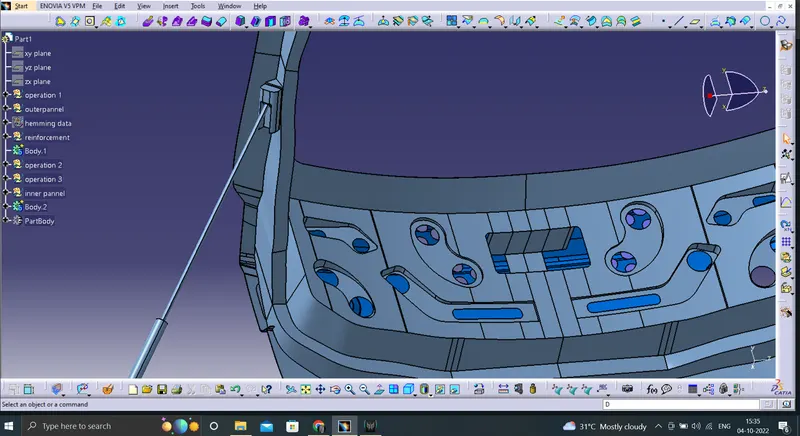
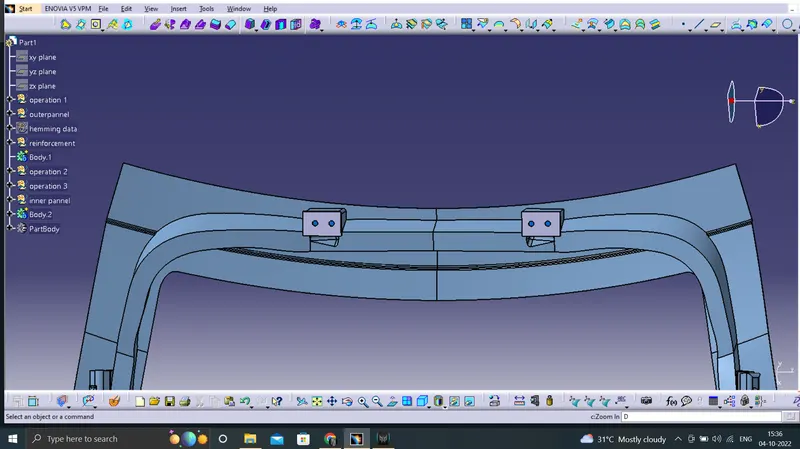
These are reinforcements which gives extra strength to the door
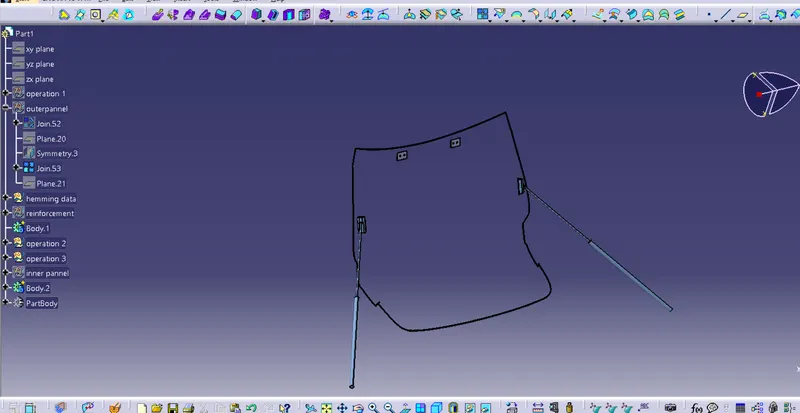
the hamming is done so as to provide the attachment to the inner and outer pannel
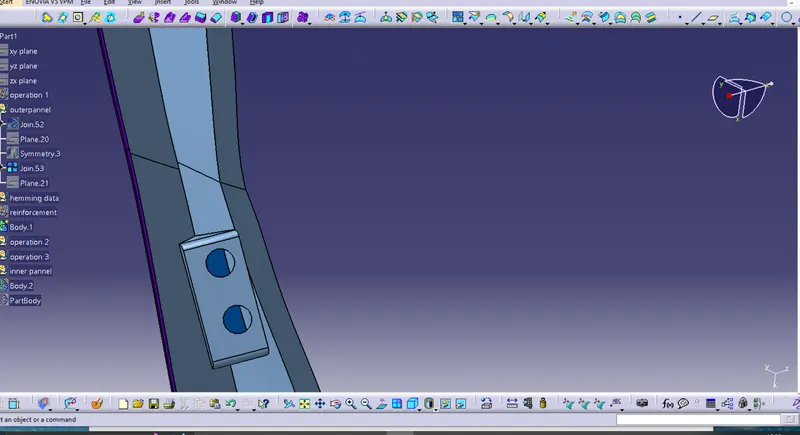
inner panel hamming
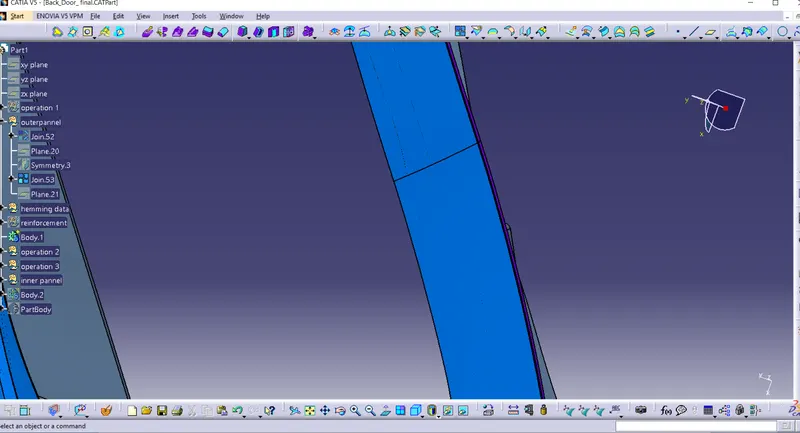
outer pannel hamming.
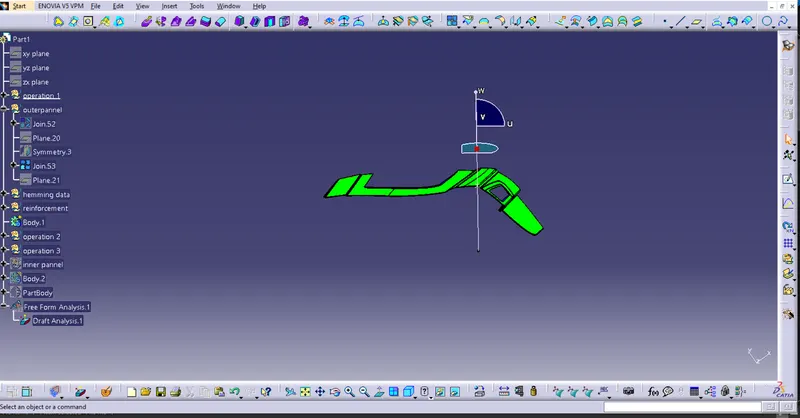
we also did draft analysis so as to check weather our product is avaliable for manufacturability .
Conclusion :
The backdoor sheet metal part body for the Hatchback car was successfully created taking into consideration all the attachments embossments, hemming, and finally with the proper draft angle so that the final component is manufacturable. The approach to design the inner panel was taken in such a way that it dissipates the force outwards in the various crash test.