Design of backdoor
BACK DOOR/ TAILGATE
The back door protects the luggage compartment and provides rear visibility for the driver. Nowadays the back door is used for various types
- Vertical opening tailgate.
- Horizontal opening tailgate.
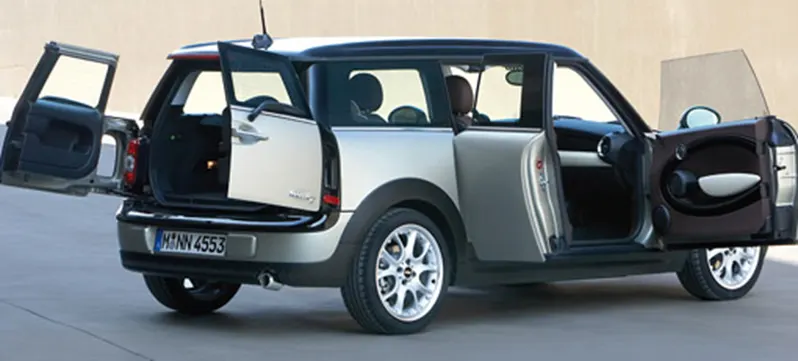
- Split rear door
- The back door is used for setting purposes.
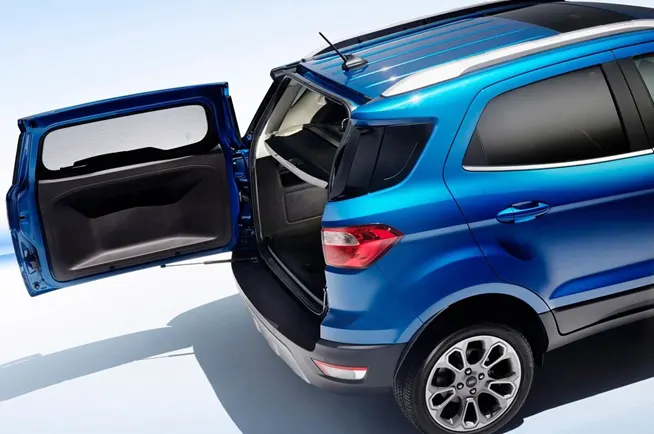
VERTICAL OPENING TAILGATE:
- Most of the cars are used vertically open doors.
- The vertical opening door was suitable for the garage or some closed parking area.
- Easy to access luggage compartment.
- fewer men’s power used to open doors.
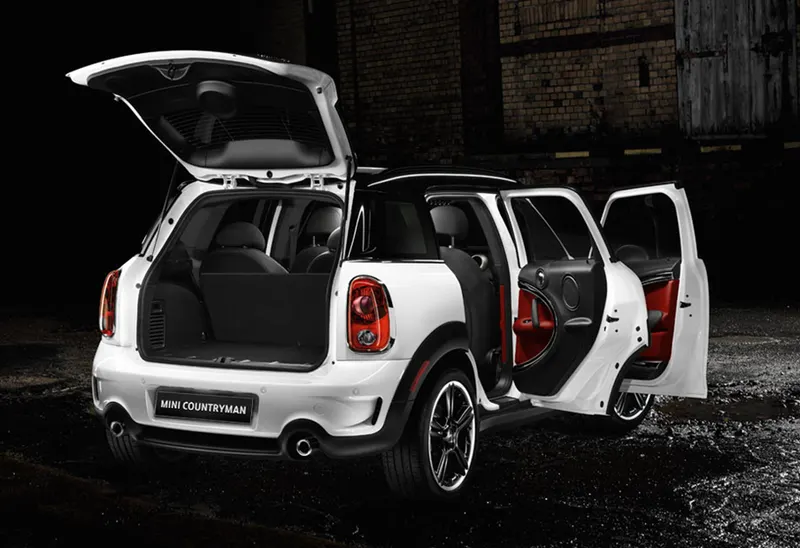
HORIZONTALLY & SPLINTED BACK DOORS:
- this type of door is used to avoid hitting the human head when opening the back door.
- Open the back door wide range to get good visibility.
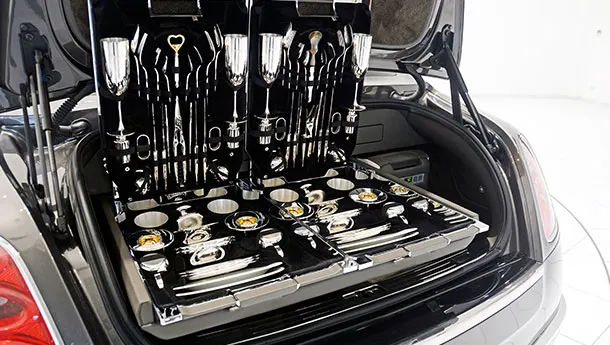
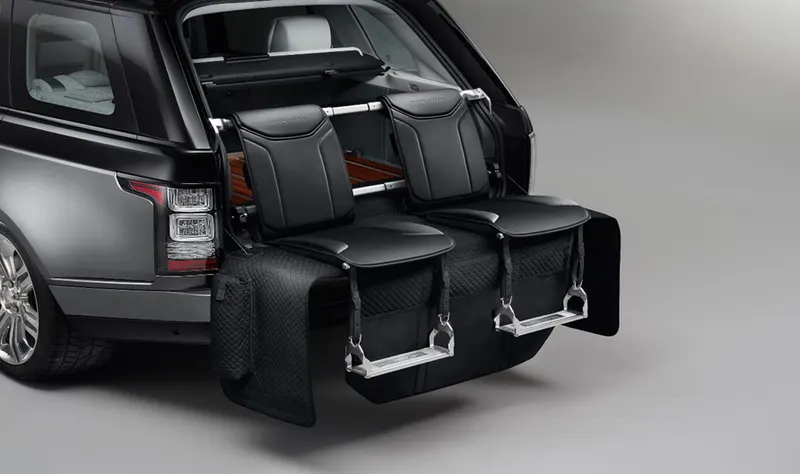
THE BACK DOOR IS USED FOR SETTING PURPOSES:
some of the luxury cars provide rear-side car seats are part of the purpose.
BACK DOOR DESIGN CONSIDERATION:
- The design requirement for the tailgate its components
- Functional requirement.
- Rear visibility criteria – regulations.
- Rear crash regulation and requirement.
- Sealing and its function.
- Joining techniques followed like hemming spot weld etc.,
- Manufacturing technique using a casting part.
- Gap and flushness requirements.
- Functional requirement of hinge & gas stays and powerlifter.
THE DESIGN REQUIREMENT FOR THE TAILGATE IS ITS COMPONENTS:
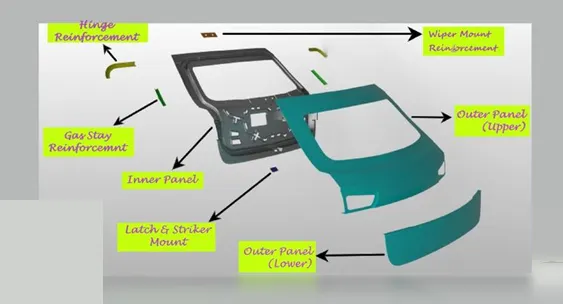
The back door design consideration is based on the type of car sedan or SUV and considers previous car design and also takes rear visibility and provides how much luggage capacity and tailgate components are:
- Hinge reinforcement
- Hinge reinforcement
- Gas stay reinforcement
- Gas stay reinforcement
- Back door inner panel
- Back door outer panel upper
- Back door outer panel lower.
FUNCTIONAL REQUIREMENTS:
- Vertical opening tailgate.
- Horizontal opening tailgate.
- Split rear door
- The back door is used for setting purposes.
REAR VISIBILITY CRITERIA – REGULATIONS:
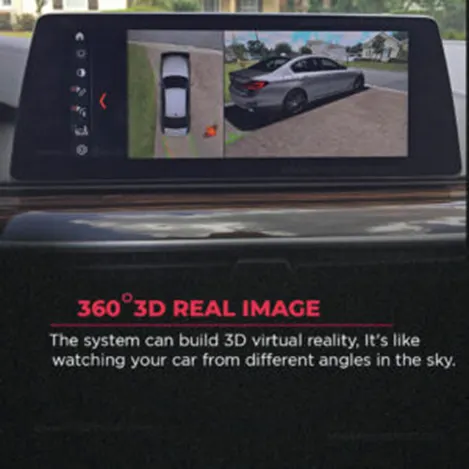
- Using rear view mirror
- Using camera.

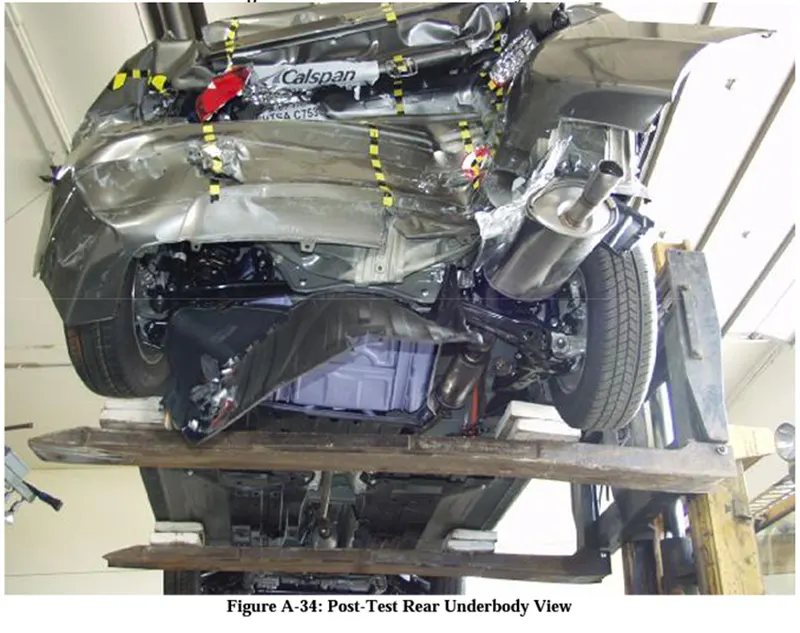
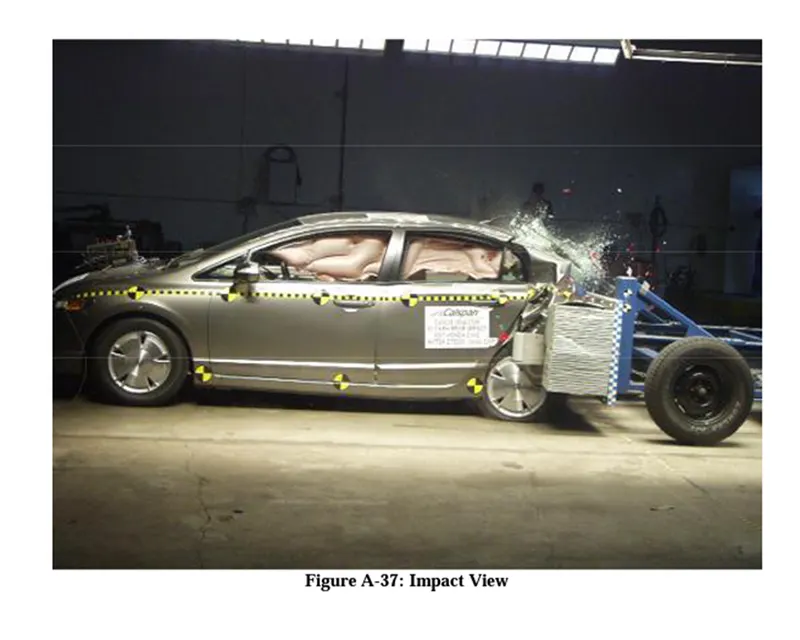
REAR CRASH REGULATION AND REQUIREMENT:
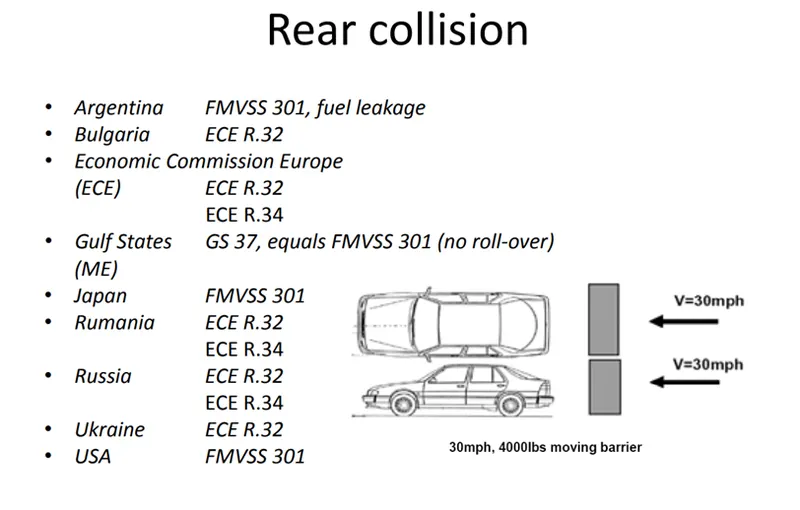
Rear crash regulation various region standard and procedure are followed by the country based on road condition and pedistryen safety and passenger safety.
SEALING AND ITS FUNCTION:
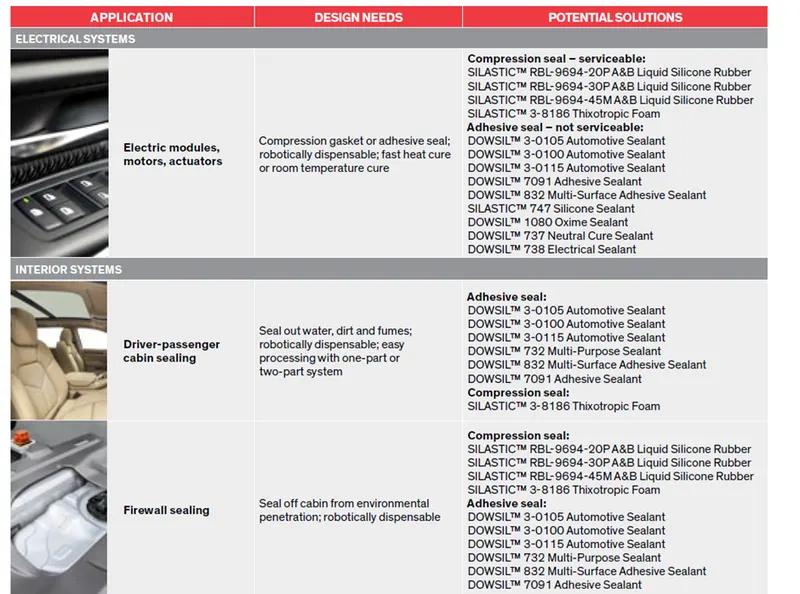
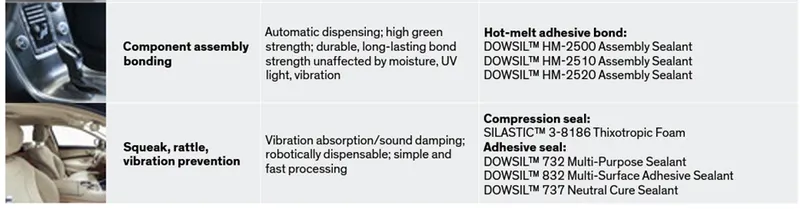
Meet trend-driven design needs for energy efficiency, greater comfort, safety, and sustainability with adhesives and sealants from Dow. Our selection of reliable and cost-effective solutions for automotive component bonding and sealing can help you achieve the:
- Energy efficiency by bonding innovative materials for lightweight design
- Driving comfort by reducing squeaks; rattles; noise, vibrations and
harshness (NVH)
- Safety by improving assembly strength and sealing durability
- Sustainability with efficient processing and reliable service life of components
Choose from a wide range of high-performance adhesives and sealants to meet
your specific process and performance requirements:
- One-part moisture-cure RTV adhesive/sealants
- Two-part condensation-cure RTV adhesive/sealants
- Heat cure adhesive/sealants
- Hot-melt adhesive/sealants
Key performance advantages of these silicone adhesives and sealants from
Dow include:
- Chemical stability when exposed to automotive fluids
- Excellent resistance to UV light, ozone, and weather
- Durable adhesive strength and flexibility with less aging, cracking, or softening
- Stable mechanical properties in extreme heat and cold
- Excellent dielectric properties
- A variety of processing and manufacturing options with versatile cure profiles
| ADVANTAGES | DISADVANTAGES |
|
|
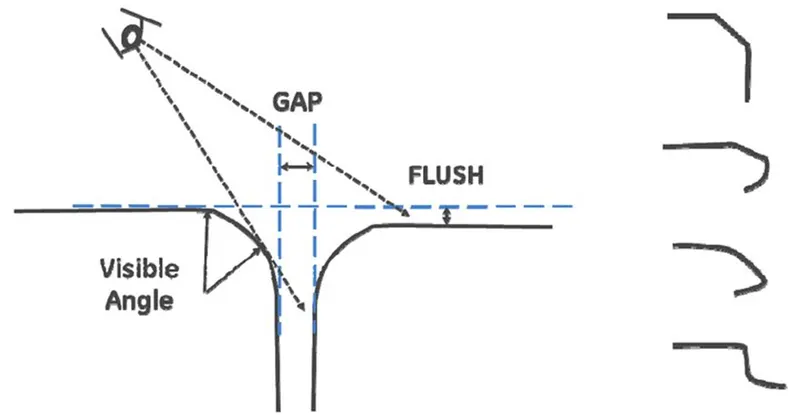
GAP AND FLUSHNESS REQUIREMENTS:
The gap is the horizontal separation between two surfaces, and the flush is the vertical displacement between two surfaces in the orthogonal direction.
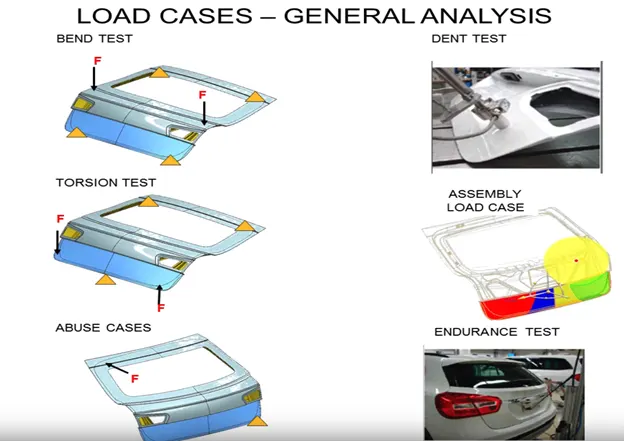
LOAD CASE -GENERAL ANALYSIS:
- Bend test.
- Torsion test.
- Abuse cases.
- assembly load case.
- endurance test.
- dent test.
Bend Test:
constrain all four regions and give force to the center of the back door. to get a nominal value to come back to the original position.
Torsion Test:
contain to the two hinges and latch and striker and bottom corner to pull on forward onside and another side pulls rear direction.
Abuse case:
over slamming or hinging when the door is open
Dent test:
produce the dent to check to the door will be come back to the original position.
assembly load case:
during assembling the vehicle how much force is given to the body and whether the door is standing.
Endurance test:
the endurance test is the workability test the door will be opened and closed a particular number of cycles and see how the door behaves end of the cycle.
MANUFACTURING EFFECTS OVER SPINDLE TYPE AND POSITION
| GAS STAY | POWER SPINDLE |
| HINGE INSIDE BACK DOOR | HINGE OUTSIDE BACKDOOR |
| GAS STAY SOCKET BODY MOUNTING | GAS STAY SOCKET BODY MOUNTING |
| GAS STAY SOCKET BACK DOOR | GAS STAY SOCKET BACK DOOR |
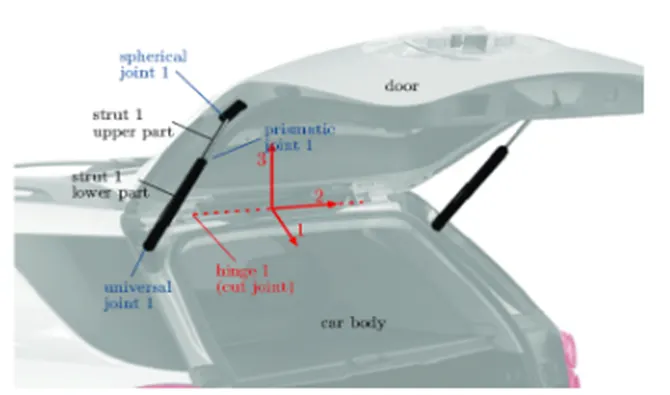
Gas stays type:
Gas stay types backdoor/liftgate/tailgate is an ideal and most commonly used tailgate mechanism from lower segment car to luxury car segment. The ideal components of a tailgate consist of a hinge, door, gas stay, and some rubber beadings for sealing of door which is shown in the image below:
Powered lift system:
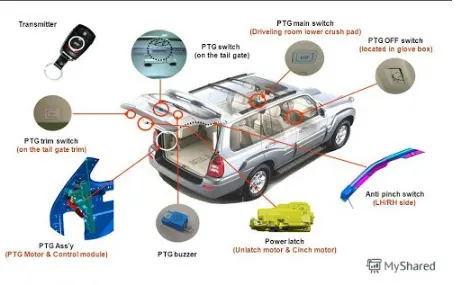
The power trunk lid system is another sophisticated way of trunk/liftgate opening mechanism which is to automatically opens and closes the trunk/liftgate and releases the latch by the touch of a button. The following image shows the component used in the powered trunk/back door lift system.
The powered trunk lift system consists of a power latch, anti-pinch switch, PTG ass’y, and PTG main switch. When the switch is pressed in the compartment or outside the power latch releases the latch and the entire backdoor is opened. The anti-pinch switch is located to avoid accidental hand insertion during the operation of the door. These are the most convenient type of back doors in which the bottom split is used as a support or even as a table for the tour-going people.
DIFFERENCE BETWEEN ALUMINUM AND STEEL PARTS:
| ALUMINIUM | STEEL |
| part is casted | parts are stamped |
| reinforcement can be neglected | reinforcement is necessary |
| local thickness can be varied | has only uniform thickness |
| lighter in weight and less number of components | heavier in weight and more components |
| price high | price low |
Composites:
OEMs might have found an alternative material lighter than steel to reduce the weight of automobiles. OEMs are considering composites to replace steel and aluminum due to their properties:
- 10x stronger than steel
- 8x stronger than aluminum
- Very light compared to both steel and aluminum
Current alternate lightweight materials:
Ford is using natural fiber–reinforced composites to reduce vehicle weight. Cellulose tree fibers are used in the armrests of the Lincoln MKX mid-size SUV, while rice hulls and wheat are used to reinforce plastics and storage bins.
3M has developed hollow glass microspheres called “glass bubbles” that are engineered from water-resistant, chemically stable soda-lime borosilicate glass. It helps reduce the composite weight by up to 40%. It can be used as filler in sheet or bulk molded composites.
Tata Steel has launched an alternative for current flooring and sidewall material for buses and trailers. Coretinium is an optimized polypropylene honeycomb core used to lighten the weight of floors and sidewalls. Currently, it is used in the EU region for commercial vehicles.
SABIC, a chemical manufacturing company, launched a fiber-reinforced thermoplastic composite bulkhead to replace the traditional panels made of metal and thermoset materials. It is expected to have a 35% mass reduction compared to the existing metals.
DSM Engineering Plastics developed EcoPaXX PA 410, a bio-based polyamide used in the crankshaft cover on Volkwagen’s MDB-4 TDI diesel engines.
Cadillac CT6 uses carbon fiber-reinforced plastic (CFRP) to lighten the weight of the body. Parts made of CFRP such as the hood, splitter, and wheel spats are super lightweight, imparting high performance and fuel efficiency as well as greater traction at high speeds.
BASF, in partnership with Magna and Ford, developed a carbon-fiber composite grill opening reinforcement. It was used in the 2016 Ford Shelby GT350 Mustang. The material is 24% lighter than traditional metal. BASF’s Acrodur is a water-based, low-emission binder that strengthens the natural fibers to create a sustainable, stable, and lightweight solution for car roof frames. It was used in the Mercedes Benz E class.
TOOL USED TO DESIGN A BACK DOOR: NX CAD.
Using NX cad to design back door type keys through curve mesh, bridge curve, blend corner, the law of existence, offset surface, offset curve in the face, curve on the surface, face blend, etc.,
DESIGN CONSIDERATION:
- Improve the strength of the inner panel.
- provide good rear visibility.
- reduce rough surface.
- provide various mounting about the back door.
- sealing weather strips.
- improve strength during the collision.
DRAFT ANALYSIS:
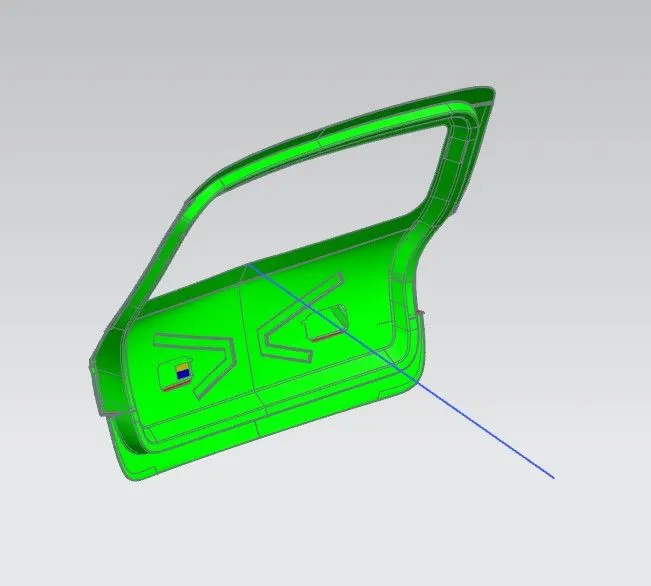
STRIKER MOUNTING PROCEDURE :
- First, make to hinge mounting point.
- The hinges are mounted to create a leaner axis between the two hinges.
- Create on datum plane center between to hinges.
- To create a circle in a trajectory axis
- draw one line from the center point to the bottom of the door to which place to mount the hinge point .
- this point to mount a striker.