Design of backdoor
Design of backdoor
Objective:
Developing a back-door design based on the styling surface with given information and to position the latch reinforcement striker, hinge and wiper mountings. The report constitutes about positioning of Latch and Stricker, Wiper motor. Tail light mounting, Gas stay Reinforcements with suitable emboss definitions and Hemming flanges.
Introduction:
Backdoor is also known as tail gate. Backdoor is also has a swinging or closure commodity. First, deciding the hinge axis and then the latch & striker point join the trajectory to decide the motion of swinging. Also, at right side doors the sealing flange is also important.
Preparing the master in the OY top, bottom, hinge area both sides. Developing the sealing surface, corners because gas stay at top and bottom mounting point and also to develop the sealing flanges w.r.t to styling surface. After develop sealing flange then follow the conditions like rear visibility, luggage area thinner.
The backdoor section is better for luggage area and the area cannot make a straight surface because need some strength to the panel for rear crash purpose and maintain the space to accommodate the latch and striker, wiper motor. Luggage area or sealing is contact with rear floor at the bottom, roof at the top and body side or tail gate.
Parts of the Back-door Assembly:
- Outer panel
- Inner panel
- Sealing Flange
- Hinge reinforcement
- Gas stay reinforcement
- Wiper reinforcement
- Latch and Stricker reinforcement
SHEET METAL DESIGN
While designing components top priority is for function and second is for cost effective manufacturing process selection.
- Keeping part simple
- Lesser material yield
- Consideration of minimum manufacturing stages
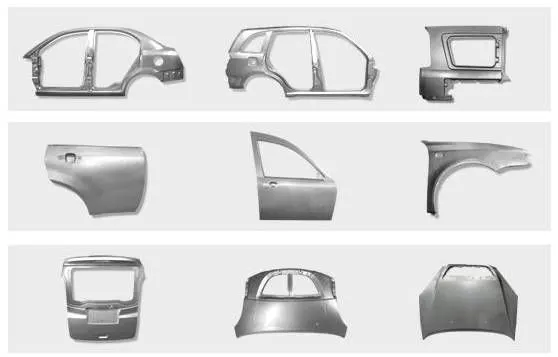
Design Process:
Study manufacturing process available.

Use simple shapes like straight cuts, bends and punched holes.
Complex sheetmetal parts are difficult to manufacture. It can be done by breaking it into simple parts.
Choose an optimum material and thickness.
Sheetmetal parts are made to have large feature tolerances by aligning the layout lines.

The order of forming operations is important for sheetmetal parts.
Parts Of the BackDoor
Inner Panel
Hinge Mounting Bracket ( LH & RH )
Gas Stay Bracket ( LH & RH )
Wiper Motor Support Bracket
Latch
Latch Reinforcement
Hinge reinforcement ( LH & RH )
Gas Stay Reinforcement ( LH & RH )
Outer panel:
Outer panel is the styling part of the back door and it is developed in different way of structures to attractive the customers, not only back door but every portion of the car outer panel is designed very fine.
Inner Panel:
The inner door panel is a component which is used for strengthening the door assembly and it is one of the most important components on which all accessories are mounted like hinges, glass guide channel, moulded trim, latch etc.…. The possible method is the integration method, in this method the part is stamped out of a single blank. This reduces the number of tools needed the assembly cost and eliminates any fit ability problem.
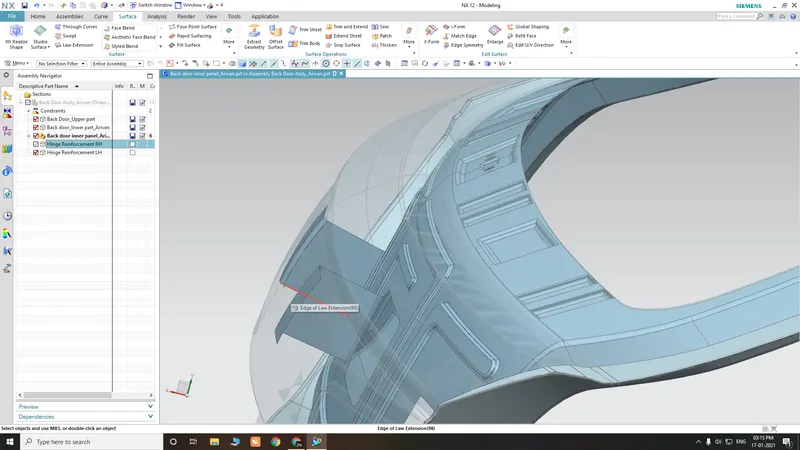
The inner panel consists of different contours known as Emboss & various cutouts made on the emboss which reduces the weight of the backdoor.
The various commands & features that were used to design the inner panel are given as follows:
- Offset Surface : This command is used to create a surface or a body by offsetting a set of faces.
- Offset Curve in Face : Offsets curves along the faces on which they lie.
- Swept : Creates a body by sweeping a section along one or more guides using various options to control the shape along the guide.
- Bridge Curve : Creates a tangent blend curve between two objects.
- Trim Sheet : Trims off a pirtion of a sheet body.
- Trim and Extend : Trims or extends a set of edges or faces to the intersection with another set of edges or faces.
- Extend Sheet : Extends a sheet body by distance or to the intersection with another body.
- Trim Body : This command is used to trim a portion of a body along a plane or a face.
- Through Curves : Creates a body through multiple sections where the shape changes to pass through each section.
- Studio Surface : Creates a surface using any number of section and guide strings.
- Law Extension : Creates a law-controlled extension from base sheet, dynamically or based on laws for distance and angle.
- Face Blend : Adds tangent blend faces between selected set of faces based on the radius specified.
- Edge Blend : Rounds sharp edges between faces based on the radius specified.
- Projected Curve : Projects curves, edges, or points onto faces or planes.
- Emboss : Modifies a body with faces made by projecting a section along a vector, with options for end cap location and shape.
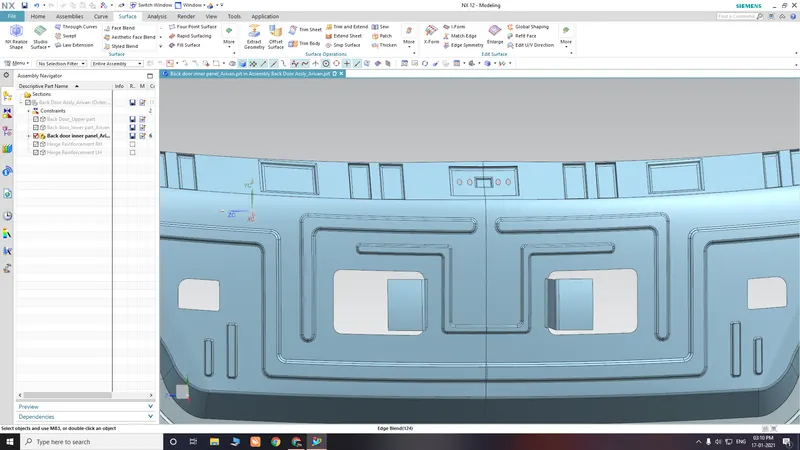
- Curve on Surface : Creates a surface spline feature directly on a face.
- Mirror Geometry : Copies geometries and mirrors them across a plane.
- Sew : Combines sheet bodies by sewing common edges together, or combines solid bodies by sewing common faces.
- Thicken : Creates a solid body by adding thickness to a set of faces.
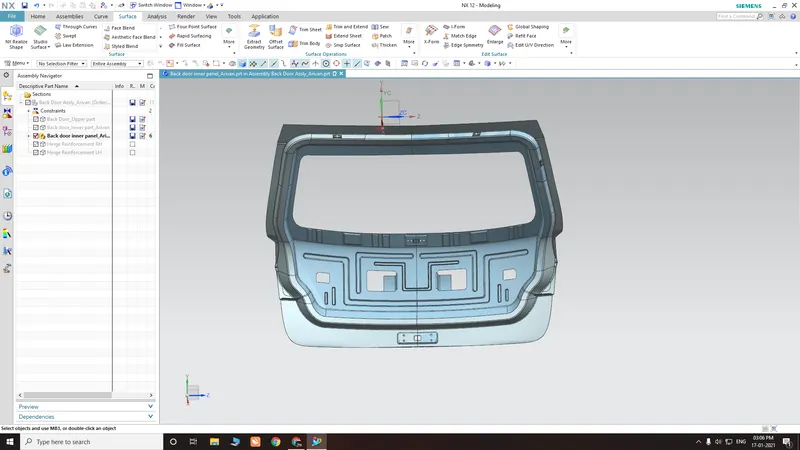
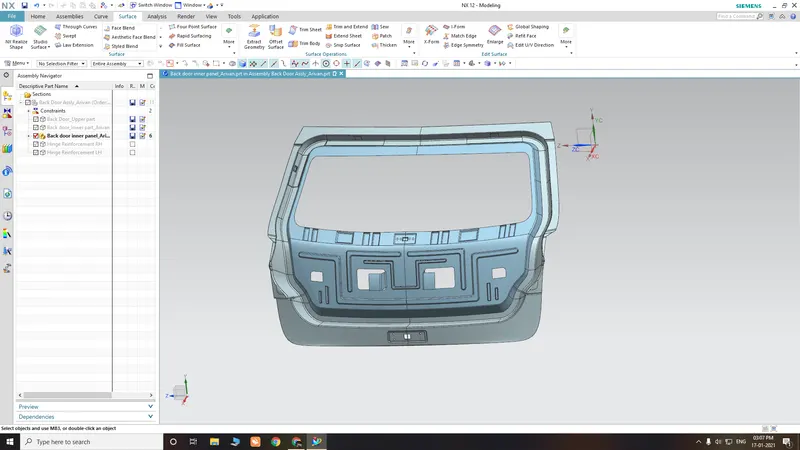
Reinforcements:
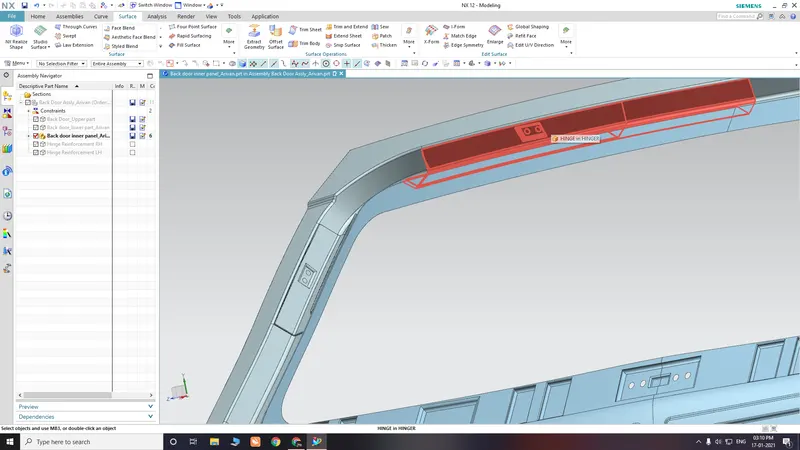
Sealing Flange:
The Sealing Flange section showed forms an integral part as it contacts with Roof, Body Side Door and Rear Lower panel.
Hinge reinforcement part:
Hinge reinforcements are used to open and close the doors of the car and it also gives strengthen at hinge areas. So that no need of extra reinforcements in inner panel at hinge area.
Gas-stay reinforcement:
The purpose of gas stay reinforcement is to lift the back door of the car.
Gas stay reinforcement is two types and they are
- Manual system
- Power lift system
Wiper motor reinforcement:
Instead of making the whole inner panel of a thicker sheet, a sheet with less thickness in addition to local reinforcement is provided to increase the strength of the component and reduce the weight.
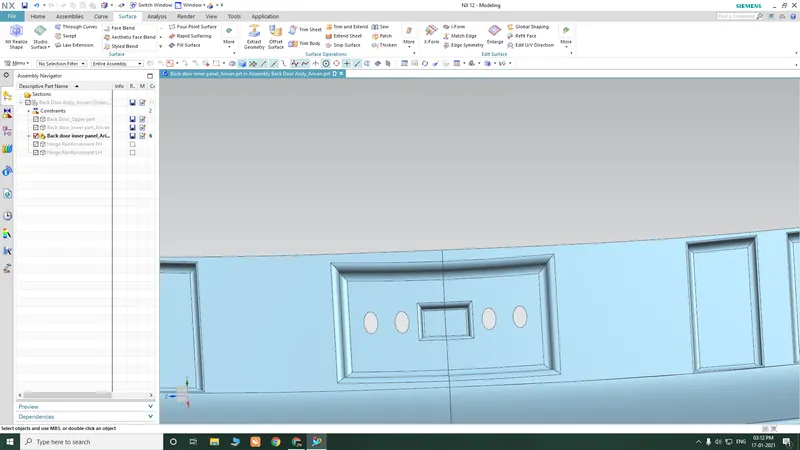
Latch and striker reinforcement:
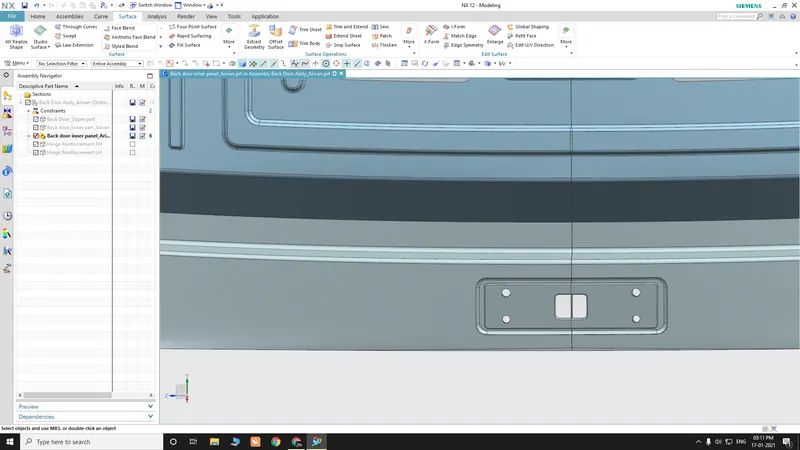
The Latch and striker reinforcement mounting point is developed with the help of axis from hinge position and it is taken approximately then created emboss at bottom of the panel to mount latch and striker assembly
 .
.
MASTIC SEALANTS
A mastic sealant is a type of liquid sealant that cures in an elastic state, thus making it flexible while holding the bond of the surfaces that has attached together. It adheres to just about any material making an all-purpose type of sealant.
- The main purpose of the outer panel is for the aesthetic looks. Thus we cannot use bolts or welding. This has to be done with the help of the hemming and mastic sealants. Mastic sealants are elastic compound that behaves like the rubber. It is placed between the outer and inner panel. Initially is it in paste form, but after the hot furnace bath it gets hardened thus joining the outer and inner panel. Mastic sealant has the tendency to increase the strength of the panel and has influence of 80mm diameter.
PROS
- One positive characteristic of mastic sealant is that it has a very smooth exterior while keeping its rigid form underneath.
- Surfaces do not have to be primed when using this type of sealant, and although applied thick, it adheres smoothly to any surface. It is important that the area to be joined or sealed be clean and dry, just like any other sealant on the market.
- Mastic sealant may be used outdoors as well because of its waterproof quality. It can be applied on rain duct leaks outdoors, for example.
- It is also favored for areas under high or low temperatures such as heater vents or drier vents and contains ultraviolet inhibitors to make sure that it is protected from damaging effects of the sun that will often weaken other types of sealants. That makes it a good choice for use on roofs, or any surface that is constantly exposed to sunlight. Most mastic sealants will also work well with metal because they do not corrode over time.
- it functions well in areas with mild vibration and heat, like heating ducts.
CONS
- Mastic sealant is not recommended for areas that have too much joint movement, or anything that will be moved a long length.
- It works well with constant pressure on it, but not constant movement.
- It also works best when applied thickly and is not recommended if only a thin layer is needed such as touch ups. Another sealant is a better choice for those types of repairs.
Conclusion:
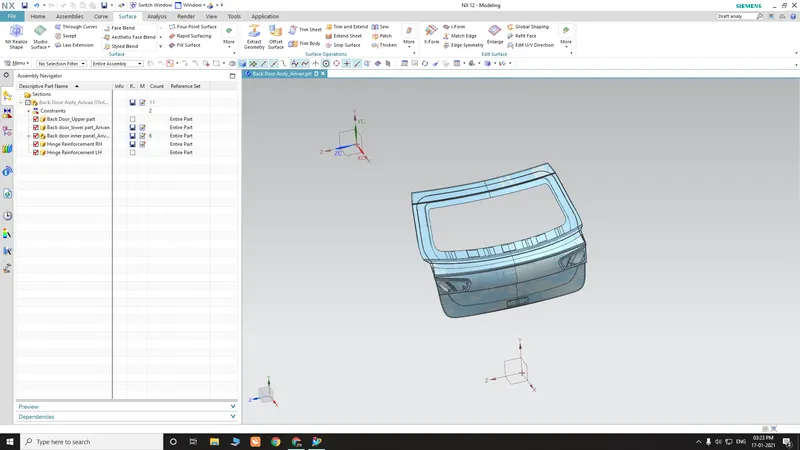
The car back door is developed with the help of styling surface and developed essential embosses reinforcement to give strength to back door. Draft analysis done for inner panel w.r.t to tooling direction.