Design of backdoor
Objective:
Use the provided styling surface to come up with a back door design, use appropriate design methodologies and provide the
necessary reinforcements and embosses.
Software Used:
catia v5
Backdoor Introduction:
An automobile back door or Tailgate is the panel that covers the boot (or trunk) of an automobile. It enables access to the main luggage compartment.
A hinge allows the boot lid to be raised, while devices such as springs or gas cylinders hold it up in the open
position The Backdoor is an assembly of many parts such as inner panel, outer panel upper, outer panel lower and Reinforcement.
Inner panel is attached to the outer panel using mastic sealant.
Total no. of parts in Backdoor are:
Back door outer panel (upper)
Back door outer panel (lower)
Back door inner panel
Hinge reinforcements
Gas stay reinforcements
Latch and striker reinforcements
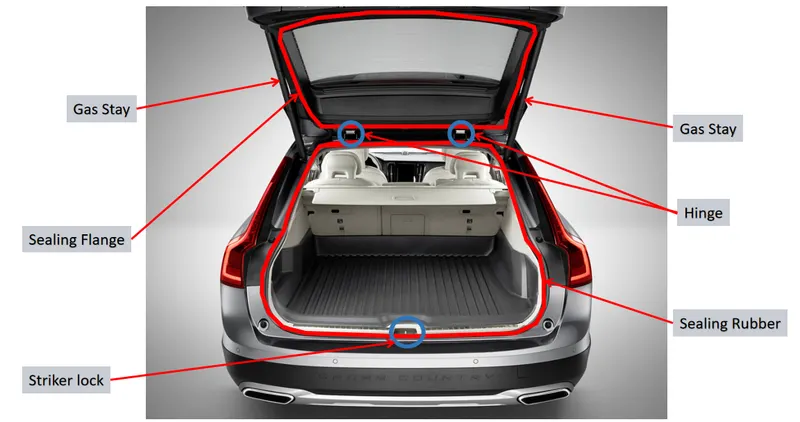
The material used for backdoor varies as per the price range of the vehicle. Most of the low cost vehicles use steel as it is cheaper and
use parts that are stamped using moulds.
These parts are usually of uniform thickness and reinforcements are added to improve local strength where needed.
The premium vehicles use aluminium parts which are usually die casted and hence can have variable
thickness.
This removes the need of reinforcements hence keeping the weight even lower as aluminium parts are lighter in
comparison.
On the contrary aluminium is more expensive than steel hence its applications are limited in cheaper vehicle. Currently
due to the extensive use of plastics trims and plastic parts the cost of aluminium is affordable for the manufacturers in all price
brackets.
Use of aluminium reduces the overall weight of the component and hence the vehicle improving its fuel efficiency.
Backdoor parts thickness value used in this design:
1. Outter panel - 0.75 mm
2. Inner panel - 0.75 mm
3. Reinforcements - 1 mm
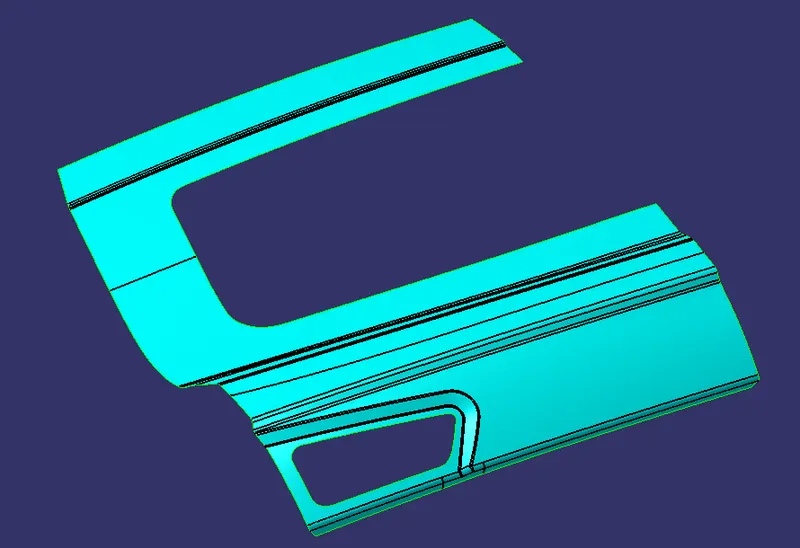
DESIGN OF INNER PANEL:
The inner door panel is a component which is used for strengthening the door assembly and it is one of the most important
components on which all accessories are mounted like hinges, glass guide channel, moulded trim, latch etc.
The possible method is the integration method. In the integration method, the part is stamped out of a single blank. This reduces the number of tools needed;
the assembly cost and eliminates any fit ability problem.
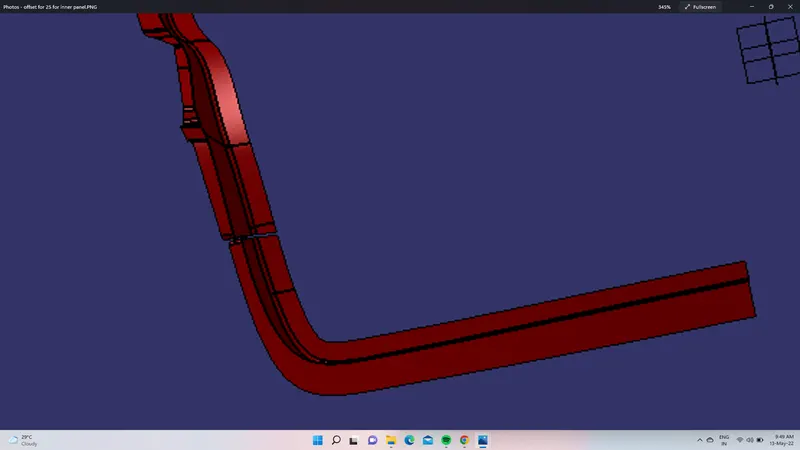
The inner panel was designed by offsetting the given class A surface as per the given master section. The inner panel consists of
Emboses and Mastics.
Embosses
Embosses has been given to create extra strength in inner panel and embosses design needs to be inspired by force
dissipation phenomena like here I have made embosses in a way if any object hit from front most of the force will get dissipated by
its design towards the upper left & right corner so that less force reach at occupants end.
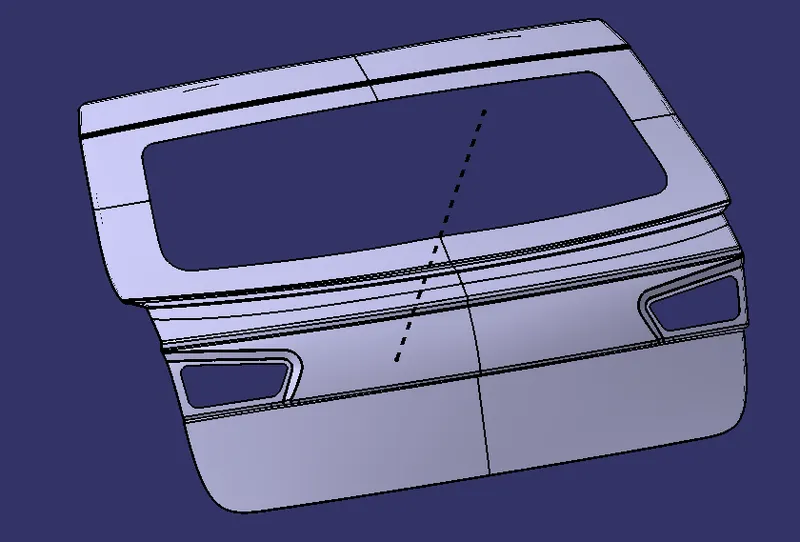
DESIGN OF OUTER PANEL:
The outer panel of the back door is similar to other BIW components where it is the aesthetic part of a vehicle.
The coating provided is of multi-stage which has the property of scratch resistance, rust prevention and smooth and attractive finishes.
The outer panel also has the provisions for the tail lamp, rear fog lamp and also has the provision for licence plate mountings. Most of the hatchback cars
have the provision for wiper motor
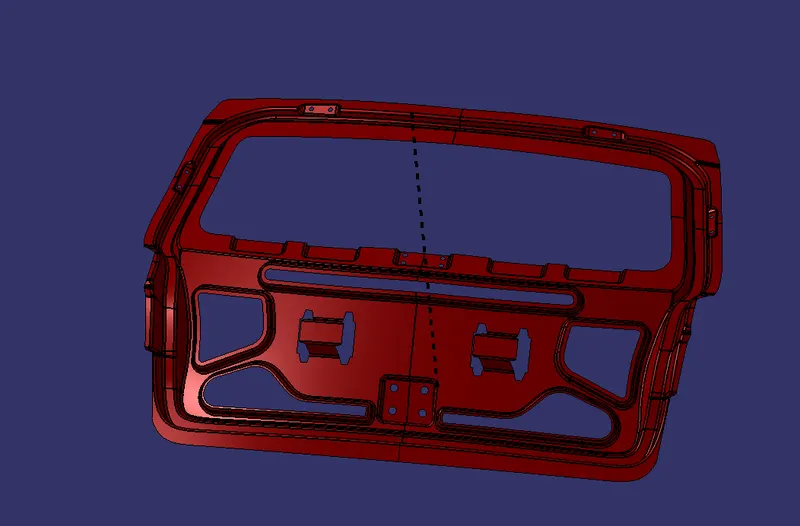
Inner panel draw direction:
The inner panel is produced by either casting or through deep drawn method.Mostly alumininum panel is only casted , steel inner
panel is made by deep drawn process only.
If it is deep drawn ,then there must be a tooling direction through which that direction the panel is deep drawn.
DRAFT ANALYSIS:
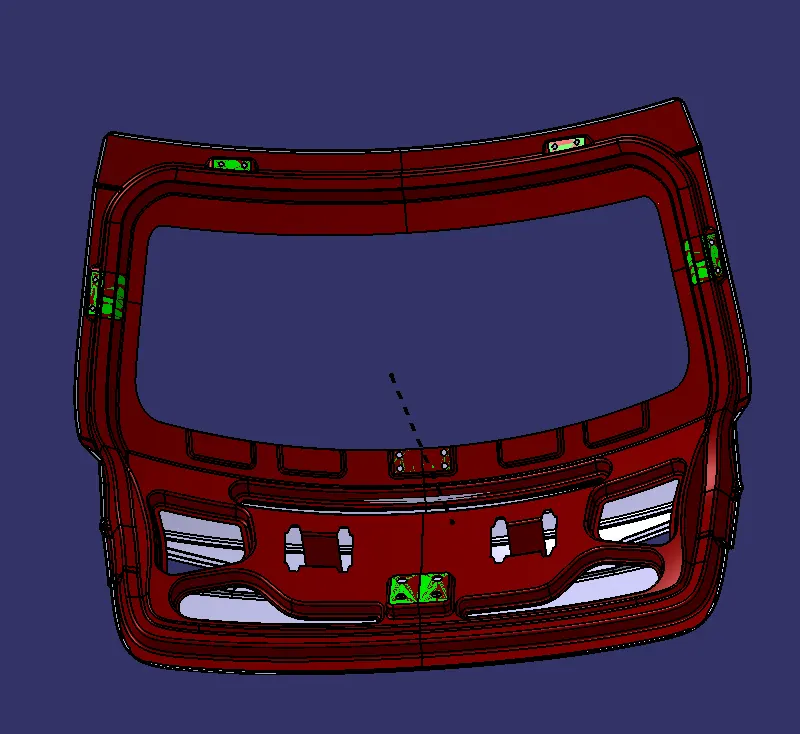
Draft analysis of inner panel is carried out through the tooling direction only.Only the green areas are acceptable and i worst cases
yellow regions are accepted but the blue and red regions are never accepted.
The draft angle for aluminium casted panel is 2 to 3 degrees is enough but if it is steel then the angle is more than 7 degrees.
In this project i considered it as steel and used 7 degrees as draft angle and direction is choosen as tooling direction which is the
deep drawn direction
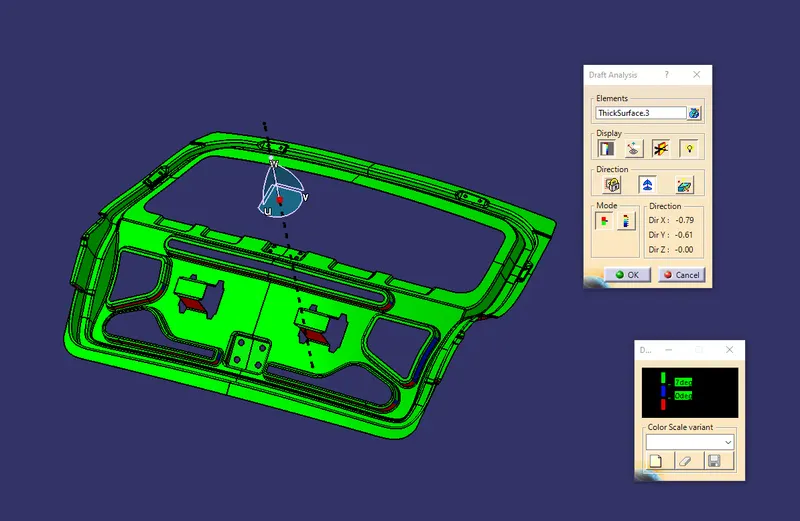
From the above fig. it is clear that all areas are in green color so my design is passed draft analysis.
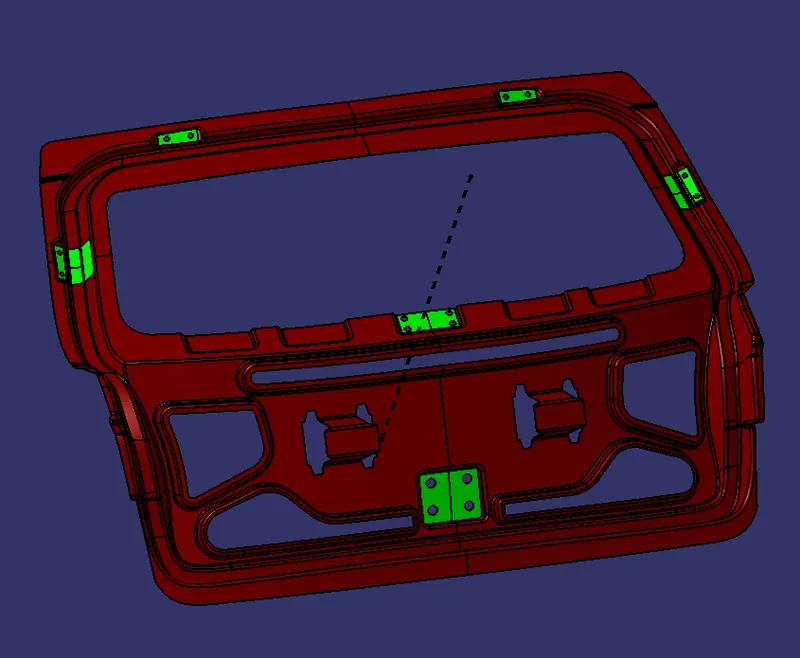
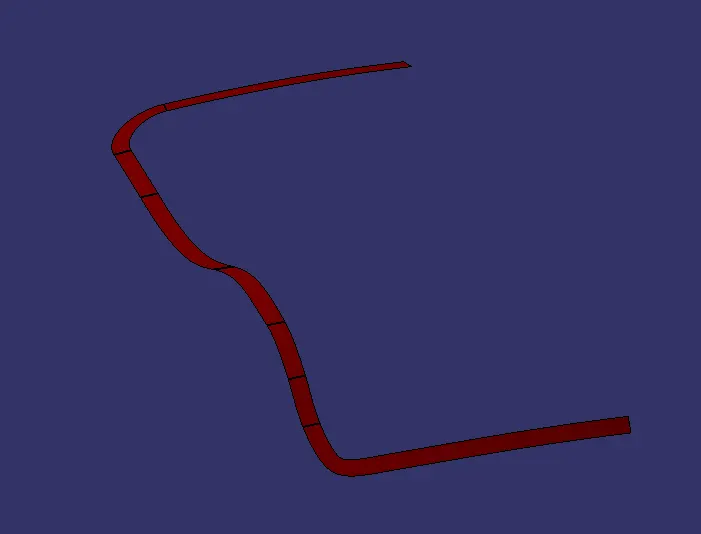
REINFORCEMENTS:
As mentioned for local strengthening reinforcements are usually provided.
Instead of making the whole panel off a thicker sheet, a thinner sheet with thicker local reinforcements wherever needed is preferred.
The reinforcements are usually 1-1.5mm thick whereas
the panel itself is 0.55- 1 mm thick.
HINGE REINFORCEMENT:
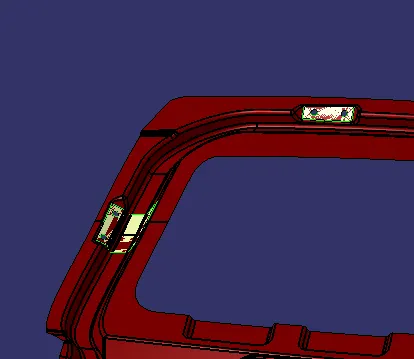
Hinges support the weight of the whole backdoor.Hence, the reinforcements must be provided there too.
The emboss is designed in such a way that the hinges should operate freely.The hinge is connected to the rear roof of the car.
GAS STAY REINFORCEMENT:
Gas stay is used to lift the backdoor automatically.There are two types of gas stay one is semi-automated and another one is fully
automated.
In semi automated type the back boor needs little force to lift after that it lift the backdoor automatically.
In fully automated , it has power spindle which lift the backdoor automatically
WIPER MOTOR REINFORCEMENT:
Wiper is used to to wipeout the rain water falls on the backdoor window.It is actuated by the motor which is mounted on the inner
panel.Due to the vibration and heat created by the motor.
The inner panel where the motor is mounted gets deform and the parts attached to the motor starts to vibrate which leads to poor NVH.
So we have to provide the reinforcement where the wiper motor is placed
LATCH REINFORCEMENT:
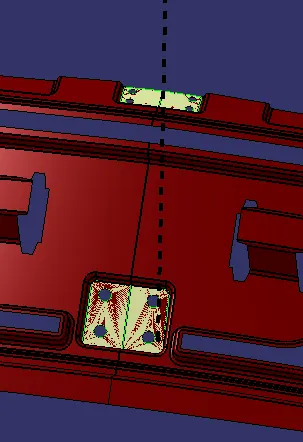
At bottom of the panel , reinforcement and emboss are given to accomodate the latch and striker assembly.
Generally key operated or automatic remotly controllable mechanism is used to keep the door open or closed.
The actuators , recivers and other electronic devices are mounted on the inner panel only
Conclusion
Thus the back door was designed from the given styling surface and Draft analysis is also done on the inner panel to check the manufacturing conditions. In this challenge i learned to design the Inner panel, the Outer panel, Wiper Motor reinforcement, Hinge
reinforcement, Gas Gtay reinforcements, Latch and Striker reinforcement and its position.