Design of backdoor
AIM :
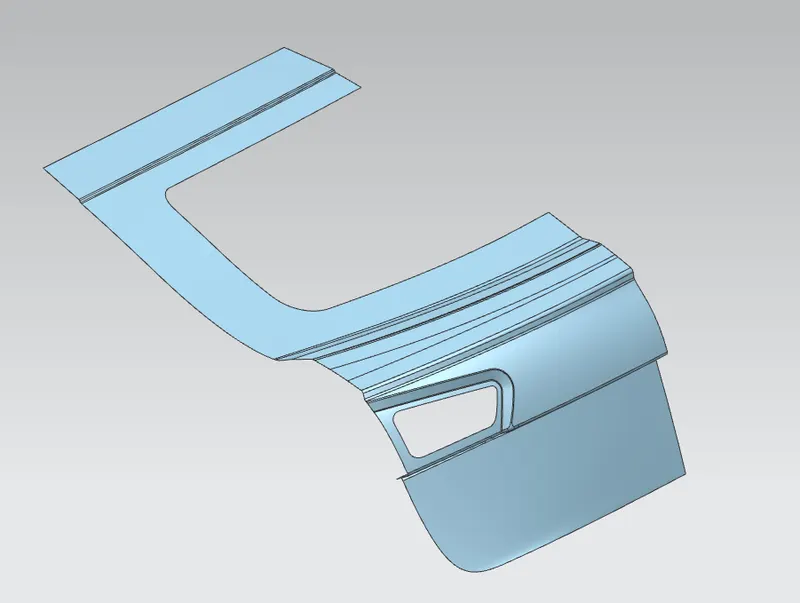
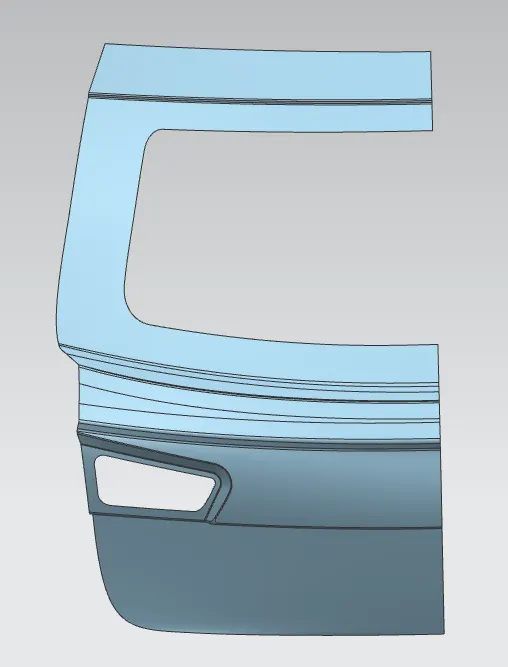
To design the back door using the provided styling surface and by using appropriate design methodologies and by providing the necessary reinforcements and embosses.
INTRODUCTION :
A door is a hinged part which is used for entry and exit of the vehicles. Back doors are one of the type doors of the vehicle which are located next to the passenger seat which provides access to the luggage compartment. In most of the cars, these back doors are operated with the help of gas stay which in turn reduces the effort required to lift or opening the door. Some luxury cars have powered backdoor which in turn is driven by an electric motor. This kind of system is also called a powered trunk lid system. Hatchback or station wagons are sold as 3 door or 5 door models. In this case, the rear hatch is classified as door this is because it enters the passenger compartment. The back door designed should meet the safety requirement for the rear collision.
TYPES OD BACK DOOR :
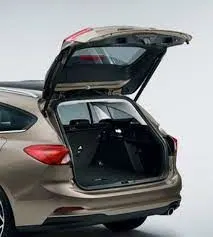
TOP MOUNTED :
This type of back doors is used in a station wagon, pickup truck and some of the sport utility vehicles. Today’s modern cars use top-mounted tailgating systems which are both powered and also gas stay supported. These top mounted tailgates provide greater rear visibility compared to side-mounted or bar doors which have canter pillars in it.
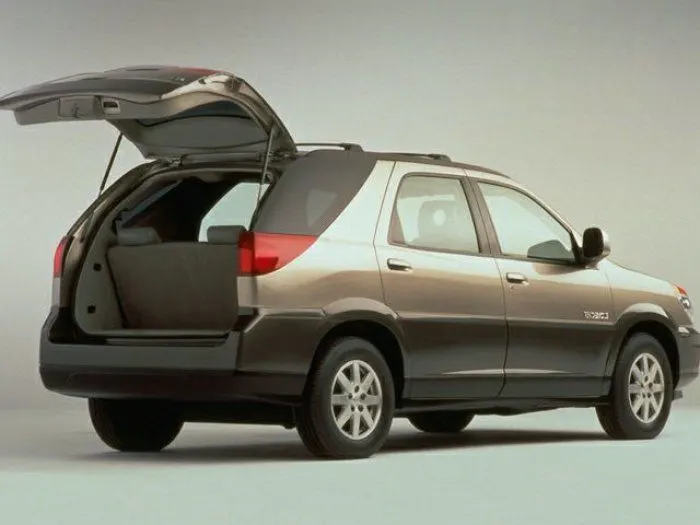
SIDE MOUNTED TYPES :
As the name signifies side-mounted doors are the one which is used in the van type MPVs, SUVs, pickup truck vehicles. These side-mounted doors or barn doors are a lot easier compared to top-mounted doors. These doors are generally smaller in size and can be easily accessed. These doors are more convenient for the goods handlers for long pipe and lengthy components where one door is kept open. These doors also save accidental head impacts. It is a lot easier to load and unload
items in the side-mounted doors.
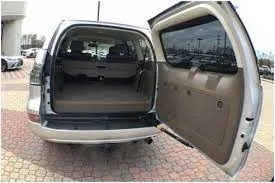
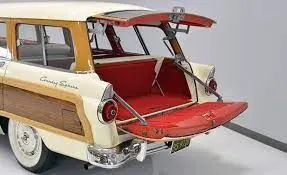
BOTTOM TYPE :
This bottom type or split type backdoor system are used in the car type such as estate type car, pickup trucks and some luxury SUVs.These are the most convenient type of back door in which the bottom split is used as a support or even as a table for the tour going people.
TYPES OF MECHANISM :
GAS STAY TYPE :
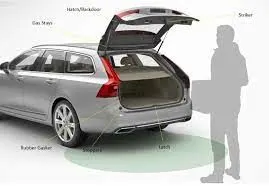
Gas stay types backdoor/liftgate/tailgate is an ideal and most commonly used tailgate mechanism from lower segment car to luxury car segment. The ideal components of tailgate consist of a hinge, door, gas stay and some rubber beadings for sealing of door.
POWERED LIFT SYSTEM :
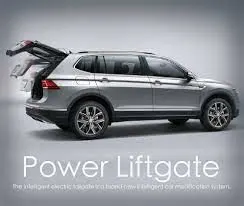
Power trunk lid system is another sophisticated way of trunk/liftgate opening mechanism which is to automatically open and close of the trunk/liftgate and release of the latch by the touch of a button. The following image shows the component as used in the powered trunk/back door lift system. Powered trunk lift system consists of a power latch, anti-pinch switch, PTG ass’y, PTG main switch. When the switch is pressed in the compartment or outside the power latch releases the latch and the entire backdoor is opened. The anti-pinch switch is located in order to avoid accidental hand insertion during the operation of the door.
BACKDOOR :
An automobile back door or tailgate is the panel that covers the trunk of an automobile. It enables access to the main luggage compartment. A hinge allows the boot lid to be raised, while the gas cylinders or springs hold it up in the open position. The back door is an assembly of many parts such as inner panel, outer panel and the reinforcements. Inner panel is attached to the outer panel using mastic sealants. The parts in the backdoor are :
- Inner panel.
- Outer panel.
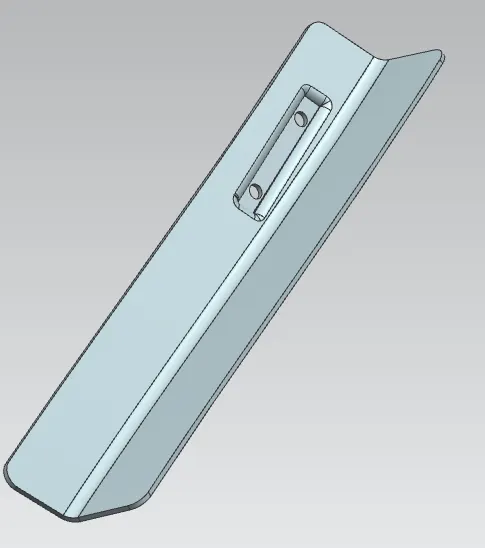
- Hinge reinforcement.
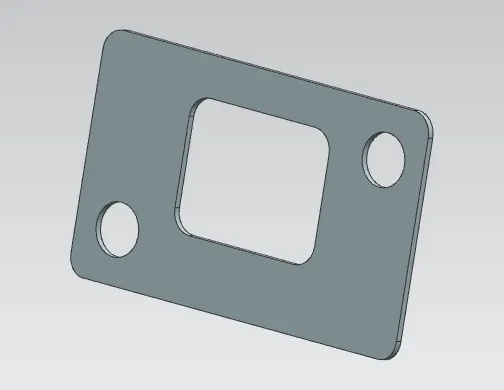
- Gas stay reinforcement.
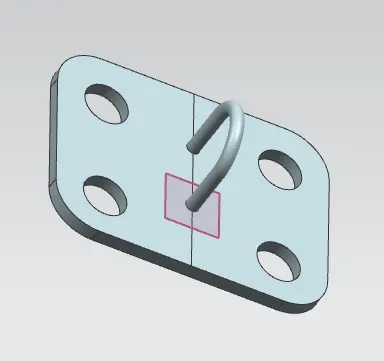
- Wiper motor reinforcement.
- Striker reinforcement.
Door parts thickness is given below :
- Outer Panel - 0.75 mm
- Inner Panel - 0.75 mm
- Reinforcements - 1.5 mm
Given Data,
INNER PANEL :
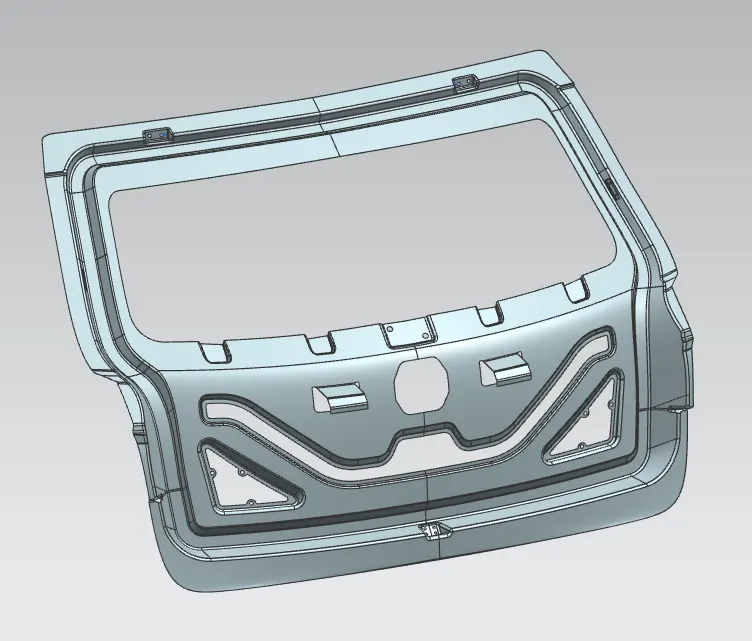
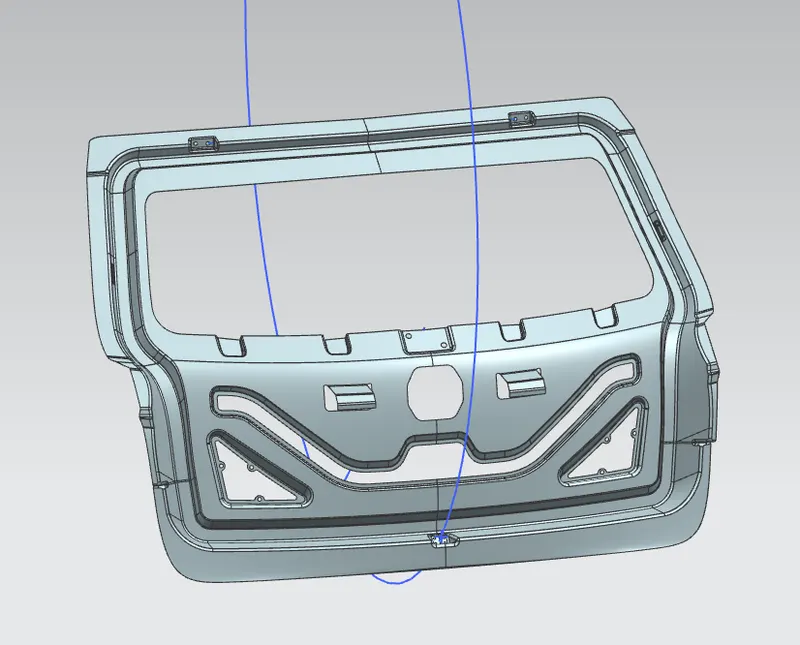
Inner door panel is a component which is use for strengthening the door assembly and it is one of the most important components on witch all accessories are mount like hinges, glass guide channel and gas stay.Back door inner panel is mounted with the the Roof.Inner is mounted with the outer panel with the help of hemming process.
- Materials used for the Inner panels are steels,Aluminum.
- For giving more strength to the inner panels by Adding extra reinforcements to strengthen the parts.
EMBOSS :
Embossing is a metal forming process for producing raised or sunken designs or relief in sheet material by means of matched male and female roller dies, theoretically with no change in metal thickness, or by passing sheet or a strip of metal between rolls of the desired pattern.
- Metal sheet is drawn through the male and female roller dies producing a pattern or design on the metal sheet. Depending on the roller dies used, different patterns can be produced on the metal sheet.
- Emboss should be in 7 degree to 25 degree inclinte in angle and it should not be in 90 degree angle,why because when we do stamping in manufacturing the stamping tool fits the sheet metal hence it will not come out of that sheet metal,So this is the main reason why the emboss face is in angle.
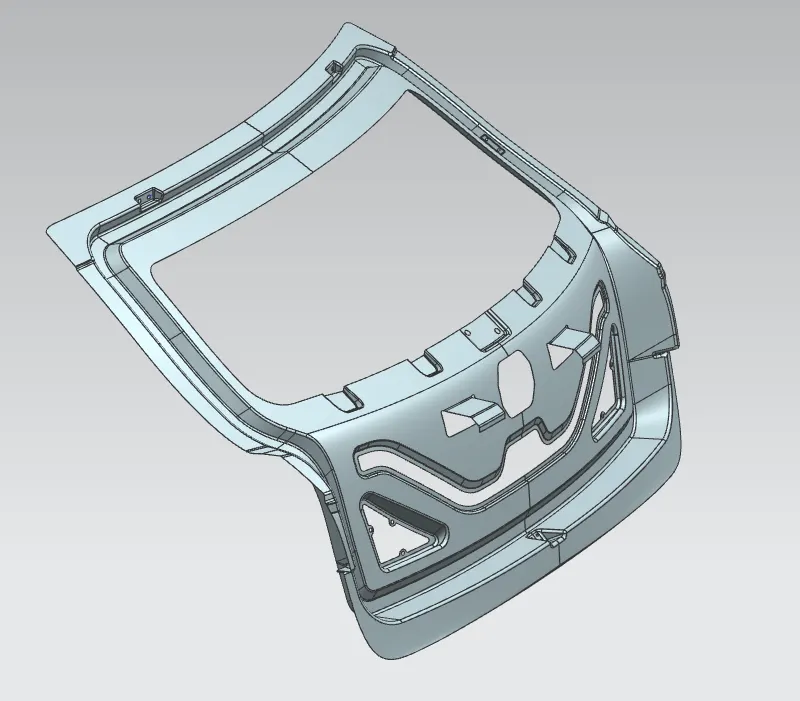
- Creating emboss in the outer panel direction because when collision happens from backside of the car this impact intially falls on the embossed faces then force disssipates according to the design of emboss then the remaining force hits the inner panel.For this case i designed my emboss towards outer panel direction.
- Located within the embossing stand itself are two engraved and mated hardened steel rolls, geared together to maintain top-to-bottom pattern registration. The width and diameter of these rolls depends on the strip width, material thickness, pattern depth, and material tensile strength and hardness.
- In most machines, the upper roll blocks are stationary, while the bottom roll blocks are movable. The pressure with which the bottom roll is raised is referred to as the tonnage capacity. This figure also depends on the aforementioned parameters.
- Embossing machines are generally sized to give 2" of strip clearance on each side of an engraved embossing roll. Many embossing machines are custommanufactured, so there are no industry-standard widths. It is not uncommon to find embossing machines in operation producing patterns less than 6' wide all the way up to machines producing patterns 70"+ wide.
- The illustration that follows provides a two-dimensional look at a typical embossing line setup with an embossing roller in the middle. The illustration shows the metal sheet entering the roller, and then the embossed sheet leaving toward the drawing rollers.
- Embossed metals are used in industry for two reasons: aesthetic and functional. Aesthetic applications also include appliance panels, building products, elevator panels, garage door panels, automotive trim, metal office furniture, and others.
- Functional applications are those in which a performance characteristic is enhanced. This can include a metal products ability to disperse liquid more effectively, reduction friction and static, increase a metal panel’s stiffness and rigidity, increase a metal surface area for acoustic or heat transfer applications,and improve traction.
- The embossing process can produce a variety of patterns. Some of the most common patterns include stucco, leather grain, wood grain, weather grain, and rough sawn cedar. Most embossers will tool to form any needed pattern, depending on the cost parameters involved.
CABLE HARNESS GAP :
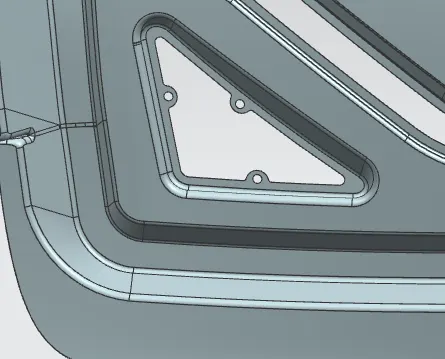
I left some gap for Headlamp Harness and tailgate light harness cables. Left some gap also dissipates the force when collision happens.
INNER AND OUTER PANEL MOUNTING FLANGE :
I provided two mounting Flanges for mounting the inner panel with outer stylish panel. Two flanges is wnough strength for holding the outer and inner panels with the help of sealants. In between inner panel and outer panel we providing sealants.
WIPER MOTOR MOUNTING :
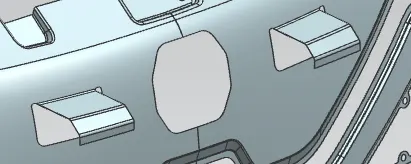
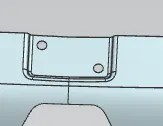
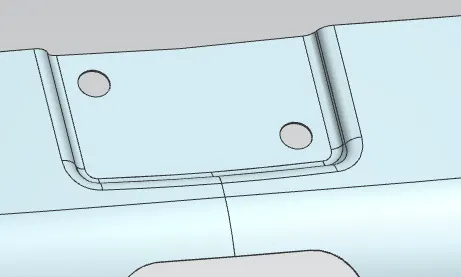
This picture represents wiper motor mounting area.
REINFORCEMENT :
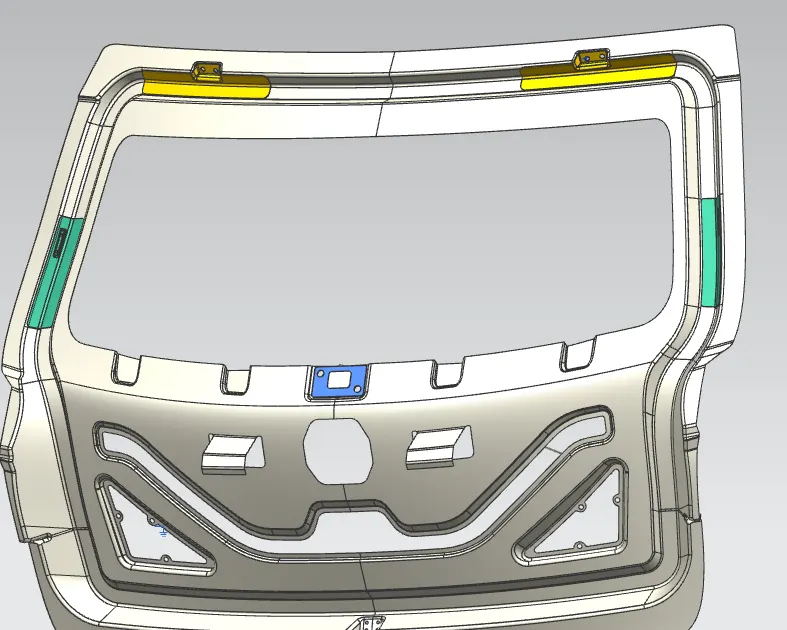
To reduce the impact to the occupants inside the car, additional latch and hinge reinforcement to the hood. When latch and striker are placed, there is drop in strength at that position thus reinforcement is required. Also stiffness pads are placed to reduce NVH. Hinge and latch reinforcement thickness is kept at 1.5 mm but it may vary.
RELIEF AREA :
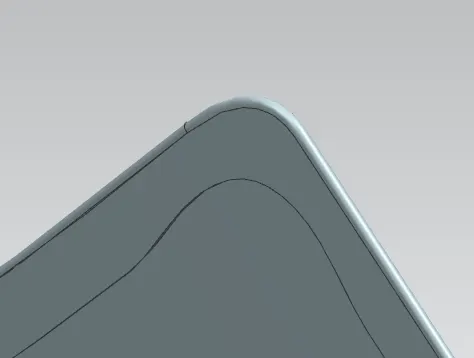
Relief is provided onto the part or component in order to remove any stresses developed in a particular area. sharp corners that takes place during the hemming process is carried out. Thus corners are rounded or chamfered. We are leaving 2 mm from sheet metal for Roll hemming process.
POSITION OF LATCH :
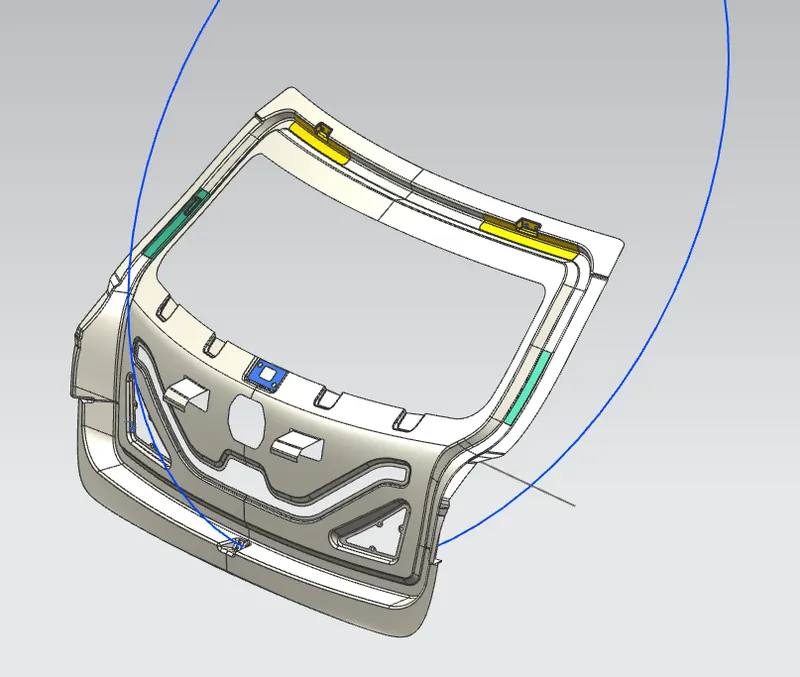
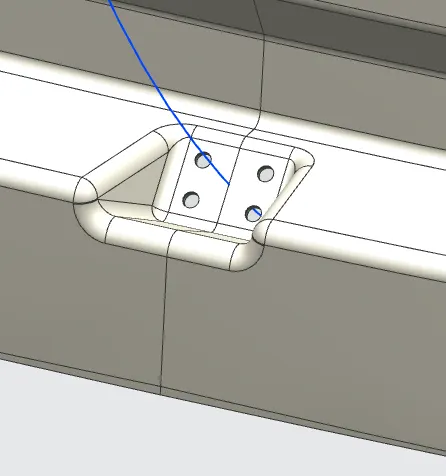
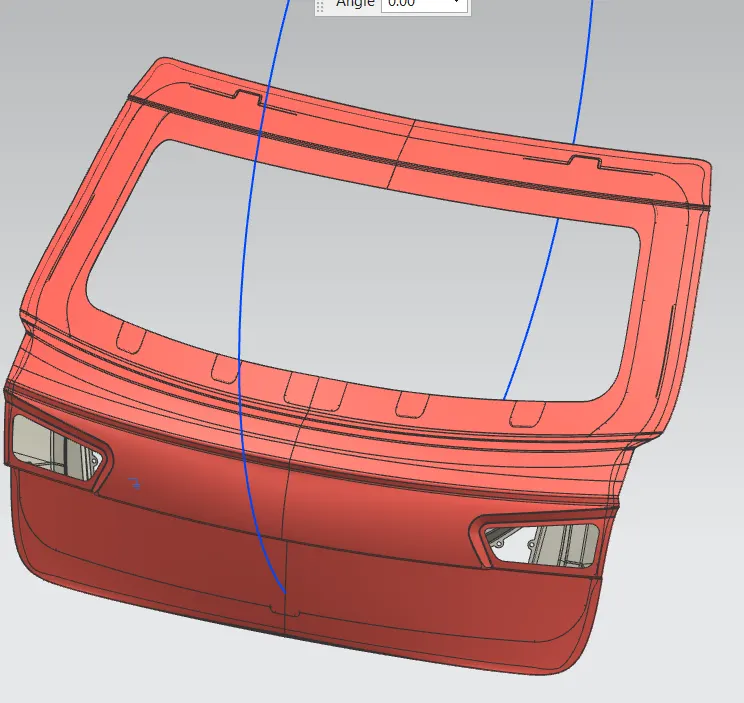
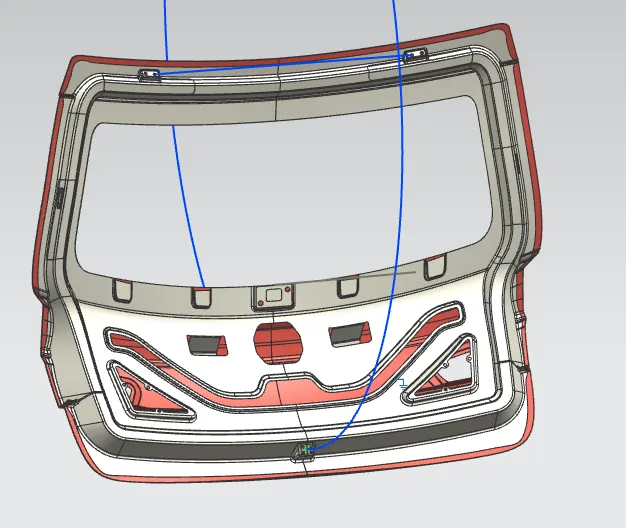
Position of latch and striker is perpendicular to the hinge then only the latch and striker mechanism works properly when the door closing and opening position. For the proper opening and closing of the Door, the striker should be perpendicular to the trajectory of the Door. For this, hinge is assembled at its position.
- To check the hinge axis as the center we draw a big circle to the position the latch in such a way that it is perpendicular to the hood trajectory.
- In between the two hinges the striker is perpendicular to the midpoint of two hinges,Why because while closing and opening of latch and striker the opening
position be similar actions.
IMAGES OF BACK DOOR :
INNER PANEL :
OUTER PANEL :
STRIKER :
WIPER MOTOR :
GAS STAY REINFORCEMENT :
BACK DOOR :
CONCLUSION :
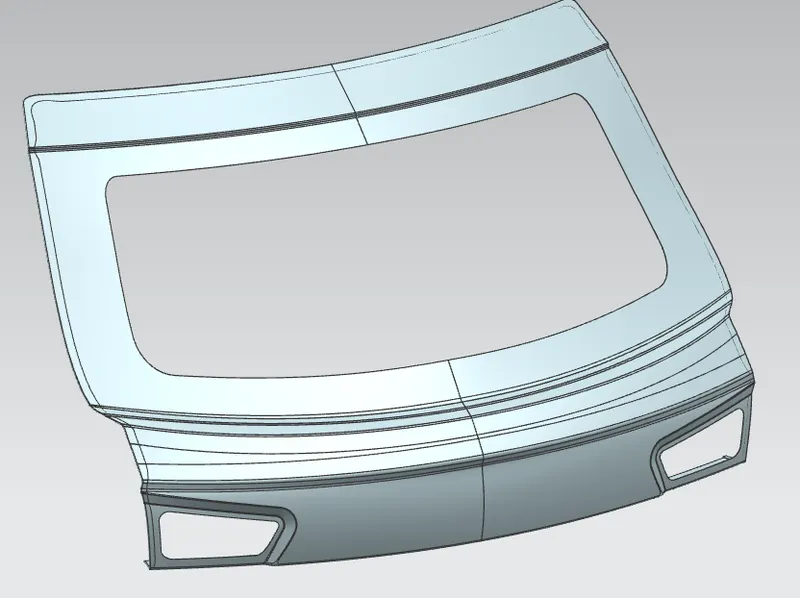
Thus the back door was designed from the given styling surface and draft analysis is also done on the outer panel to check the manufacturing conditions. I have designed the inner panel, outer panel, wiper motor reinforcement, hinge reinforcement, gas stay reinforcements, Latch and striker.