Design of backdoor
DESIGN OF BACKDOOR
AIM
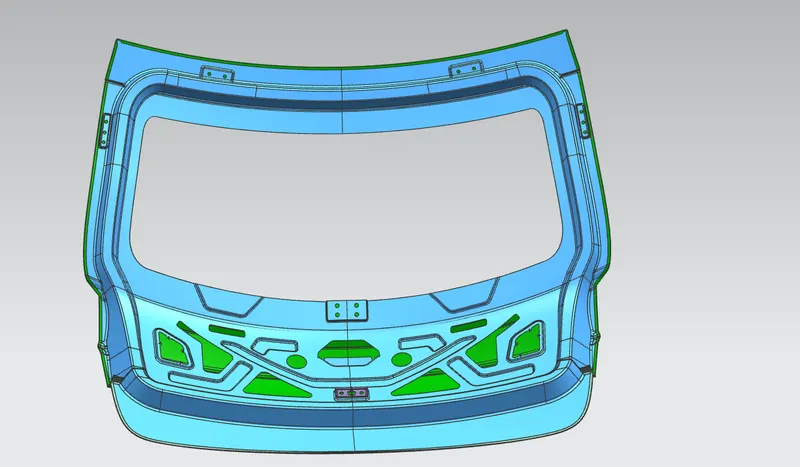
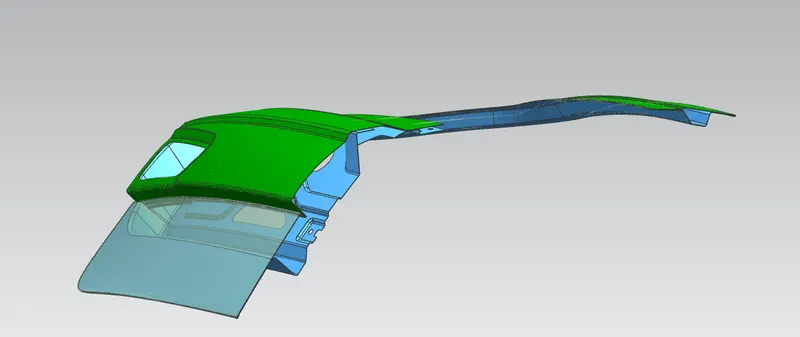
The aim of this challenge is to create a design of all the backdoor assembly with all the components from the given information and the skin data of the outer panel using Siemens NX-CAD.
THEORY/ INTRODUCTION
The backdoor of a car/ automotive is the rearmost BIW component that provides space for the passenger luggage. Backdoor is also known as tailgate in case of SUV’s, station wagons and pickup trucks. Backdoors are mainly classified into three types based on the positions they are hinged to the car body namely top mounted, side mounted and bottom mounted backdoors. Backdoors can also be classified into two types based on the mechanisms used to open the backdoor like in some cases gas stays are used on either side of the backdoor to assist the user while lifting the door and in some cases a power spindle is used. The main components that a usual backdoor consists are:
- Backdoor outer panel – It is further divided into backdoor upper and lower outer panel. Thickness has to be maintained at 0.75mm
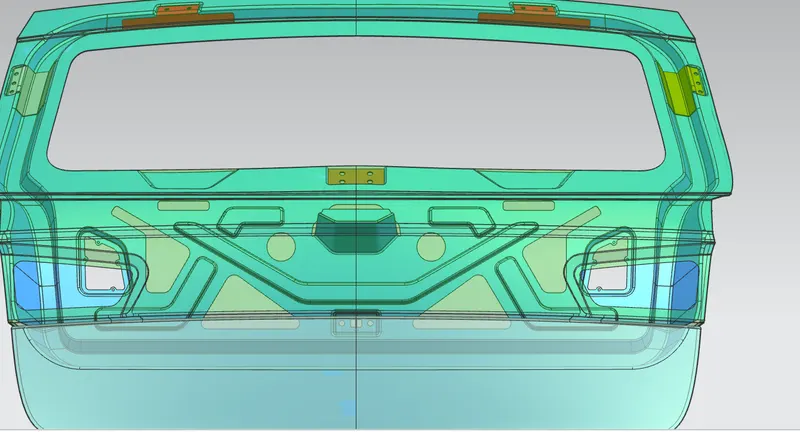
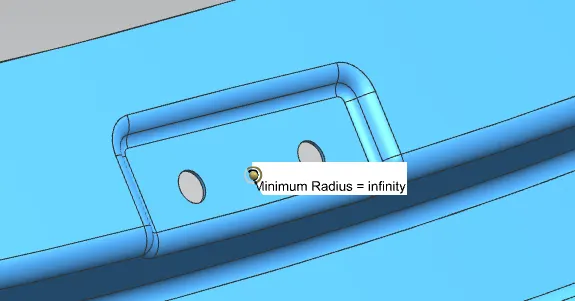
- Backdoor inner panel – Inner panel consists of all the embosses for hinge assembly, gas stay reinforcements, latch and striker reinforcements and also embosses on the inner panel to improve performance in crash test analysis like in the hood design but in this case these are provided not to distribute the forces but to absorb all the impact before the inner panel so the direction should be away from the inner panel and towards the outer panel. Also all embosses that are created for the reinforcements must have a flat surface and mounting holes on the surface. The inner panel is also provided with a flange to join the inner and outer panel. Thickness of the inner panel is to be maintained at 0.75mm.
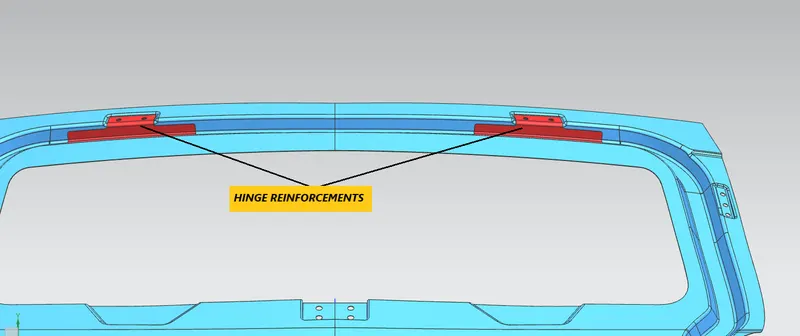
- Hinge reinforcements – Hinge reinforcements are provided where emboss for the hinge assembly is positioned based on the design i.e., top or bottom or side of the backdoor. Reinforcement’s thickness is to be maintained at 1.5mm.
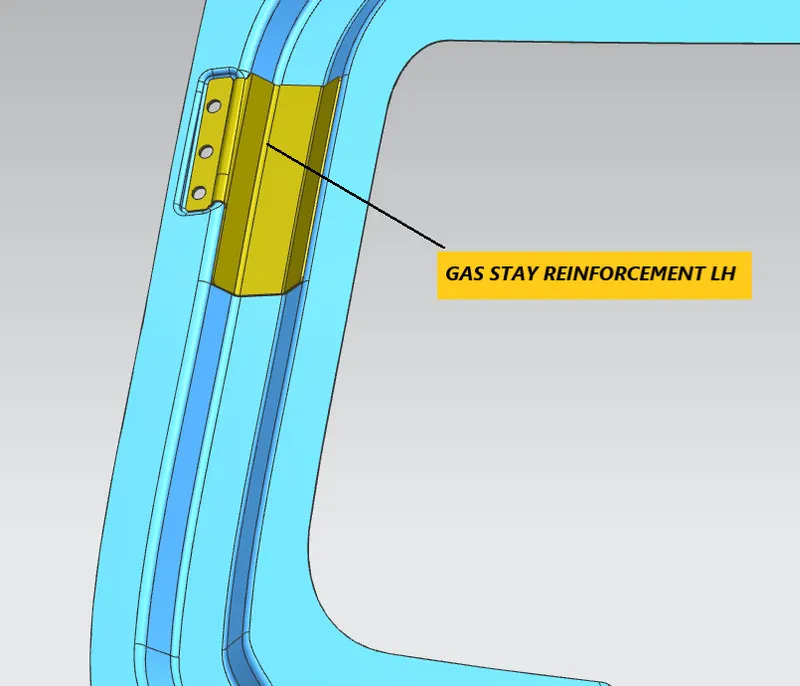
- Gas stay reinforcements – Gas stay reinforcements are provided to accommodate the gas stay assembly and the thickness is same as that of the hinge reinforcements.
- Latch and striker assembly – Latch and striker assembly is used to lock the backdoor and the latch trajectory must be tangent to the circle/ arc drawn with the midpoint of the axis as centre and the distance between the midpoint and the latch mounting area as the radius. Thickness is same as that of the Hinge reinforcements.
IMPORTANT CONSIDERATIONS WHILE DESIGNING A BACKDOOR
1. REAR VISBILITY CRITERIA
The design has to be made focusing on improving rear visibility criteria without affecting other parts of the backdoor.
2.LOAD CASES
There are several types of tests that are performed on the backdoor while analyzing the design of the backdoor such as:
- Bend Test – The two upper hinge positions and similar positions on the lower side are constrained and two equal loads in same direction are applied approximately on the centerline of the backdoor to test how much the part is able to restore its original position upon unloading.
- Torsion Test – Two hinge positions and the latch positions are constrained to be fixed and two equal and opposite loads are applied on the centerline of the lower backdoor to test how much the part is able to restore its original position upon unloading.
- Abuse Test – This test is done to know how the part behaves to over slamming and overhanging condition (when people lay their body weight on the backdoor when it is opened) and the right lower position is constrained to be fixed for this test.
- Dent Test – For this test a dent is made on the backdoor and how much the part is able to restore its original position.
- Assembly Load cases – When the backdoor outer panel is assembled with other components a certain amount of force is applied. This test is done to ensure that the components are able to withstand this force or not.
- Endurance Test – As a door the backdoor will be opened and closed many times. So, to know the endurance limit this test is done and the number of cycles is noted.
3. DEEP DRAWING
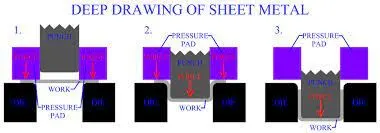
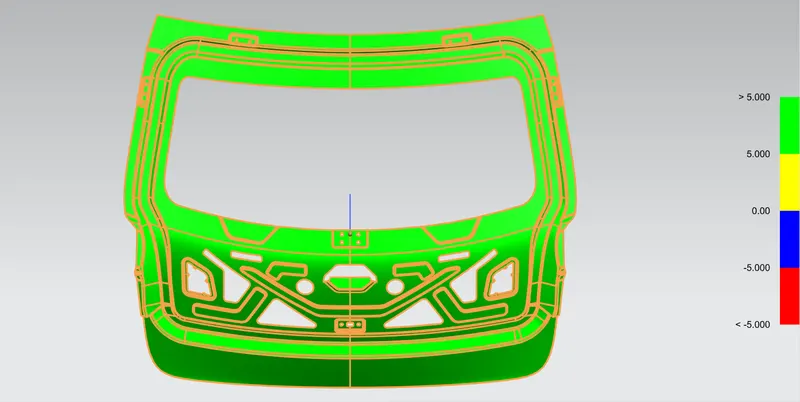
Inner panel and outer panel are manufactured by a sheet metal operation known as Deep drawing. In this operation the sheet metal is placed between dies and a punch is used to draw the sheet metal in the tooling direction. So, Draft analysis is used to check whether the inner and outer panels have any negative draft angles.
4. LANCING
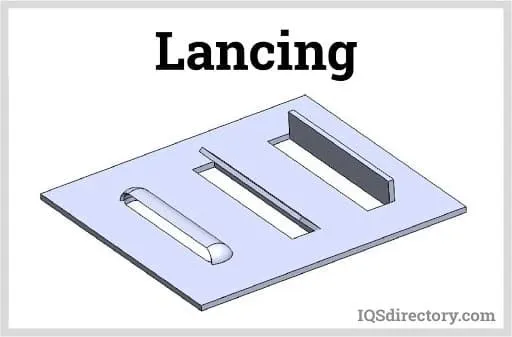
The flange in the inner panel that is used to join the inner and outer panels through mastic sealants is manufactured using sheet metal operation known as Lancing. Lancing is a piercing operation in which the work piece is sheared and bent with one strike of the die. A key part of this process is that there is not reduction of material, only a modification in its geometry. So, the area of the portion that we trim off the inner panel must be greater than or equal to the area of the flange and also the distance between the outer panel and this flange must be 5mm for the mastic sealant.
5.HEMMING
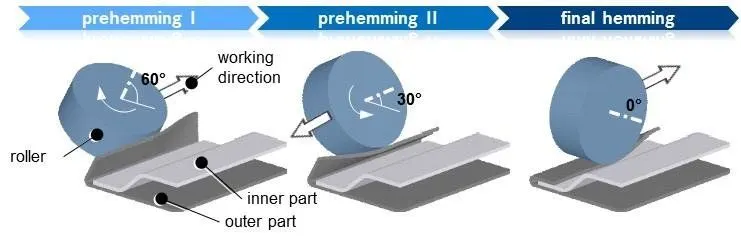
Hemming is a sheet metal forming process used to join to sheet bodies by bending it to 180 degrees. It usually happens in three different stages firstly, bending it to 90 degrees and in second stage bending it to 135 degrees and finally to 180 degrees. There are usually four different types of hemming processes:
- Open hem
- Closed hem
- Tear drop hem
- Rolled hem
Open type hem is used to join the inner and outer panels of the backdoor. So, a 2mm distance and 0.2mm tolerance values must be maintained between the inner and outer panels.
6.LATCH TRAJECTORY
As seen in the hood design the same principle has to be followed in order to ensure proper locking of the backdoor.
PROCEDURE
- Repairing the Outer surface
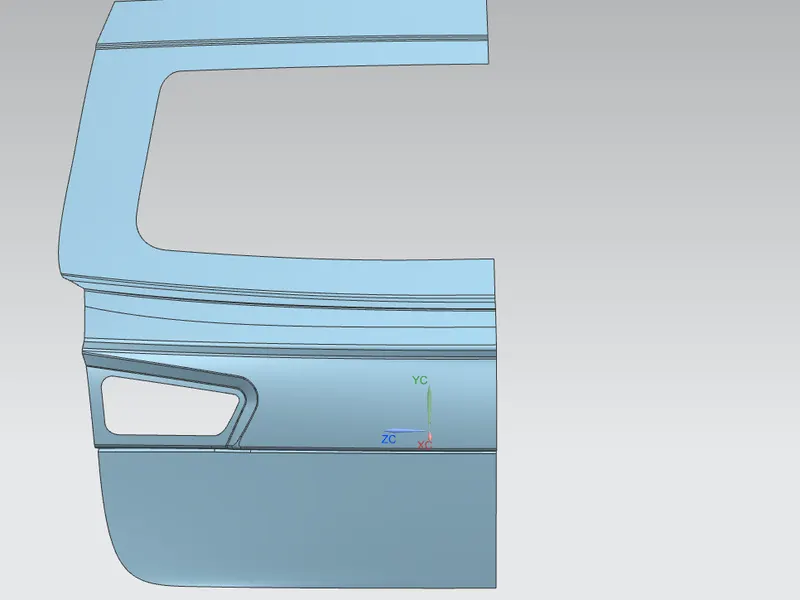
The skin data that is provided to us is not a good surface and sheets are disjoint at some places. So, we try to fix this issue by hiding the current surface and creating a new surface and after getting a good outer panel surface we separate both upper and lower surfaces of outer panel.
- Backdoor Inner panel
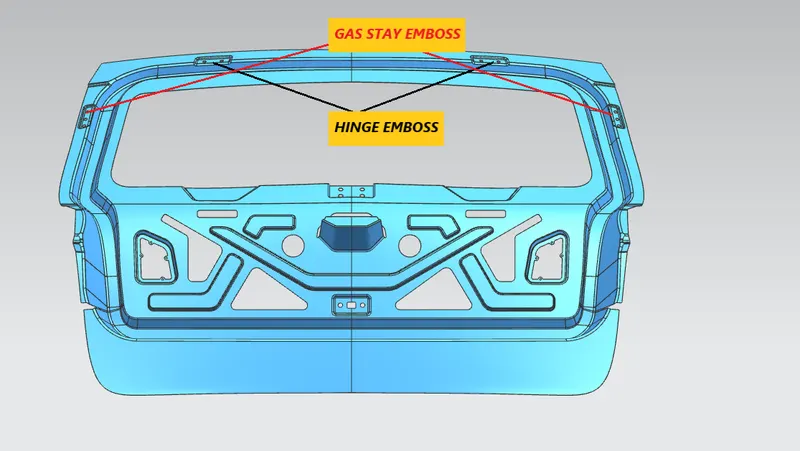
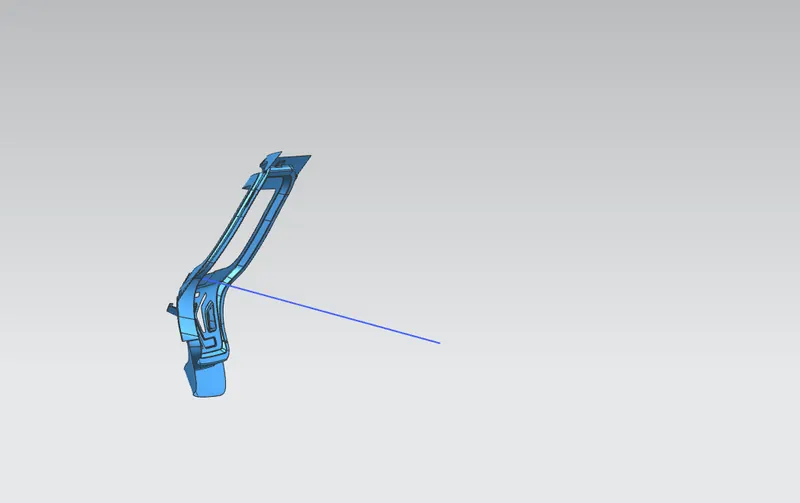
Once the outer panel is done we first provide a tooling direction in which we create the sealing flange for the inner panel, connecting flange and other parts and after the surface is done we create emboss for inner panel, hinge, gas stay, latch, wiper motor. Emboss on the inner panel is suggested to be in a Y/U shape because the inner panel with this type of emboss seems to be performing better than other inner panels with different emboss.
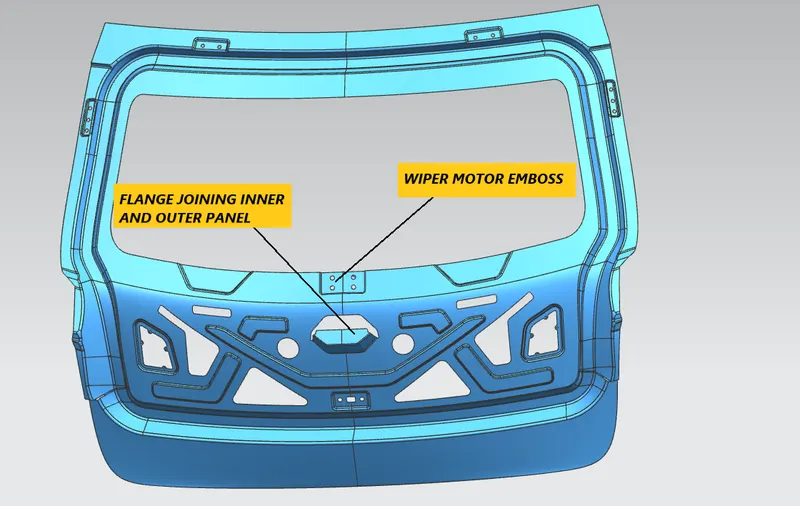
Tooling direction:
3.Hinge reinforcements
4.Gas stay reinforcements
5.Latch and striker reinforcements
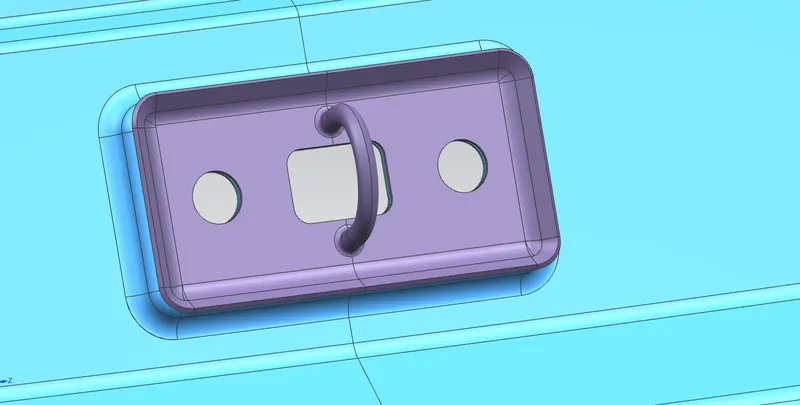
6.Wiper motor reinforcements
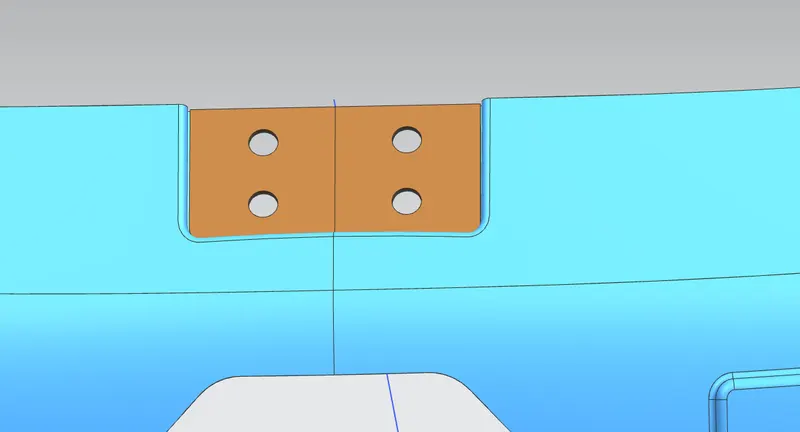
7.Latch trajectory
8.Hemming
Hemming needs to made for both upper and lower outer panel of the backdoor according to the given hem data
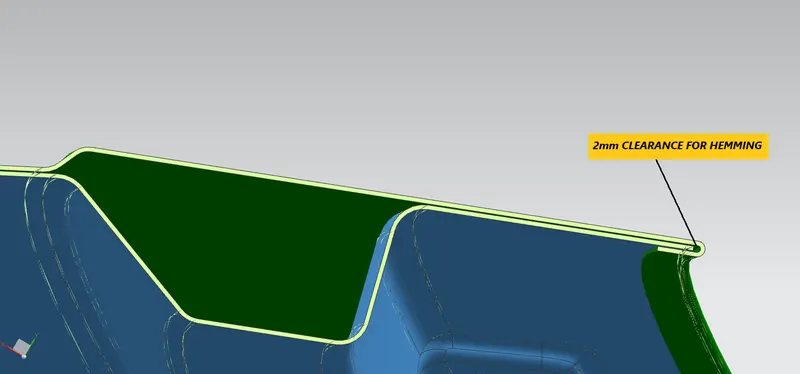
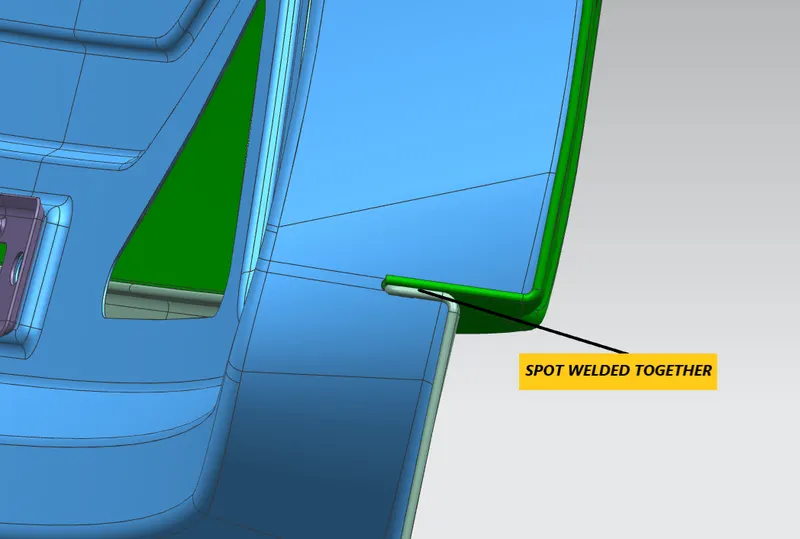
- Relief angles
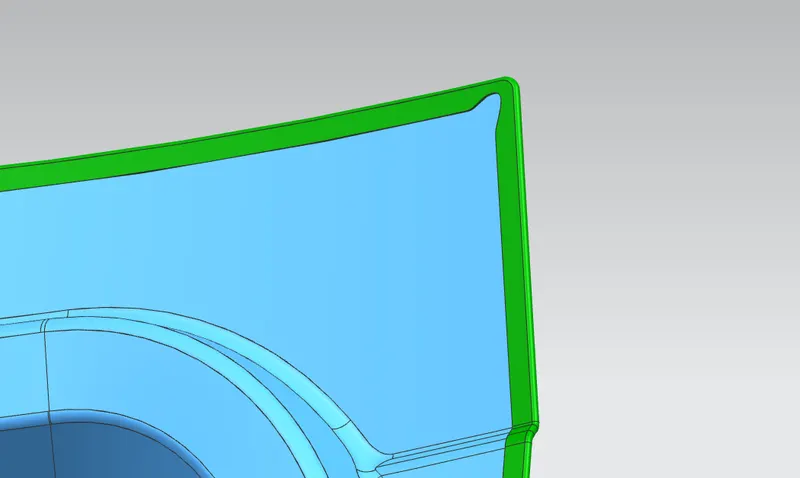
Relief must be given where the sharp edges are present in order to avoid stress concentration which results in chipping.
- Draft Analysis
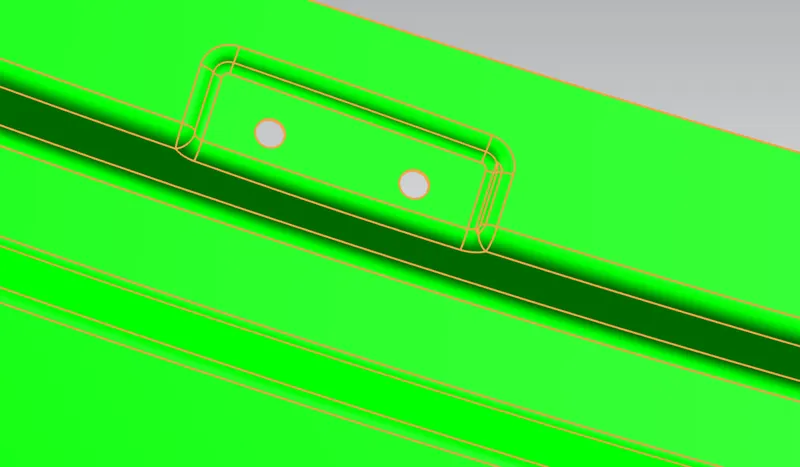
Draft analysis is done after thickening the assembly and tooling direction needs to be considered. We check for negative draft angles and find a way to rectify them.
FINAL ASSEMBLY