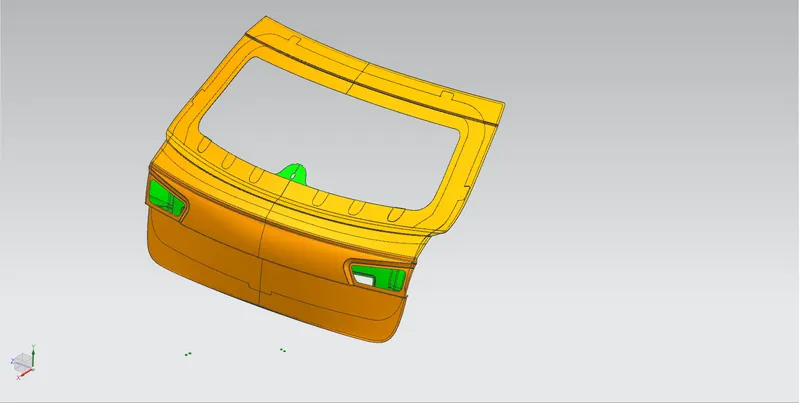
Design of backdoor
Objectives:
- To understand the Design parameters of the backdoor.
- To design the backdoor inner panel, outer panel upper and lower
- To add all the necessary reinforcement and embossed/cut-outs to the inner door panel.
- To perform draft analysis of the inner panel along the tooling direction for manufacturability.
Introduction :
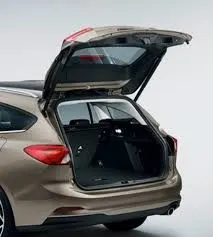
Back doors are one of the type doors which closes the back side of the car compartment. These are located next to the passenger seat which provides access to the luggage compartment. In most of the cars, these back doors are operated with the help of gas stay which in turn reduces the effort required to lift open the door. Some luxury cars have powered backdoors which in turn are driven by an electric motor.
Types of mounting on back door
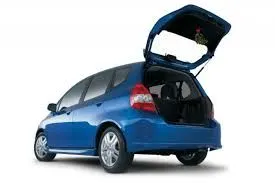
Top-Mounted :
This is the most common type of back door which is widely used in a particular station wagon, Sedan and some of the sport utility vehicles. Today’s modern cars use top-mounted tailgating systems which are both powered and also gas stay supported. These top mounted tailgates provide greater rear visibility compared to side-mounted or bar doors which have canter pillars in it.
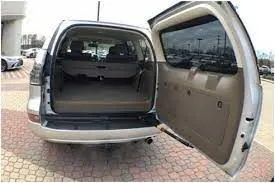
Side Mounted Backdoor:
This type of backdoor is hinged to the body side and opens in sideways. In this type generally the size is small and can be easily accessed. It is easier to load and unload items inside the backdoor. This door is more convenient for goods handlers for long pipe and lengthy components where one door is kept open. This backdoor is generally used in the van type MPVs, SUVs and Pickup truck vehicles.These types doors also save accidental head impacts.
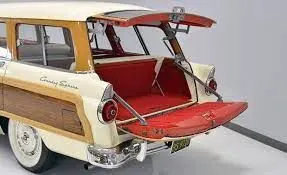
Bottom Mounted :
This type of backdoor is hinged to the bottom of the vehicle and opens from upward to downward. This is the most convenient type of backdoor in which the bottom split is used as a support. It is very easy and comfortable for loading and unloading of goods. This type of backdoor is used in pickup trucks and some luxury SUVs.
Lifting mechanism of Backdoor
Gas stays type:
Gas stay is a device used for supporting the backdoor in its open position by the means of an actuator which is activated by gas. This is designed to be used in upward lifting doors, once the door is opened slightly the spring will push the door to the fully open position. Euro fits stock various size springs depending on the door size requirement.
Powered Lift system:
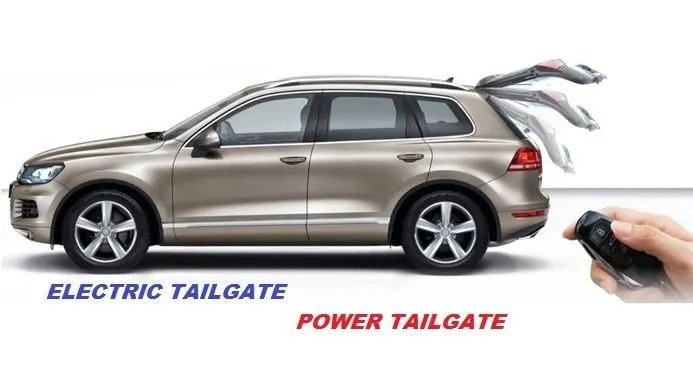
The powered lift assisting system opens and closes the backdoor by simply pressing a button. It provides additional security and value to the vehicle. Installation is designed for the do-it-yourself and comes with various brackets depending on the car. Powered lift system consists of a power latch, anti-pinch switch and PTG main switch. When the switch is pressed, the power latch releases the latch and the entire backdoor is opened. The anti-pinch switch is located in order to avoid accidental hand insertion during the operation of the door.
Design consideration of the backdoor:
- Rear visibility
- Hinges and gas stays
- Fit and clearances
- Boot spaces and accessibility
- Rear crash regulation
- Strength criteria
- Draft analysis
DIFFERENT METHODS OF MANUFACTURING FOR BACK CAR DOOR:
Deep Drawing :
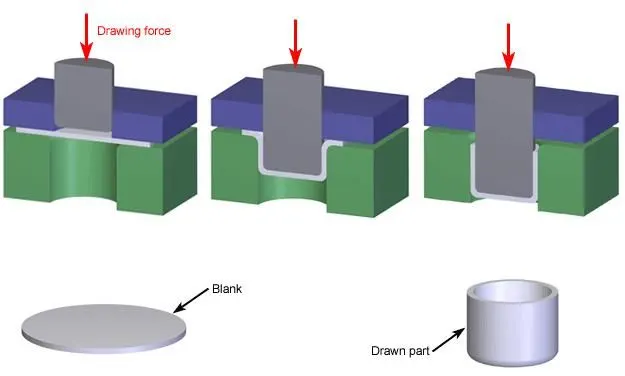
The total drawing load consists of the ideal forming load and an additional component to compensate for friction in the contacting areas of the flange region and bending forces as well as unbending forces at the die radius. The forming load is transferred from the punch radius through the drawn part wall into the deformation region (sheet metal flange). In the drawn part wall, which is in contact with the punch, the hoop strain is zero whereby the plane strain condition is reached. In reality, mostly the strain condition is only approximately flat. Due to tensile forces acting in the part wall, wall thinning is prominent and results in an uneven part wall thickness, such that the part wall thickness is lowest at the point where the part wall loses contact with the punch, i.e., at the punch radius.
Trimming :
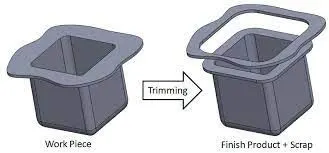
Trimming is a manufacturing process that is used as a finishing operation for forged parts, in order to remove flash. Most often it is desirable to perform this operation while the work is still hot for maximum efficiency, therefore it is usually incorporated into the larger production process.
Hemming :
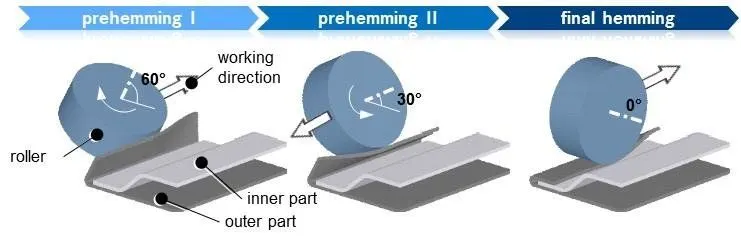
Hemming is a forming operation in which the edges of the sheet are folded or folded over another part in order to achieve a tight fit. Normally hemming operations are used to connect parts together, to improve the appearance of a part and to reinforce part edges.In car part production, hemming is used in assembly as a secondary operation after deep drawing, trimming and flanging operations to join two sheet metal parts (outer and inner) together. Typical parts for this type of assembly are hoods, doors, trunk lids and fenders.The accuracy of the hemming operation is very important since it affects the appearance of the surface and surface quality. Material deformations, which occur during the hemming process, can lead to dimensional variations and other defects in parts. Typical hemming defects are splits or wrinkles in the flange, material overlaps in the corner areas or material roll-in. This is why it is important to use simulation tools in order to, on the one hand, better understand the hemming process and, on the other hand, significantly reduce the number of “trial and error” loops during tryout and production.
Lancing :
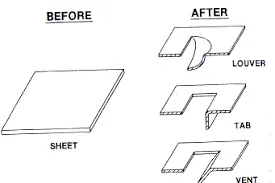
Lancing is a piercing operation in which the workpiece is sheared and bent with one strike of the die. A key part of this process is that there is not reduction of material, only a modification in its geometry.The cut made in lancing is not a closed cut, like in perforation even though a similar machine is used, but a side is left connected to be bent sharply or in more of a rounded manner.
Components of Back-Door
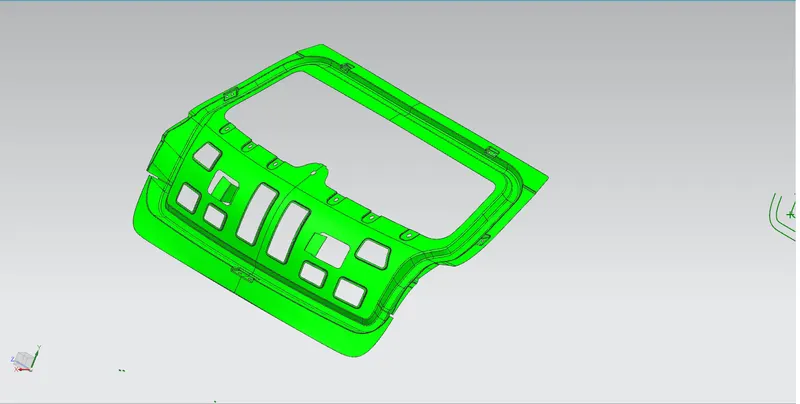
- Outer panel Upper
- Outer Panel Lower
- Inner-Panel
- Reinforcement Right and Left Side
Inner panel: It is the most crucial part in the entire assembly as it provides the strength to the back door assembly, design of innerpanel is such a way that after collision the force must dissipate energy. Therefore all the embossed and cut outs are done on the inner panels. Other features like hinge reinforcement and striker emboss. In order to enhance more strength of the outer panel the outside edge of the with 5mm gap.
LATCH TRAJECTORY :
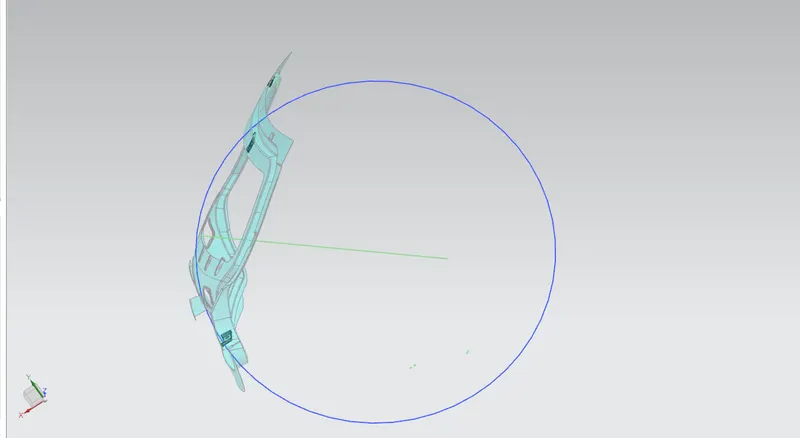
It can be defined as the imaginary path at which the latch(Striker) coming from the hood opens and closes. The trajectory depends upon the centre of the hinge, therefore if it's wrong then the striker will not be fixed with the lock.
Design of reinforcement:
Reinforcement is provided in the design to improve the strength in the area where loads are acting.
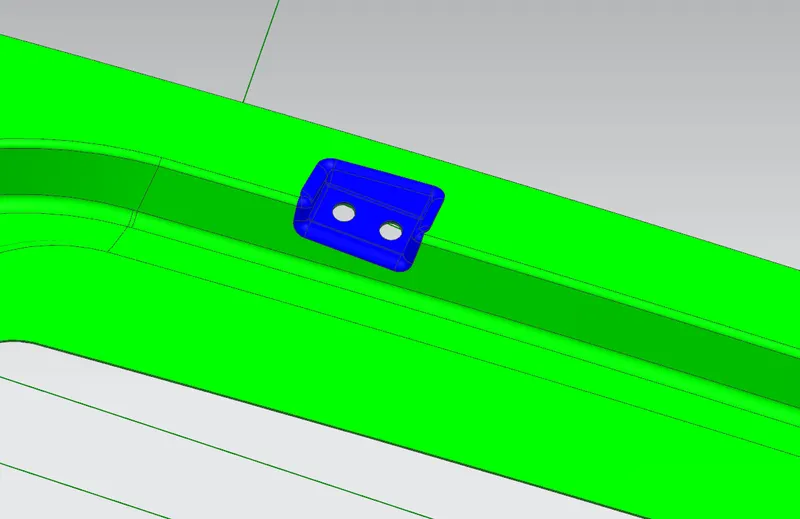
a.Hinge reinforcement:
Hinge is used for opening and closing of the backdoor. One end of the hinge is fixed on the backdoor and other end on the roof on both sides of the back door.Hinge reinforcement is done to compensate for the weak region due to acting load over it.
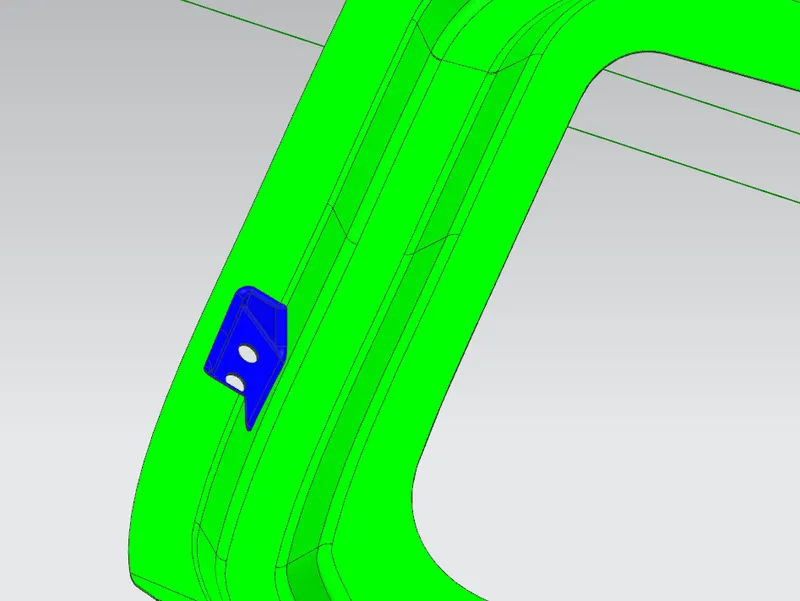
b.Gas stay reinforcement:
Gas stay is a device used for supporting the backdoor in its open position. The reinforcement is done so that it improves the strength during bolting and in backdoor open position by spreading the load over the surface.
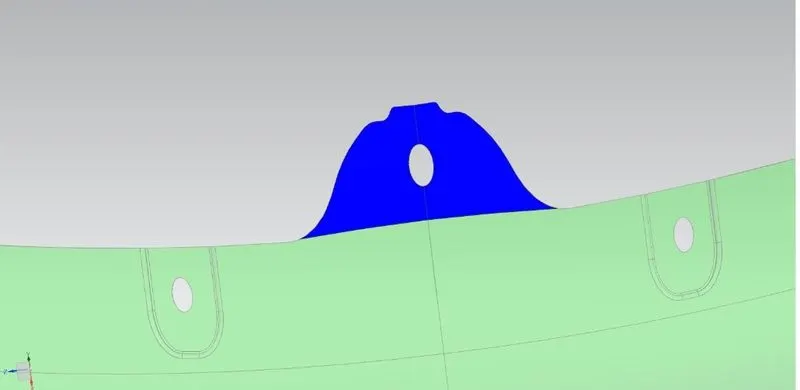
c.Wiper motor reinforcement:
The water or dust on the rear window is less likely to flow off compared to a more traditional sedan or coupe. So, a wiper is installed to clear the window and allow the driver better visibility behind them for changing lanes on multi-lane roads with the help of an internal mirror.Wiper motor reinforcement is created to mount the wiper motor assembly.
DESIGN OF OUTER PANEL:
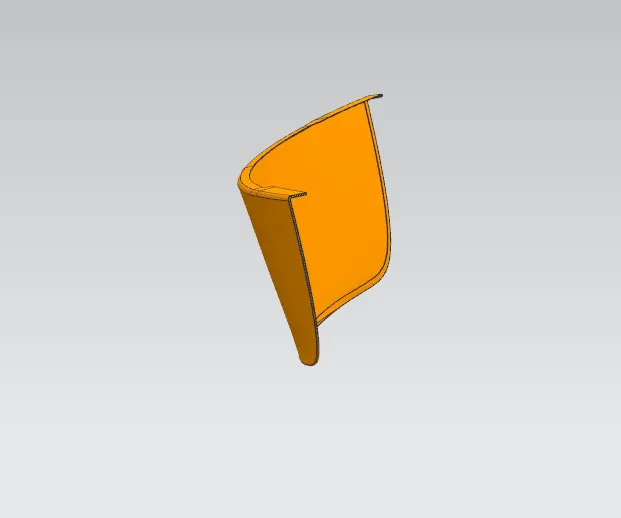
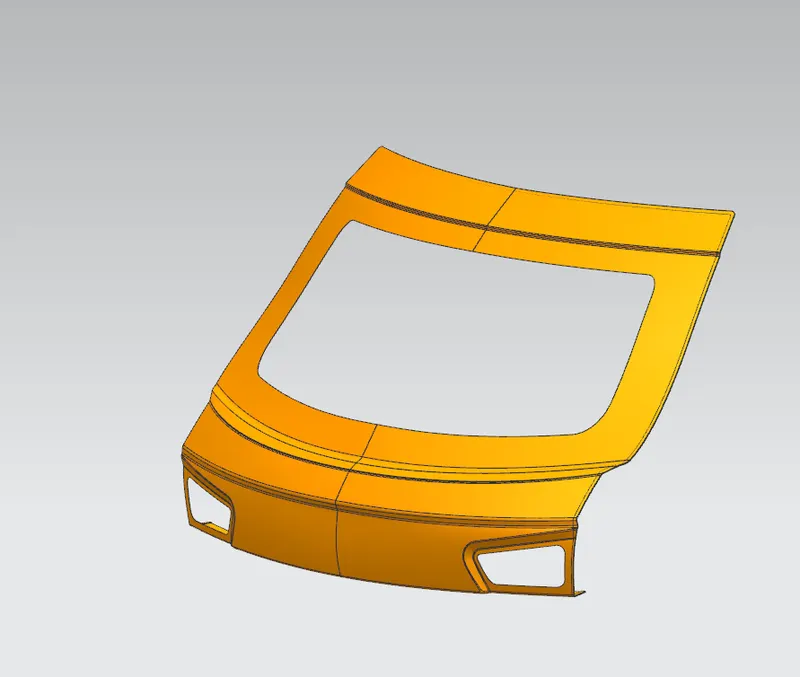
The outer panel of the back door is similar to other BIW components where it is the aesthetic part of a vehicle. The coating provided is multi-stage which has the property of scratch resistance, rust prevention and smooth and attractive finishes. Theouter panel also has the provisions for the tail lamp, rear fog lamp and also has the provision for licence plate mountings. Most hatchback cars have the provision for a wiper motor.
DRAFT ANALYSIS:
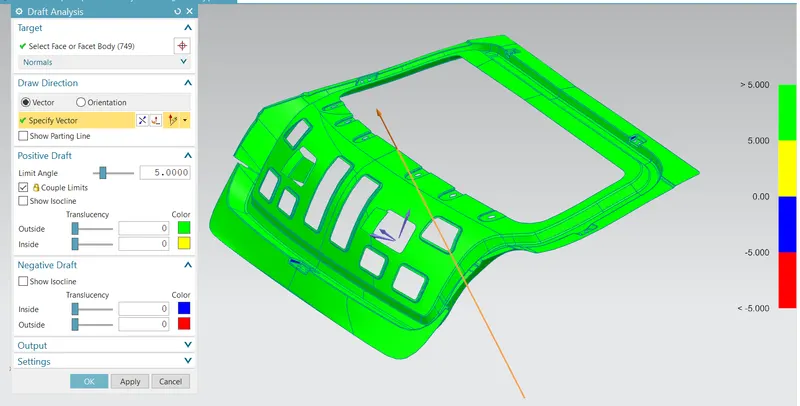
Before realising the drawing the design analysis team will do the draft analysis in order to check if the part designed can be easily removed or not. This type of analysis is done based on colour ranges identifying zones on the analysed element. Where the deviation from the draft direction at any point, corresponds to specified values.The minimum angle of 7˚ is considered for the analysis. Green colour on the parts that all face along the tooling direction has a positive draft angle greater than 7˚ and passed in the analysis. Whereas the red colour also indicates that there is a negative angle present, which is difficult to manufacture .
Tooling direction:
The backdoor is going to be manufactured by a deep drawing process. In this process, there are core and die. The core part follows the single straight path, the inclination angle of the core is called the tooling direction. In this design the tooling axis was created by drawing two lines which touch the opposite ends of the styling surface and the middle of it and then the bisecting line is drawn between these two lines to determine the tooling axis line. The tooling axis was created so that the manufacturing team could take the reference of this tooling axis and manufacture the part accordingly.
Conclusion:
Finally, all the components along with the design considerations and its intentions are modeled as NX-Cad. Then after they are assembled necessary panels, reinforcement and embossed.