Design of backdoor
NX BACK DOOR
OBJECTIVE:
- To design a BIW of Back Door from the given Class-A Surfacing. Inner Panel is designed and assembled with Hinge Reinforcements, Gas Stay Reinforcements, Wiper Motor Reinforcements, and Latch Reinforcements.
INTRODUCTION:
- In this project I have are designed a back door for a hatchback car where it is hinged at roof level. Similar to the hood and side doors, the backdoor is a swinging/closure commodity in a car. It consists of an outer and inner panel. It is a very critical component because of the passenger safety requirements.
- The Backdoor has to be designed by keeping in mind the space required for the luggage compartment as well as to accommodate the Latch and Striker motor and Wiper motor without compromising the strength of the component.
- Usually, Aluminum or Steel is used to manufacture the backdoor. While Aluminum backdoor is lighter in weight and has a lesser number of components (since the part is "cast", it has the varying thickness and therefore doesn't require reinforcements). Steel backdoor is "deep drawn" with uniform thickness, added reinforcements, and therefore is heavier. But the production n cost of the latter is lesser and therefore a Steel backdoor is priced lower.
DESIGN CONSIDERATION FOR BACKDOOR INNER PANEL:
- Rear Visibility.
- Support structures like hinges and gas stay.
- Mounts for wiper motor, tail lamps, and other wiring loops.
- Fit and clearances.
- Boot space
- Rear crash regulations and requirements.
- Sealing and its functions.
- Joining techniques like hemming, spot welding, Mastic Sealent, etc.
COMPONENTS OF BACKDOOR:
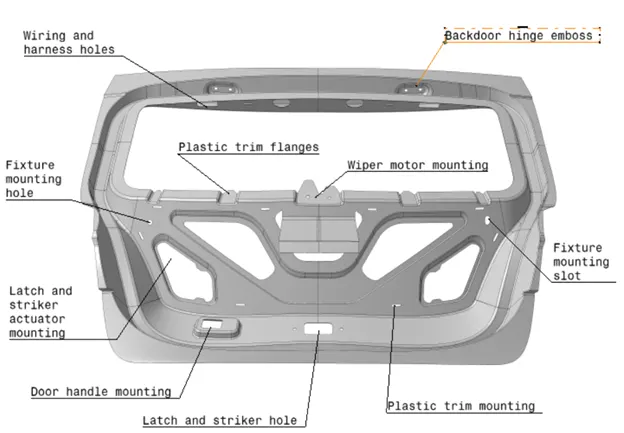
- Inner panel
- Outer panel upper
- Outer panel lower
- Hinge reinforcement LH
- Hinge reinforcement RH
- Gas stays reinforcement LH
- Gas stays reinforcement RH
- Wiper motor reinforcement
- Latch reinforcement
TYPES OF DOORS BASED ON WORKING POSITION
- Top Mounted Door
- Side-mounted Door
- Bottom Door
- Plastic trim
DIFFERENT SHEET METAL PROCESSES USED FOR MANUFACTURING THE BACK DOOR
DEEP DRAWING:
The metal deep drawing process is an effective method of manufacturing cups, cans, and other similar deep drawing products. The deep drawings have two main categories.
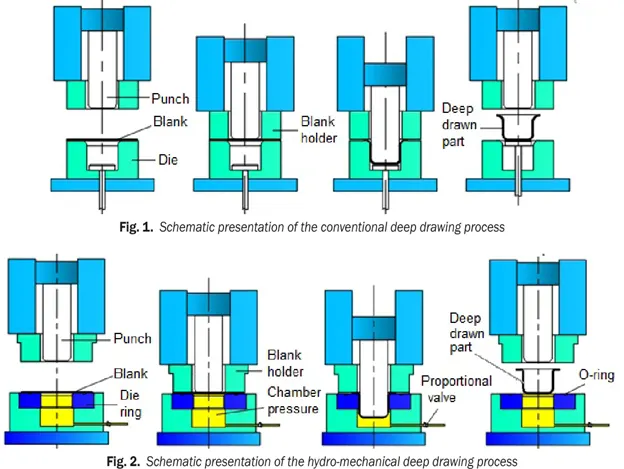
- FIRST- STAGE DRAWING: The blank shape of metal is placed on the die and in contact with the punch. When the metal specimen is a flat piece of sheet metal is used in forming and finishing the product. Initially, the punch moves in a downward direction. The outer rim of the blank is subjected to pure radial drawing (drawing toward vertical axes) between the die and blank metal. The metal becomes a bend and slides over the die and is also stretched between die and punch. The metal in the vicinity of the punch head and contact with it bend and slide over the radii and stretch over the punch head.
- REDRAWING: The components drawn from the first stage again it is redrawn convert into more depth to form a cup shape in the die and punch. The second stage of drawing is called redrawing.
EMBOSSING:
Embossing is a metal forming process for producing raised or sunken designs or relief in sheet materials by means of matched male and female roller dies, theoretically with no change in metal thickness or by-passing sheet or a strip of metal between rolls of the desired pattern. The metal sheet is drawn through the male and female roller dies producing a pattern or design on the metal sheet. Depending on the roller dies used, different patterns can be produced on the metal sheet.
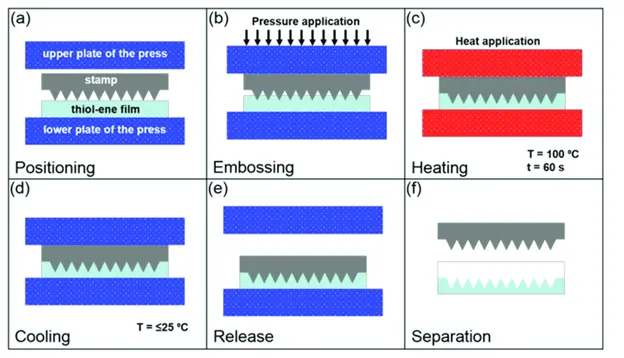
Materials commonly used in the metal embossing process include:
- Aluminum alloys
- Steel alloys
- Zinc
- Copper
- Galvanized steel
- Brass
- Cold-rolled steel
HEMMING:
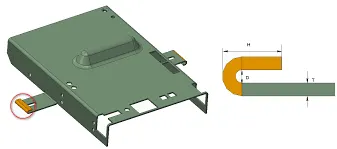
Hemming is a forming operation in which the edges of the sheet are folded or folded over another part in order to achieve a tight fit. Normally hemming operations are used to connect parts together, to improve the appearance of a part, and to reinforce part edges.
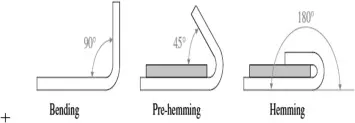
In car part production, hemming is used in assembly as a secondary operation after deep drawing, trimming, and flanging operations to join two sheet metal parts (outer and inner) together. Typical parts for this type of assembly are hoods, doors, trunk lids, and fenders.
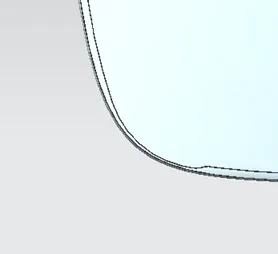
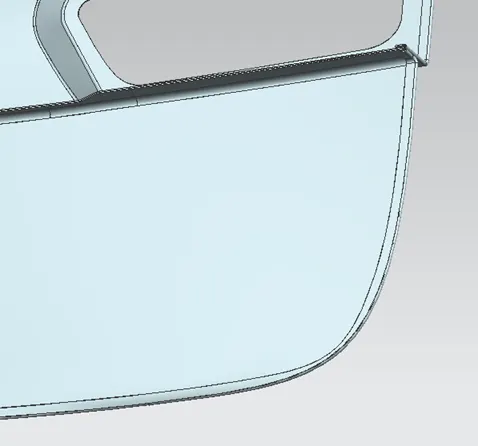
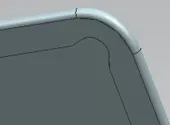
Relief is done to decrease the stress concentration along with the corners and also to decrease the clumping of metal along with the corners, this is done by trimming the corner by a minimum radius for the rollers to pass along smoothly
There are various types of hemming operations:
CONVENTIONAL DIE HEMMING: In conventional die hemming, the flange is folded over the entire length with a hemming tool.
ROLL HEMMING: In roll hemming, the hemming roller is guided by an industrial robot to form the flange.
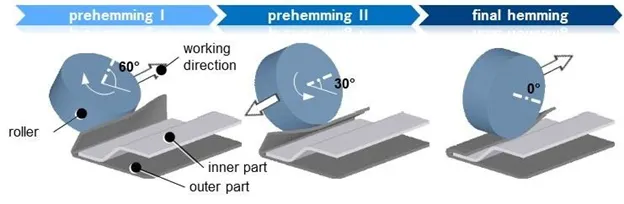
OPEN HEM: A Hem has a full round feature and a return flange. In the open hem, the bend angle is equal to 180 degrees.
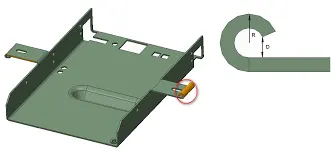
TEARDROP HEM: In teardrop hem, the bend angle is greater than 180 degrees
 .
.
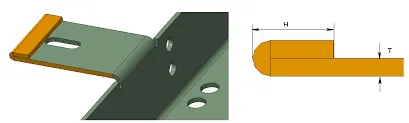
CLOSED HEM: Hems without any inside radius are called the closed hem. Closed hems are not recommended if the hem geometry is to be painted or if the material used is SST or Aluminum.
BLANKING:
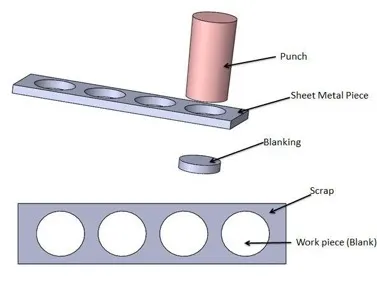
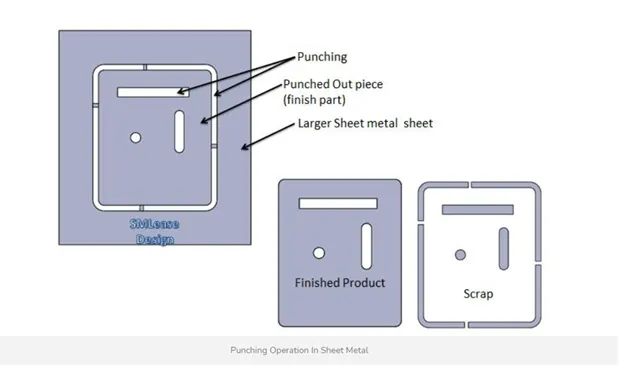
Blanking is a cutting operation of a flat metal sheet and the article punched out is known as blank. Blank is the required product of the operation and the metal left behind is considered as a waste.
PUNCHING:
It is similar to blanking only the main difference is that the hole in the required product and the material punched out from the hole is considered as waste.
DESIGN REQUIREMENTS:
HINGE MOUNTING:
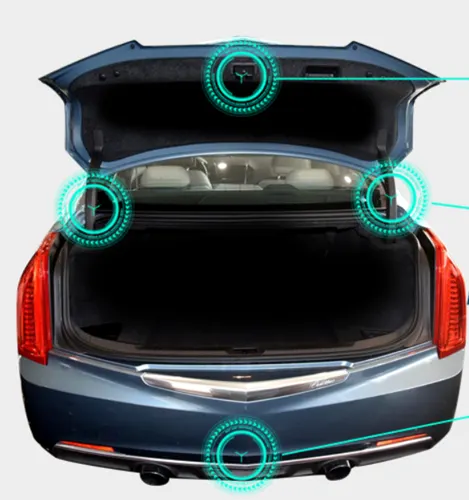
These are used in order to join or attach the door panel with the roof attachment in order to open and close the door properly.
A door mounting method for an automobile, comprising: a door hinge-attaching step of preparing door hinges each comprised of a body-side hinge arm, a door-side hinge arm, and a hinge pin which connects said hinge arms to each other for rotation relative to each other, and attaching said body-side hinge arms to an uncoated automobile body, a temporary door-fixing step of temporarily fixing uncoated doors to said door-side hinge arms of said door hinges.
GAS STAYS MOUNTING:
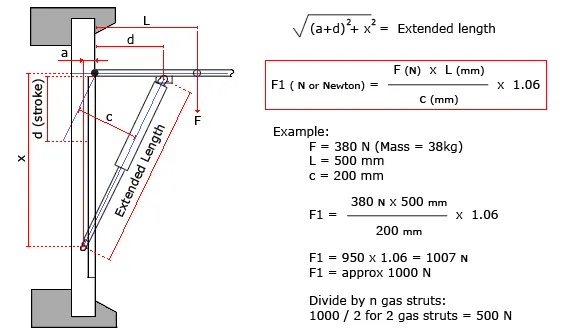
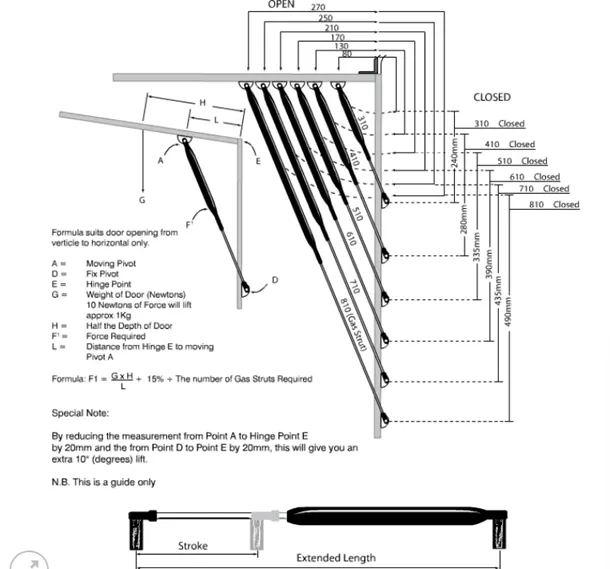
In order to attach the door and provide a provision to open and close it, gas stays are used to provide an opening and closing mechanism. This helps in opening the door with minimum effort.
WIPER MOTOR:
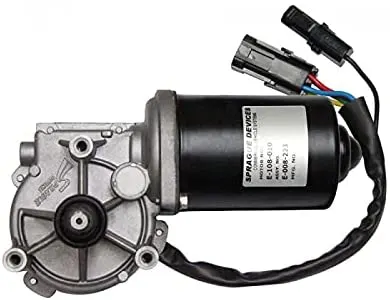
Windshield wipers are powered by a small electric motor, usually mounted on the firewall or under the cowl (the area under the windshield's base). The motor activates linkage that moves the wiper arms back and forth. On vehicles with a rear window wiper, a separate motor powers the one in the rear.
DESIGN PROCEDURE:
EXTRACTED GEOMETRY: Creates an associative copy of bodies, surfaces, curves, points, etc.
OFFSET SURFACE: This command is used to create a surface by offsetting a set of faces.
OFFSET CURVE IN FACE: It is used to offset curves along a selected face or surface.
TRIM SHEET: It is used to cut off a portion of the surface.
BRIDGE CURVES: Creates a tangent blend curve between two objects.
THROUGH CURVES: Creates a surface through multiple sections where the shape changes to pass through each section.
THROUGH CURVE MESH: Creates a body through a mesh of sections in one direction and guides in another direction where the shape fits through the mesh of curves.
SWEPT: Creates a body by sweeping a section along one or more guides using various options to control the shape along with the guide.
STUDIO SURFACE: Creates a surface using any number of sections and guide strings.
FACE BLEND: Add tangent blend faces between a selected set of faces with a specified radius.
PROJECTED CURVE: Using this command we can project curves, sketches, or points onto the selected face or plane.
LAW EXTENSION: It creates a law-controlled extension from the base sheet, dynamically or based on laws for distance and angle.
EXTEND SHEET: Extends the sheet body by distance or to the intersection with another body.
EDGE BLEND: Rounds the sharp edges of the faces with a specified radius.
EMBOSS: This command modifies the surface by projecting a section along a vector, with options for end cap location and shape.
CURVE ON SURFACE: It is used for sketching a spline on the face or surface.
MIRROR GEOMETRY: Copies the geometry and mirrors them across a plane.
SEW: Sew is used to combine sheet bodies by sewing their edges together.
THICKEN: It gives thickness to the surface body.
STRIKER AND HINGE ASSEMBLY:
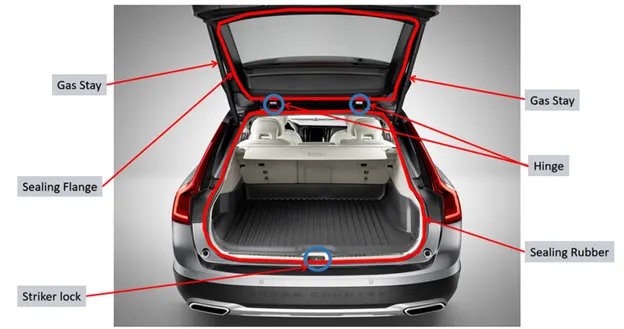
Latch & striker positioning and orientation is the critical stage in the backdoor design.
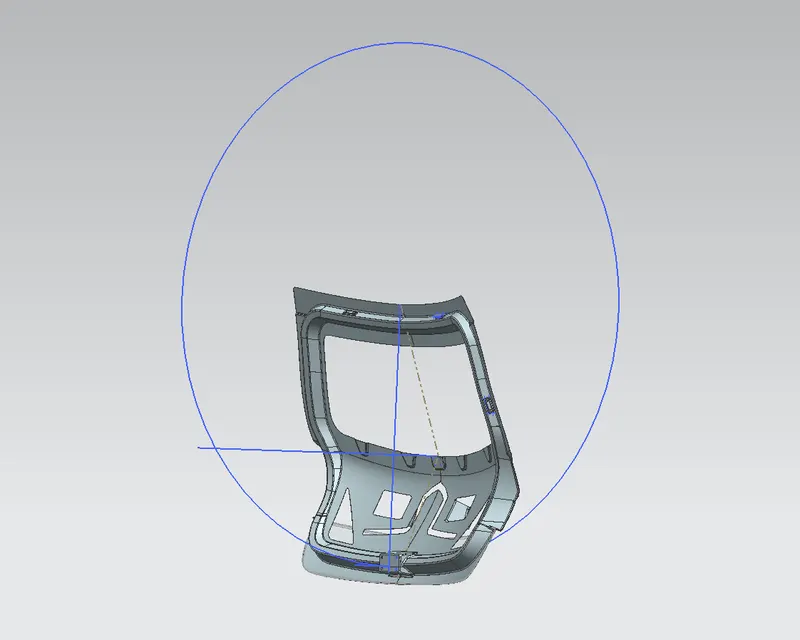
The positioning is done using sketching a circle with the center as the axis of the hinge which passes through the center of the striker. The latch striker must be perpendicular to the circle to get the correct orientation of the latch which enables it to close the backdoor perfectly.
DRAFT ANALYSIS:
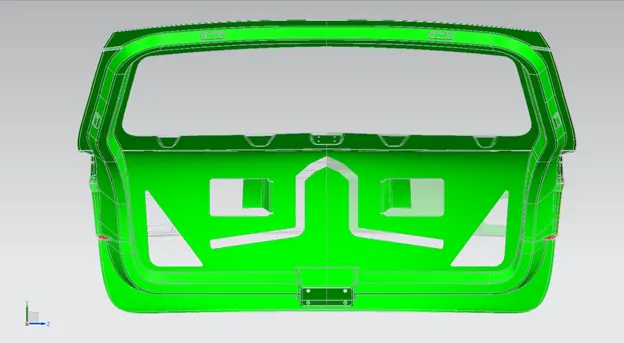
VIEWS:
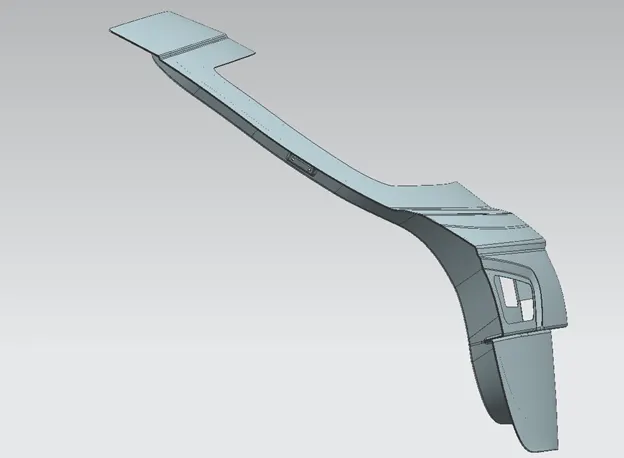
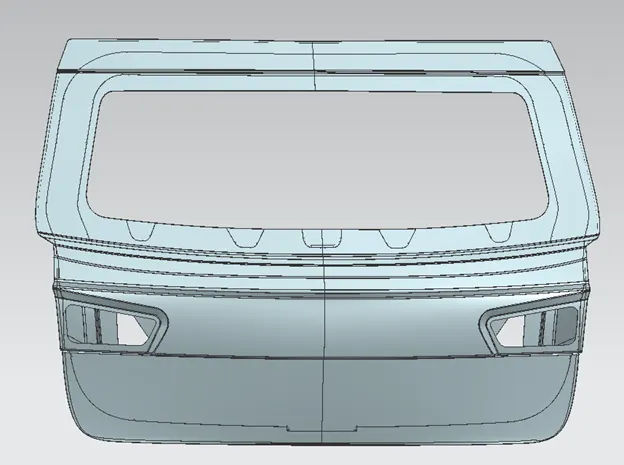
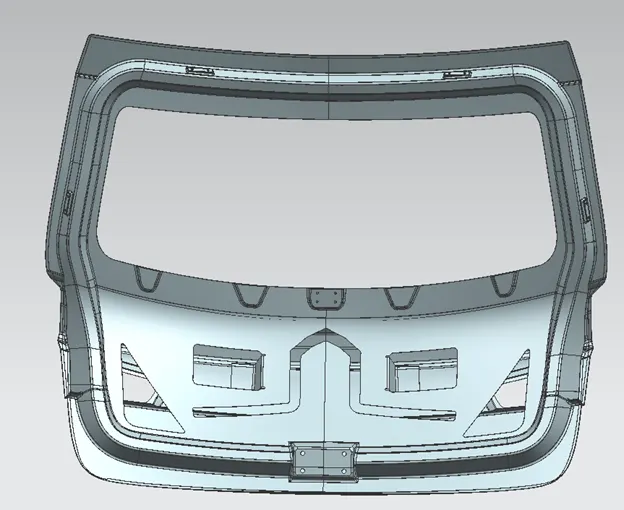
Conclusion:
Thus the back door is designed from the given styling surface with necessary reinforcement and emboss.