Design of backdoor
The back door, also known as the tail gate, provides closure to the vehicle at the rear side. It houses the boot where the luggage can be stored and encloses a rear windshield through which the driver can see towards the rear of the vehicle.
Following figure shows back door of a Maruti Suzuki CELERIO.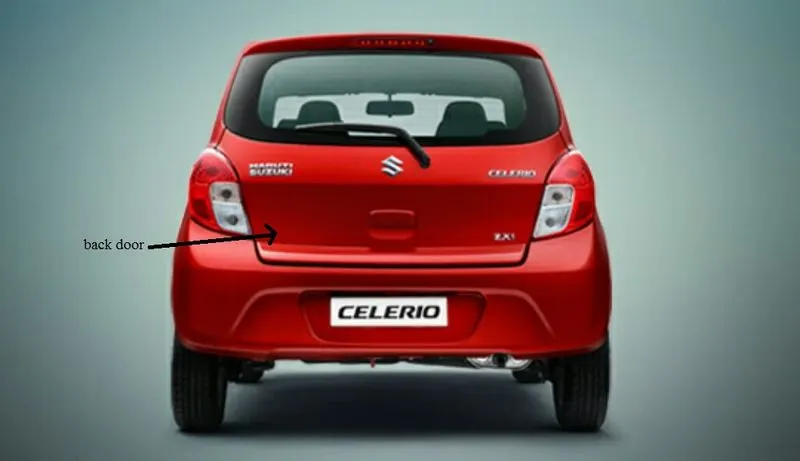
Generally, steel is made use of for manufacturing the door, but nowadays using Aluminum is also becoming very common.
When using steel the parts are stamped and reinforcements become necessary. Steel parts produced have uniform thickness and the parts are higher in weight. The minimum draft angle provided on steel parts should be a minimum of 7 degrees so as to allow deep drawing of the parts. The number of parts needed also increase. This results in having a reduced luggage space and a lesser visibility zone in the rear windshield. The cost of steel parts is lower.
With aluminium the part can be casted, reinforcements can be neglected and local thickness can be varied. Aluminium parts are lighter in weigth and contribute to having lesser number of parts in the assembly. The draft angle provided for deep drawing can be as less as 3 degress or even nil. This contributes to increase in luggage area and an increase in the visbility zone in the rear windshield. However, the cost accounted for manufacturing aluminium parts is high.
All major OEMs are incorporating the usage of Aluminium for back door owing to the benefits it provides.
The back door is subjected to various load cases apart from checking for manufacturing feasibilty by the CAE ( Computer-Aided- Engineering) team of an OEM. These load cases include: bend test, dent test, torsion test, assembly load case test, abuse case test and endurance test.
In the bend test, all 4 corners of the rear door: 2 hinges and 2 bottom corners are constrained and a force is applied on the door's center portion. There is a nominal value of force at which the the door should return back to its original position once the force applied is removed.
Torsional test includes constraining 2 hinge corners and latch & striker corner and then applying force to the bottom corners in directions opposite to each bottom corner. Observations are made to determine the force at which the part would return back to its original position after removal of the force.
Abuse cases includeoverslamming of the door or hanging on the door. The dent test includes applying force to the door and observing whether the door is returning back to its original postion after removal of the force.
Assembly load test includes applying force to the door assembly and checking whether the assembly returns back to its original postion after removal of the force.
Endurance test is the workablity test. Here, the door is opened and closed for certain number of cycles and behavior of the door is observed at the end of cycle.
The back door is supported in its open condition by means of a gas-stay. The following figure shows the gas stay with back door in open condition of a Maruti Suzuki SWIFT.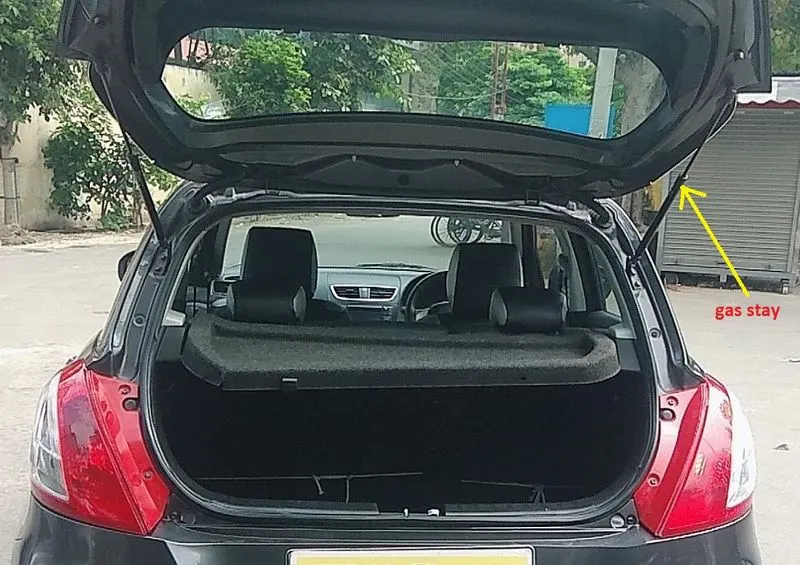
The back door can be opened either using a handle mounted on the back door or using a power button. The handle is connected to the latch and striker mechanism of the door. Using the handle the latch is activated and the door pulls out slightly therby allowing a person to open the back door. When using a power button, the door is opened using a power spindle.
The angle between the gas stay centerline and the door hinge centerline shoud be between 80 to 90 degrees. The distance between the end of gas stay near to the hinge and the hinge centerline should be between 60 to 90 mm. These parameters ensure that the kinematics of the door are good. If there is deviation in these values then the kinematics of the door would not be in proper condition. These values arise from the calculation of the force required to be exerted by the gas stay on the door to keep the door in open condition. This force is defined using weigth of the door, type of gas-stay and type of force exerted by the gas-stay.
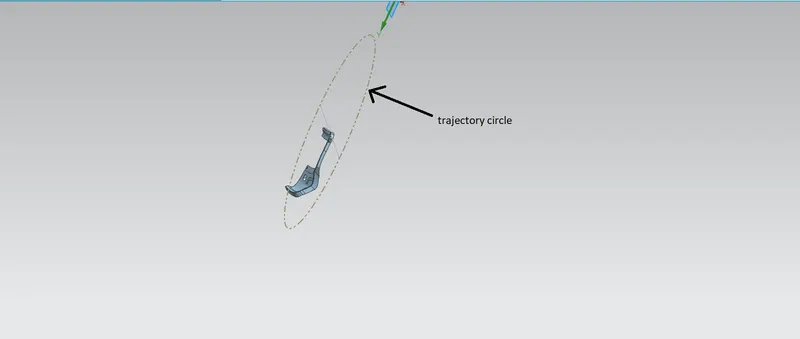
The latch and striker mechanism is positioned with respect to the position of the hinges of the back door. The latch and striker is so positioned that the lacth is perpendicular to the circle drawn with centre as the hinge and radius as the latch fixation point. This ensures that the door closes properly. This circle also gives indication of the door opening trajectory.
Result of challenge:
The inner panel of the door is designed using the door outer surface.
The postion of the latch and striker using hinge position is validated using the trajectory circle as shown in figure below.
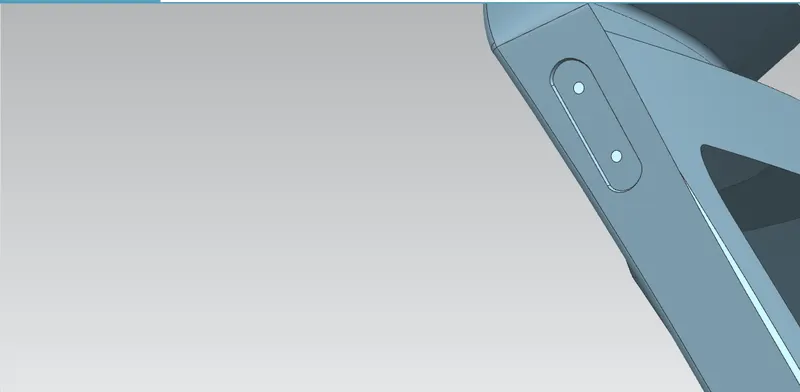
Reinforcements for latch and striker, door hinges, wiper motor, gas-stay have been provided on the inner panel.
The following figures show the reinforcements.
Latch and striker reinforcement: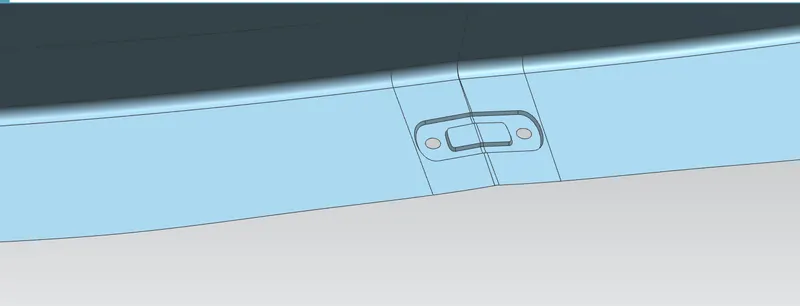
Wiper motor reinforcement: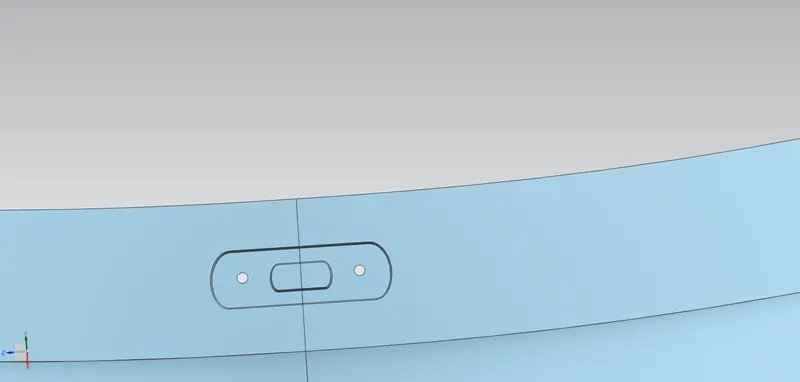
Gas-stay reinforcement:
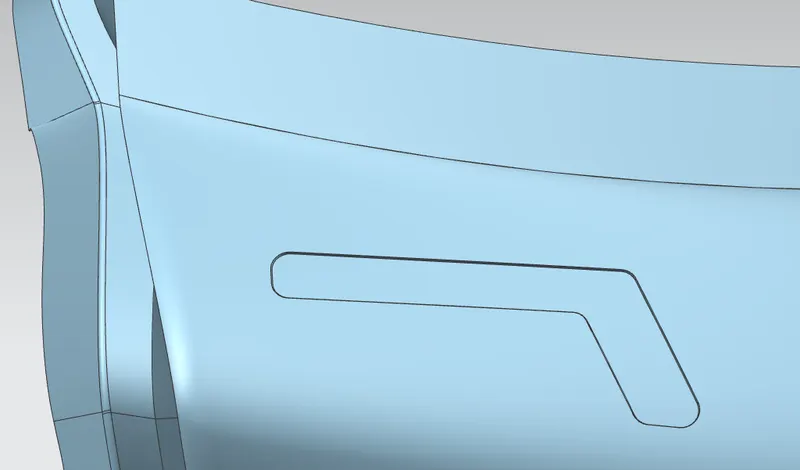
Following figure shows the emboss.
Mastic zones have been given on the back door to facilitate inner and outer panel joining as shown in figure below.
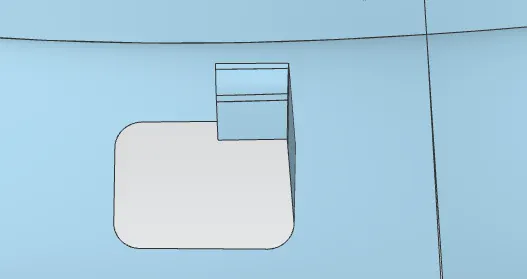
Also, cut-outs have been given to reduce weigth of the inner panel as shown below.