Design of backdoor
Definition Car Back Door :
The back door is a hinged door/tailgate at the rear of the vechicle. It may be used for loading and unloading cargo, or to get passengers in and out , in case there are seats presents at the rear.A car boot door, often referred to as a "trunk" in American English, is a hinged or lidded panel located at the rear of a car or other motor vehicle. It is designed to provide access to a storage compartment in the rear of the vehicle, typically used for storing items such as luggage, groceries, tools, and other cargo. The car boot door is usually mounted on hinges, allowing it to be opened and closed to access the storage area. It is an essential component of most automobiles and is used for both storage and safety purposes, as it can provide a secure and enclosed space for transporting goods and also acts as a protective barrier for the rear of the vehicle.
The Components Of Back Door :
- Inner Panel
The car boot door inner panel refers to the interior surface or lining of the trunk or boot door in an automobile. It is the part of the car boot door that is not visible when the door is closed, as it faces the interior of the vehicle's storage compartment. This inner panel is designed to provide structural support to the boot door, as well as to protect the interior components and wiring that may be located inside the door.
The car boot door inner panel can be made from various materials, such as metal, plastic, or fabric, depending on the specific design and purpose of the vehicle. It may also include features like insulation or carpeting to enhance the aesthetics and protection of the trunk or boot area. The inner panel is typically designed to fit snugly against the door's frame and may have various components attached to it, such as handles, latches, or release mechanisms for opening and closing the door. It plays a crucial role in the overall functionality, appearance, and safety of the car's trunk or boot area.
- Outer panel
The outer panel provides a protective barrier for the contents of the trunk or boot, shielding them from external elements such as rain, dust, and debris.The outer panel is typically designed to be durable and resistant to damage. It is made from materials like metal, plastic, or composite materials that can withstand the rigors of daily use and provide long-lasting protection.In some cases, the outer panel may include features like a third brake light, reflectors, or backup camera housing, which enhance safety by improving visibility to other drivers.
- Reinforcements
- Hinge mounting emboss LH and RH:
Car boot door hinge mounting refers to the process of attaching and securing the hinges that allow the boot or trunk door of an automobile to open and close. Hinges are critical components of the door, enabling it to pivot around a fixed point, which is typically located on the vehicle's body or frame.
- Gas Stay Or Tailgate Lifter: A tailgate lifter in a boot door is a mechanism or system designed to assist in the opening and closing of the trunk or boot door of an automobile. This feature is commonly found in modern vehicles and serves several purposes.A tailgate lifter, often referred to as a "power tailgate" or "automatic tailgate," provides convenience to the vehicle owner or user. With the press of a button on a key fob, inside the car, or on the tailgate itself, the mechanism automatically lifts the trunk door open or closes it without the need for manual effort. This is particularly useful when carrying heavy items or when your hands are full.
- Wiper Arm Motor Assembly Mounting Emboss:
A boot door wiper arm motor is a component of a motor vehicle's rear windscreen wiper system, commonly known as the "rear wiper." It is responsible for powering the movement of the wiper arm and blade on the rear windscreen or boot door, which is typically used to wipe away rain, snow, dirt, or debris, thereby enhancing visibility for the driver through the rear window.
- Boot Door Latch Mounting Emboss : Car boot door latch mounting refers to the process of attaching and securing the latch mechanism that is responsible for keeping the trunk or boot door of an automobile securely closed. The latch is a critical component that ensures the door remains shut during vehicle operation, preventing it from accidentally opening while the car is in motion.
Tooling Direction
"Car boot door tooling direction" typically refers to the specific orientation and arrangement of tools and equipment used in the manufacturing or assembly process of a car boot (trunk) door. This concept is relevant in the context of designing and organizing the tools, machinery, and processes involved in producing car boot doors efficiently and accurately.Ensuring that tools are aligned accurately with the car boot door is essential to maintain quality and precision during manufacturing. The tooling direction specifies the correct alignment and adjustment of tools to meet design specifications.
Latch Stiker Dirction Path
Car boot door latch direction path" typically refers to the specific path or route that the latch mechanism in a car's boot (trunk) door follows when it engages or disengages to securely close and open the door. This concept is relevant in understanding how the latch mechanism functions within the door assembly. The latch direction path is essential for ensuring the effective and reliable operation of the boot door latch.Proper alignment is crucial in determining the latch direction path. The components of the latch system, including the striker, catch, and any associated linkage or release mechanisms, must be aligned correctly to ensure the latch engages and disengages as intended.
Hemming
Car boot door hemming, or simply "hemming," refers to a specific manufacturing process in the automotive industry that involves folding and bending the edges of a metal panel used in the construction of a car's boot (trunk) door. The purpose of hemming is to provide a smooth and finished edge to the panel while also adding strength and rigidity to the door. In some cases, an adhesive or sealant may be applied to the folded edge to provide additional protection against moisture and to create a secure seal. This is especially important to prevent water from entering the boot area.Hemming is performed using specialized machinery and tooling designed for this purpose. These tools may include press brakes, dies, rollers, or other equipment that can fold and bend the metal.
Hemming Relief
While we do hemming we give corner relief at the turns of the part. because during manufacturing rolls cannot travel at the corner and it may create wrinkles while hemming at the corner. so we give a curvature for avoiding those problem.
Draft Analysis
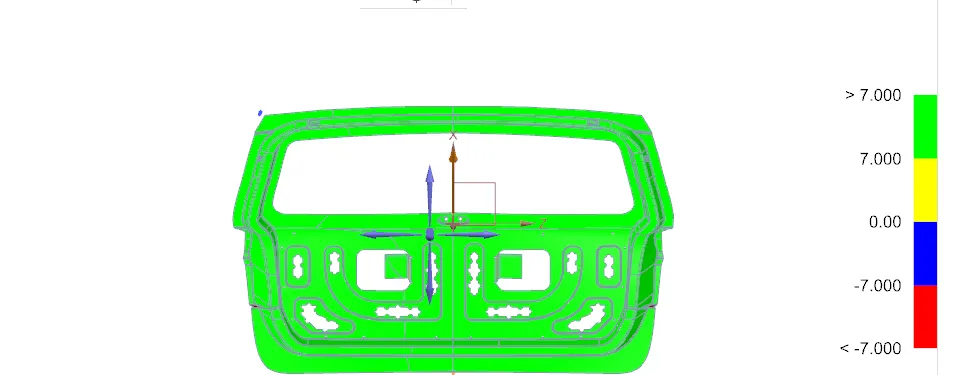
Here are the parts that are made as per the master section and also clearing the draft analysis. Draft analysis is done in NX software. We can change the draft angle and analyze is it clearing the required criteria. It is shown is different color zones. So identifying it will be easier. It will let us know that the part can be removed easily during manufacturing or not. Minimum draft angle of 7 Degree is considered for analysis. green color infer on the parts that all face along the tooling direction has positive draft angle greater than 7 degree and passed in analysis.
Design considerations:
- Rear visibility
- Boot space & accessibility
- Sealing Flange
- Support structures like hinges and gas stays.
- Mounts for wiper motor, tail lamps and other wiring loops
- Rear crash regulations
- Joining techniques such as hemming, spot welding etc.
- Gap and flush requirements
Thus we have designd the back door by the provided styling surface of a back door design, I have use and provided the necessary reinforcements and embosses for the backdoor design.
https://drive.google.com/drive/folders/1Zvatct9ZdxK7qAVOoDsk9lAgSQ46f8Px?usp=sharing