Design of backdoor
Design of Backdoor
Objective: To design the Back door of the car using the given Class ‘A’ surface.
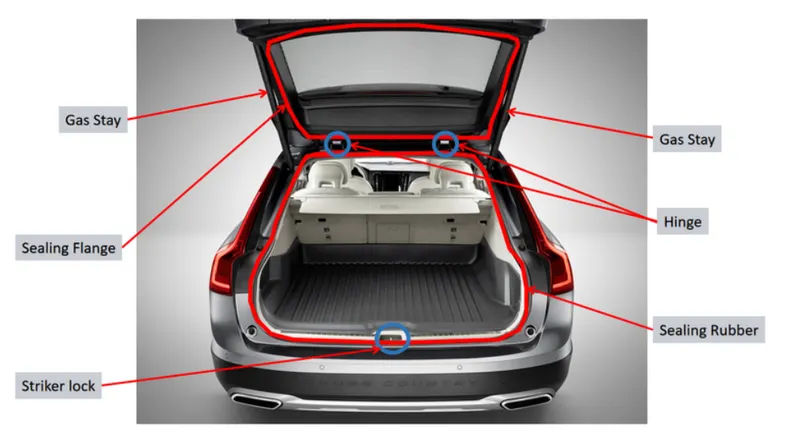
A Door is a hinged part which is used for entry and exit of the vehicles. Backdoors are one of the types of doors of the vehicle which is located next to the passenger seat and provides access to the luggage compartment. In most of the cars, these back doors are operated with the help of gas stay which in turn reduces the effort required to lift the door. Some luxury cars have a powered backdoor which in turn is driven by an electric motor. This kind of system is also called a powered trunk lid system hatchback or station wagons are sold as 3 doors or 5 doors models. In this case, the rear hatch is classified as a door this is because it enters the passenger compartment. The naming is mainly used in Europe countries. In case of safety, the backdoor design should meet the rear collision's safety requirement.
Functions of the Backdoor:
- It protects the occupants and luggage from getting damaged.
- It houses the assembly of the wiper motor, tail lamps, and other parts.
- It fills in as a section and leaves a point for baggage/travellers.
- It houses windshield glass which helps in rear visibility.
- Parking sensors and rearview cameras are mounted on them.
Types of Backdoor based on working positions:
The door or opening of a cargo area may be hinged at the top, side & bottom. If the door is hinged in the bottom it is called a tailgate.
- Top mounted
- Side-mounted doors
- Bottom type
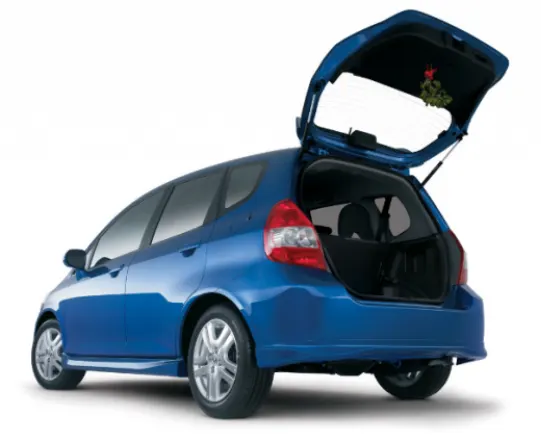
- Top mounted
These types of back doors are used in station wagons, pickup trucks and some other sports utility vehicles. Today’s modern cars use top-mounted tailgating systems which are both powered and also gas stay supported. These tailgates provide greater rear visibility compared to other types.
- Side mounted
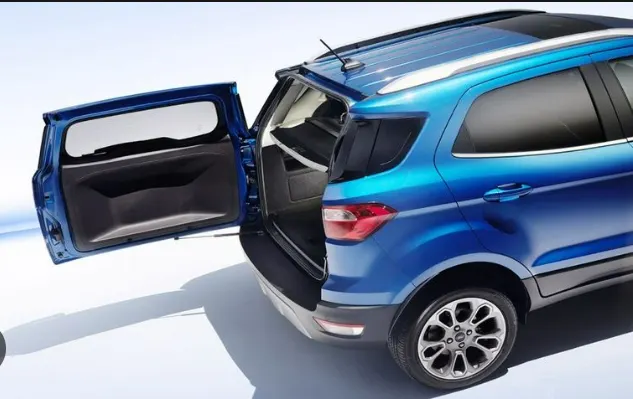
It is generally used in van-type MPVs, SUVs, and pickup truck vehicles. These side-mounted door/barn doors are a lot easier compared to top-mounted ones. These doors are generally small in size and can be easily accessed. These doors are more convenient for the goods handlers carrying lengthy objects, and long pipes where one door is kept open. It also saves accidental head impacts. It is a lot easier to load /unload things in vehicles having side-mounted doors.
- Bottom mounted
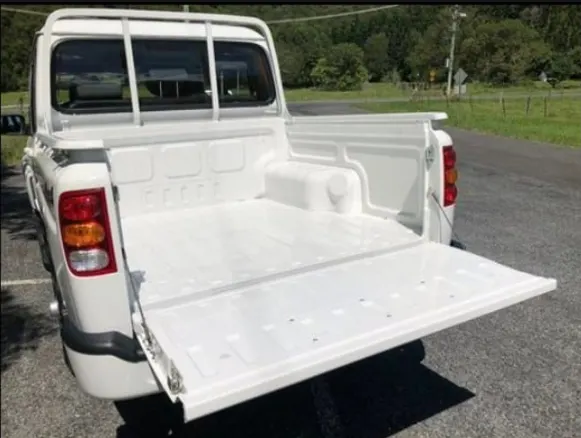
Bottom type or split type backdoor system is used in estate-type cars, pickup trucks and some luxury SUVs. These are the most convenient type of backdoor in which the bottom split is used as a support or even as a table for touring people.
Types based on Working Mechanism:
- Gas Stays type.
- Powered Lift system.
- Gas Stay type:
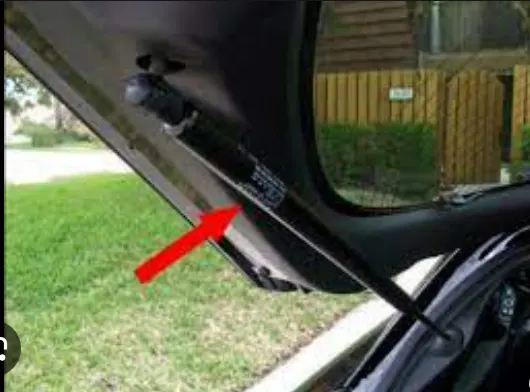
Gas Stay type backdoor is an ideal and most commonly used tailgate mechanism from lower segment car to luxury car segment. The ideal components of the tailgate consist of a hinge, door, gas stay and some rubber beadings for the sealing of the door.
- Powered Lift System:
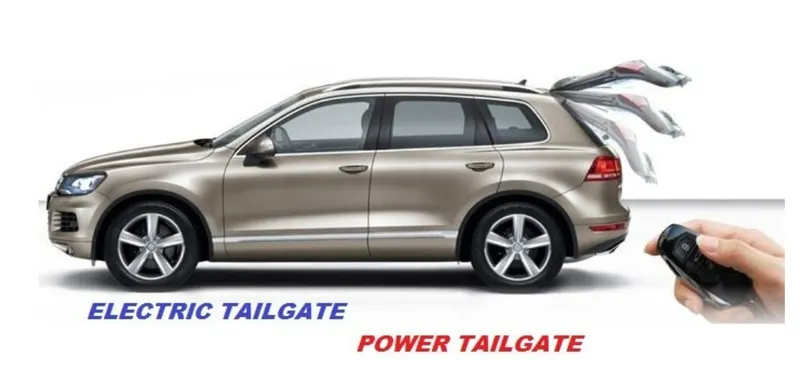
A power trunk lift system is another sophisticated way of trunk or liftgate opening mechanism which is to automatically open and close the trunk and release the latch by the touch of a bottom. The powered trunk Lift system consists of a power latch, anti-pinch switch, PTG assay, and PTG main switch. When the switch is pressed in the compartment or outside the power latch releases the latch and the entire backdoor is opened. The anti-pinch switch is located to avoid accidental hand insertion during the operation of the door.
Materials Selection:
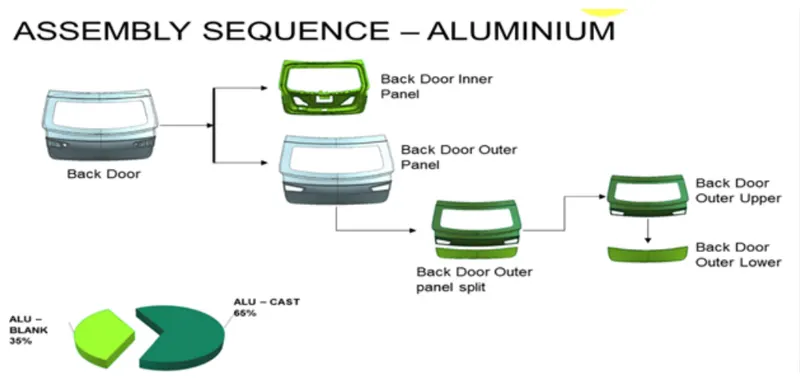
The choice of material assumes a significant part in deciding the general load of the secondary passage. Steel and aluminium are the most frequently used materials. The thickness of Steel is higher than Aluminum consequently adding more weight to the entryway. The material utilized in the assembling of the secondary passage relies on the spending plan of the vehicle, most minimal expense vehicles use steel as it is less expensive contrasted with Aluminum. Another thing to keep in mind is that, if cast aluminium parts are used instead of deep-drawn steel ones, there won't be any need for reinforcements. Instead, the car will weigh less by 5-10 kilograms, which will make it perform better. Likewise, the draft plot for projected parts is around 3 degrees while for profound drawn parts is around 7-10 degrees which helps in expanding the baggage/lodge space.
Manufacturing methods
As of late, there have been two ways to deal with diminishing vehicle weight. One is by utilizing material lighter than steel and the other is by upgrading the steel structure. Although the previous appears to be exceptionally powerful, it is pricey so it might just be utilized for a costly auto industry that is attempting to utilize steel, which isn't expensive and recyclable. Steel that is light can be made by improving the structure's performance or by using new manufacturing methods or by improving the structure's performance. One of the endeavours is the ULSAB (Ultra Light Steel Auto Body) idea.ULSAB recommends three primary weight decrease procedures, for example, hydro framing and the Designer Welded Clear (TWB).
A Tailor Welded Blank is a blank that is compared to two separate pieces of sheet metal that have been welded together before stamping. Tailor Welded Blanks allow the welding of different grades, different thicknesses or different corrosion coating together to give the properties needed in different areas, without increasing the number of tools needed to form the part and eliminating the fit ability concerns. They also allow a high degree of flexibility in designing parts and large blanks can be formed from much smaller sheets. The use of Tailor Welded Blanks would reduce the weight of the car. Having the ability to selectively place different thicknesses of material would result in weight reductions. An example of this production is the door's inner panel. The only strength requirement on a door inner is in the region where the hinges attach to the panel
The Different panels or regions are as follows:
- Inner Panel.
- Outer Upper Panel.
- Outer Lower Panel.
Backdoor Assembly:
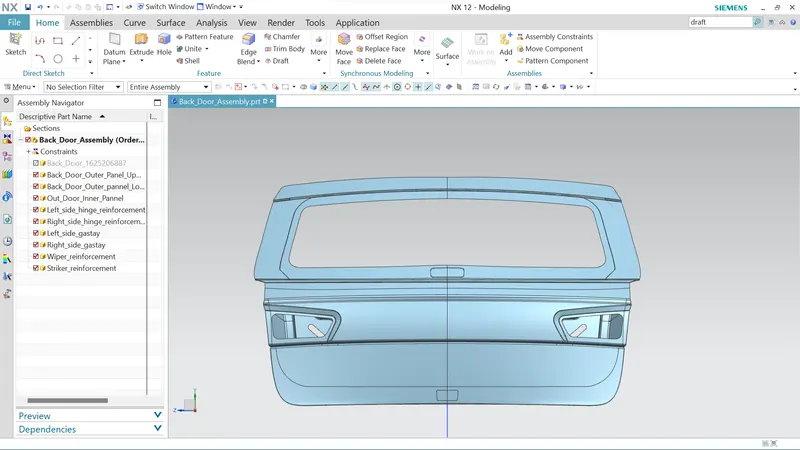
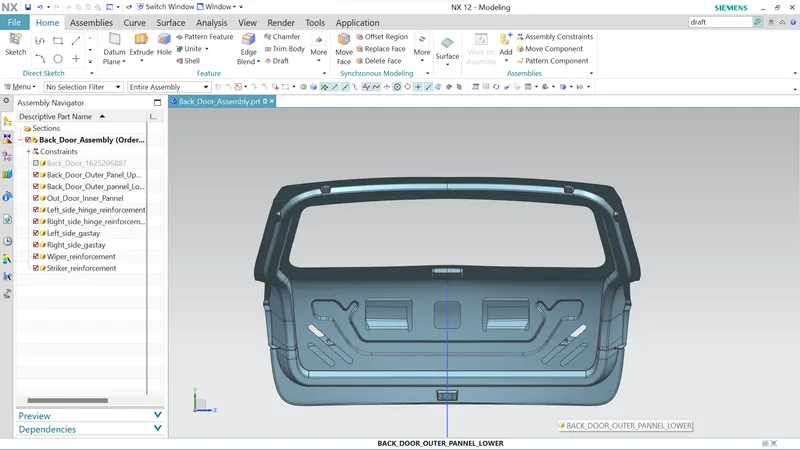
- Inner Panel
- Outer Panel.
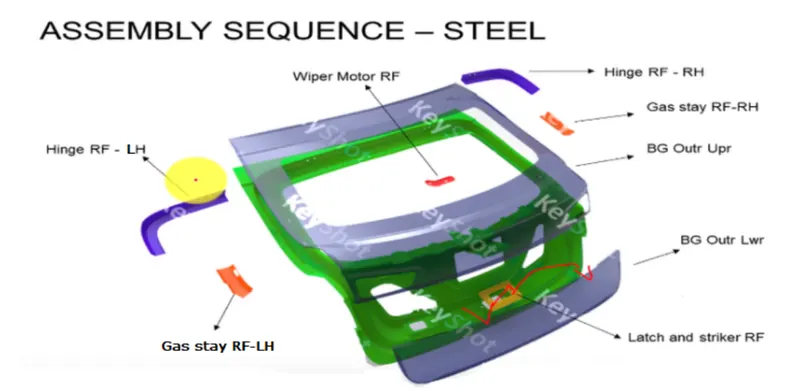
- Hinge Reniforcement.
- Gas Stay Reinforcement.
- Wiper Motor Reinforcement.
- Latch and Striker Reinforcement.
1. Inner Panel:
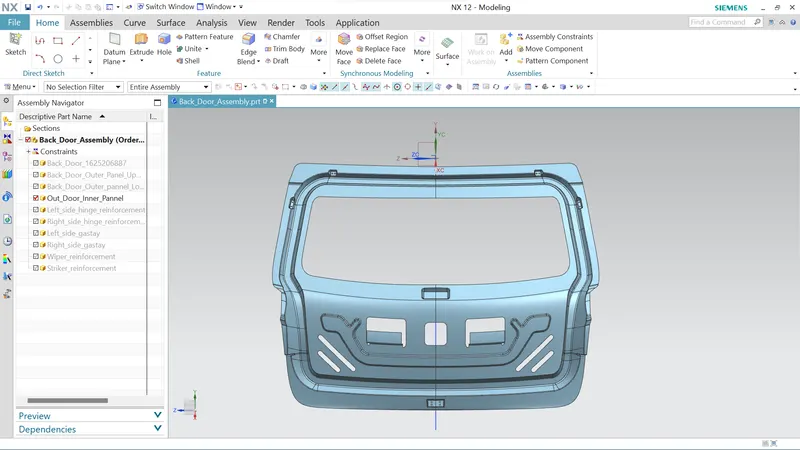
The inner Panel is a component which is used for strengthening the door and it is one of the most important components on which all accessories are mounted like hinges, glass guide channel, mounted trim, latch etc.., The possible method is the integration method. In the integration method, the part is stamped out of a single blank. This reduces the number of tools needed and the assembly cost and eliminates any fit ability problem.
2. Outer panel:
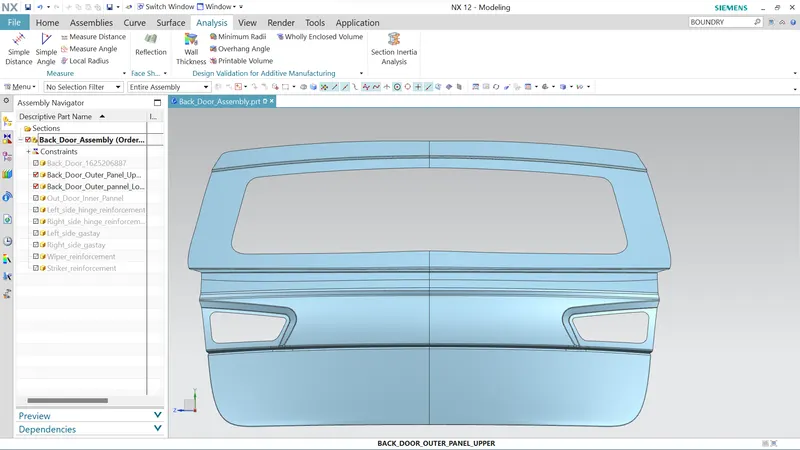
The Outer panel of the back door is similar to other BIW components where it is the aesthetic part of a vehicle. The coating provided is multi-stage which has the property of scratch resistance, rush prevention and smooth and attractive finishes. The Outer panel also has provisions for the tail lamp, and rear fog lamp and also has the provision for licence plate mountings. Most of the hatchback cars have the provision for wiper motors.
3. Hinge Reinforcement:
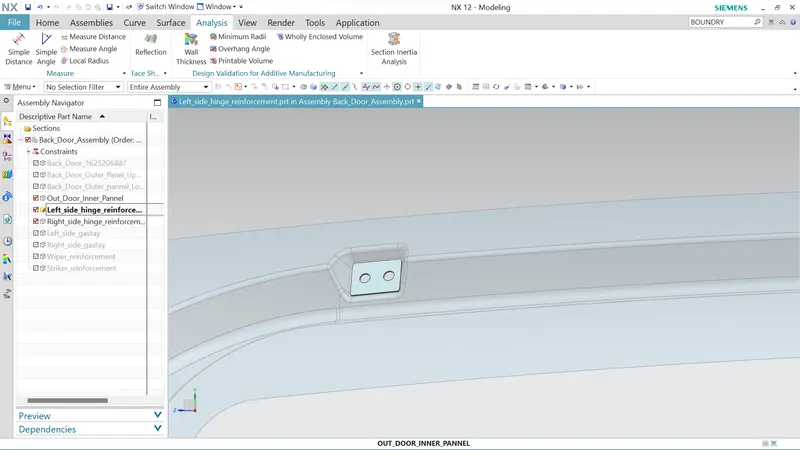
Hinges support the weight of the whole backdoor. Hence reinforcement is provided here too. Emboss is designed such that the hinges should be operated freely. The electrical wiring looms are through the holes along the periphery to keep them hidden.
4. Gas stay Reinforcement:
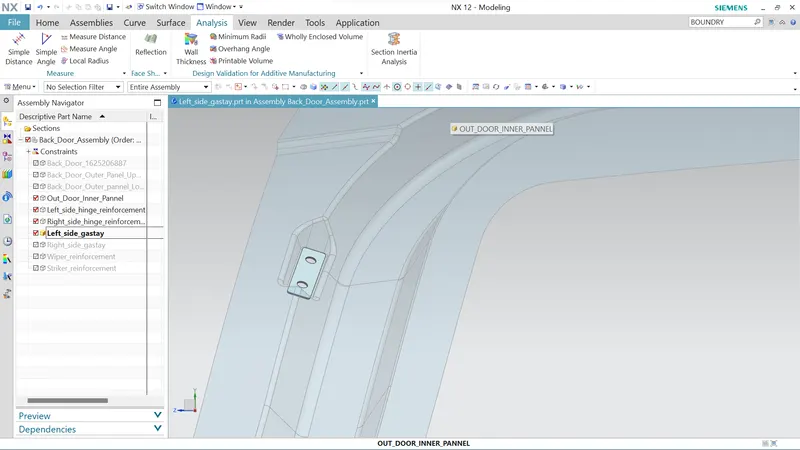
An angled or Diabolic emboss is provided for the gas stay mounts. The angle makes it easy to be machined and stamped. It is reinforced with a thicker sheet.
5. Wiper motor Reinforcement:
A dedicated space near the window is left for wiper motor assembly. A cavity is placed in the middle of the panel for the necessary components in the assembly as well as other accessories.
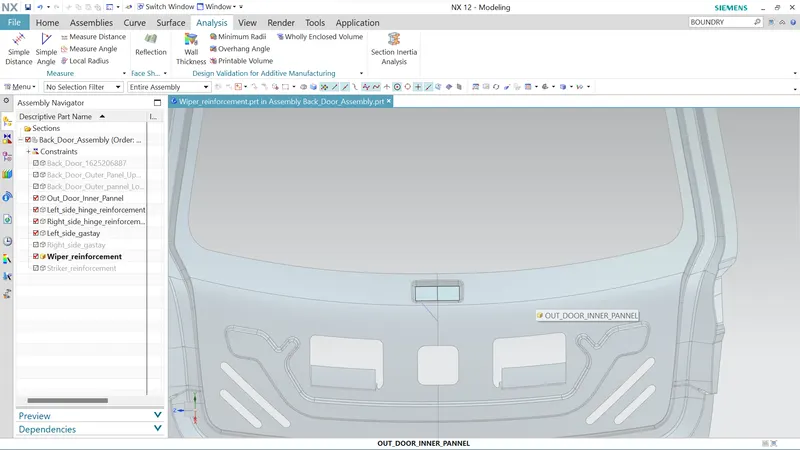
The holes or cavities are placed strategically to accommodate wiring looms, tail lamp mounts, and other accessories. Embosses help stiffen the panel and act like local reinforcements. Extensions are provided around holes which are attached to outer panels and acts are crumple zone elements in case of rear impacts.
6. Latch and striker Reinforcement:
At the bottom of the latch and striker assembly. Generally, a key-operated or automatic remotely controllable locking mechanism is used to keep the door closed and open. Another purpose of the emboss design is to distribute impact force towards hinges and latch assembly which are reinforced and can absorb them.
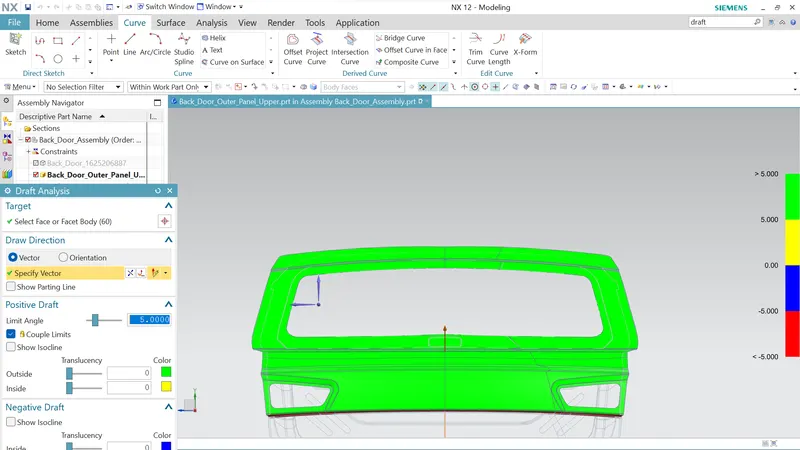
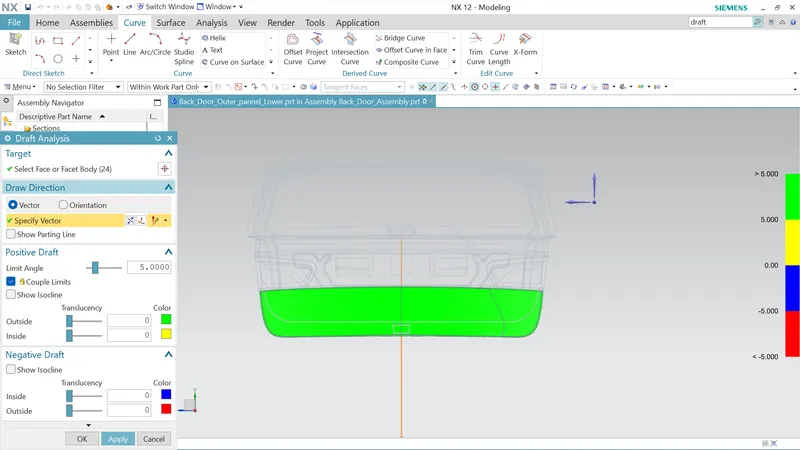
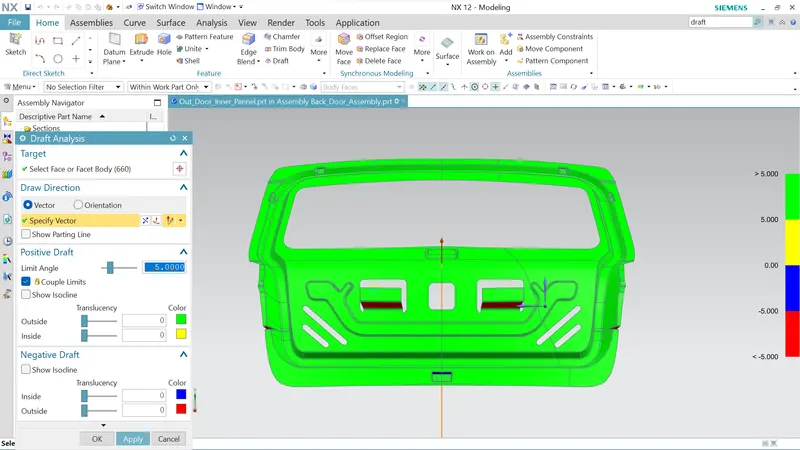
DRAFT ANALYSIS:
Final Assembly:
Conclusion:
By applying sheet modeling methodologies and accord of Designing Principles, the plan of the backdoor was finished utilizing NX computer-aided design