Design of backdoor
BACK DOOR DESIGN
Aim:
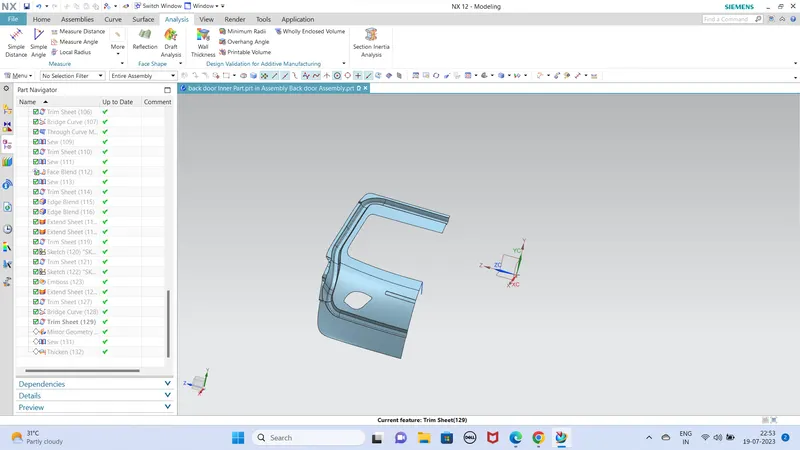
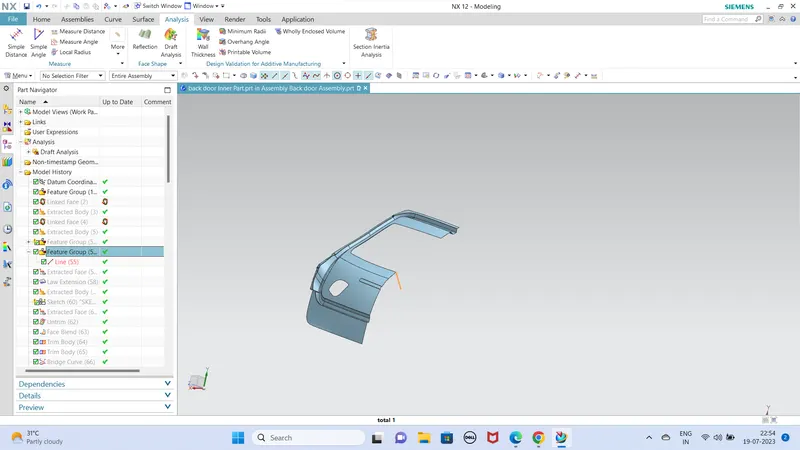
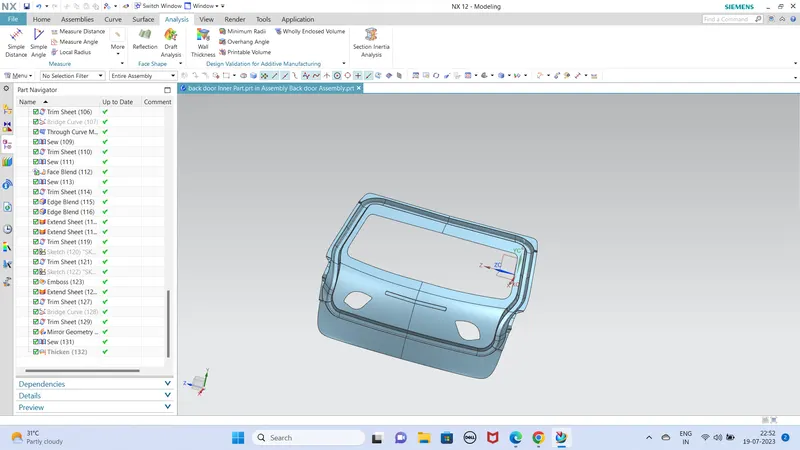
Use the provided styling surface to come up with a back door design, use appropriate design methodologies, and provide the necessary reinforcements and embosses.
INTRODUCTION
Back Door:
The term "back door" or "tailgate" simply refers to the opening and closing of the back of the vehicle.It encircles the back of the car.It gives access to a boot or boot that contains cargo.Hatchbacks, estates/station waggons and liftbacks are characterised primarily by a tailboard that hinges at the roof.A cargo area door or entrance may hinge from the top, side, or bottom.
This technique is typically carried out manually in the majority of autos. To open and close the tailboard with the car key, one must exit the vehicle.These days, automakers provide cutting-edge technologies like an automatic tailboard. The electronic closing and opening of the tailboard is handled by an automatic tailboard of a vehicle.
Manufacturing:
The manufacturing process of a car back door typically involves the following steps:
-
Design and engineering: The first step in the manufacturing process is designing the back door. This involves creating detailed drawings and using computer-aided design (CAD) software to create a 3D model of the door.
-
Material selection: Once the design is finalized, the materials for the back door are selected. Most car doors are made from steel, aluminum, or composite materials.
-
Cutting and forming: The selected material is cut to the required size and shape using a variety of cutting tools such as lasers, saws, and shears. The door is then formed using stamping machines and presses.
-
Welding and assembly: The individual parts of the back door are welded together using specialized welding techniques such as spot welding, TIG welding, and MIG welding. The door handle, locks, hinges, and other components are also installed at this stage.
-
Surface treatment and painting: The back door is then subjected to various surface treatments such as sandblasting, grinding, and polishing to remove any impurities and improve the surface finish. Finally, the door is painted using a robotic spray system to give it a smooth and durable finish.
-
Quality control: Once the door is painted and assembled, it undergoes a series of quality control checks to ensure that it meets the required specifications and standards. These checks include measurements, functional tests, and visual inspections.
-
Packaging and shipping: Finally, the finished back door is packaged and shipped to the car assembly plant, where it is installed on the vehicle.
Types of Back Door:
- Top Mounted door
- Side mounted door
- Bottom Mounted Door
Components to be designed:
- Inner panel
- outer panel
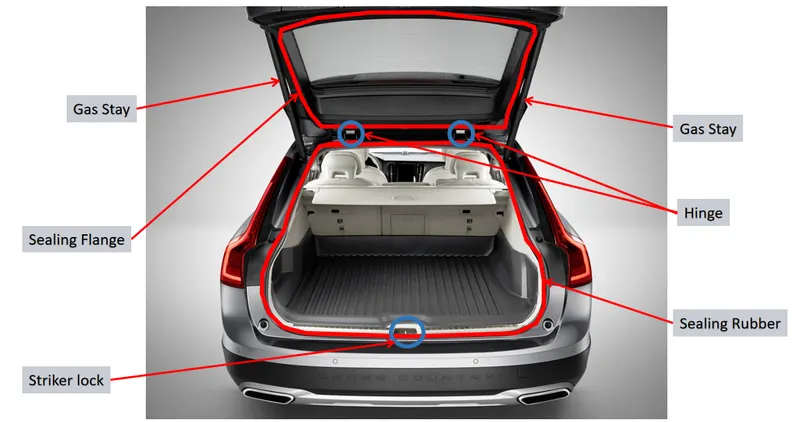
- hinge and its reinforcement
- wiper motor reinforcement
- latch & stricker and its reinforcement
Deep Drawing:
- A sheet metal blank is radially dragged into a forming die during the deep drawing process by the mechanical action of a punch. Thus, it is a shape change process that keeps the material. When the drawn part's depth is more than its diameter, the procedure is referred to as "deep" drawing.
Manufacturing:
The manufacturing process of a car back door typically involves the following steps:
-
Design and engineering: The first step in the manufacturing process is designing the back door. This involves creating detailed drawings and using computer-aided design (CAD) software to create a 3D model of the door.
-
Material selection: Once the design is finalized, the materials for the back door are selected. Most car doors are made from steel, aluminum, or composite materials.
-
Cutting and forming: The selected material is cut to the required size and shape using a variety of cutting tools such as lasers, saws, and shears. The door is then formed using stamping machines and presses.
-
Welding and assembly: The individual parts of the back door are welded together using specialized welding techniques such as spot welding, TIG welding, and MIG welding. The door handle, locks, hinges, and other components are also installed at this stage.
-
Surface treatment and painting: The back door is then subjected to various surface treatments such as sandblasting, grinding, and polishing to remove any impurities and improve the surface finish. Finally, the door is painted using a robotic spray system to give it a smooth and durable finish.
-
Quality control: Once the door is painted and assembled, it undergoes a series of quality control checks to ensure that it meets the required specifications and standards. These checks include measurements, functional tests, and visual inspections.
-
Packaging and shipping: Finally, the finished back door is packaged and shipped to the car assembly plant, where it is installed on the vehicle.
Types of Back Door:
- Top Mounted door
- Side mounted door
- Bottom Mounted Door
Components to be designed:
- Inner panel
- outer panel
- hinge and its reinforcement
- wiper motor reinforcement
- latch & stricker and its reinforcement
Deep Drawing:
- A sheet metal blank is radially dragged into a forming die during the deep drawing process by the mechanical action of a punch. Thus, it is a shape change process that keeps the material. When the drawn part's depth is more than its diameter, the procedure is referred to as "deep" drawing.
Manufacturing:
The manufacturing process of a car back door typically involves the following steps:
-
Design and engineering: The first step in the manufacturing process is designing the back door. This involves creating detailed drawings and using computer-aided design (CAD) software to create a 3D model of the door.
-
Material selection: Once the design is finalized, the materials for the back door are selected. Most car doors are made from steel, aluminum, or composite materials.
-
Cutting and forming: The selected material is cut to the required size and shape using a variety of cutting tools such as lasers, saws, and shears. The door is then formed using stamping machines and presses.
-
Welding and assembly: The individual parts of the back door are welded together using specialized welding techniques such as spot welding, TIG welding, and MIG welding. The door handle, locks, hinges, and other components are also installed at this stage.
-
Surface treatment and painting: The back door is then subjected to various surface treatments such as sandblasting, grinding, and polishing to remove any impurities and improve the surface finish. Finally, the door is painted using a robotic spray system to give it a smooth and durable finish.
-
Quality control: Once the door is painted and assembled, it undergoes a series of quality control checks to ensure that it meets the required specifications and standards. These checks include measurements, functional tests, and visual inspections.
-
Packaging and shipping: Finally, the finished back door is packaged and shipped to the car assembly plant, where it is installed on the vehicle.
Types of Back Door:
- Top Mounted door
- Side mounted door
- Bottom Mounted Door
Components to be designed:
- Inner panel
- outer panel
- hinge and its reinforcement
- wiper motor reinforcement
- latch & stricker and its reinforcement
Deep Drawing:
- A sheet metal blank is radially dragged into a forming die during the deep drawing process by the mechanical action of a punch. Thus, it is a shape change process that keeps the material. When the drawn part's depth is more than its diameter, the procedure is referred to as "deep" drawing.
- Punch, die, and binder are the stiff tools. After inserting the metal sheet blank, the plate holder in deep drawing closes.
- The sheet is then held in place between the binder and the die. This procedure slows the sheet's flow as it is drawn, preventing wrinkles from accumulating underneath the binder. The sheet is stretched over the die radius by the punch before being formed in the die. As a result, the punch force required to form is gradually raised all the way to the lower dead centre of the punch.
- Stretch forming achieves forming solely as a result of a reduction in sheet metal thickness, as contrast to pure deep drawing where there is no reduction in sheet metal thickness.
Embossing:
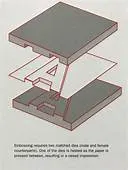
- Embossing is a process of creating a raised design or pattern on a surface. Embossing can be done on various materials including metal, paper, and plastic.
- Embossing a car back door, it is important to consider the material of the door. Car doors are typically made of metal or plastic, and the embossing process may vary depending on the material.