Design of backdoor
REPORT ON BACK DOOR DESIGN
AIM
The aim of this project is to design the back door outer panel, inner panel and renforcements from the given class-A surface. Also the objective of this design is to create the proper tooling axis and do draft analysis on both the class-A surface and final component.
INTRODUCTION
Back Door
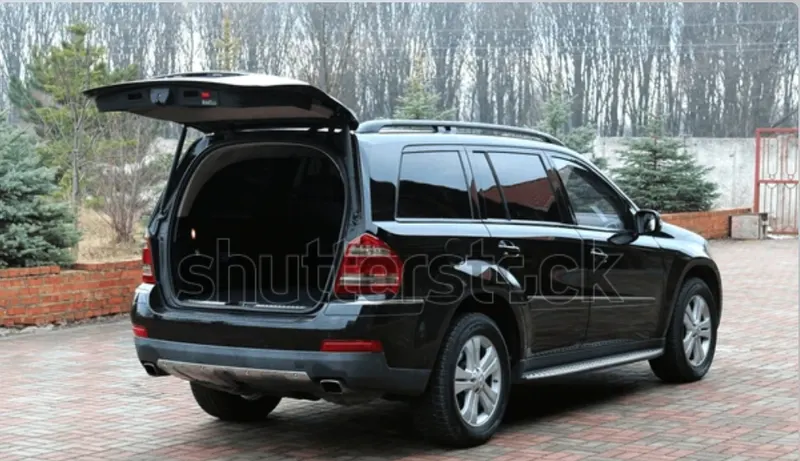
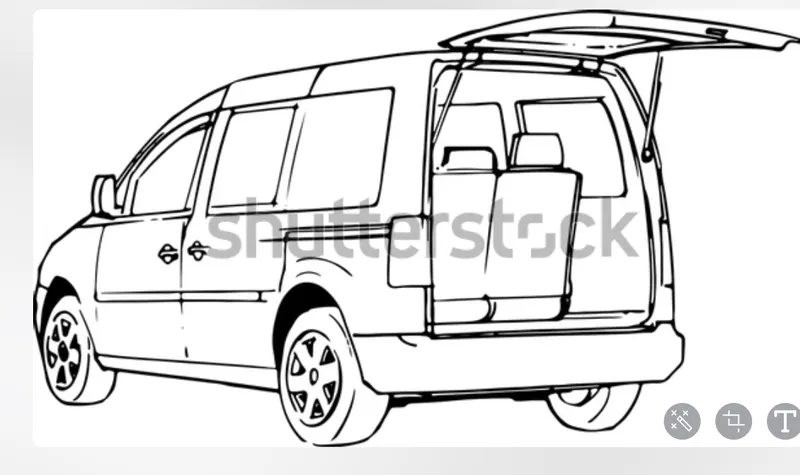
A door which is located at the rear side of a car which gives access for the boot space to store luggage, spare wheel etc. These doors can be operated manually or electric powered. In most of the luxury cars door is electrically operated.
In most cars, usually this process will be done manually. One has to get down the car to open and close the tail-gate with the car key.Nowadays, automobile manufacturers providing Advanced features like the automated tail-gate. An automatic tail-gate in the car will do the process of shutting and opening the tail-gate electronically.
Back Door Assembly:
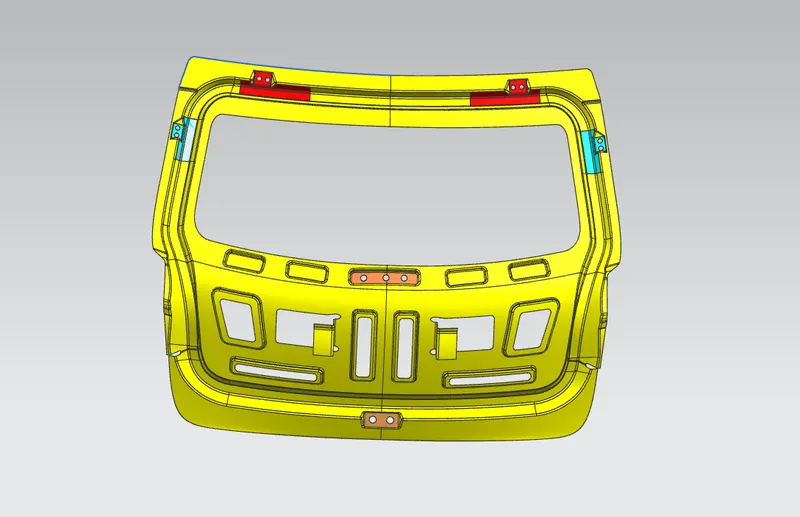
- Inner panel
- outer panel
- hinge and its reinforcement
- wiper motor reinforcement
- latch & stricker and its reinforcement
MANUFACTURING PROCESS
Deep Drawing:
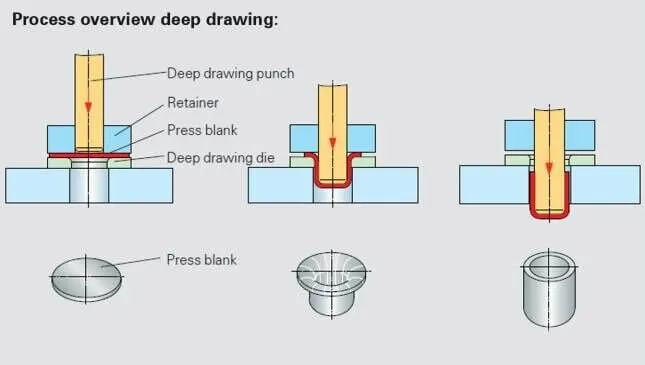
The metal deep drawing process is an effective method of manufacturing of cups, cans and other similar deep drawing products. The deep drawings having two main categories.
- First- stage drawing: The blank shape of metal is placed on the die and contact with the punch. When the metal specimen is flat piece of sheet metal used in forming and finish the product. Initially the punch moves in downward direction. The outer rim of blank is subjected to pure radial drawing (drawing toward in vertical axes) between die and blank metal. The metal become a bend and sliding over die and also stretched between die and punch. The metal in vicinity of punch head and contact with it bend and slide over radii and stretch over punch head.
- Redrawing: The components drawn from first stage again it is redrawn convert into more depth to form a cup shape in the die and punch. The second stage of drawing is called as redrawing.
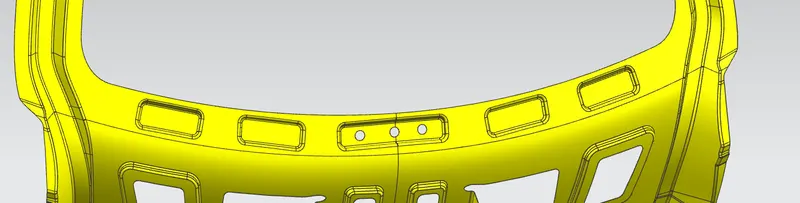
Embossing:
Embossing is a metal forming process for producing raised or sunken designs or relief in sheet materials by means of matched male and female roller dies, theoretically with no change in metal thickness or by-passing sheet or a strip of metal between rolls of the desired pattern. Metal sheet is drawn through the male and female roller dies producing a pattern or design on the metal sheet. Depending on the roller dies used, different patterns can be produced on the metal sheet.
Hemming:
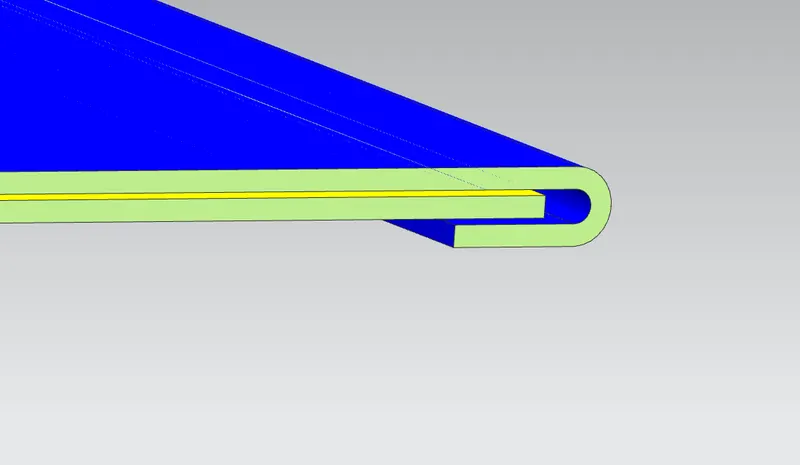
Hemming is a forming operation in which the edges of the sheet are folded or folded over another part in order to achieve a tight fit. Normally hemming operations are used to connect parts together, to improve the appearance of a part and to reinforce part edges.
In car part production, hemming is used in assembly as a secondary operation after deep drawing, trimming and flanging operations to join two sheet metal parts (outer and inner) together. Typical parts for this type of assembly are hoods, doors, trunk lids and fenders.
Blanking:
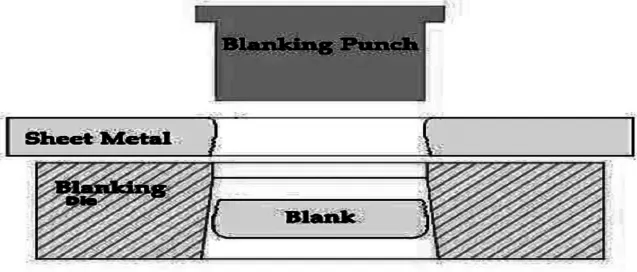
Blanking is a cutting operation of a flat metal sheet and the article punched out is known as blank. Blank is the required product of the operation and the metal left behind is considered as a waste.
Punching:
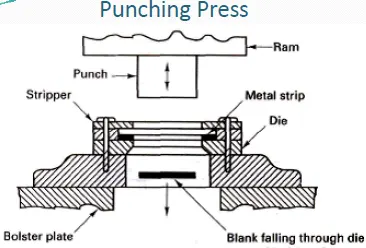
It is similar to blanking only the main difference is that, the hole is the required product and the material punched out from the hole is considered as a waste.
SPOT WELDING:
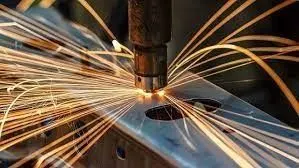
Spot Welding is a form of resistance welding also known as Resistance Spot Welding (RSW). Spot Welding involves using heat produced by resistance to an electrical current to join materials together. The current heats the materials to a point where they become malleable. The use of strong pressure bonds them together.
BACK DOOR DESIGN PROCEDURE
Parts of Back Door Design -
- Outer Panel
- Inner Panel
- Hinge Renforcements
- Gas Stay Renforcements
- Wiper Motor Mounting
- L & S Mounting
Outer Panel
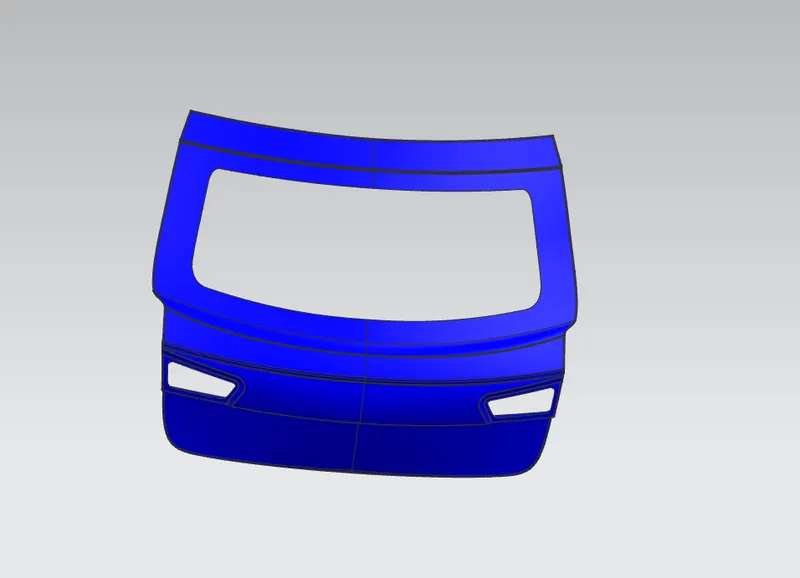
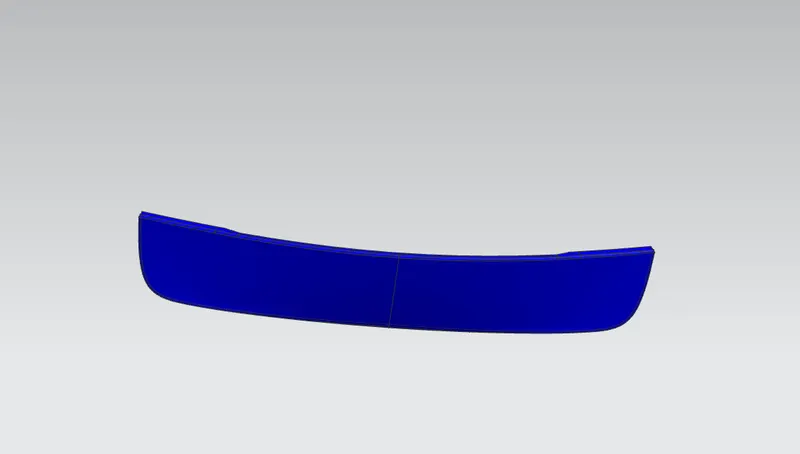
We create outer panel from given class-A surface. There are two parts of outer panel - Outer Panel Upper & Outer Panel Lower.
Inner Panel
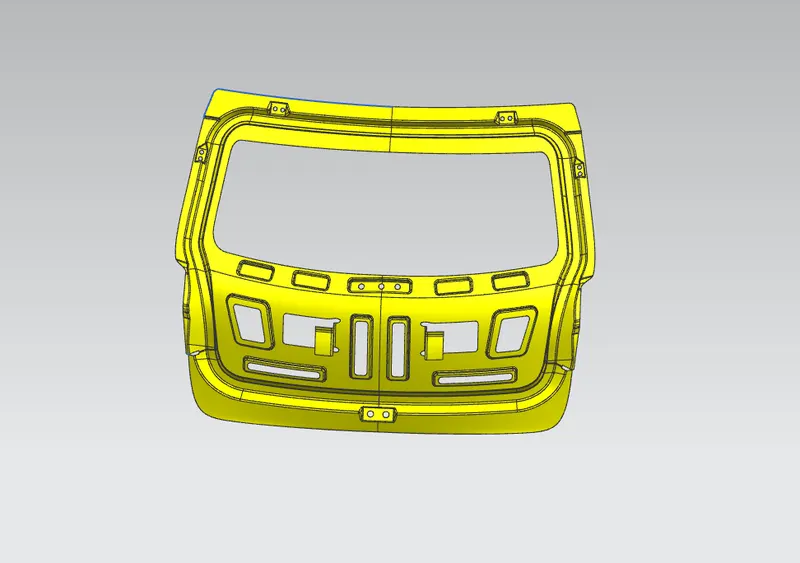
We create Inner Panel by offsetting the class-A surface and by creating the flanges.
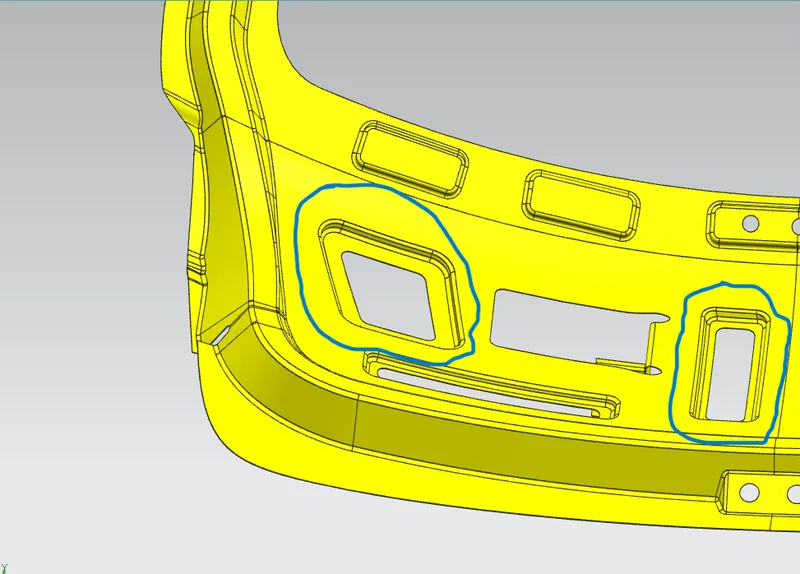
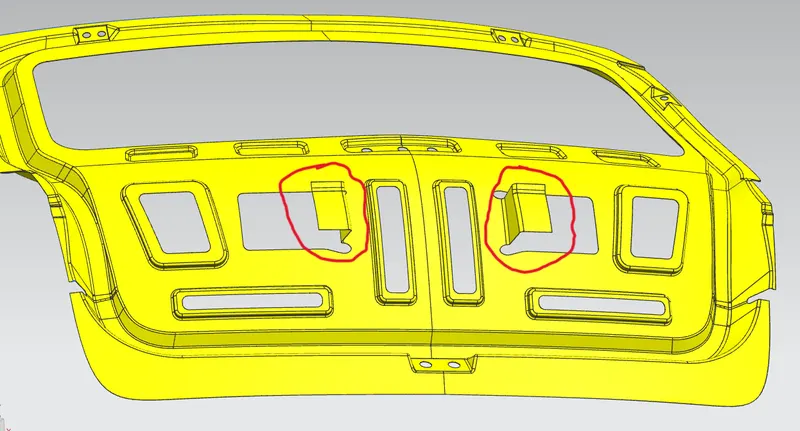
Cable Harness Gaps
I left some gap for Headlamp Harness and tailgate light harness cables.
Left some gap also dissipates the force when collision happens.
To much of cutting the inner panel leads to weaken the panel.
I & O Panal Mounting Flange ( Inner and outer )
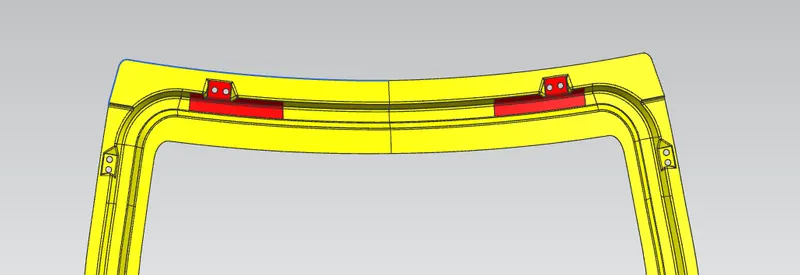
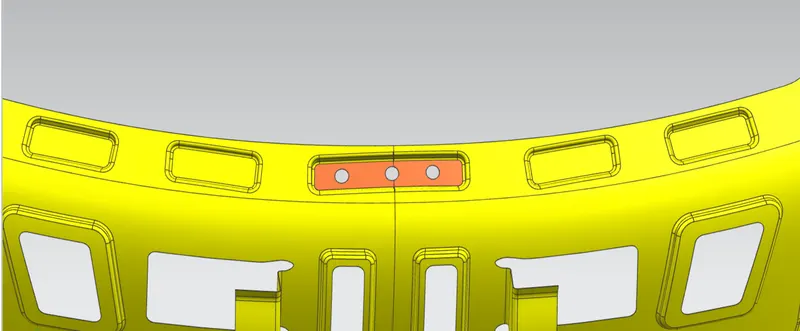
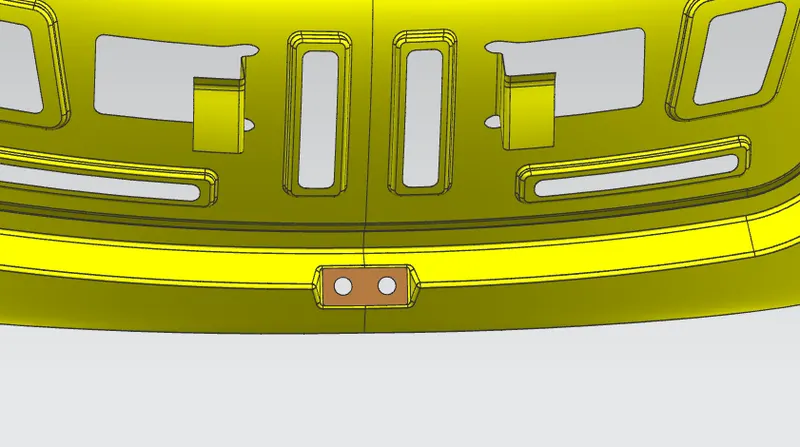
Highlighted red spot is the mounting portion of inner panel to the outer stylish part.
I provided two mounting Flanges for mounting the inner panel with outer stylish panel.
DRAFT ANALYSIS:
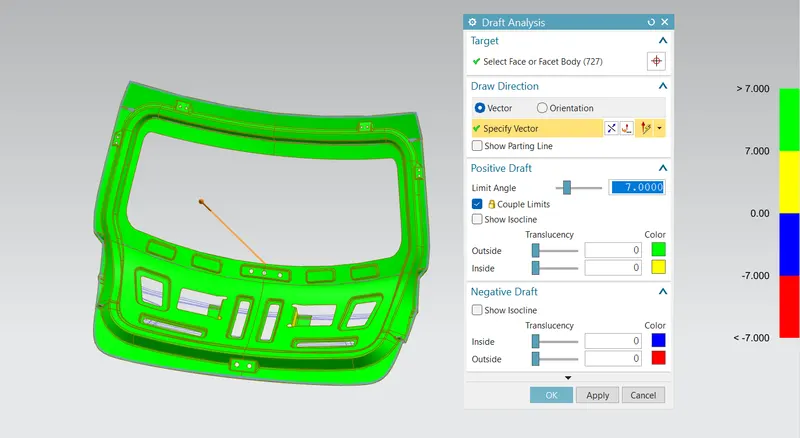
Draft analysis of inner panel is carried out through the tooling direction only.Only the green areas are acceptable and i worst cases yellow regions are accepted but the blue and red regions are never accepted.
REINFORCEMENT
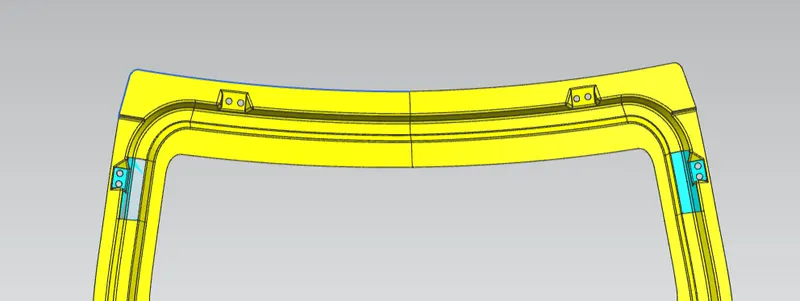
Vehicle Door reinforcement structures as provided to reduce impact in collisions. In one embodiment, the structure is to include a lower reinforcement panel configured to mount to a vehicle chassis and an upper reinforcement panel welded to the lower reinforcement panel wherein the deflection of a front deformable wall of the upper reinforcement panel is configured to trigger deflection of rear deformable wall of the lower reinforcement panel.
Hinge Renforcements
Gas Stay Renforcements
Wiper Motor Mounting Renforcement
L & S Mounting Renforcement
Inner Panel with all Renforcements -
CONCLUSION
We discussed about the Back Door outer panel, inner panel and renforcements. we also discussed about the different manufacturing process for the component. Then we create the renforcements for the inner panel and also do the draft analysis.