Design of backdoor
AIM :
The provided styling surface to come up with a back door design, use appropriate design methodologies, and provide the necessary reinforcements and embosses.
INTRODUCTION :
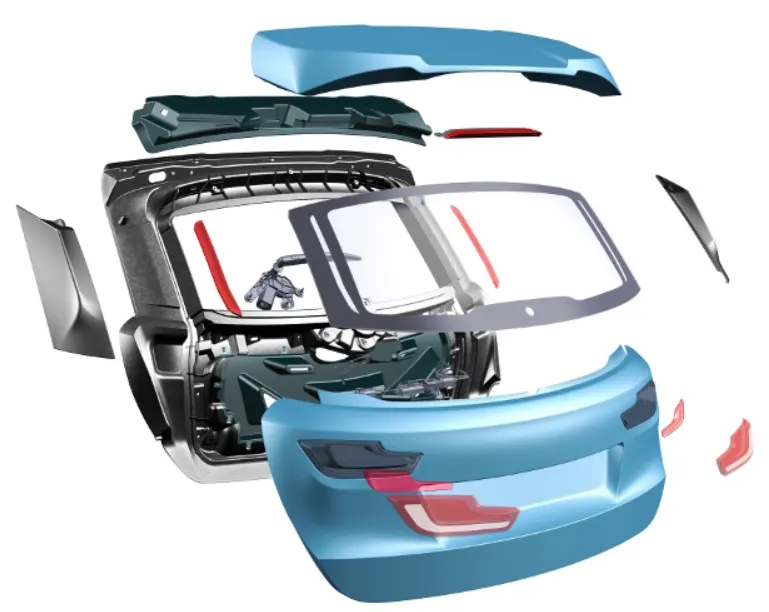
It is a hinged board or door at the rear of the vehicle.Back Door is also referred as 'Hatch' or 'Tailgate' or 'Trunk-lid' or 'Boot-door'. Its the rearmost part of the vehicle which gives access to the trunk and has mounts for tail lamps, hinges, wiper motor, gas stay etc.
There is some concern to maintain the reinforcement, draft Analysis and Section Analysis. If they pass these parameters back door will have the sufficient strength and reablity.
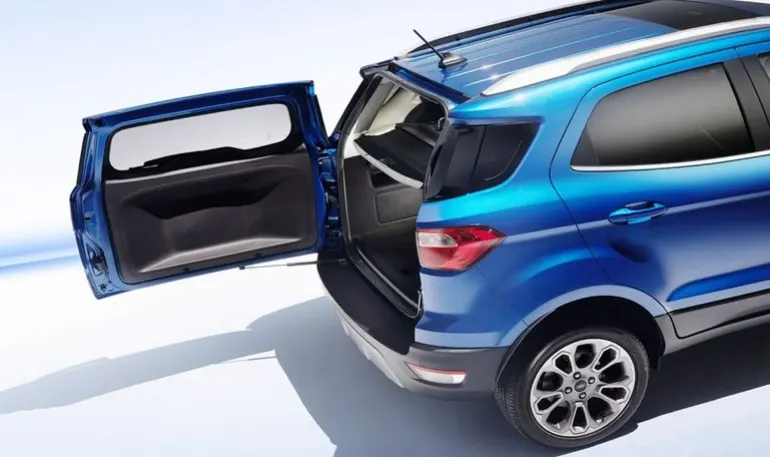
Types of doors based on working position,
- Top Mounted Door
- Side mounted Door
- Bottom Door
Top-Mounted :
This type of back doors is used in a station wagon, pickup truck and some of the sport utility vehicles. Today’s modern cars use top-mounted tailgating systems which are both powered and also gas stay supported. These top mounted tailgates provide greater rear visibility compared to side-mounted or bar doors which have canter pillars in it.

Side Mounted Doors :
From name itself we can itentify the meaning. Side-mounted doors are the one which is used in the van type MPVs, SUVs, pickup truck vehicles. These side-mounted doors or barn doors are a lot easier compared to top-mounted doors. These doors are generally smaller in size and can be easily accessed.
Types of mechanisms for Rear Door:
1. Gas stay
2. Powered lift system
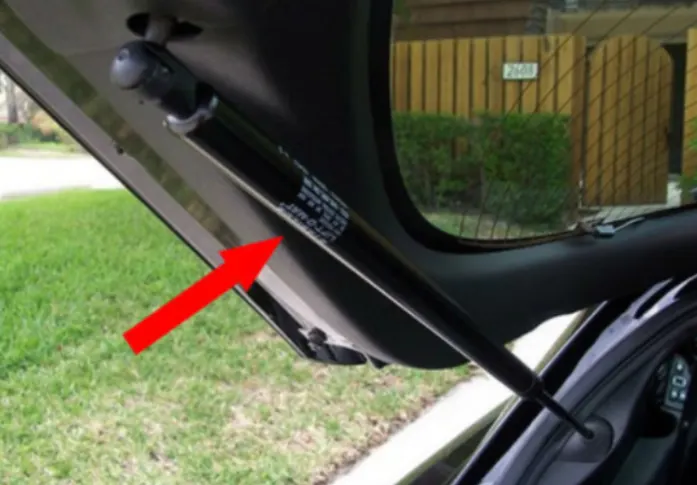
Gas stays:
Gas stay types backdoor/liftgate/tailgate is an ideal and most commonly used tailgate mechanism from lower segment car to luxury car segment. The ideal components of tailgate consist of a hinge, door, gas stay and some rubber beadings for sealing of door. Commonly inisde there was a Tension spring and Nitrogen gas with these help it can goes freely & easily the desire direction.
Powered lift system:
Power trunk lid system is another sophisticated way of trunk/liftgate opening mechanism which is to automatically open and close of the trunk/liftgate and release of the latch by the touch of a button. These type also similar to above one but one more additional addvantage we can operate with the help of remote control sytem. There was a PCB board with all control unit we have operate the rear door. Sensor type also available nowdays.

MANUFACTURING METHODS:
Recently, there have been two approaches to reducing automobile weight. One is by using material lighter than steel and the other is by redesigning the steel structure. Lighter weight material means Aluminum but it quiet costly compare to stell. Although the former seems very effective, it is very expensive so that it may only be used for an expensive automobile. Therefore, the automobile industry is trying to use steel, which is not costly and recyclable.
Lightweight steel can be achieved by improving the performance of the structure or adopting new manufacturing techniques. One of the efforts is the ULSAB (ultra-light steel auto body) concept.
ULSAB suggests three main weight reduction techniques such as hydro-forming and the tailor welded blank (TWB).
Components to create:
- Outer Upper Panel.
- Outer Lower Panel.
- Inner Panel.
- Gas Stay Reinforcement LH And RH.
- Hinge Reinforcement LH and RH.
- Striker Reinforcement.
- Wiper Reinforcement.
PROCEDURE: Standard
Different Sheetmetal processes used for manufacturing the Back Door
Deep Drawing:
The metal deep drawing process is an effective method of manufacturing of cups, cans, car side panel and other similar deep drawing products. The deep drawings having two main categories.
- First- stage drawing: The blank shape of metal is placed on the die and contact with the punch. When the metal specimen is flat piece of sheet metal used in forming and finish the product. Initially the punch moves in downward direction. The outer rim of blank is subjected to pure radial drawing (drawing toward in vertical axes) between die and blank metal. The metal become a bend and sliding over die and also stretched between die and punch. The metal in vicinity of punch head and contact with it bend and slide over radii and stretch over punch head.
- Redrawing: The components drawn from first stage again it is redrawn convert into more depth to form a cup shape in the die and punch. The second stage of drawing is called as redrawing.
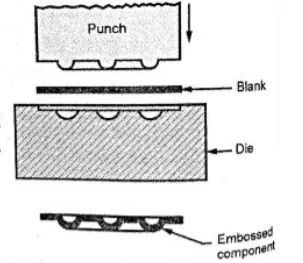
Embossing:
Embossing is a metal forming process for producing raised or sunken designs or relief in sheet materials by means of matched male and female roller dies, theoretically with no change in metal thickness or by-passing sheet or a strip of metal between rolls of the desired pattern. Metal sheet is drawn through the male and female roller dies producing a pattern or design on the metal sheet. Depending on the roller dies used, different patterns can be produced on the metal sheet.
In otherword Emboss are used to strengthen the weakness place even more better there is no change in thickness.
Hemming:
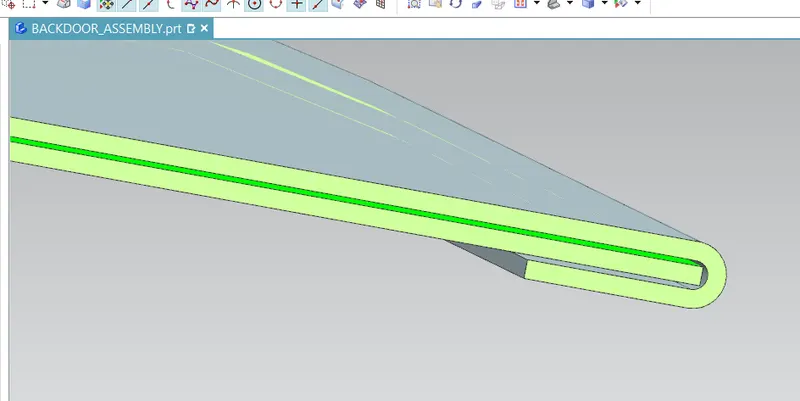
Hemming is a forming operation in which the edges of the sheet are folded or folded over another part in order to achieve a tight fit. Normally hemming operations are used to connect parts together, to improve the appearance of a part and to reinforce part edges.
In car part production, hemming is used in assembly as a secondary operation after deep drawing, trimming and flanging operations to join two sheet metal parts (outer and inner) together. Typical parts for this type of assembly are hoods, doors, trunk lids and fenders.
There are various types of hemming operations:
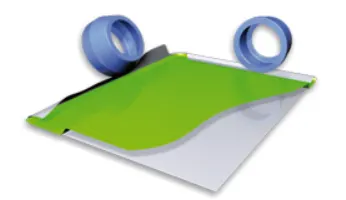
- Conventional die hemming: In conventional die hemming, the flange is folded over the entire length with a hemming tool.
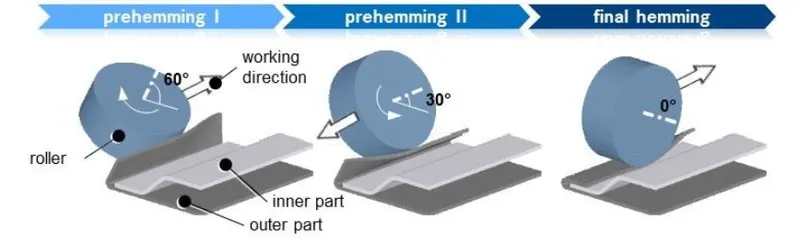
- Roll hemming: In roll hemming, the hemming roller is guided by an industrial robot to form the flange.
Open Hem: A Hem has a full round feature and a return flange. In open hem bend angle is equal to 180 degrees.
Tear drop Hem: In tear drop hem the bend angle is greater than 180 degrees.
Closed Hem: Hems without any inside radius are called as closed hem. Closed hems are not recommended if the hem geometry is to be painted or if the material used is SST or Aluminium.
Blanking:
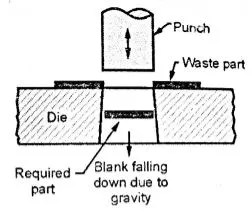
Blanking is a cutting operation of a flat metal sheet and the article punched out is known as blank. Blank is the required product of the operation and the metal left behind is considered as a waste.
Punching:
It is similar to blanking only the main difference is that, the hole is the required product and the material punched out from the hole is considered as a waste.
SPOT WELDING:
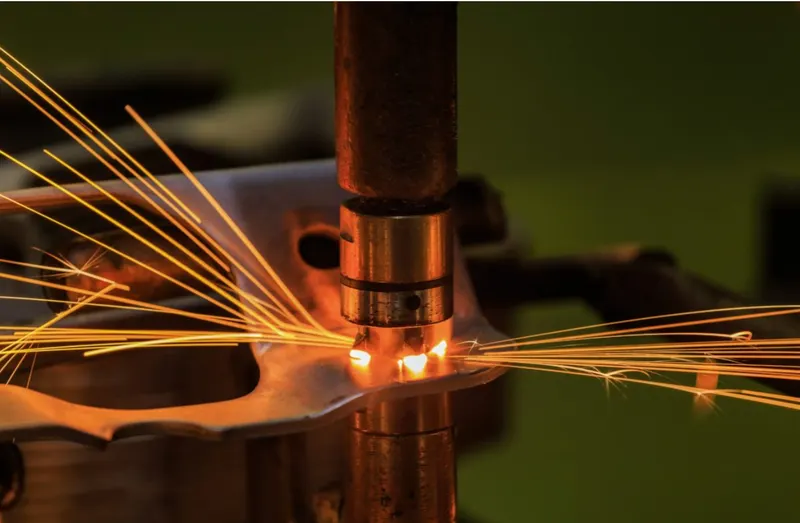
Spot Welding is a form of resistance welding also known as Resistance Spot Welding (RSW). Spot Welding involves using heat produced by resistance to an electrical current to join materials together. The current heats the materials to a point where they become malleable. The use of strong pressure bonds them together.
Normally spot weld has tolerance in sheet it should have 0mm clearance on both side od sheet. And Two eletrode will toch each other thereby spot weldding will happen in sheet.
1. Checking the Geometry:
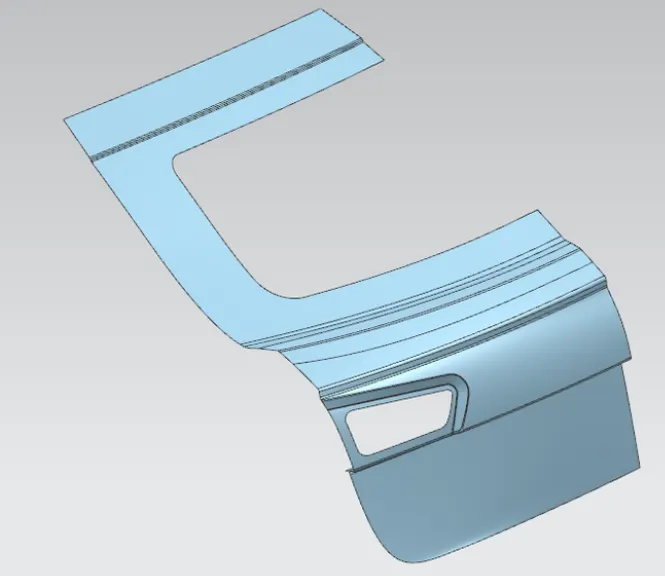
- Once the model is opened, we get a Surface from styling team, with the help we need check the all surfaces was made correct if not mean delete it and redraw it. After that sew together in proper way if not means again redraw the particular that surface along and sew it again of the back door.
 .
.
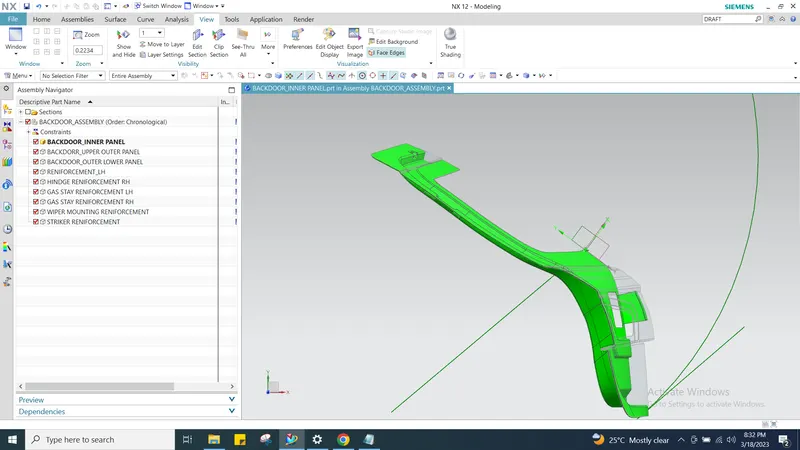
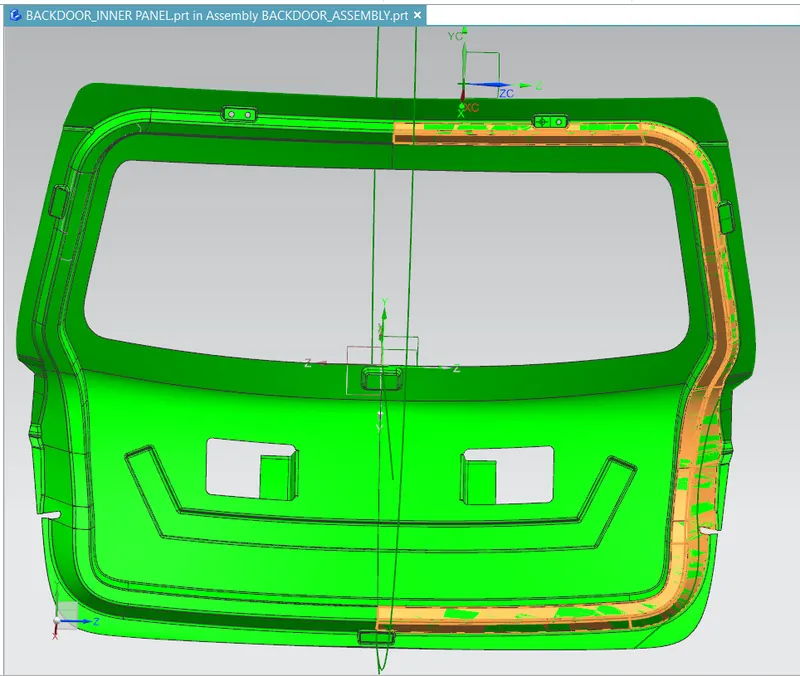
INNER PANEL & Tooling axis creation:
After that create a sketch of tooling direction which will help you to do offset surface, thicken and even more. Then work on sealing flange, Connecting flange, Connecting blend.
Embossing
Embossing is a metal forming process for producing raised or sunken designs or relief in sheet material by means of matched male and female roller dies, theoretically with no change in metal thickness, or by passing sheet or a strip of metal between rolls of the desired pattern.
- Metal sheet is drawn through the male and female roller dies producing a pattern or design on the metal sheet. Depending on the roller dies used, different patterns can be produced on the metal sheet.
- Emboss should be in 7 degree to 25 degree inclinte in angle and it should not be in 90 degree angle,why because when we do stamping in manufacturing the stamping tool fits the sheet metal hence it will not come out of that sheet metal,So this is the main reason why the emboss face is in angle.
Characteristics of the metal embossing process include:
- Its ability to form ductile metals,
- Its use in medium to high production runs,
- The ability to maintain the same metal thickness before and after embossing,
- The ability to produce unlimited patterns, depending on the roll dies, and
- The ability to reproduce product with no variation.
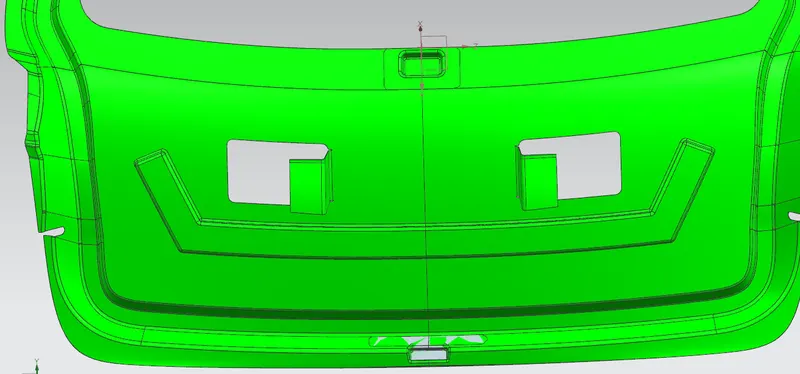
Embossing machines are generally sized to give 2" of strip clearance on each side of an engraved embossing roll. Many embossing machines are custom-manufactured, so there are no industry-standard widths.
I & O Panal Mounting Flange ( Inner and outer )
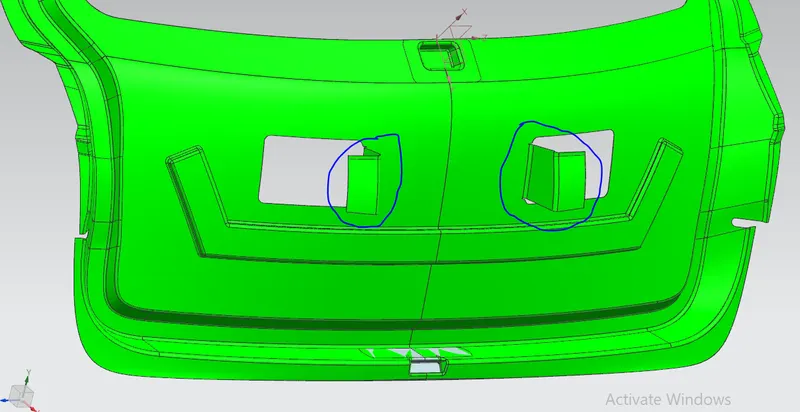
I provided two mounting Flanges for mounting the inner panel with outer stylish panel.
Two flanges is wnough strength for holding the outer and inner panels with the help of sealants.
In between inner panel and outer panel we providing sealants.
MASTIC SEALANTS
A mastic sealant is a type of liquid sealant that cures in an elastic state, thus making it flexible while holding the bond of the surfaces that has attached together. It adheres to just about any material making an all-purpose type of sealant.
- The main purpose of the outer panel is for the aesthetic looks. Thus we cannot use bolts or welding. This has to be done with the help of the hemming and mastic sealants. Mastic sealants are elastic compound that behaves like the rubber. It is placed between the outer and inner panel. Initially is it in paste form, but after the hot furnace bath it gets hardened thus joining the outer and inner panel. Mastic sealant has the tendency to increase the strength of the panel and has influence of 80mm diameter.
- We need to maintain min 5mm gap for outer and inner pannel for mastic sealants.
DRAFT ANALYSIS:
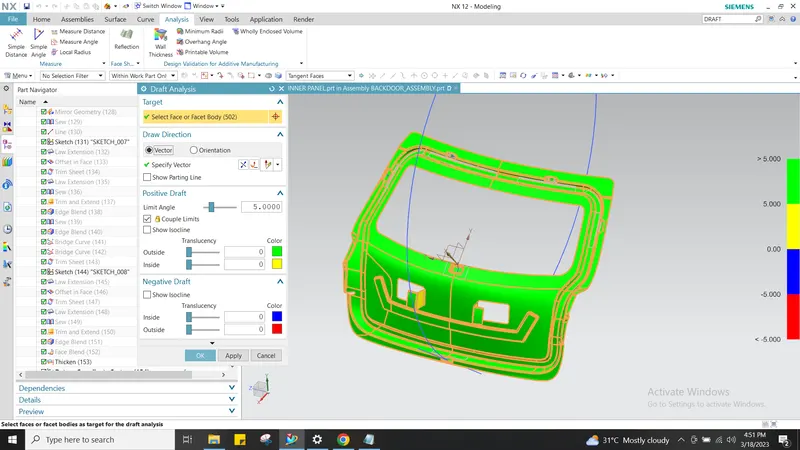
Draft analysis of inner panel is carried out through the tooling direction only.Only the green areas are acceptable and i worst cases yellow regions are accepted but the blue and red regions are never accepted.
The draft angle for aluminium casted panel is 2 to 3 degrees is enough but if it is steel then the angle is more than 7 degrees.
In this project i considered it as steel and used 7 degrees as draft angle and direction is choosen as tooling direction which is the deep drawn direction.
WIPER MOTOR MOUNTING
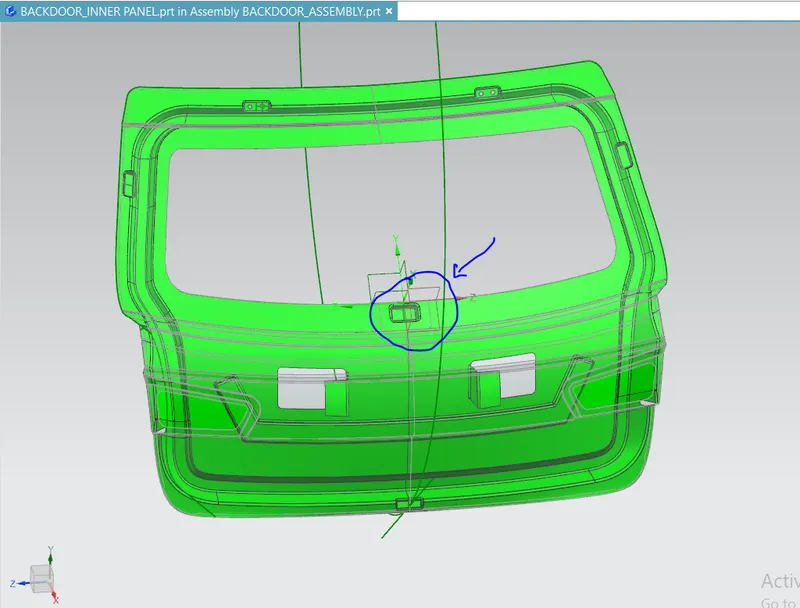
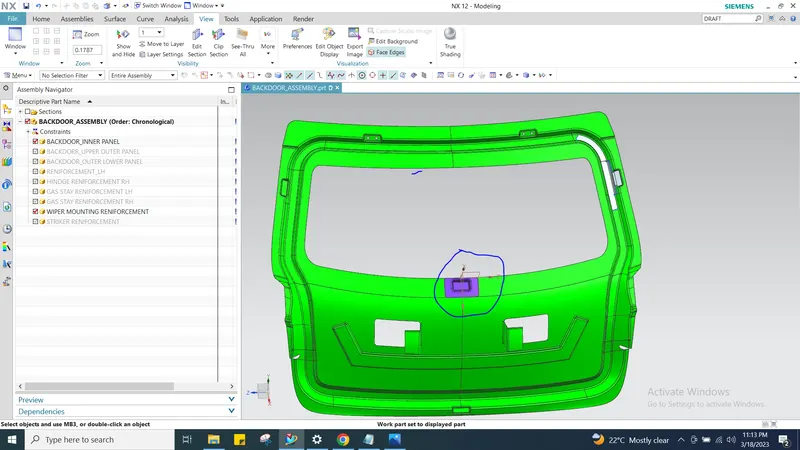
Below picture represents wiper motor mounting area,Highlighted red spot area is for wiper motor mouniting area.
REINFORCEMENT
Vehicle Door reinforcement structures as provided to reduce impact in collisions. In one embodiment, the structure is to include a lower reinforcement panel configured to mount to a vehicle chassis and an upper reinforcement panel welded to the lower reinforcement panel wherein the deflection of a front deformable wall of the upper reinforcement panel is configured to trigger deflection of rear deformable wall of the lower reinforcement panel.
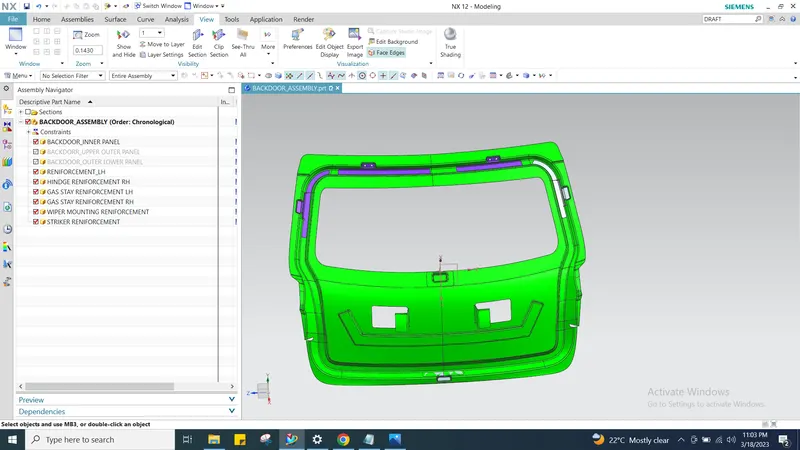
reinforcement thickness is kept at 1.5 mm
Hinge Reinforcement
Hinge are simple mechanical bearing devices that are used to connect two parts and allow them to rotate relative to each other about a fixed axis. Depending on the type employed, the components can move (most commonly) within a limited arc or with 360° freedom.
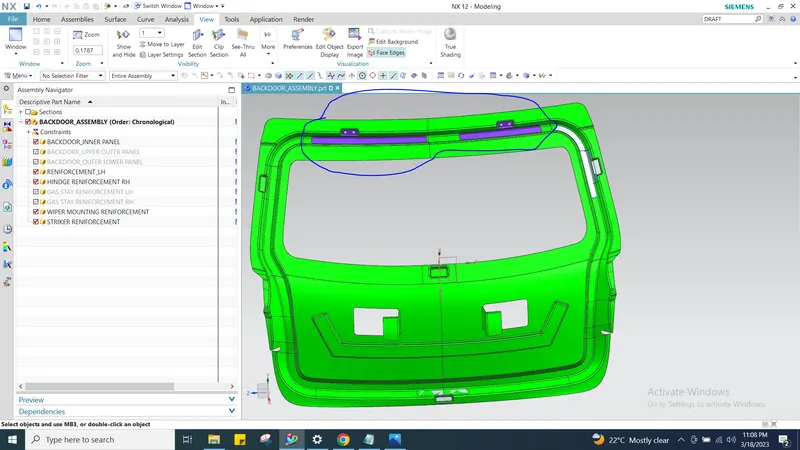
Hinge rotates in the rotational axis in that it will loose some strength there,It means huge Back door opens with the help of small hinges only in this case hinge needs extra strength,For this we providing extra strength in the form of Reinforcement
Hinge Reinforcement thickness be 1.5mm.
Gas Stay Reinforcement
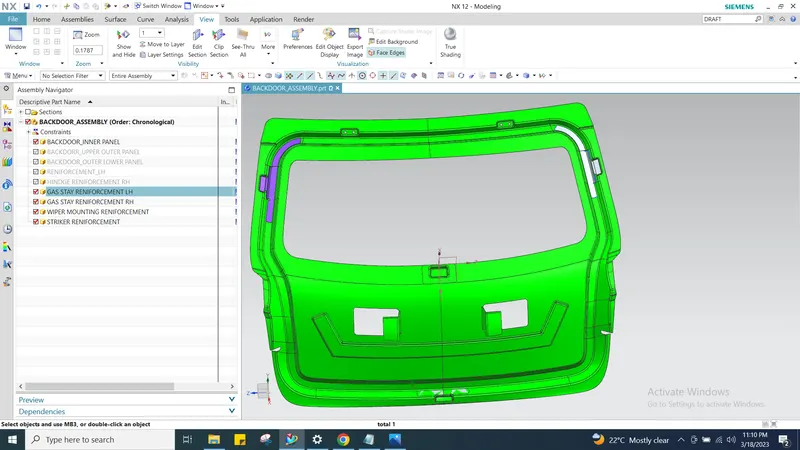
Gas springs, or gas struts, are rods that provide support for doors, hatches, lids and covers that are horizontally hinged. They act as support in a variety of ways including, lifting, positioning and lowering; because of this versatility they are used in a wide range of applications.
Inotherword there was one tension spring in over there and nitrogen gas with help of gas stay can work.
Wiper Motor Reinforcement
Windshield wipers are powered by a small electric motor, usually mounted on the firewall or under the cowl (the area under the windshield's base). The motor activates linkage that moves the wiper arms back and forth. On vehicles with a rear window wiper, a separate motor powers the one in the rear.
RELIEF DATA:
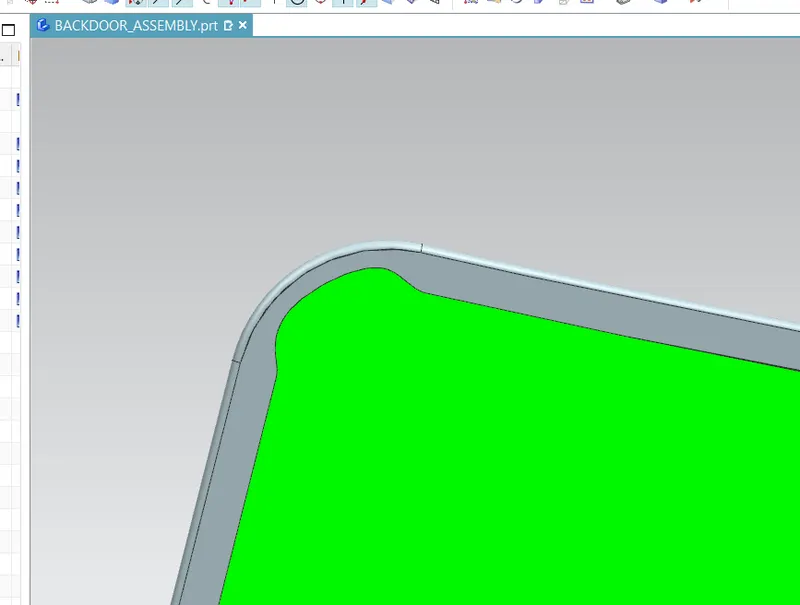
Relief is provided onto the part or component in order to remove any stresses developed in a particular area i.e sharp corners that takes place during the hemming process is carried out. Thus corners are rounded or chamfered.
We leaving 2 to 3mm from sheet metal for Roll hemming process.
Position of Latch :
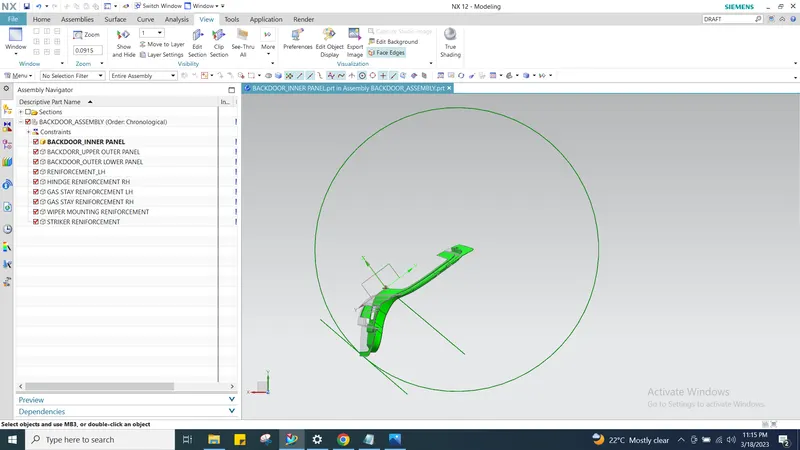
Position of latch and striker is perpendicular to the hinge then only the latch and striker mechanism works properly when the door closing and opening position.
For the proper opening and closing of the Door, the striker should be perpendicular to the trajectory of the Door. For this, hinge is assembled at its position. Once it is placed, hinge axis is drawn.
CONCLUSION:
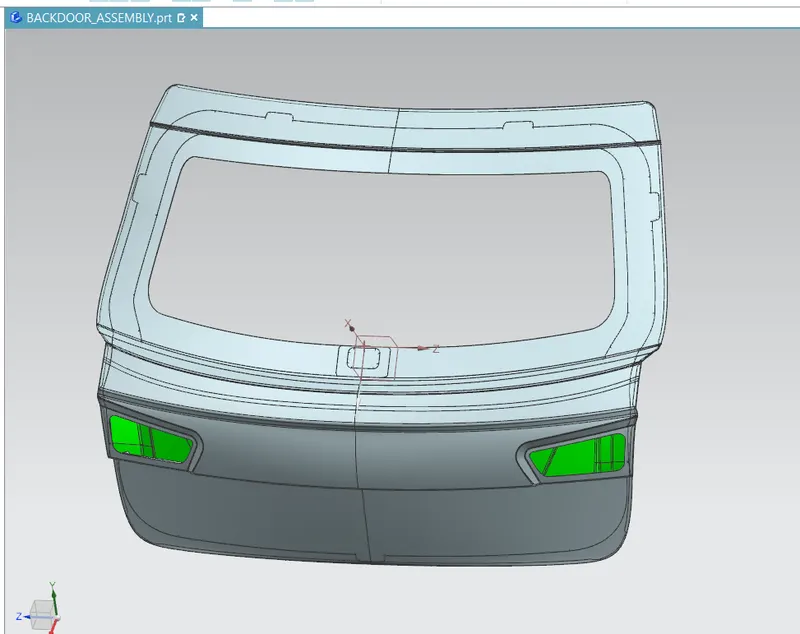
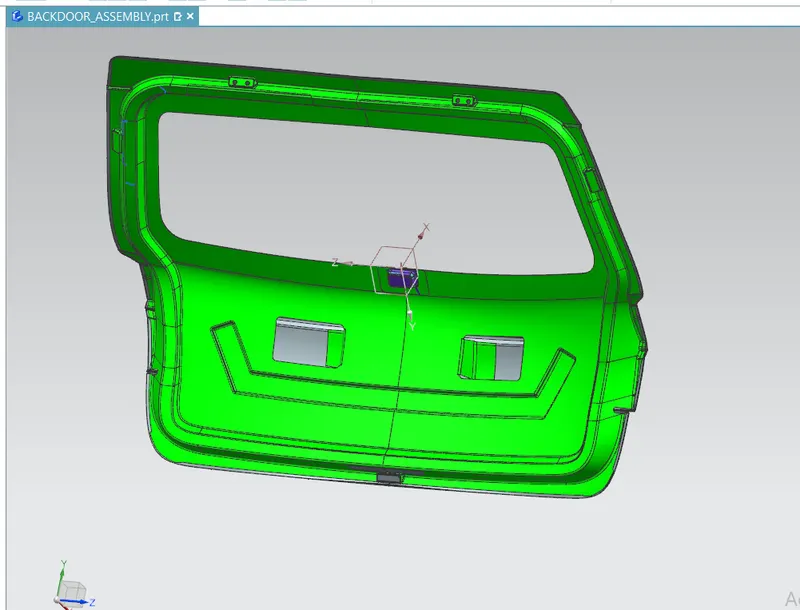
As per provided input given of styling surface of a back door design, I have did appropriate design methodologies and provided my own thoughts and the necessary reinforcements and embosses for the Backdoor design.