Design of backdoor
Back-Door Design
Objective:
To create a detailed 3D model of Automobile Backdoor using siemens NX.
Introduction:
In this project a detailed model of an automobile door assembly is created using Siemens NX in-order to understand and familiarize with different parameters and criteria’s for modelling and producing a back door. The back door is an aesthetic as well as a safety component of an automobile. The door is designed in such a way that on impact on the rear side of the car would redirect the forces in a perpendicular direction of the impact force. Thus keeping the rear passengers safe. The door panel consists of three main components.
- Inner panel: Inner panel is the main component of the door as it is designed for dissipating the force of impact to the sides of the automobile body. The inner panel consists of the reinforcements as well as the mastic points.
- Outer panel: The outer panel serves as an aesthetic component while also providing extra strength to the inner panel. The curvature of inner panel is based on the design of the outer panel.
- Reinforcements: The reinforcements provide additional strength to the inner panel at the points where other components such as the latch and hinge will be placed. These reinforcements ensure that the hinges and the latch have better support to avoid failure.
Design Methodology:
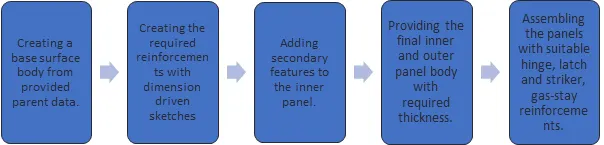
Description:
In order to design the rear door, certain parameters and criteria are supposed to be met for it to be functional and producible. These parameters are as follows:
- Rear visibility criteria
- Boot space criteria
- Clearance and fit
- Latch and striker placement
- Mastic points placement
- Hinge and gas stay mountings
- Tooling direction
Inner panel:
The inner panel is designed to dissipate the impact forces and to provide support to the entire back door.
The panel consists of embosses, mountings, mastic points etc.
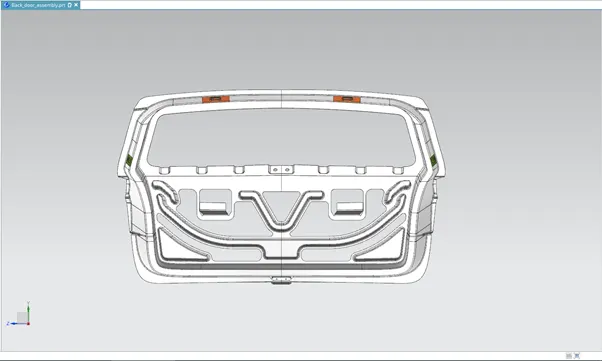
The embosses deviate the force upwards and it the side of the back door in order to minimise the damage to the door panels and the passengers. The panel is joined to the outer panel using mastic points as shown below.
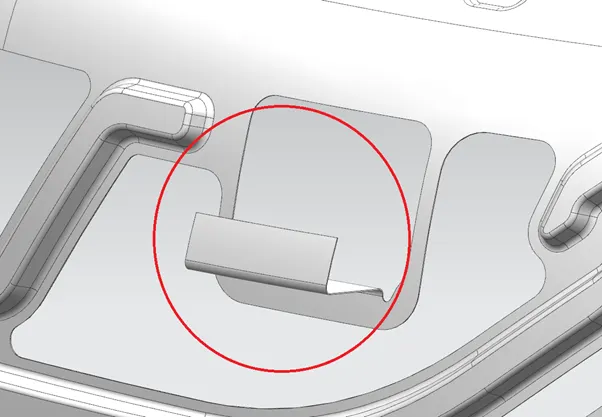
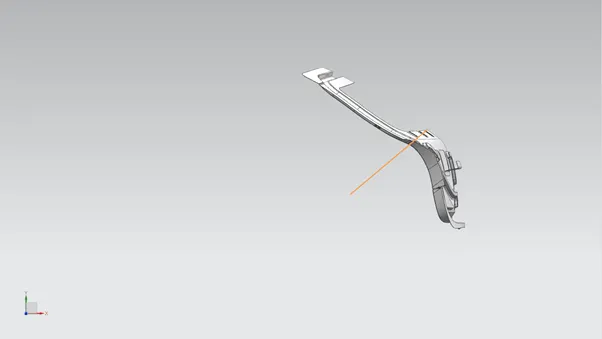
The sealing flange as well as the inner panel surfaces are created based on a fixed tooling direction.
The tooling direction is decided by using the angle bisector of two lines following the outer panel curve as shown:
Outer panel:
The outer panel consists of two parts, the top panel and the bottom panel. These panels are connected to each other at the middle flange. The outer panel consists cut-outs for the windshield and the tail lights.
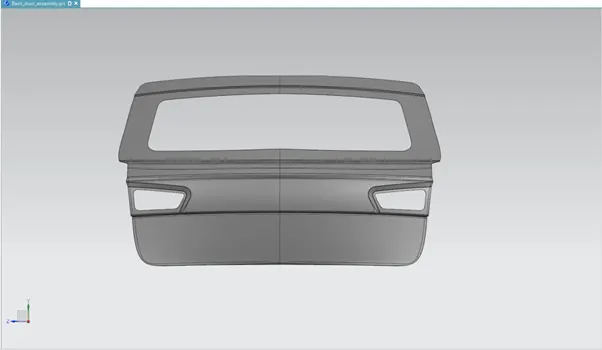
The panels are joined to the inner panel using mastics and hemming around the corners.
Reinforcements:
Reinforcements are provided to strengthen the mounting areas in order to avoid failure. The various reinforcements provided in the design are – Hinge, gas stay, wiper -motor, latch and striker.
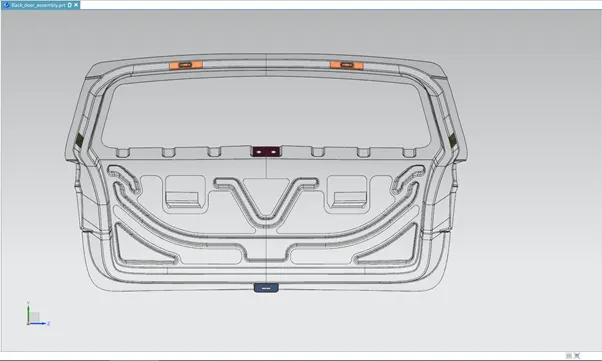
- Hinge reinforcement:
The hinge reinforcement provides extra strength to the hinge mounting emboss on the inner panel.
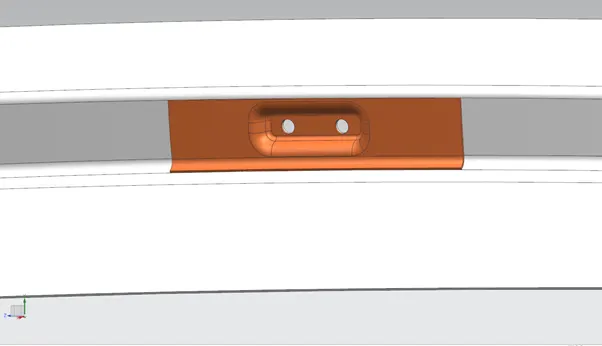
- Gas- Stay reinforcement:
The gas stay mounting is used to place the supports which help open and close the back door.
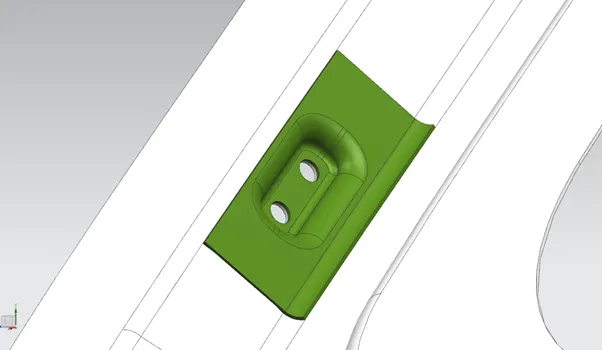
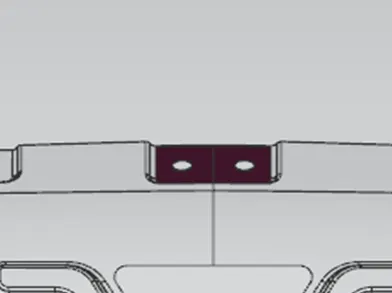
- Wiper-motor reinforcement:
The wiper-motor mounting is placed beneath the windshield cutout as shown below.
- Latch-striker reinforcement:
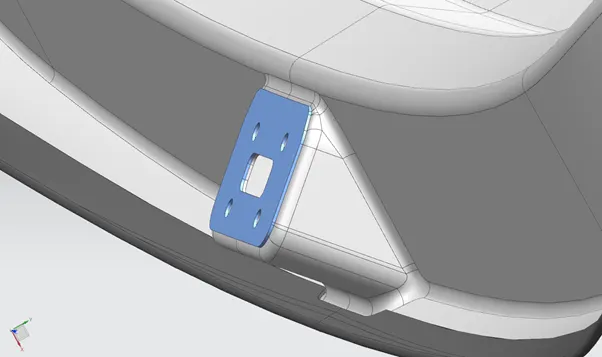
The latch and striker mounting is designed based on the hinge axis criteria.
According to this criterion the hinge axis should be perpendicular to the latch surface.
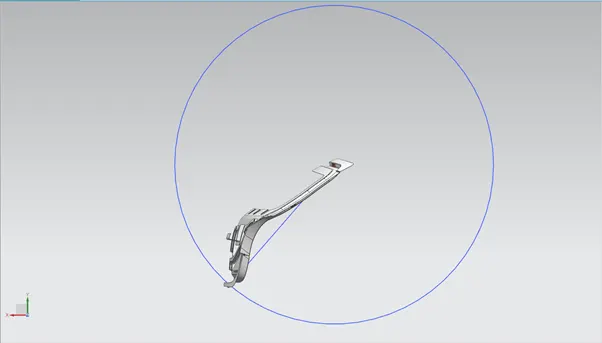
Based on the mentioned parameter, the following placement is designed.
Hemming:
Hemming is a commonly used process in sheet metal production. This process involves bending of one sheet onto another in order to lock the two sheets together.
In this design the inner panel and outer panel are connected using hems around the sheet edges.
A tolerance of 0.2mm is kept between the sheets as per production parameters. The maximum thickness of the inner and outer panels is 0.75mm.
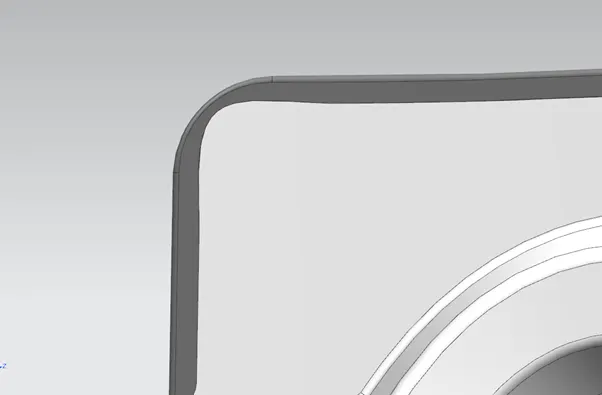
Conner reliefs are provided in order to avoid stress in the hem at sharp bends. This prevents the sheet from failure and damage from the excess stress at the corners.
Complete assembly:
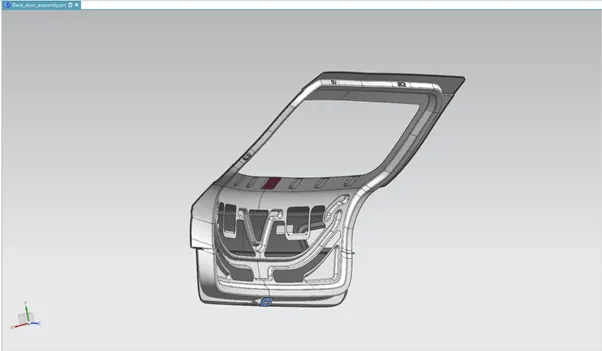
The inner and outer panel are assembled along with the reinforcements as shown:
Conclusion:
By using the above mentioned parameters and following the design methodology, the complete assembly of the back door is complete in siemens NX.