Cyclone Separator Challenge
Aim:- To perform analysis on cyclone separator and calculate the separation efficiency and pressure drop.
Objective:-
- To write a few words about any four empirical models used to calculate the cyclone separator efficiency.
- To perform an analysis on a given cyclone separator model by varying the particle diameter from 1 μm to 5 μm and calculate theseparation efficiency in each case. Discuss the results. [Use both the velocity's as 3m/sec.]
- To perform an analysis on a given cyclone separator model by varying the particle velocity from 1 m/sec to 5 m/sec and calculate the separation efficiency and pressure drop in each case. Discuss the results. [Use particle diameter size as 5 μm for all cases & keep flow velocity same as particle velocity]
Cyclone separator:
1.Cyclone separators or simply cyclones are separation devices that use the principle of inertia to remove particulate matterfrom flue gases
2.Cyclone separators is one of many air pollution controlling devices known as precleaners since they generally remove larger pieces of particulate matter.
3.This prevents finer filtration methods from having to deal with large, more abrasive particles later on. In addition, several cyclone separators can operate in parallel, and this system is known as a multicyclone.
4.It is important to note that cyclones can vary drastically in their size. The size of the cyclone depends largely on how much flue gas must be filtered, thus larger operations tend to need larger cyclones.
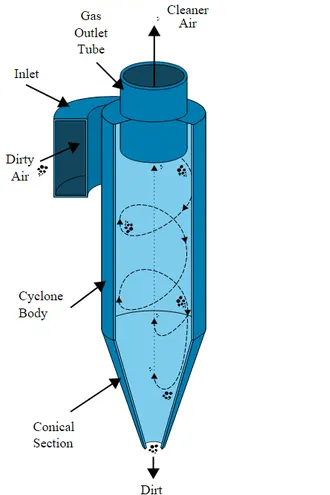
Working:
1.Cyclone separators work much like a centrifuge, but with a continuous feed of dirty air.
2.In a cyclone separator, dirty flue gas is fed into a chamber.which creates a spiral vortex, similar to a tornado. This spiral formation and the separation
3.The lighter components of this gas have less inertia, so it is easier for them to be influenced by the vortex and travel up it. Contrarily, larger components of particulate matter have more inertia and are not as easily influenced by the vortex
4.Since these larger particles have difficulty following the high-speed spiral motion of the gas and the vortex, the particles hit the inside walls of the container and drop down into a collection hopper.
6.These chambers are shaped like an upside-down cone to promote the collection of these particles at the bottom of the container. The cleaned flue gas escapes out the top of the chamber.
7.Most cyclones are built to control and remove particulate matter that is larger than 10 micrometers in diameter. However, there do exist high efficiency cyclones that are designed to be effective on particles as small as 2.5 micrometers. As well, these separators are not effective on extremely large particulate matter. For particulates around 200 micrometers in size, gravity settling chambers or momentum separators are a better option.
Empirical models used to calculate the cyclone separator :
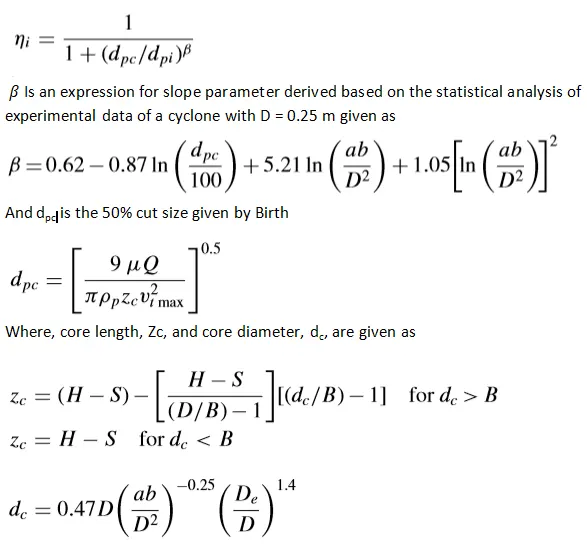
1) Iozia and Leith Model
Iozia and Leith logistic model is developed based on force balance. The model assumes that a particle carried by the vortex endures the influence of two forces: a centrifugal force, Z and a flow resistance, W . The collection efficiency ηi of particle diameter dpi can be calculated from
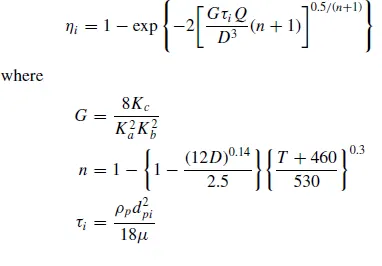
2)Koch and Licht Mode:
Koch and Licht collection theory recognized the inherently turbulent nature of cyclones and the distribution of gas
residence times within the cyclone.
Koch and Licht describedparticle motion in the entry and collection regions with the ad- 200
ditional following assumptions:
Assumptions:
• The tangential velocity of a particle is equal to the tangential velocity of the gas flow, i.e. there is no slip in the
tangential direction between the particle and the gas.
• The tangential velocity is related to the radius of cyclone by u Rn = constant.
Aforce balance and an equation on the particles collection yields
the grade efficiency
3) Li and Wang Model:
1.The Li and Wang model includes particle bounce or reentrainment and turbulent diffusion at the cyclone wall.
2.A twodimensional analytical expression of particle distribution in thecyclone is obtained.
3.Li and Wang model was developed based on the following assumptions:
Assumptions:
• The radial particle velocity and the radial concentrationprofile are not constant for uncollected particles within
the cyclone.
• Boundary conditions with the consideration of turbu185 lent diffusion coefficient and partic bounce reentrainment on the cyclone wall are:
c = c0, at θ = 0
Dr ∂c/∂r= (1 − α)wc, at r = D/2
The tangential velocity is related to the radius of cyclone by: u Rn = constant.
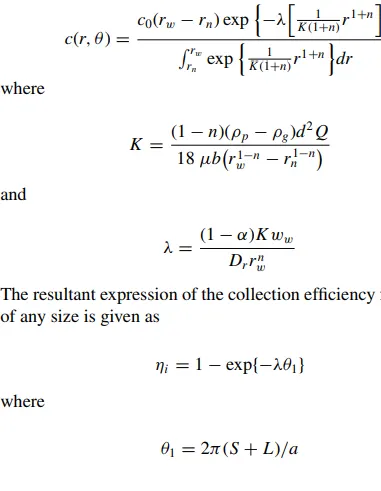
The concentration distribution in a cyclone is given as:
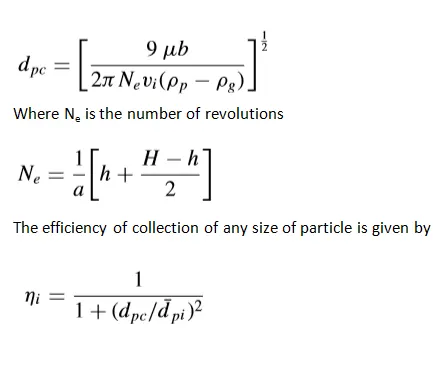
4)Lapple Model
1.Lapple model was developed based on force balance without considering the flow resistance.
2.Lapple assumed that a particle entering the cyclone is evenly distributed across the inletopening.
3.The particle that travels from inlet half width to thewall in the cyclone is collected with 50% efficiency.
4.The semiempirical relationship developed by Lapple to calculate a
50% cut diameter, dpc, is
Procedure:
1)Geometry:
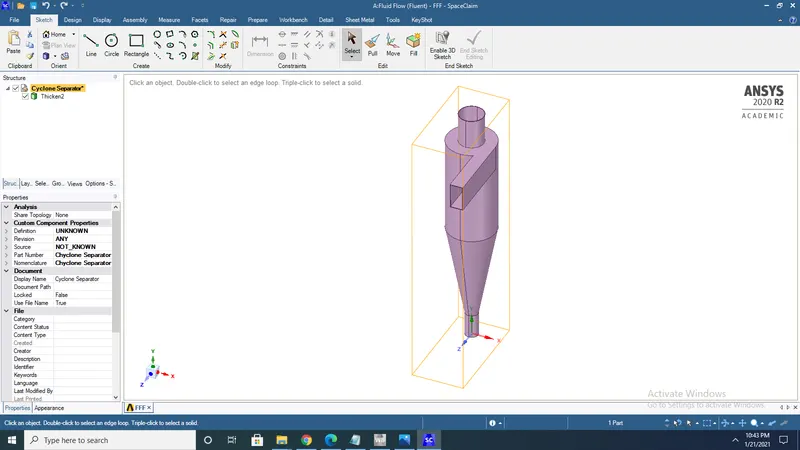
1.Import cyclone separator file to ansys fluent
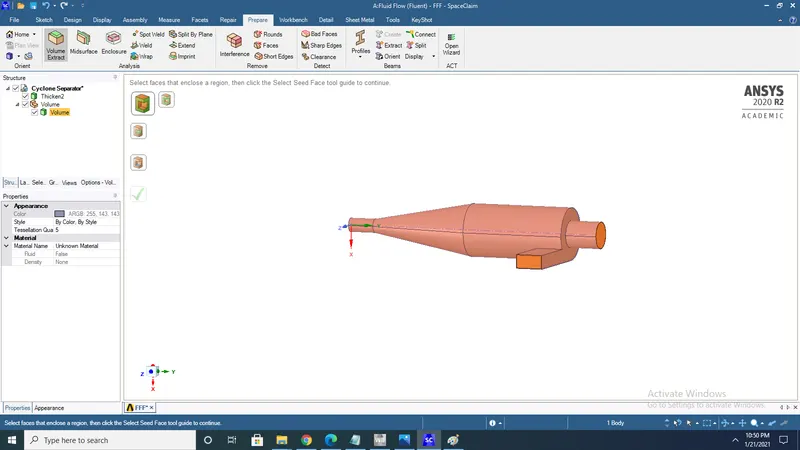
2. Go to prepare and select option Fluid extract ro extract fluid from 1 inlet and 2 outlets
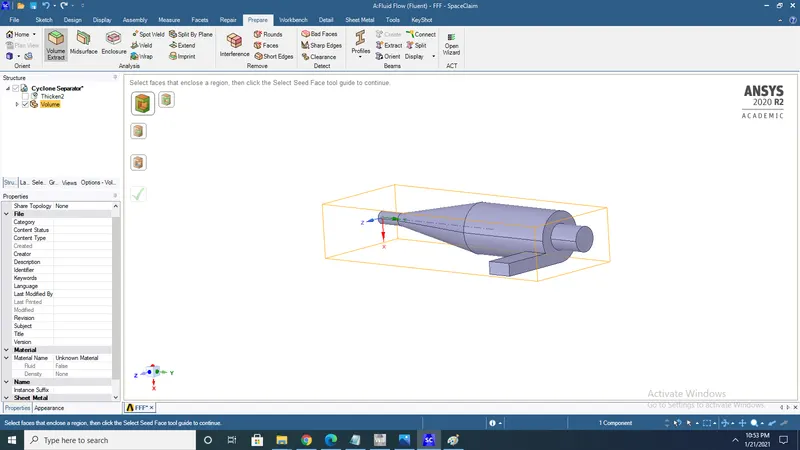
3.Supress cyclone separtor geometry
Meshing: (Base line mesh):
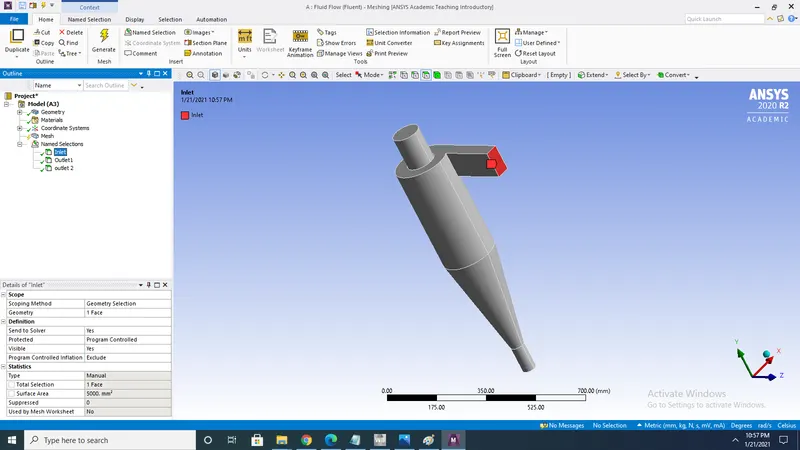
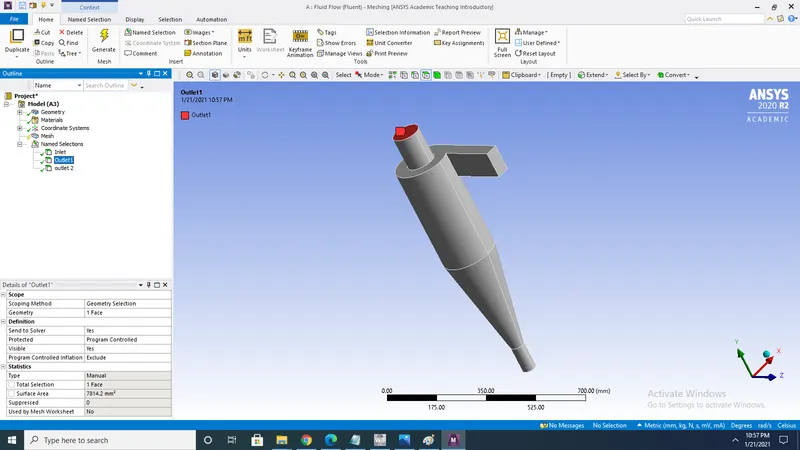
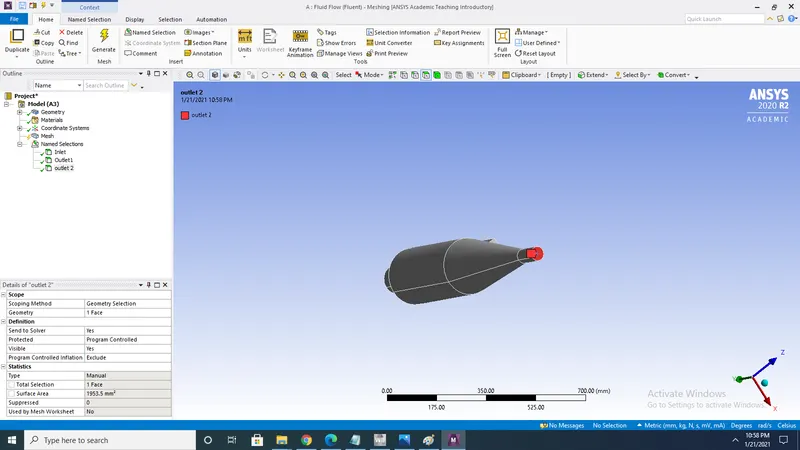
Named selections:
1)Inlet
2)Outlet1
3)Outlet2
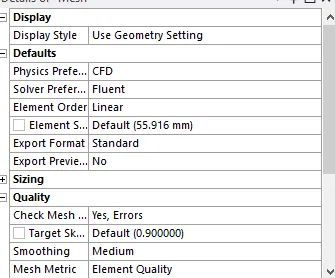
4)Default Mesh size
5)Generate Mesh in sectional plane
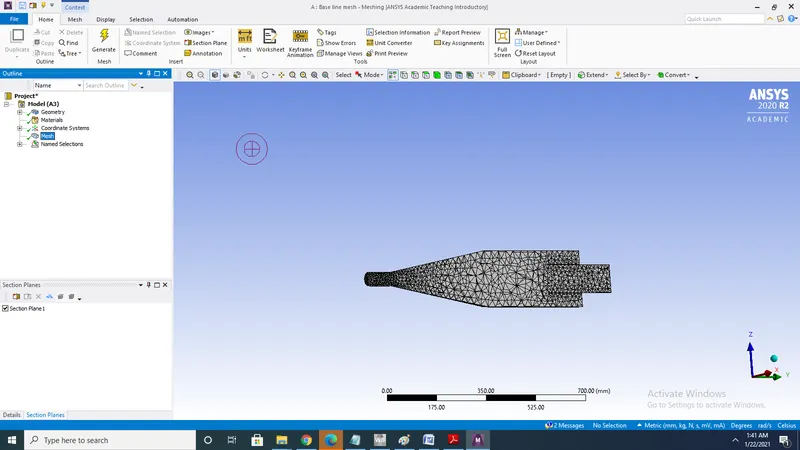
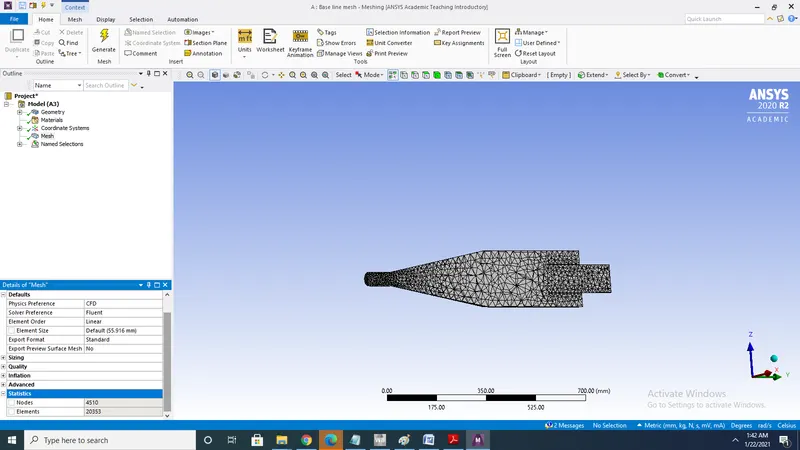
6)Stastics
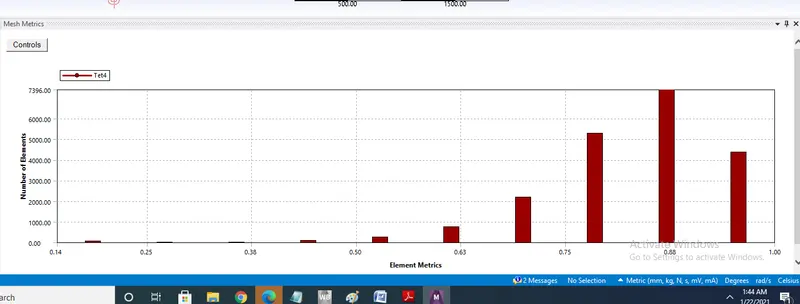
Quality:
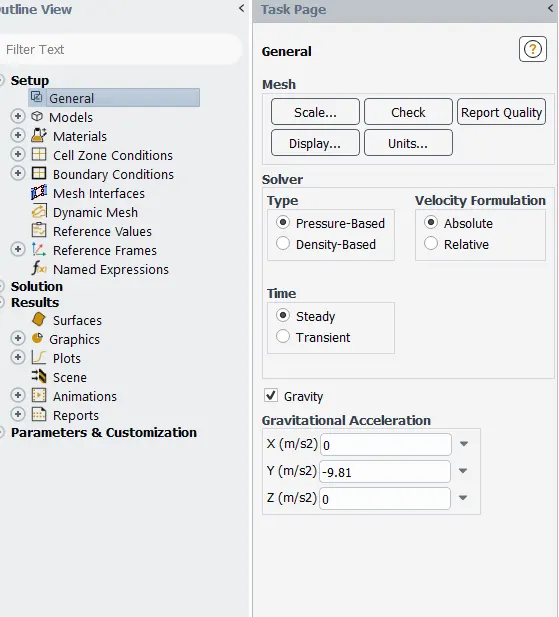
Setup: (baseline)
1)General
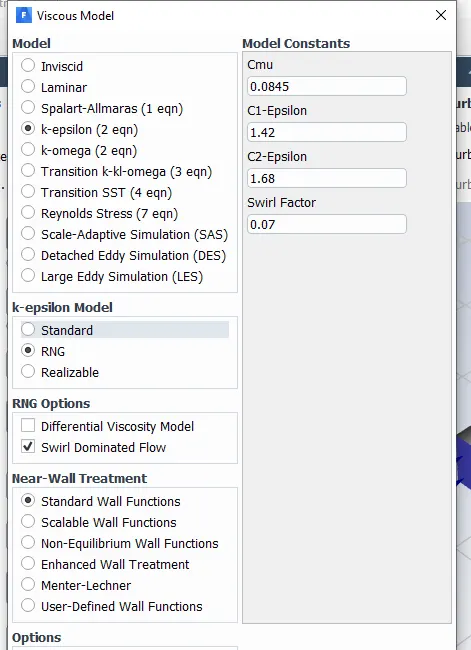
2)Models
1)Viscous model k-epsilon -RNG- (it enhances accuracy in swirling caes)
2).select swirl dominated flow
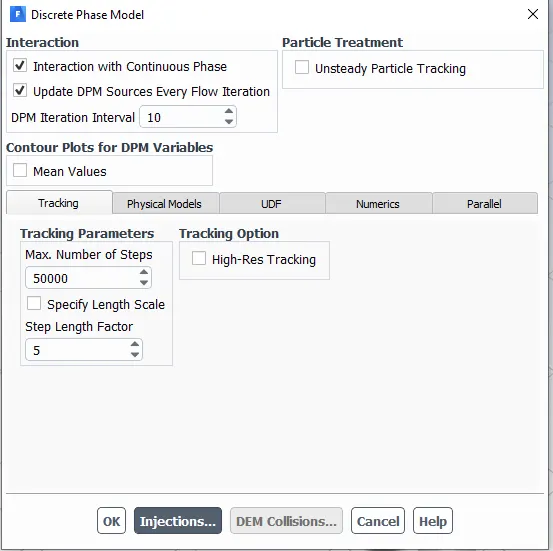
3)Discrete model
1)Coupled flow 2) un coupled flow
2) unCoupled flow: in uncoupled flow discrete phase will not have any intreaction with contionous phase
3).Coupled flow:in coupled flow discrete phase will influence with contionous phase
Injections:
1)DPM iteration interval allows to control frequency of particle trapped
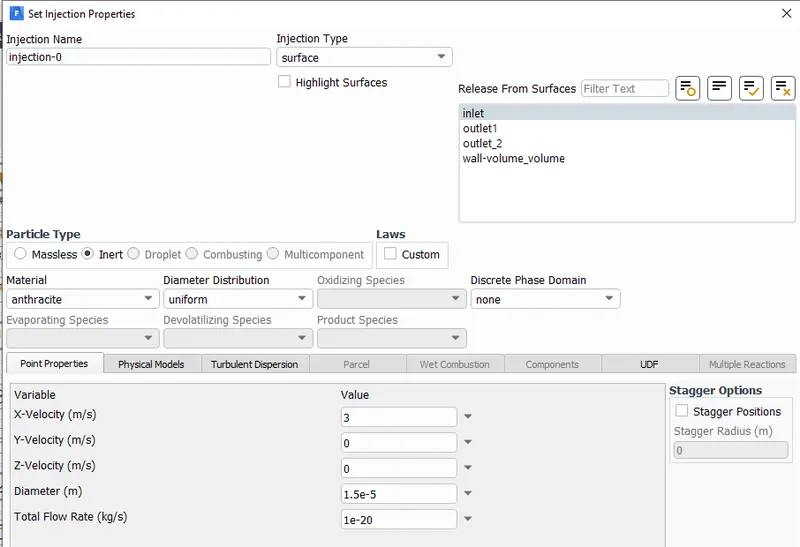
2)use injections surface injections (Anthracite) partice-inert,x-velocity-3m/s
diameter=5e-6
4)Boundary conditions
inlet v=3m/s
check dpm
use reflect
Outlet(Top):- Escape
Outlet(Bottom/dustbin) - Trap
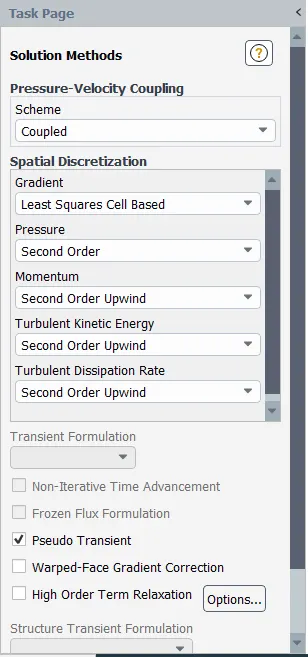
5)Methods:
6)Solution
Standard solution-No of iterations=600
7)Results
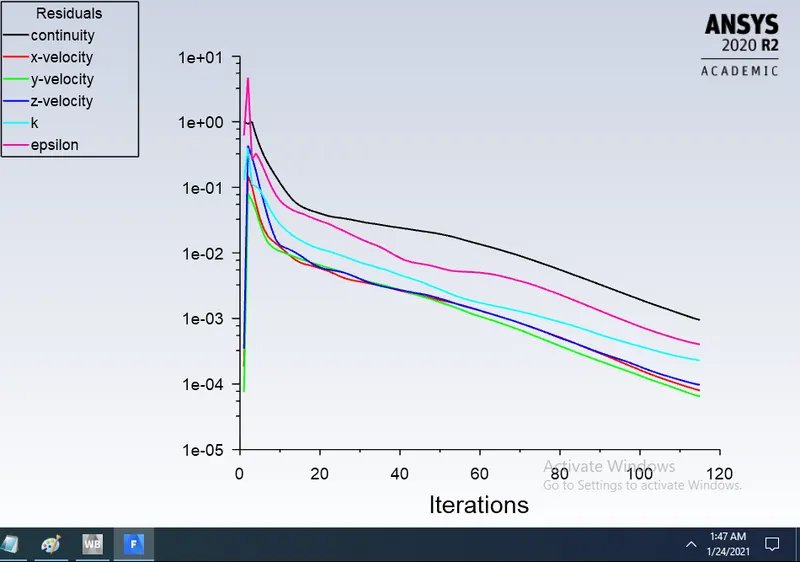
Residuals:
DPM Values:

Cyclone separator efficiency:
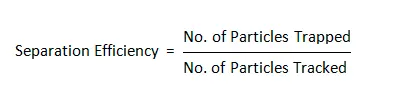
Efficiency=(3/4)*100=75%
1)REfinment of Mesh:
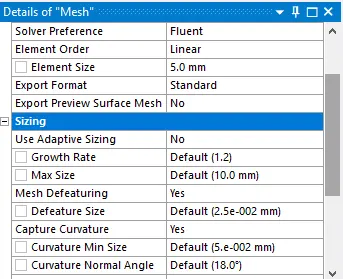
2)Generate Mesh in sectional plane
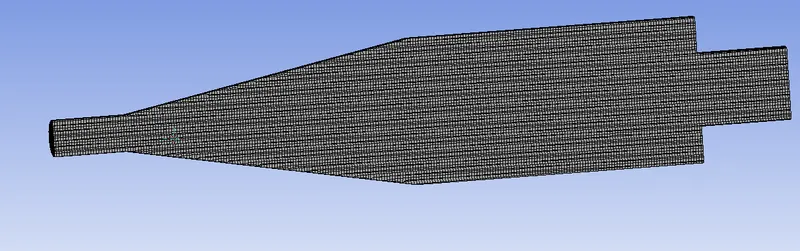
Cartesian method:
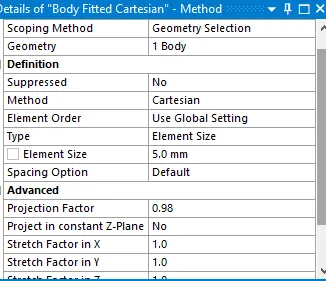
3)Stastics
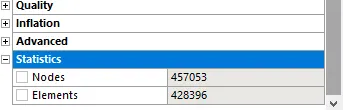
Setup after refinment:
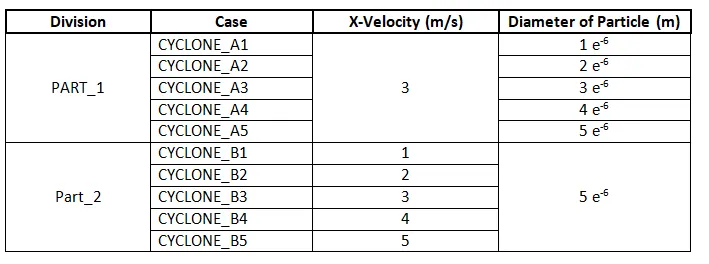
Table1:
Perform analysis at various velocities and diameter of particles:
Part-1(Cyclone_A1):
(inlet velocity=3m/s,Dia of particle=1e-6)
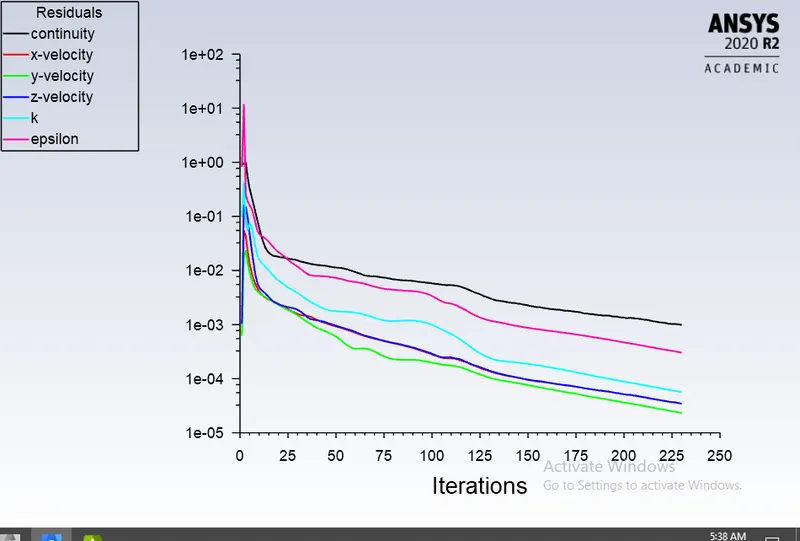
Residual:
Contour:
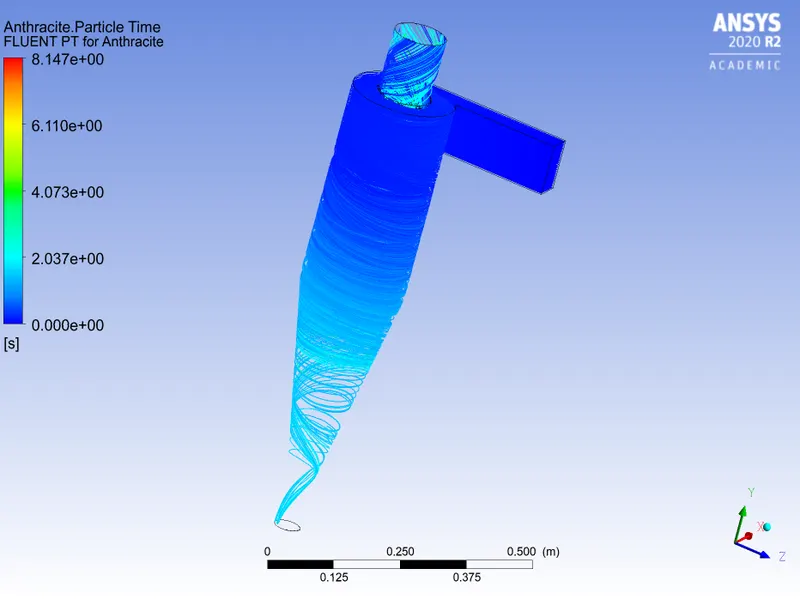
DPM:

Cyclone separator efficiency:
Efficiency=(177/378)*100
= 46.82%
Animation:
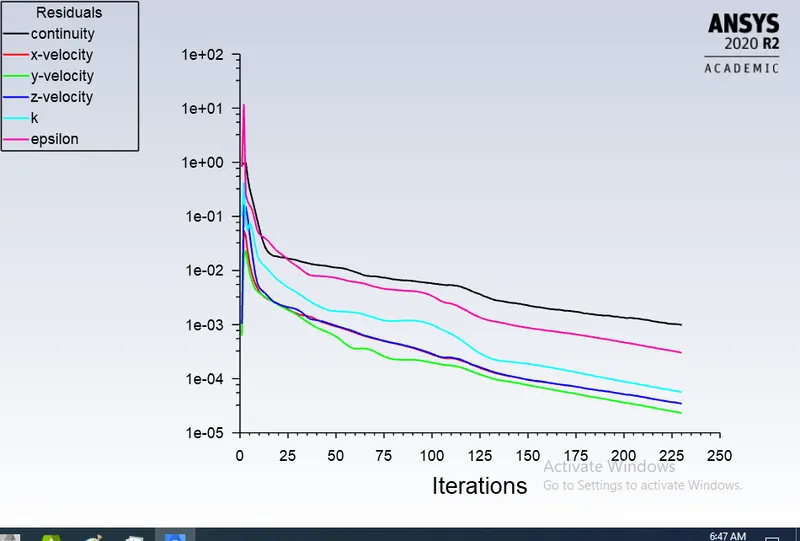
Part-1(Cyclone_A2):
(inlet velocity=3m/s,Dia of particle=2e-6)
Residual:
Contour:
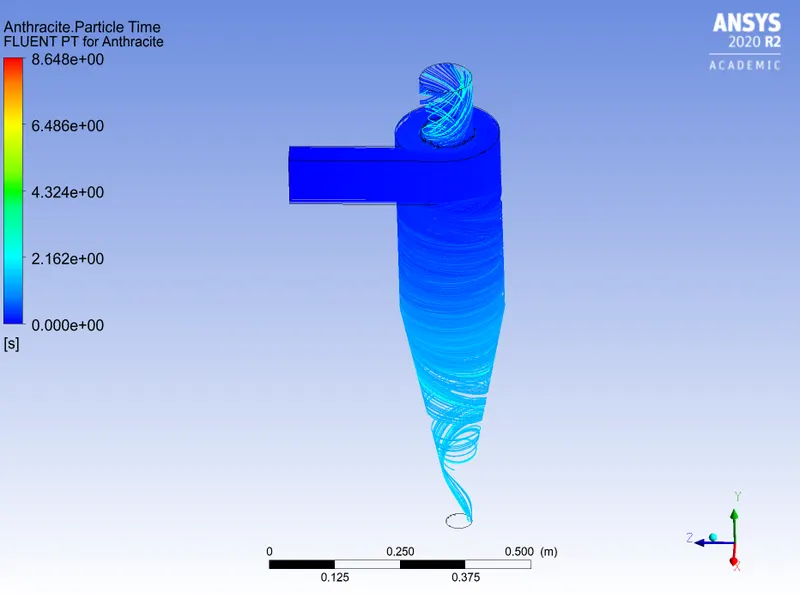
DPM:

Cyclone separator efficiency:
Efficiency= (185/378)*100
= 48.94
Animation:
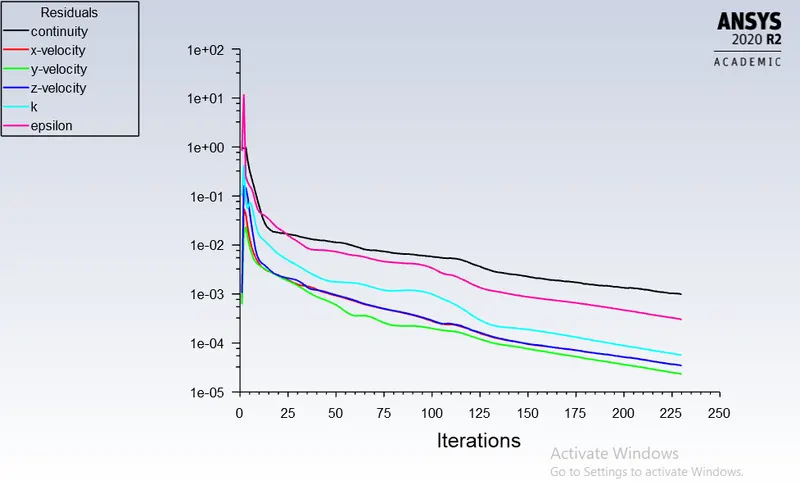
Part-1(Cyclone_A3):
(inlet velocity=3m/s,Dia of particle=3e-6)
Residual:
Contour:
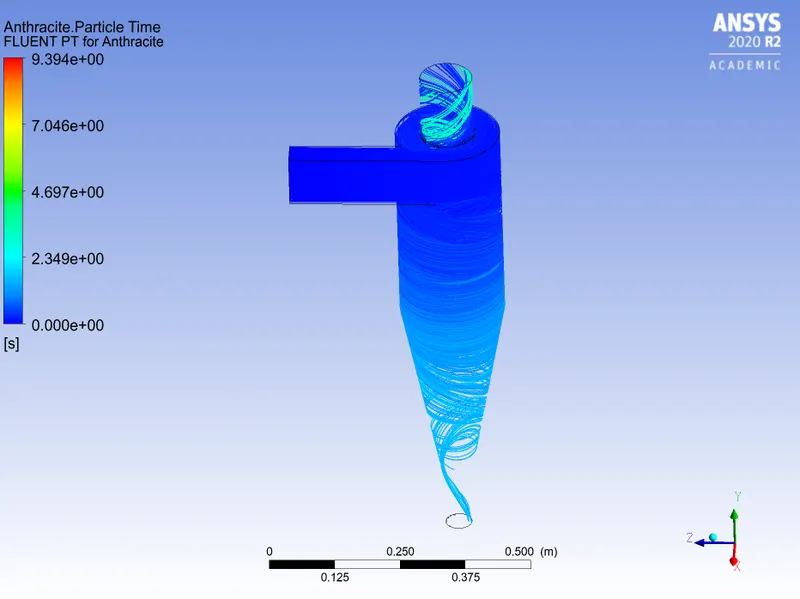
DPM:

Cyclone separator efficiency:
Efficiency=(218/378)*100
= 57.67
Animation:
Part-1(Cyclone_A4):
(inlet velocity=3m/s,Dia of particle=4e-6)
Residual:
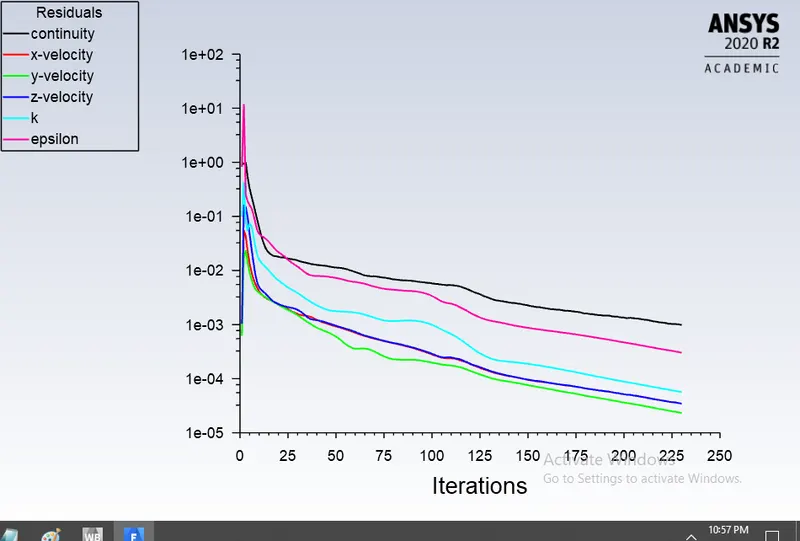
Contour:
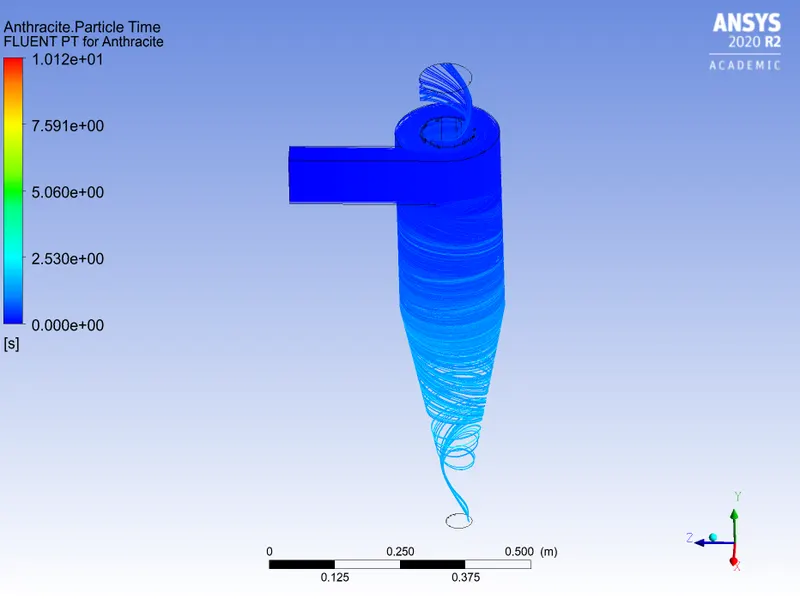
DPM:

Cyclone separator efficiency:
Efficiency = (285/376)*100
= 75.79%
Animation:
Part-1(Cyclone_A5):
(inlet velocity=3m/s,Dia of particle=5e-6)
Residual:
Contour:
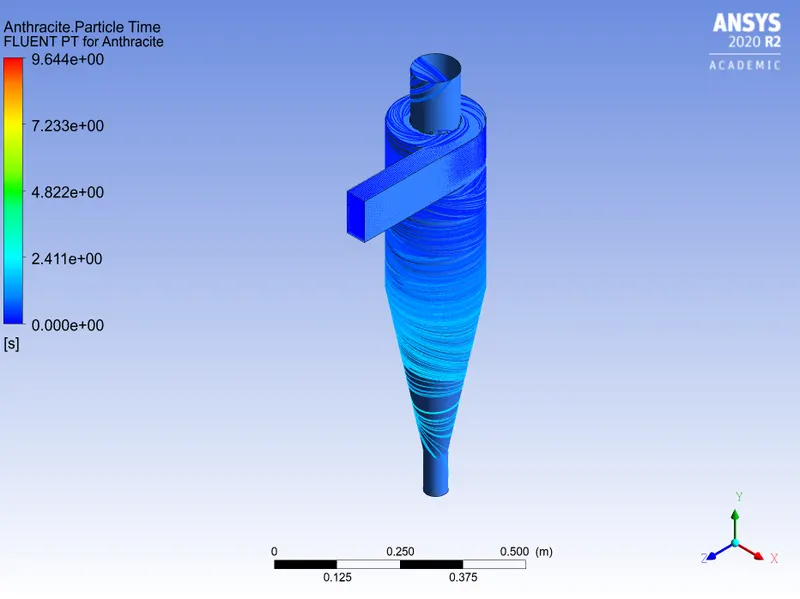
DPM:

Cyclone separator efficiency:
Efficiency = (288/378)*100
= 76.19%
Part-2(Cyclone_B1):
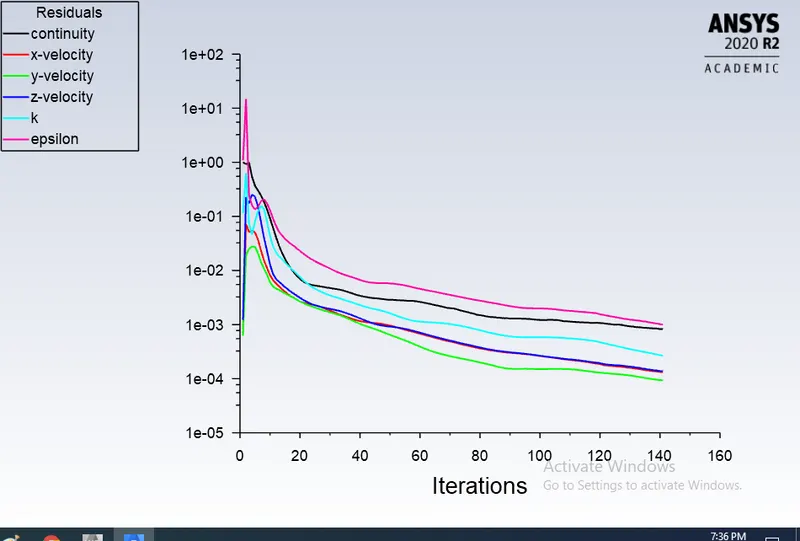
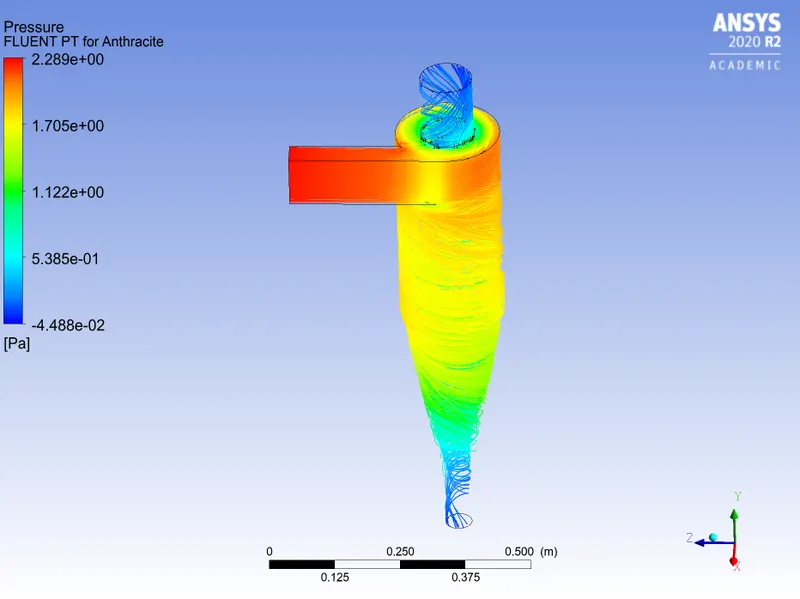
(inlet velocity=1m/s,Dia of particle=5e-6)
Residual:
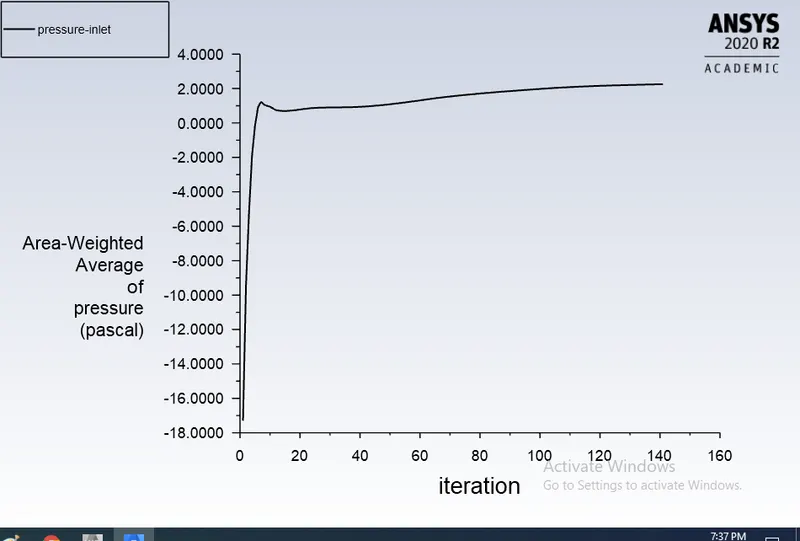
Pressure inlet:
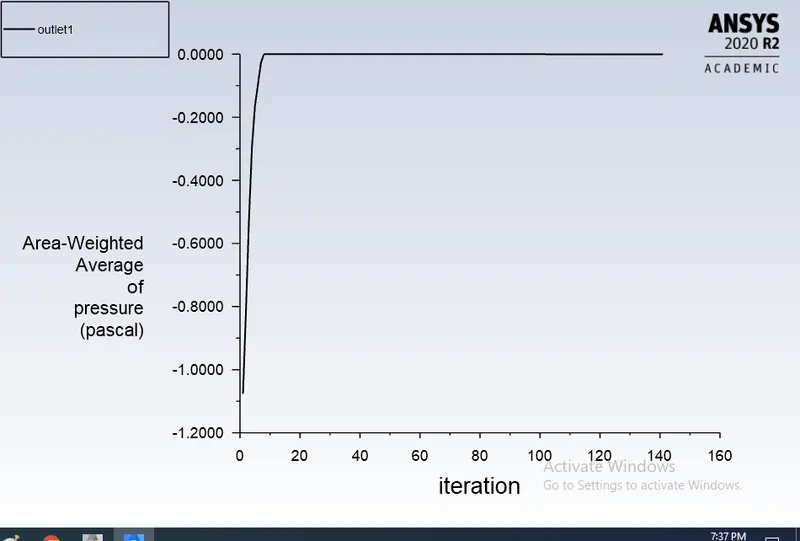
Pressure outlet(Top):
Contour:
Animation:
Values of pressure inlet/outlet:

Pressure drop=inlet-outlet
=2.2526732-(-0.00091976989)
=2.2535
DPM:

Cyclone separator efficiency:
= (14/378)*100
= 3.7%
Part-2(Cyclone_B2):
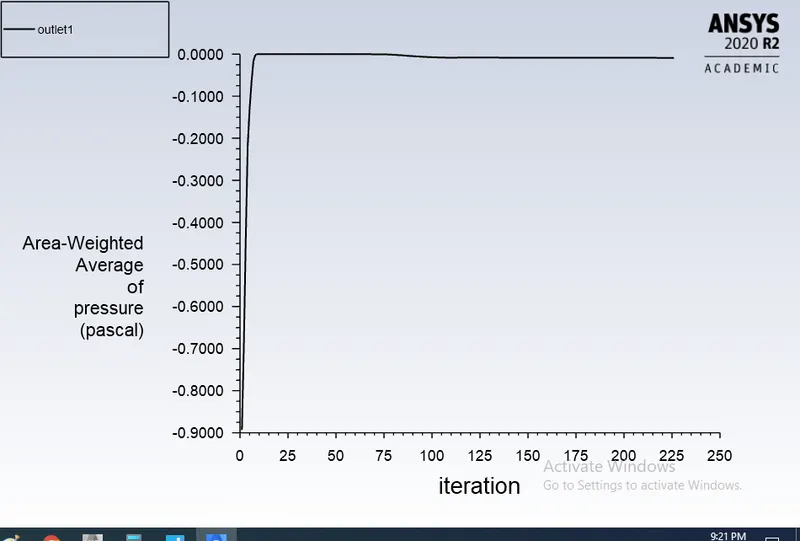
(inlet velocity=2m/s,Dia of particle=5e-6)
Residual:
Pressure inlet:
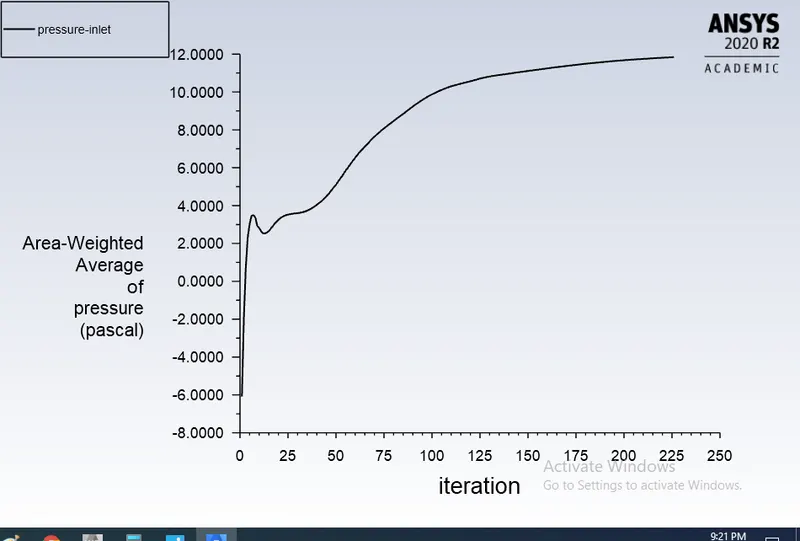
Pressure outlet:
Contour:
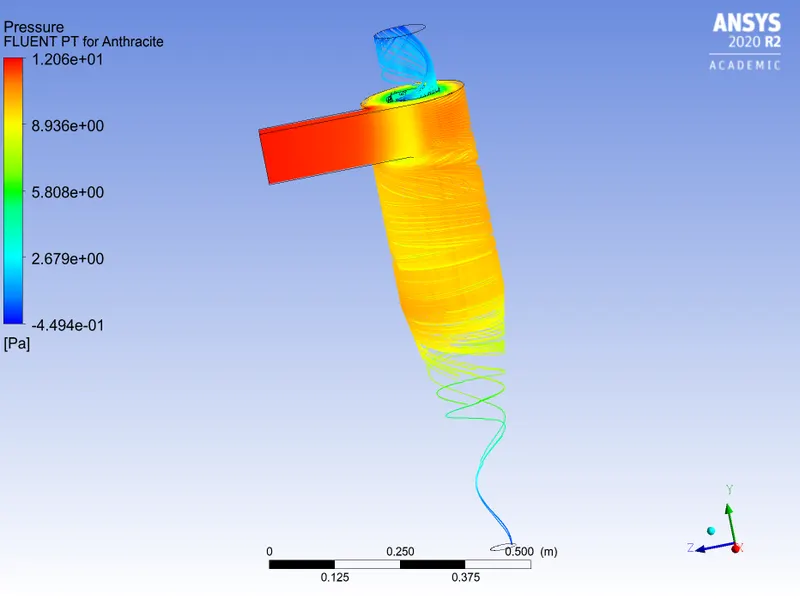
Animation:
Values of pressure inlet/outlet:

Pressure drop=inlet-outlet
=11.839394-(-0.00895)
=11.848343
DPM:

Cyclone separator Efficiency:
Efficiency=(4/378)*100
=
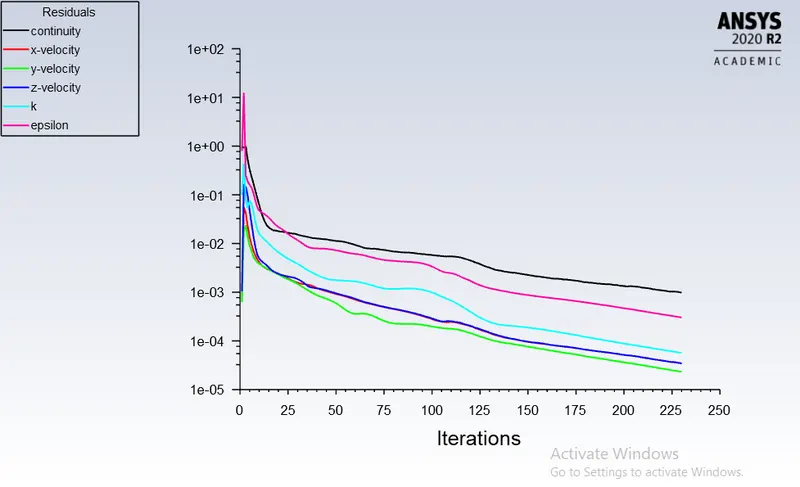
Part-2(Cyclone_B3):
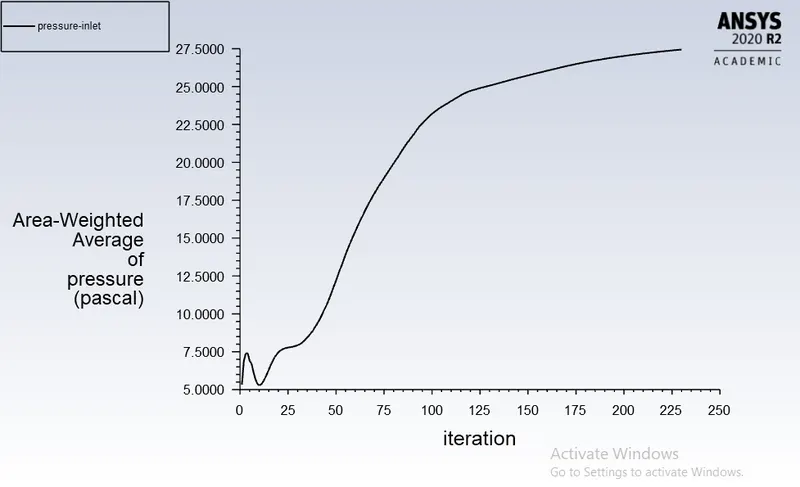
(inlet velocity=3m/s,Dia of particle=5e-6)
Residual:
Pressure outlet: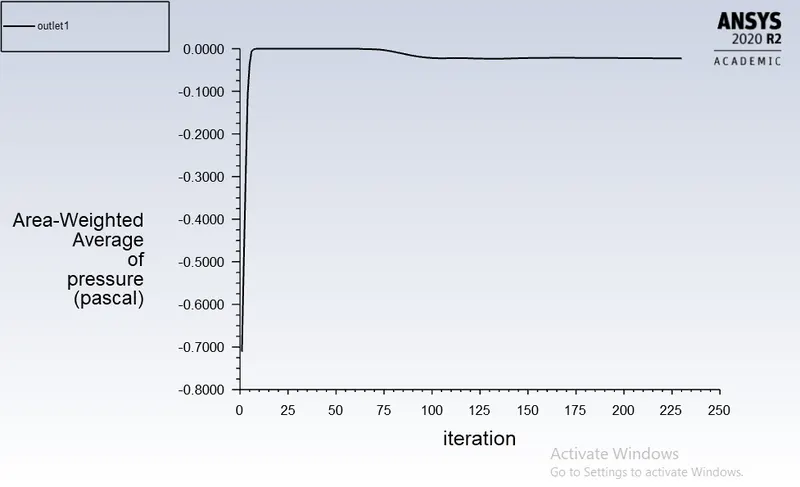
Pressure inlet:
Contour:
Animation:
Pressure drop:
Pressure drop=Inlet-Outlet
= 27.442011-(-0.022663)
= 27.46
DPM:

Cyclone separator Efficiency:
Efficiency= (283/378)*100
= 74.86%
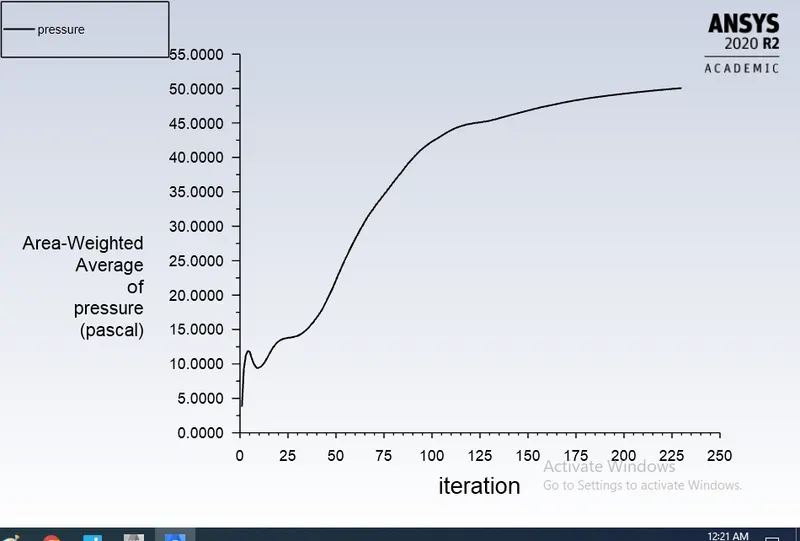
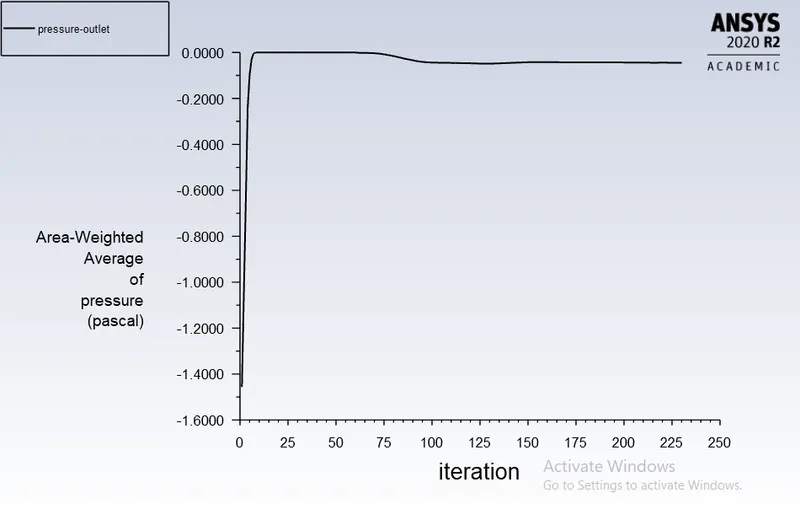
Part-2(Cyclone_B4):
(inlet velocity=4m/s,Dia of particle=5e-6)
Residual:
pressure inlet:
Pressure outlet:
Contour:
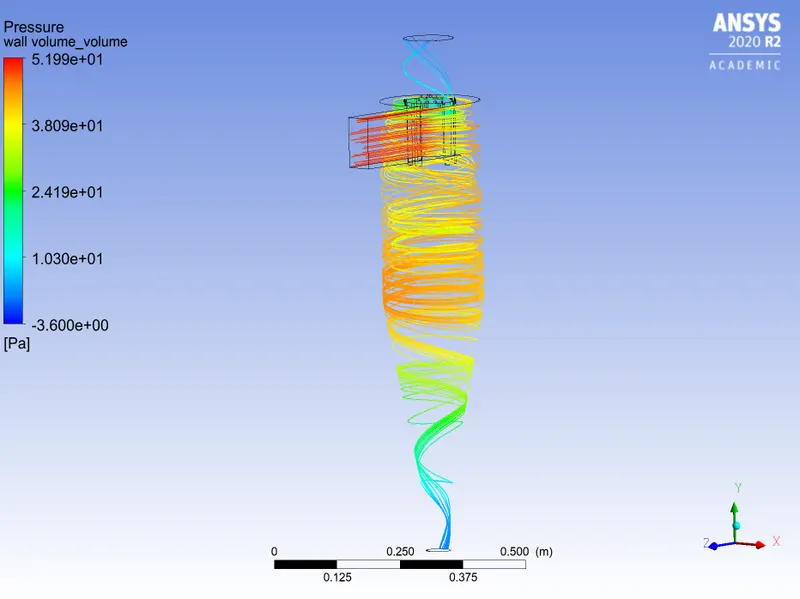
Animation:
Pressure drop:

Pressure drop=Inlet-outlet
= 50.061033-(-0.044792241)
= 50.1058
DPM:

Cyclone separator Efficiency:
Efficiency = (314/378)*100
=83.37%
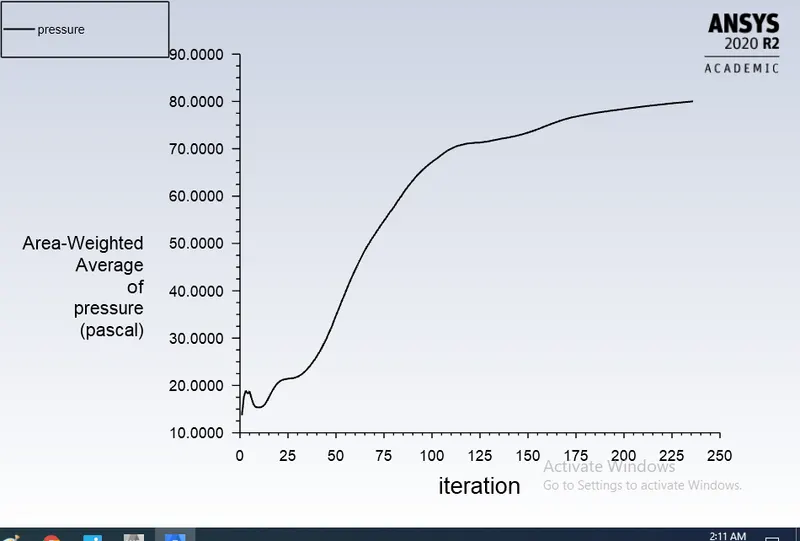
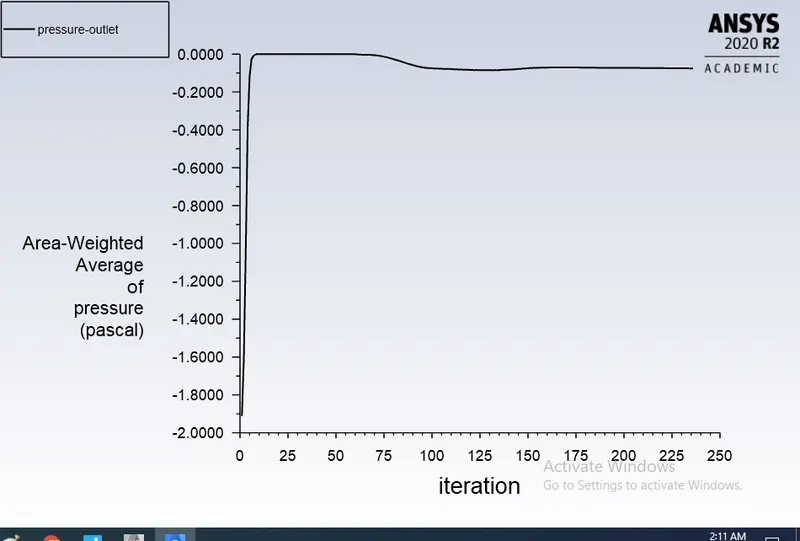
Part-2(Cyclone_B5):
(inlet velocity=5m/s,Dia of particle=5e-6)
Residual:
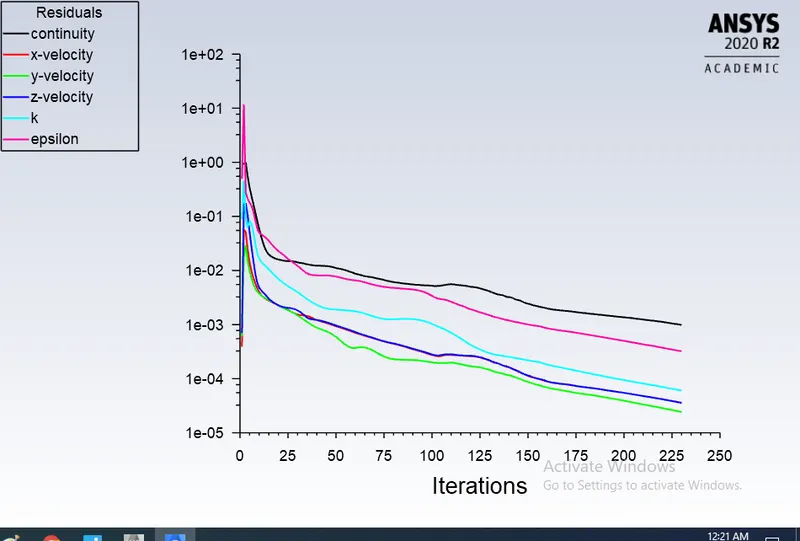
Inlet:
Outlet:
Contour:
Pressure drop:

Pressure drop=Inlet-Outlet
=80.005098-(-0.075570597)
=80.08
DPM:

Cyclone separator Efficiency:
Efficiency = (314/378)*100
= 83.06%
Part1
| Part-1 | Size of particle(m) | Velocity of particle(m/s) | Particle tracked | Particle trapped |
Particle Escaped |
Separator efficiency |
| A1 | 1e-6 | 3 | 378 | 177 | 161 | 46.82 |
| A2 | 2e-6 | 3 | 378 | 185 | 100 | 48.94 |
| A3 | 3e-6 | 3 | 378 | 218 | 105 | 57.67 |
| A4 | 4e-6 | 3 | 378 | 285 | 62 | 75.39 |
| A5 | 5e-6 | 3 | 378 | 288 | 62 | 76.19 |
Part 2
| Part-1 | Size of particle(m) | Velocity of particle(m/s) | Particle tracked | Particle trapped |
Particle Escaped |
Separator efficiency | pressure drop |
| B1 | 5e-6 | 1 | 378 | 14 | 81 | 3.7 | 2.235 |
| B2 | 5e-6 | 2 | 378 | 7 | 61 | 11.85 | 11.84 |
| B3 | 5e-6 | 3 | 378 | 283 | 62 | 74.8 | 27.46 |
| B4 | 5e-6 | 4 | 378 | 313 | 84 | 82.8 | 50.10 |
| B5 | 5e-6 | 5 | 378 | 314 | 65 | 83.8 | 80.08 |
b
Observation:
1.Cyclone separator efficiency depends on velocity and size of particle
2. Compared to part1 and part2 efficiency is more in part2 which means depends on velocity of particle compared to diameter of particle
3.Efficiency is directly propontal to pressure drop in case of part2
4.Efficiency in part2 is more compared to part1 which means velocity plays a key role
Animation:
PART1
https://drive.google.com/file/d/1NyljC32FmraqgXyGv5w2CWLGQ44dmK4G/view?usp=sharing
https://drive.google.com/file/d/11iwUBZ72lpim09JsTfUdwt6NoTI9xlXq/view?usp=sharing
https://drive.google.com/file/d/1JiIQ-hZOXo2CYz7jONOe3mSrcg86XLg4/view?usp=sharing
https://drive.google.com/file/d/1pAanad9AeJvfVXwC571A-_uVtIEaVFzs/view?usp=sharing
https://drive.google.com/file/d/1SLQSZoPjihldolaH6U-QBADruLPbjlhl/view?usp=sharing
PART2
https://drive.google.com/file/d/1Snt3_8bHVzqu6LbydQizJKx3BOLYis7v/view?usp=sharing
https://drive.google.com/file/d/1ojJO2XWHwxkLLhH22XLrIsCTkty541vA/view?usp=sharing
https://drive.google.com/file/d/1pAanad9AeJvfVXwC571A-_uVtIEaVFzs/view?usp=sharing
https://drive.google.com/file/d/1tJf0QXHLTzFhbGdU2KQa4jWnFbYCay8q/view?usp=sharing
https://drive.google.com/file/d/1z97QHdz1ZiucesxaknKQYA-7c8n5TmEQ/view?usp=sharing