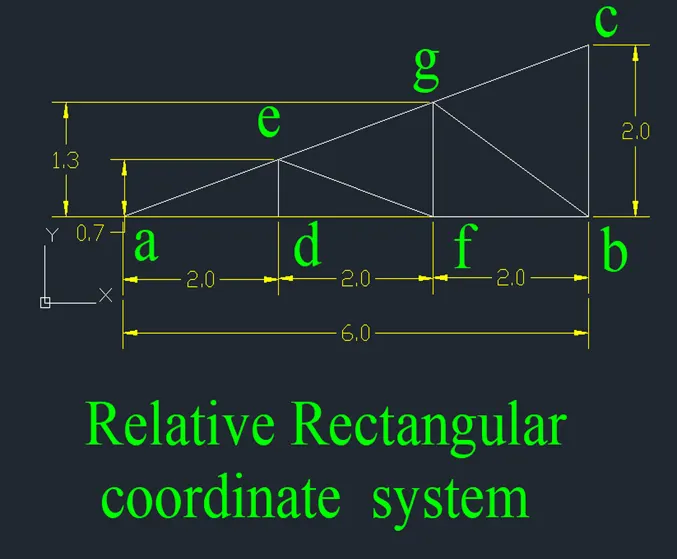
Creation of geometries by Coordinate system methods using AutoCad
AIM: To Create the geometric from P1 to P2 using all the coordinate system methods.
Apparatus:
Autocad software
Coordinate systems:
- Absolute coordinate
- Relative coordinate
- Relative polar coordinate
- Direct distance entry
Procedure:
- Open autocad
- QNEW command
- As decimal units are used (metric is selected)
- Template = Acad.dwg
- Use a wizard
- Advance setup
- Units
- Decimal (precision 0.0)
- Angle
- Decimal degree
- Angle measure
- East
- Area= 12x12
- Units
- Decimal
- Metric
Problem 1:
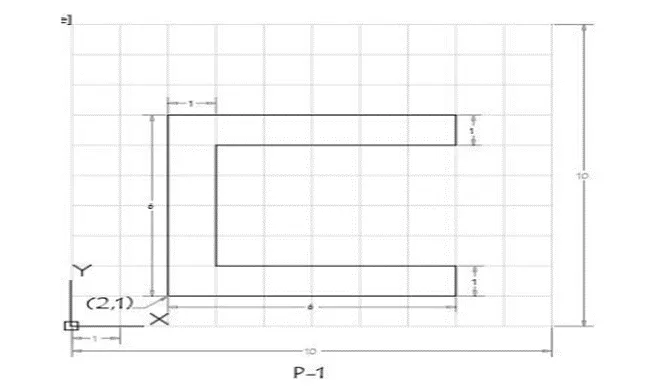
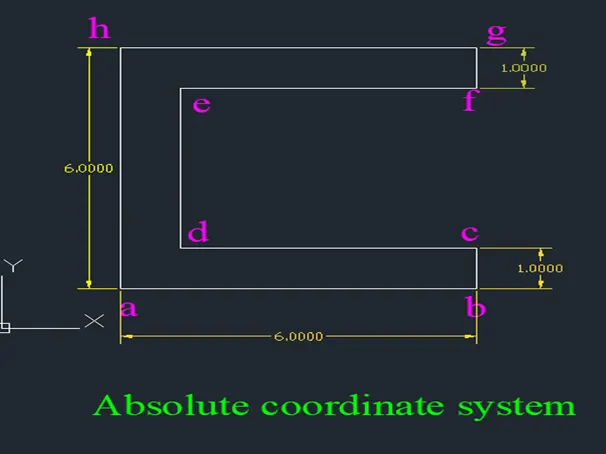
1.Absolute coordinate system
- Line command
- 2,1 (point a)
- 8,1 (point b)
- 8,2 (point c)
- 3,2 (point d)
- 3,6 (point e)
- 8,6 (point f)
- 8,7 (point g)
- 2,7 (point h)
- Close
Result:
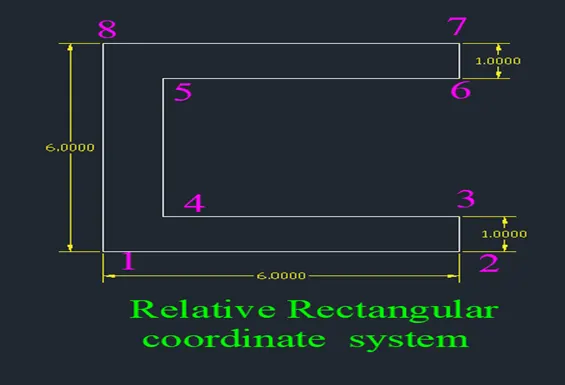
- Relative rectangular co-ordinate system
- Line command
- 2,1 (start point) (1)
- @6,0 (dx= 6 units, dy=0 units) (2)
- @0,1 (dx= 0 units, dy=1 units) (3)
- @-5,0 (dx= -5 units, dy=0 units) (4)
- @0,4 (dx= 0units, dy=4 units) (5)
- @5,0 (dx= 5units, dy=0 units) (6)
- @0,1 (dx= 0units, dy=1 units) (7)
- @-6,0 (dx= -6units, dy=0 units) (8)
- close
Result :
- Relative polar co-ordinate system
- Line command
- 2,1 (start point) (1)
- @6 <00 (dx= 6 units, dy =0 degree) (2)
- @1<900 (dx= 1 units, dy = 90degree) (3)
- @5<1800 (dx= 5 units, dy = 180degree) (4)
- @4<900 (dx= 4 units, dy = 90degree) (5)
- @5<00 (dx= 5 units, dy = 0degree) (6)
- @1<900 (dx= 1 units, dy = 90degree) (7)
- @6<1800 (dx= 6 units, dy = 180degree) (8)
- Close
Result :
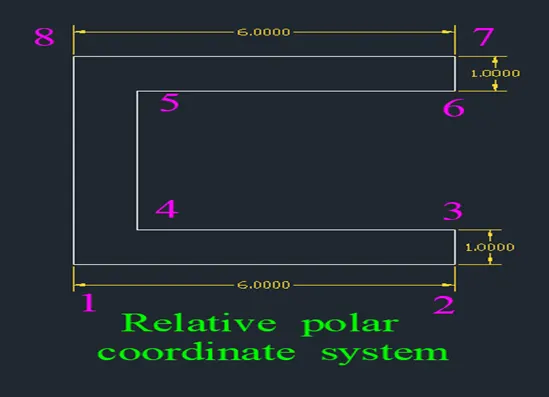
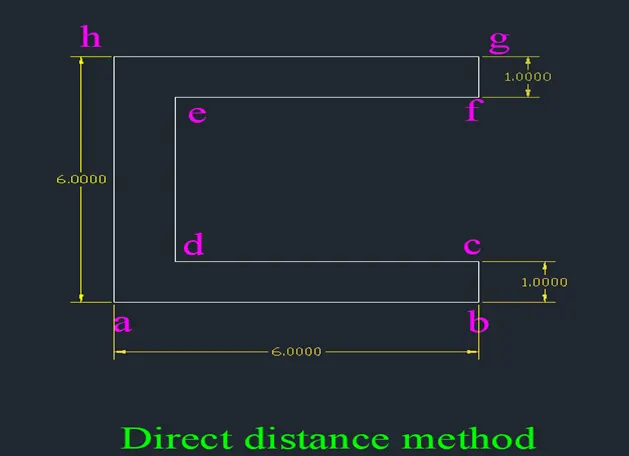
- Direct distance method:
- line command
- 6(curser facing east)
- 1(curser facing upwards)
- 5(curser facing west)
- 4(curser facing upwards)
- 5 (curser facing east)
- 1(curser facing upwards)
- 6(curser facing west)
- 6(curser facing down wards)
- close
Result :
Problem 2:
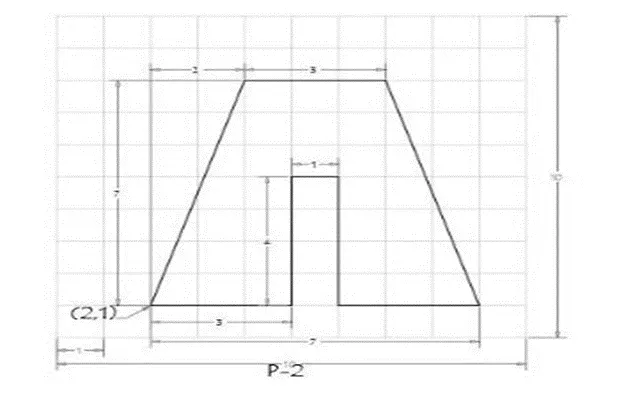
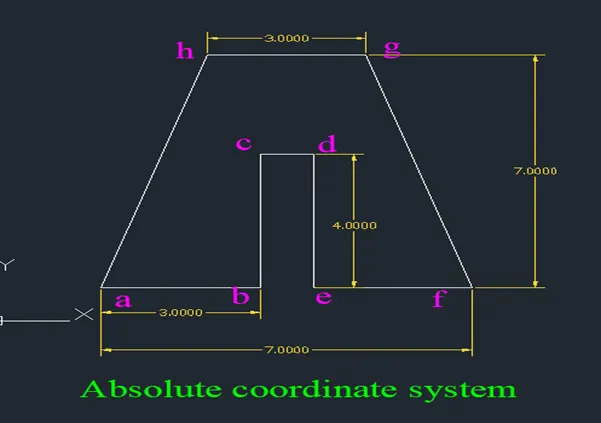
1.Absolute coordinate system
- Line command
- 2,1 (point a)
- 5,1 (point b)
- 5,5 (point c)
- 6,5 (point d)
- 6,1 (point e)
- 9,1 (point f)
- 7,8 (point g)
- 4,8 (point h)
- close
Result:
- Relative rectangular co-ordinate system
- Line command
- 2,1 (start point) (A)
- @3,0 (dx= 3 units, dy=0 units) (B)
- @0,4 (dx= 0 units, dy=4 units) (C)
- @1,0 (dx= 1 units, dy=0 units) (D)
- @0,-4 (dx= 0 units, dy=-4 units) (E)
- @3,0(dx= 3units, dy=0 units) (F)
- @-2,7 (dx= -2units, dy=7 units) (G)
- @-3,0 (dx= -3units, dy=0 units) (H)
- close
RESULT:
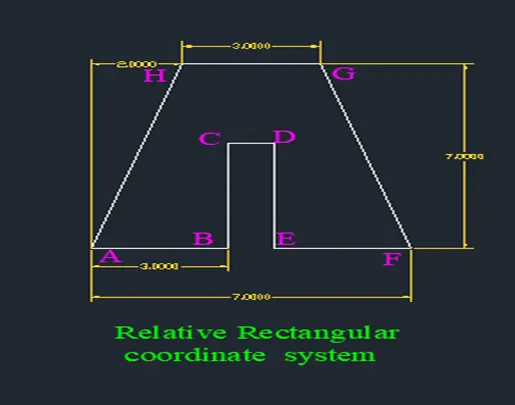
- Relative polar co-ordinate system
- Line command
- 2,1 (start point) (1)
- @3 <00 (2)
- @4<900 (3)
- @1<900(4)
- @4<2700 (5)
- @3<00 (6)
- @7<900 (line 1)
- @2<1800 (line 2)
- Join both the lines line 1 and line 2 and joint the staring point of 6 and end point of line 2.Now delete the line 1 and line 2
- @3<180 (from 7point)
- Close
Result :
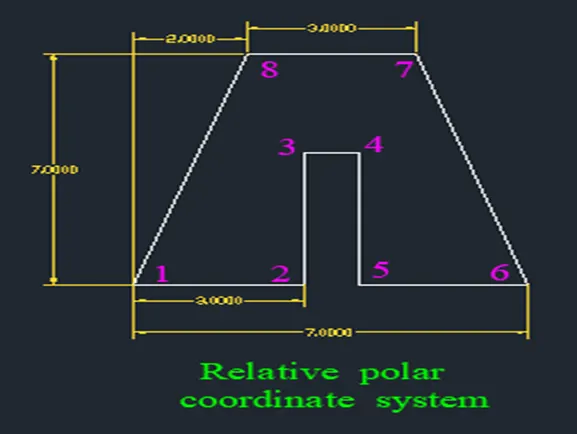
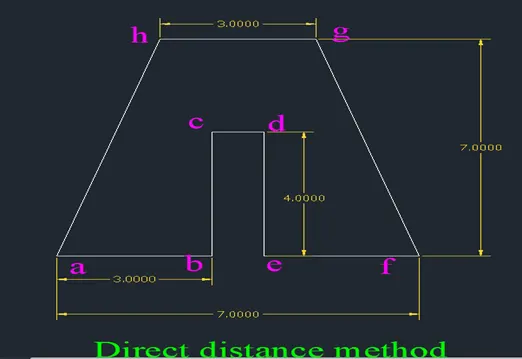
- Direct distance method:
- line command
- 3(curser facing east)
- 4(curser facing upwards)
- 1(curser facing east)
- 4(curser facing down wards)
- 3 (curser facing east)
- 7(curser facing upwards) (line 1)
- 2 (curser facing west) (line 2)
- Join the line f and the end point of line 2
- Delete the line 1 and line 2
- 3(curser facing west)
- Close
Result:
Problem 3:
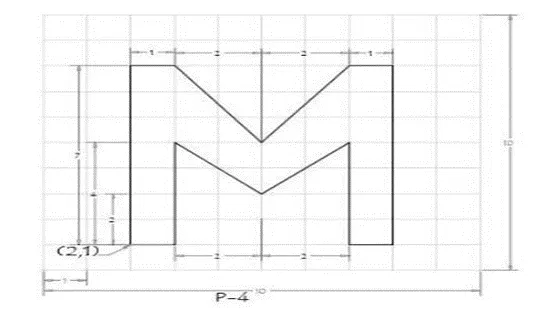
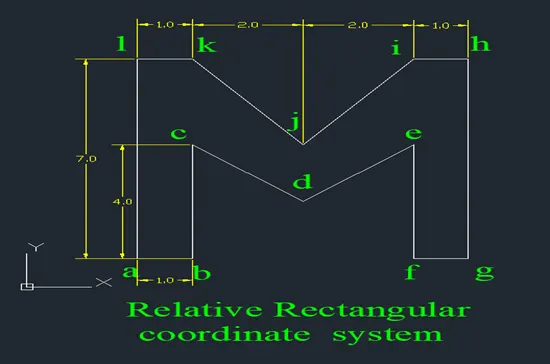
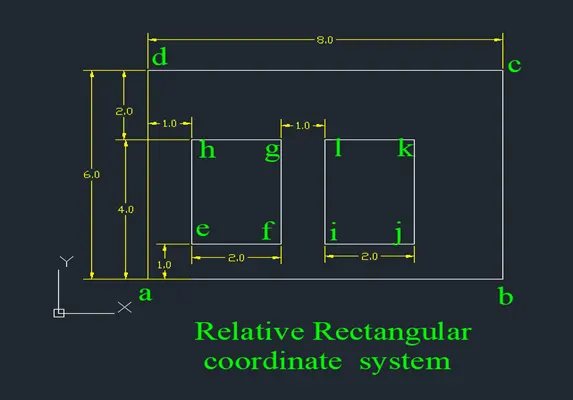
Relative rectangular co-ordinate system
- Line command
- 2,1 (start point) (a)
- @1,0 (dx= 1 units, dy=0 units) (b)
- @0,4 (dx= 0 units, dy=4 units) (c)
- @2, -2 (dx= 2 units, dy= -2units) (d)
- @2, 2 (dx= 2 units, dy= 2 units) (e)
- @0,-4 (dx= 0units, dy=-4 units) (f)
- @1,0 (dx= 1units, dy=0 units) (g
- @0,7 (dx= 0units, dy=7 units) (h)
- @-1,0 (dx= -1units, dy=0 units) (i)
- @-2, -3 (dx= -2units, dy=-3 units) (j)
- @-2,3 (dx= -2units, dy=3 units) (k)
- @-1,0 (dx= -1units, dy=0 units) (l)
- Close
Result:
Problem 4:
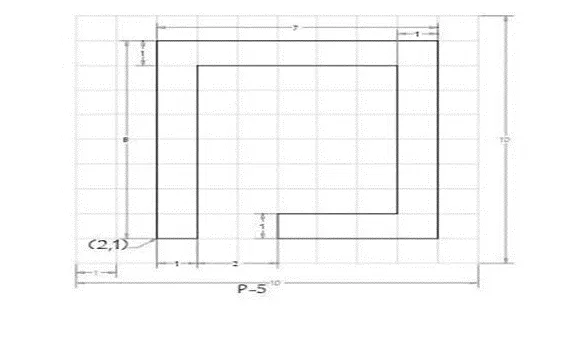
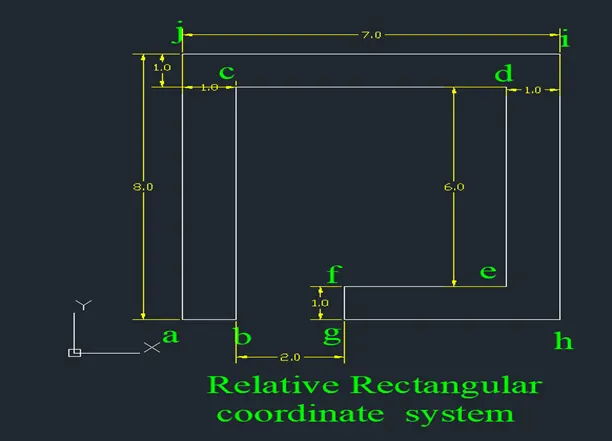
Relative rectangular co-ordinate system
- Line command
- 2,1 (start point) (a)
- @1,0 (dx= 1 units, dy=0 units) (b)
- @0,7 (dx= 0 units, dy=7 units) (c)
- @5,0 (dx= 5 units, dy= 0units) (d)
- @0, -6 (dx= 0 units, dy= -6units) (e)
- @ -3,0 (dx= -3units, dy=0 units) (f)
- @0, -1 (dx= 0units, dy=-1 units) (g
- @4,0 (dx= 4units, dy= 0 units) (h)
- @0,8 (dx= 0units, dy= 8 units) (i)
- @ -7,0(dx= -7units, dy= 0 units) (j)
- Close
Result:
Problem 5:
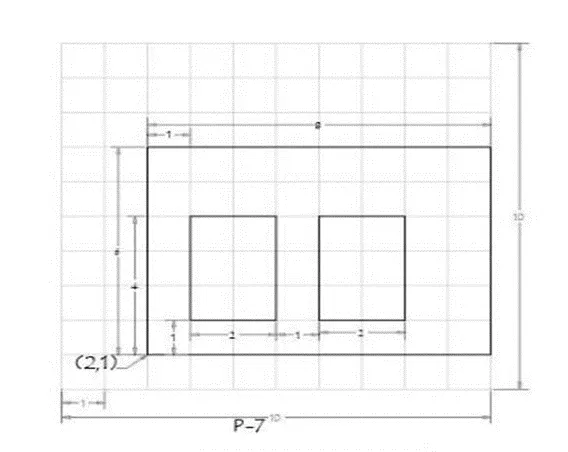
Relative rectangular co-ordinate system
- Line command
- 2,1 (start point) (a)
- @8,0 (dx= 1 units, dy=0 units) (b)
- @0,6 (dx= 0 units, dy=7 units) (c)
- @-8,0 (dx= 5 units, dy= 0units) (d)
- Close
- Line command
- 3, 2 (start point) (e)
- @ 2,0 (dx= -3units, dy=0 units) (f)
- @0, 3 (dx= 0units, dy=-1 units) (g
- @-2,0 (dx= 4units, dy= 0 units) (h)
- Line command
- 6,2 (start point) (i)
- @ 2,0(dx= -7units, dy= 0 units) (j)
- @ 0,3(dx= -7units, dy= 0 units) (k)
- @ -2,0(dx= -7units, dy= 0 units) (l)
- Close
Result:
Problem 6:
Relative rectangular co-ordinate system
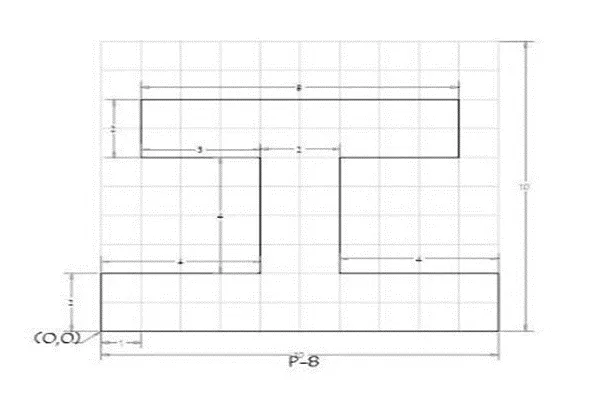
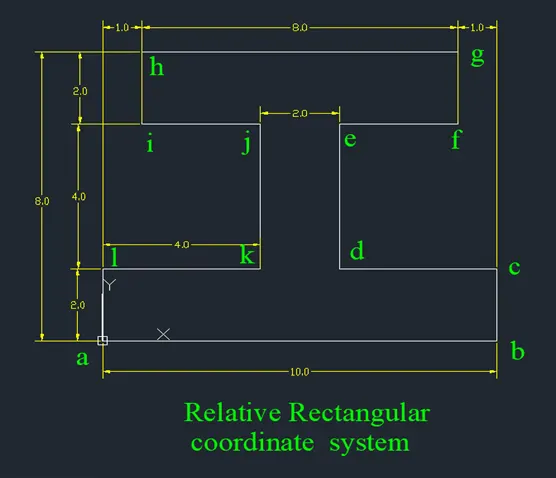
- Line command
- 0,0 (start point) (a)
- @10,0 (dx= 10 units, dy=0 units) (b)
- @0,2 (dx= 0 units, dy= 2units) (c)
- @-4,0 (dx= -4 units, dy= 0units) (d)
- @0,4 (dx= 0 units, dy= 4 units) (e)
- @ 3,0 (dx= 3units, dy=0 units) (f)
- @0,2 (dx= 0units, dy= 2 units) (g
- @-8,0 (dx= -8units, dy= 0 units) (h)
- @0,-2 (dx= 0units, dy= -2 units) (i)
- @3,0(dx= 3units, dy= 0 units) (j)
- @0,-4(dx= 0units, dy= -4 units) (k)
- @-4,0(dx= -4 units, dy= 0 units) (l)
- Close
Result:
Problem 7:
Relative rectangular co-ordinate system
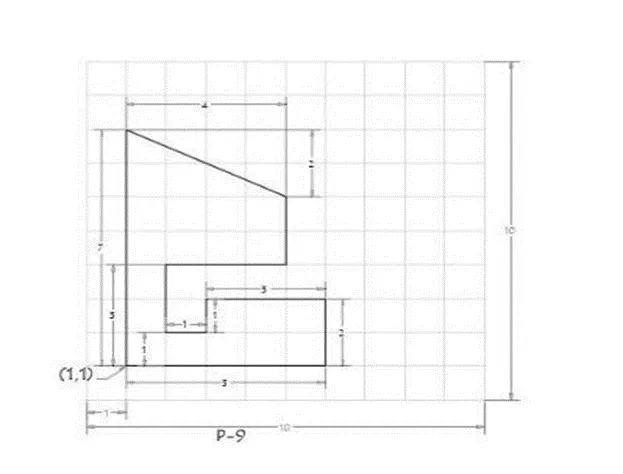
- Line command
- 1,1 (start point) (a)
- @5,0 (dx= 5 units, dy=0 units) (b)
- @0,2 (dx= 0 units, dy= 2units) (c)
- @-3,0 (dx= -3 units, dy= 0units) (d)
- @0,-1 (dx= 0 units, dy= -1units) (e)
- @ -1,0 (dx= -1units, dy=0 units) (f)
- @0,2 (dx= 0units, dy= 2 units) (g
- @-8,0 (dx= -8units, dy= 0 units) (h)
- @0,-2 (dx= 0units, dy= -2 units) (i)
- @3,0(dx= 3units, dy= 0 units) (j)
- @0,2(dx= 0units, dy= 2 units) (k)
- @-4,2(dx= -4 units, dy= 2 units) (l)
- Close
Result:
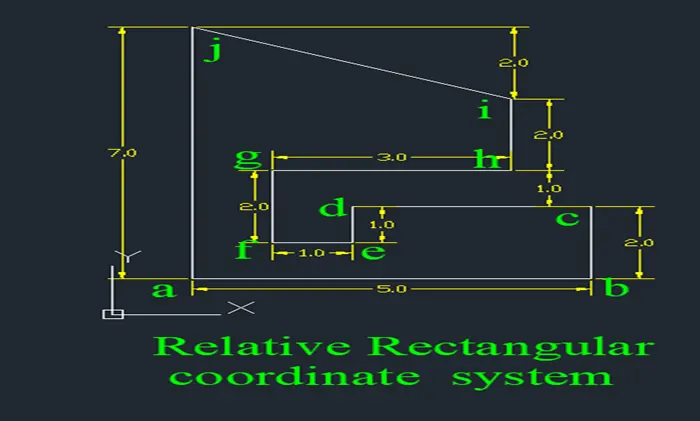
Problem 8:
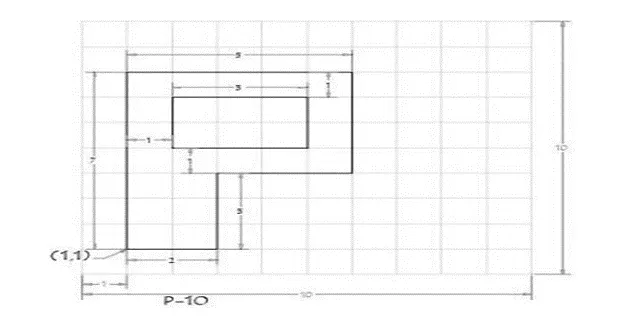
Relative rectangular co-ordinate system
- Line command
- 1,1 (start point) (a)
- @2,0 (dx= 2 units, dy=0 units) (b)
- @0,3 (dx= 0 units, dy= 3units) (c)
- @3,0 (dx= 3 units, dy= 0units) (d)
- @0,4 (dx= 0 units, dy= 4units) (e)
- @ -5,0 (dx= -5units, dy=0 units) (f)
- Line command
- 2,5 (start point) (g)
- @3,0 (dx= 3units, dy= 0 units) (h)
- @0,2 (dx= 0units, dy= 2 units) (i)
- @-3,0(dx= -3units, dy= 0 units) (j)
- Close
Result:
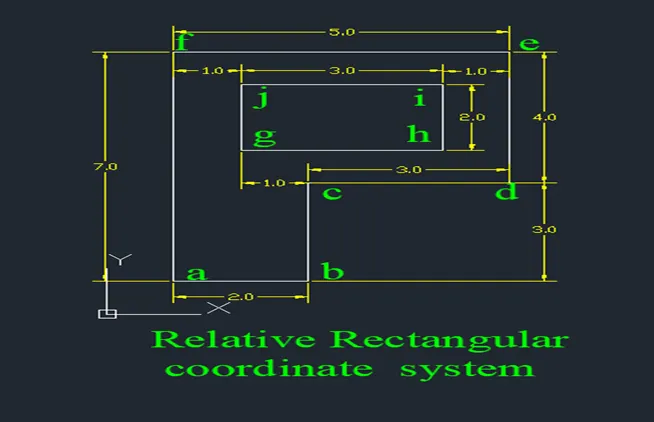
Problem 9:
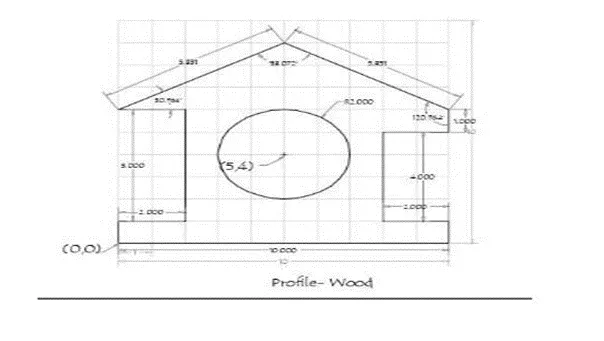
Relative rectangular co-ordinate system
- Line command
- 0,0 (start point) (a)
- @10,0 (dx= 10 units, dy=0 units) (b)
- @0,1 (dx= 0 units, dy= 1units) (c)
- @-2,0 (dx= -2 units, dy= 0units) (d)
- @0,4 (dx= 0 units, dy= 4units) (e)
- @2,0 (dx= 2units, dy=0 units) (f)
- @0,1 (dx= 0units, dy=1 units) (f)
- @-5,3 (dx= -5units, dy=3units) (f)
- @-5,-3 (dx= -5units, dy=-3 units) (f)
- @2,0 (dx= 2units, dy=0 units) (f)
- @0,-5 (dx= 0units, dy=-5 units) (f)
- @-2,0 (dx= -2units, dy=0 units) (f)
- close
- line command
- mark 5,4 start point
- take circle, radius command
- draw a circle of radius 2.
Result:
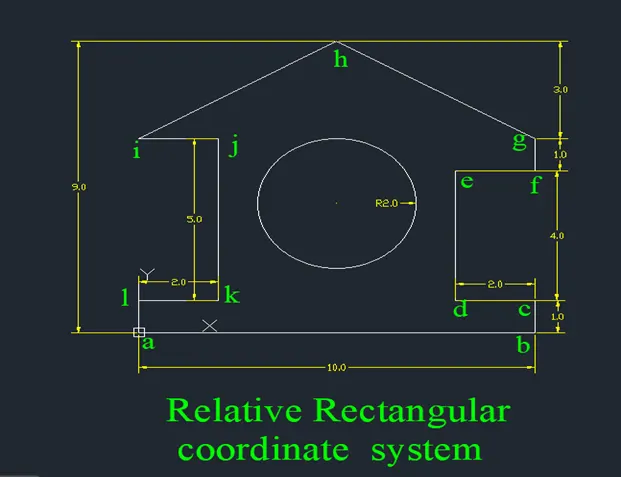
Problem 10:
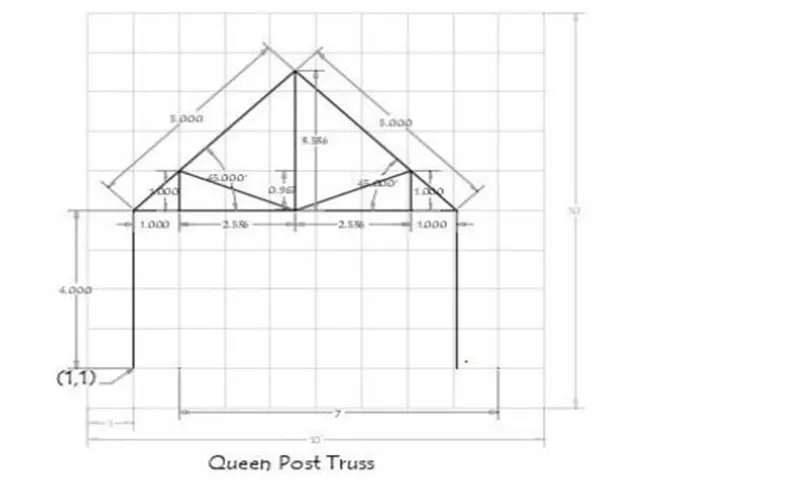
Relative rectangular co-ordinate system
- Line command
- 1,1 (start point) (a)
- @0,4 (dx= 0 units, dy=4 units) (b)
- @7.072,0 (dx= 7.072 units, dy= 0units) (c)
- @0, -4 (dx= 0units, dy= -4units) (d)
- Close
- Line command
- 536,5 start point (e)
- @0,3.536(dx= 0units, dy=3.536 units) (f)
- @-3.536, -4 (dx= -3.536units, dy=-4 units) (b)
- Close
- Line command
- 2,5 start point (g)
- @0,1 (dx= 0units, dy=1units) (h)
- @2.536, -1 (dx= 2.536units, dy=-1 units) (e)
- Close
- Line command
- Join point c and f
- 072,5 start point (i)
- @0,1 (dx= 0units, dy=1 units) (j)
- @-2.536,-1 (dx= -2.536units, dy= -1units) (e)
- close
Result:
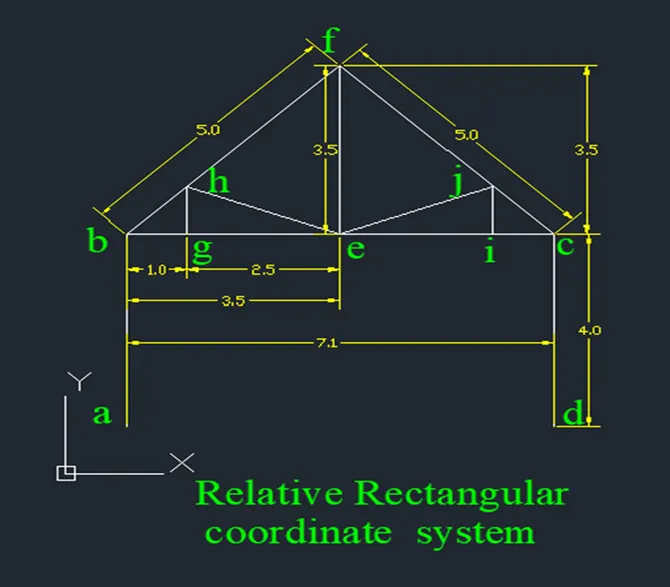
Problem 11:
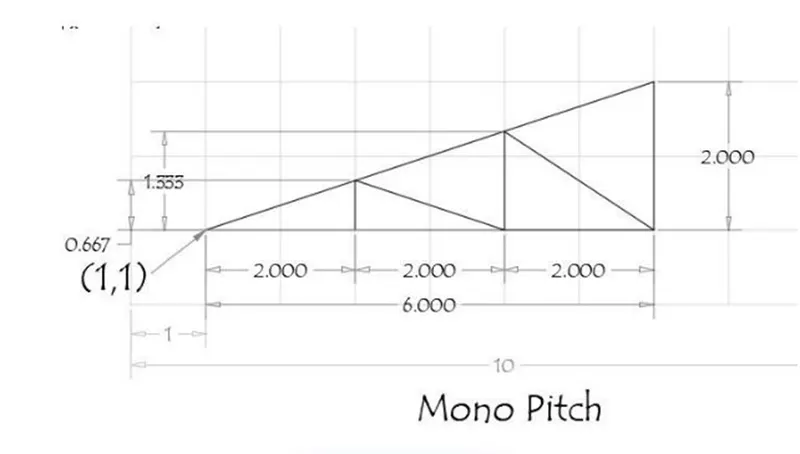
Relative rectangular co-ordinate system
- Line command
- 1,1 (start point) (a)
- @6,0 (dx= 6 units, dy= 0units) (b)
- @0,2 (dx= 0units, dy= 2units) (c)
- @-6, -2 (dx= -6units, dy= -2units) (b)
- Close
- Line command
- 3,1start point (d)
- @0,0.667 (dx= 0units, dy=0.667units) (e)
- @2, -0.667 (dx= 2units, dy=-0.667 units) (f)
- @0,1.333 (dx= 0units, dy=-1.333 units) (g)
- @2, -1.333 (dx= 2units, dy=-1.333units) (b)
- Close7867
Result: