Configuration and Characteristic of battery model
AIM: Configuration and Characteristics of Battery Model.
OBJECTIVE:
A. From the datasheet of a lithium-ion battery configure the generic battery model in MATLAB
B. Simulate generic battery model charge-discharge using UDDS data.
Introduction
The battery model is LIR18650 2600mAh and the specification mentioned in this datasheet describes the technological parameters and testing standard for the lithium-ion rechargeable cell manufactured and supplied by EEMB Co. Ltd.
Objective 1 - From the datasheet of a lithium-ion battery configure the generic battery model in MATLAB.
Block use for configuration and simulate
1. Li-ion battery block
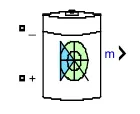
The battery block can be found out in the director Electrical/Specialized Power Systems/Electric Drives/ Extra Sources.
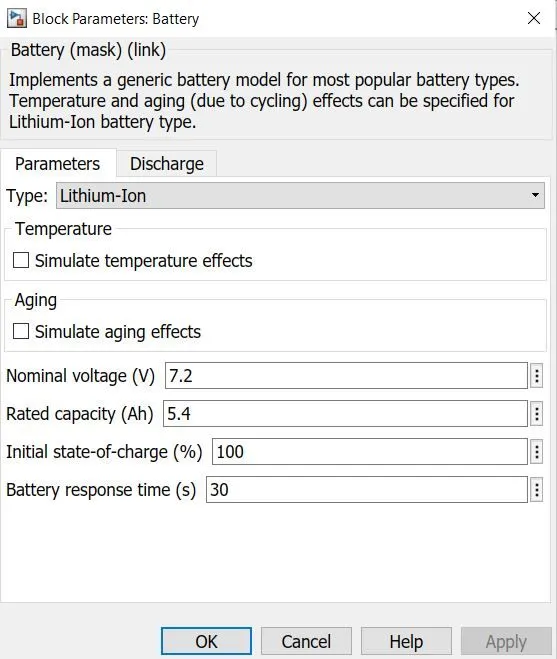
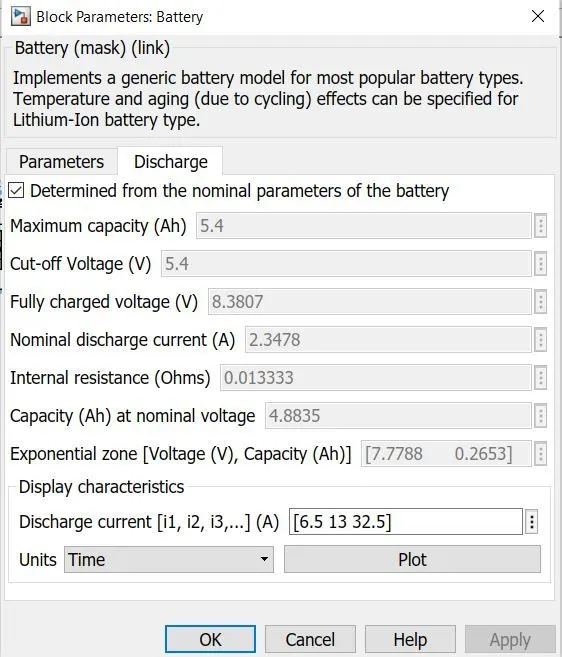
The battery parameters as per the datasheet are been entered as the properties of the batter in the model.
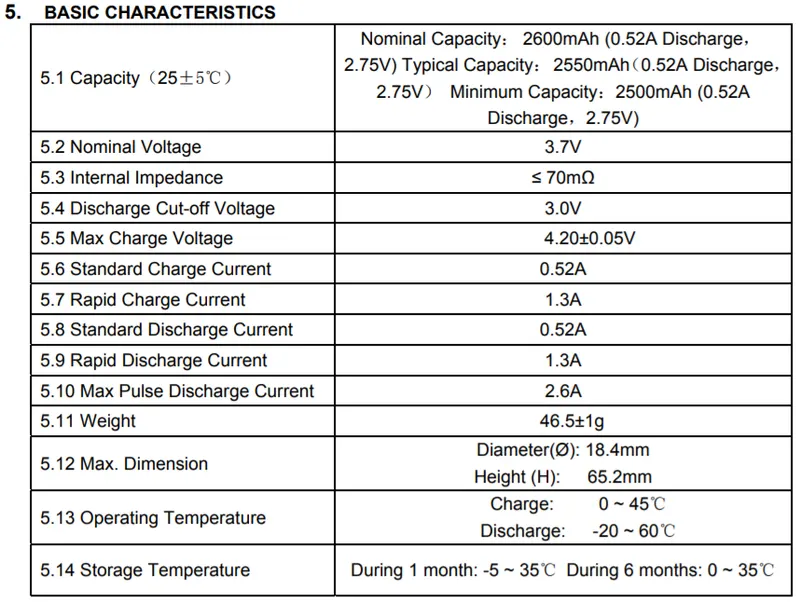
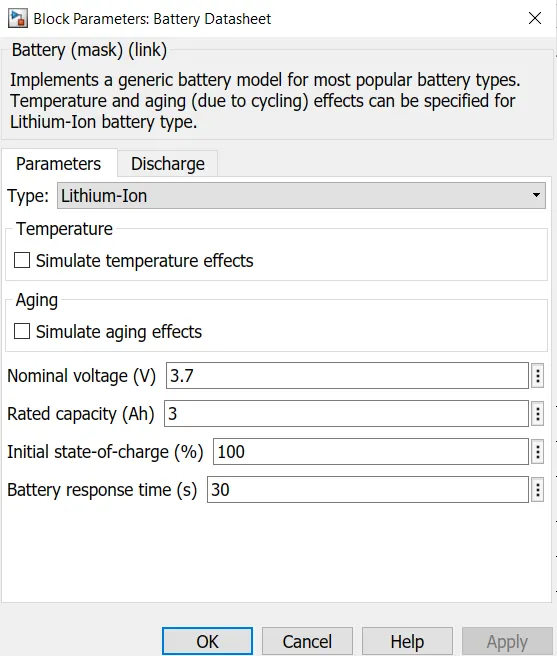
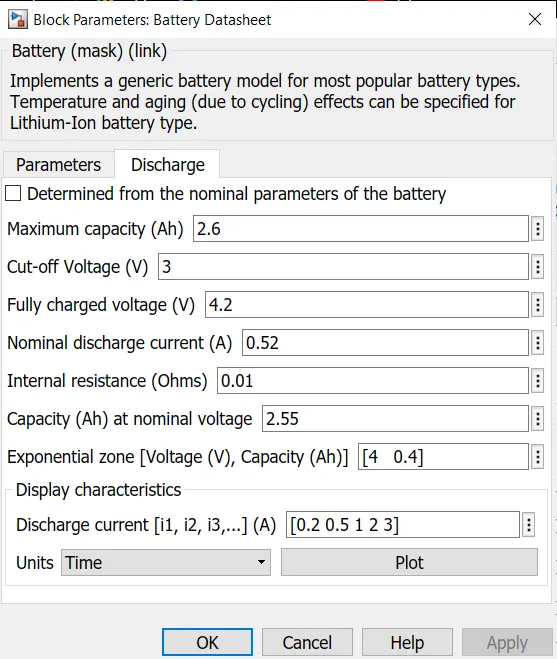
To understand the difference we will add another battery is simulated with the same model with the same kind of input conditions and all the same connected blocks. The default conditions are considered for the battery and the same simulation is executed.
2. Drive cycle source
The US FTP-72 (Federal Test Procedure) cycle is also called Urban Dynamometer Driving Schedule (UDDS) or LA-4 cycle (CFR 40, 86, App. I) [2656]. This cycle should not be confused with the UDDS schedule for heavy-duty vehicles.
The cycle simulates an urban route of 7.5 mi (12.07 km) with frequent stops. The maximum speed is 56.7 mph (91.25 km/h) and the average speed is 19.6 mph (31.5 km/h).
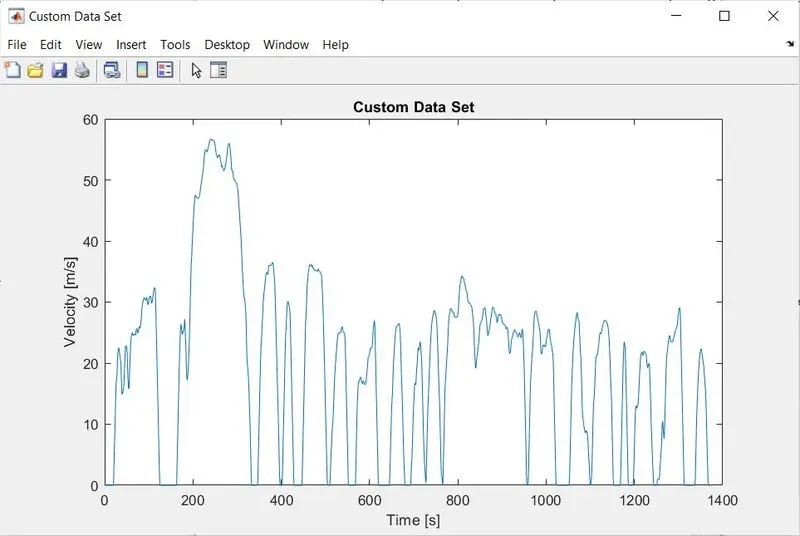
The cycle consists of two phases: (1) 505 s (5.78 km at 41.2 km/h average speed) and (2) 867 s. The first phase begins with a cold start. Weighting factors of 0.43 and 0.57 are applied to the first and second phases, respectively. Emissions are expressed in g/mile or g/km.
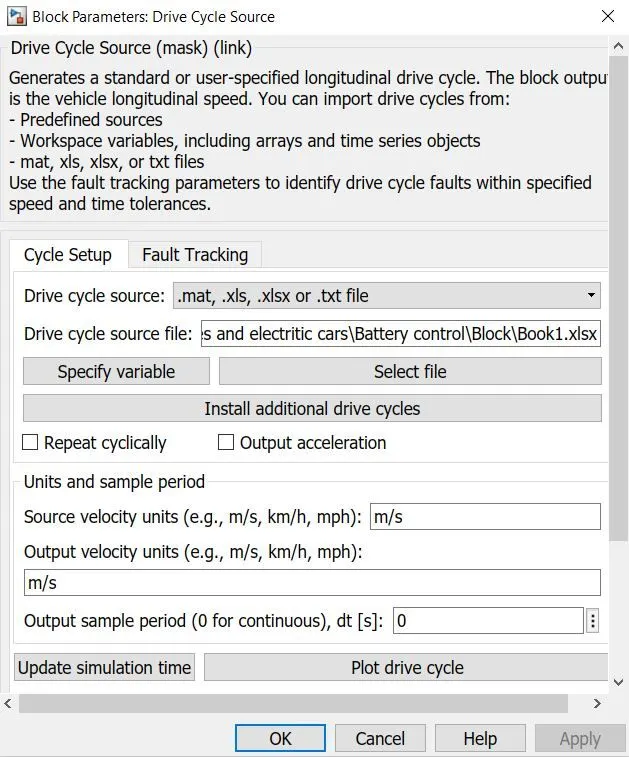
To give the UDDS drive cycle data to the model, an excel sheet is prepared and all the values for 1369 seconds are stored in the file. The values are stored as a numeric matrix at the workspace after simulating the model.
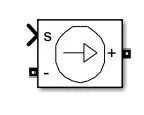
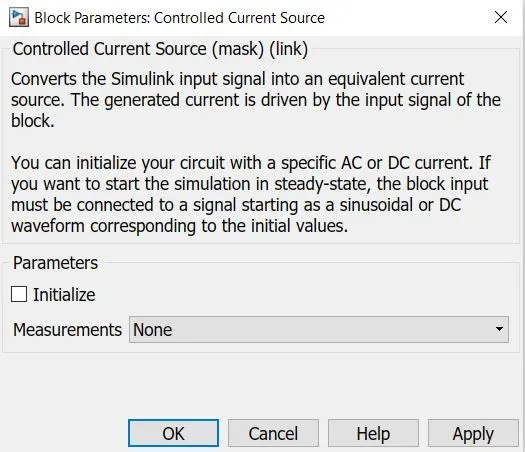
3. Controlled Current source
4. Bus selector

5. Scope
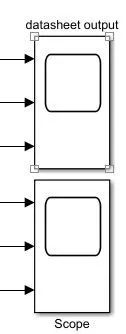
These are the components that are used for the configuration of the Li-ion battery model.
OBJECTIVE 2 - Simulate generic battery model charge-discharge using UDDS data.
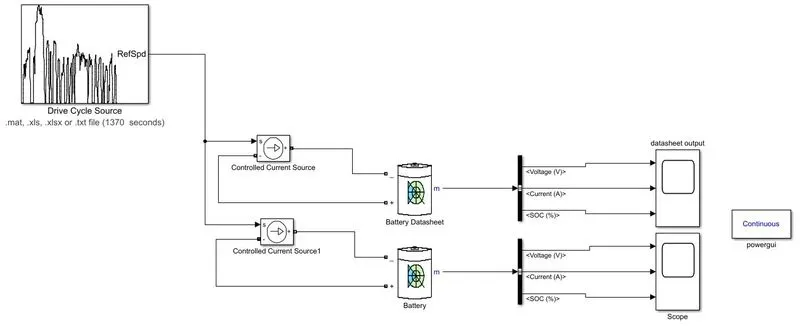
- The charging and discharging of the battery required the current/charge graph because the battery won't understand the speed Vs ti,e graph. hence we need to convert the speed-time graph to the current time UDDS cycle.
To excess, the Current profile click on UDDS current time profile
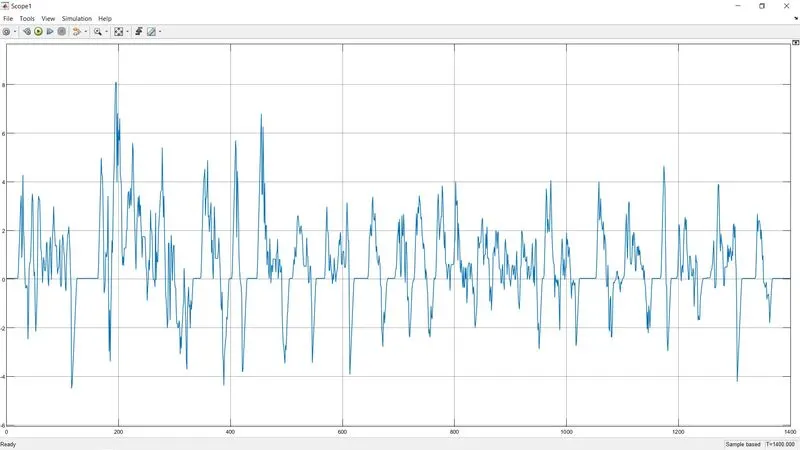
- This current cycle is given as the input to the model through the Drive cycle block.
- The output of the drive cycle is given to the current-controlled source which is connected to the battery as a load. So the battery discharges according to this signal given by the signal builder which is the UDDS drive cycle data.
- The Powergui block is necessary for the simulation of any Simulink model containing SimPowerSystems™ blocks. It is used to store the equivalent Simulink circuit that represents the state-space equations of the model.
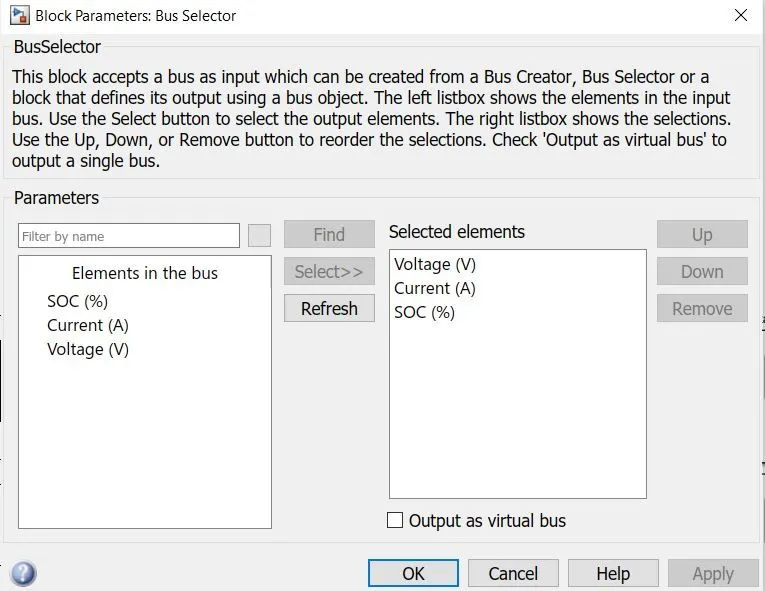
- The output of the battery is given to the scope via a bus selector. The bus selector outputs the battery signals (voltage, current, SOC) to the scope.
Rated discharge characteristic
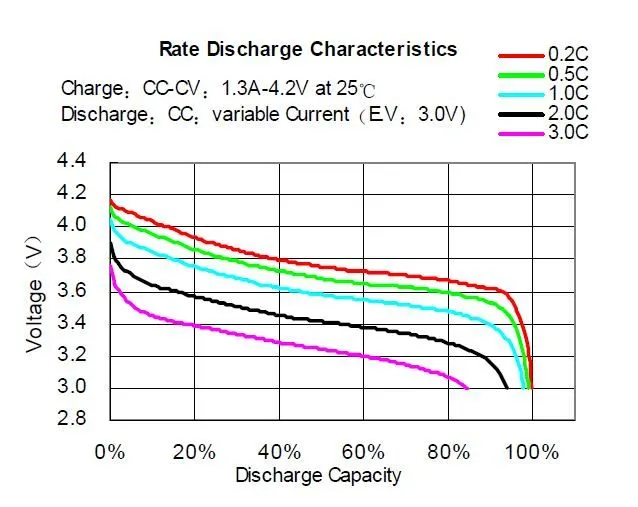
- This is how the rated discharge of the battery is plotted in the datasheet that we consider for our model.
- The following are the discharge curves that are plotted from the inputs data above.
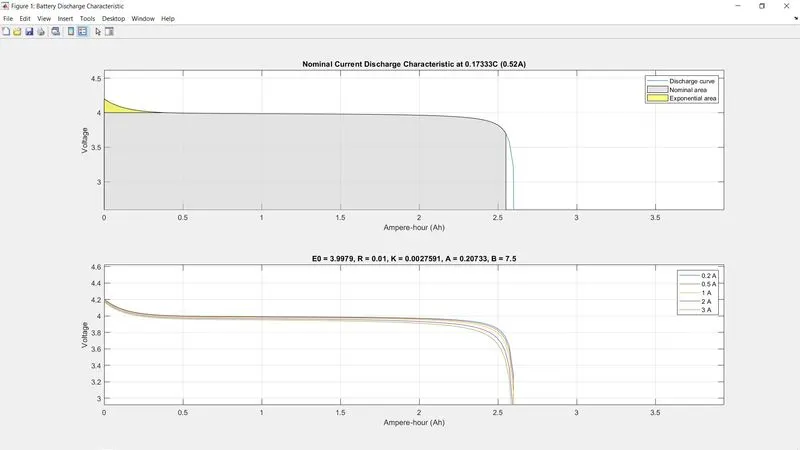
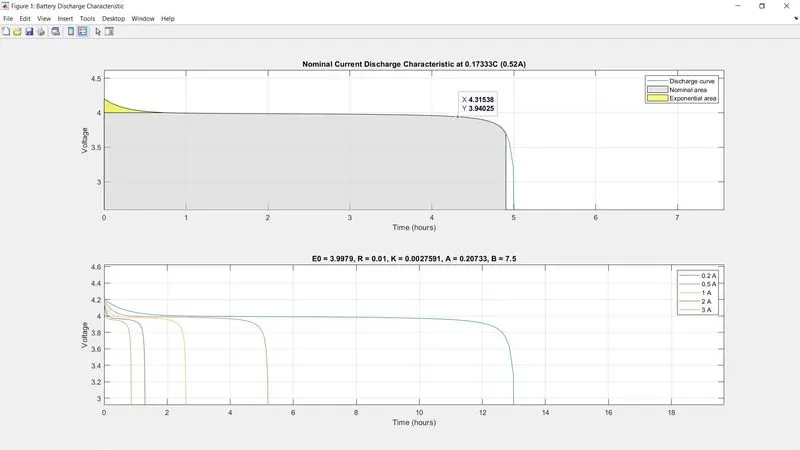
- From the discharge curves, the nominal and exponential areas are clearly distinguishable. The maximum capacity of this battery is 2.6Ah, while the standard discharge current rate is 0.52A, which makes it a standard discharge of 0.2C rate, capable of running for 5 hours at 0.52A.
- However, due to Peukert's law, this is not possible in reality due to the internal resistance and heat generated by the battery when it has to supply a higher current. If the battery were discharged at a 1C rate i.e. 2.6A, then it should certainly run for less than 1 hour due to reduced capacity.
- According to the discharge curves in the datasheet, it is shown that when the battery is discharged at 7.8A or 3C, then the capacity reduces to about 85% i.e. from 2.6Ah to ≈">≈≈2.2Ah. In addition, due to Peukert's law, the battery should not be able to run for 20 minutes at 7.8A. However, the curves plotted above depict that the capacity has only reduced from 2.6Ah to ≈">≈≈2.53Ah and it will also run for 20 minutes at 7.8A - both of which should not be the case.
- Hence, this implies that this built-in battery model in MATLAB/SIMULINK does not account for Peukert's law and that the internal resistance of the battery does not vary with the amplitude of the current.
OUTPUT
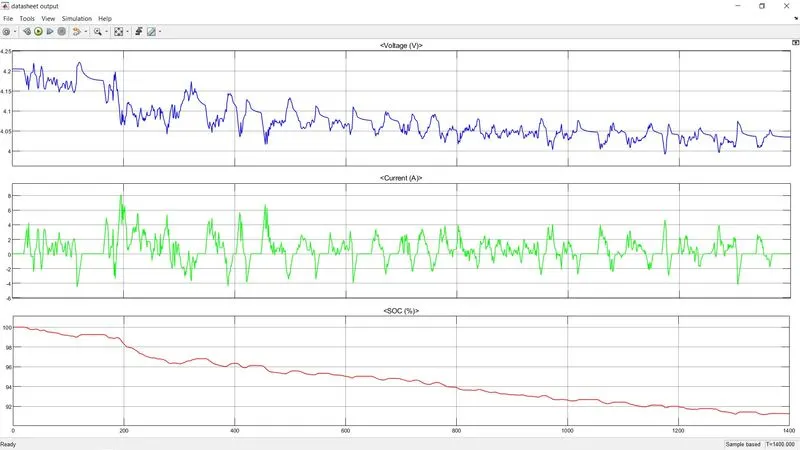
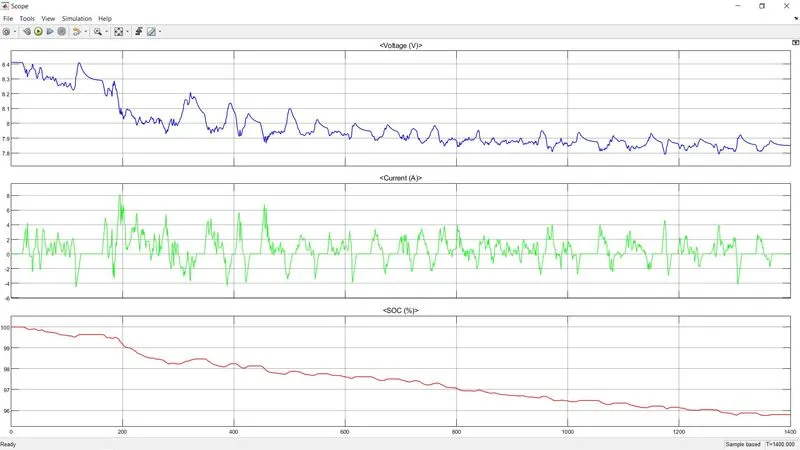
- From both the graph, we can see that the voltage drops down to the nominal voltage and then slowly decrease according to the requirement of the battery.
- The slight increase in the voltage is due to the regenerative braking of the vehicle, hence the voltage increase slightly while braking.
- The current drawn from the battery is shown by the second row of the output result. The portion where the negative current is shown is basically the regenerative braking part, where the battery getting charged by applying braking with the car paddle.
- The State Of Charge shows us the amount of charge left in the battery, giving us a rough idea about the same. The SOC is decreased as time increases and the battery is discharged. Only at the times of regenerative braking, the SOC level of the battery is raised.
CONCLUSION
The required model for the lithium-ion battery is developed and the required output for the model is derived.
Reference